Updated: 6 November 2026 by Sylwia (MyCrochetory)
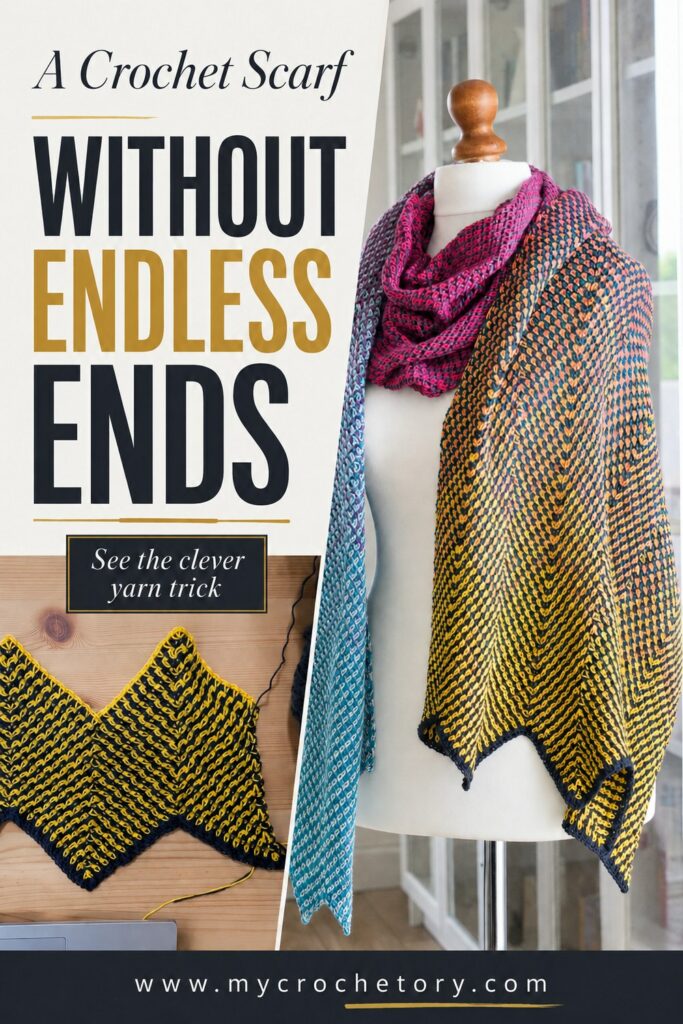
This linen stitch crochet scarf has almost 300 rows in two colors. And guess how many ends you weave in when it’s done? Four.
I love linen stitch. Weaving in ends, on the other hand, is the part of crochet I’d happily skip forever, so when I designed the Flourish Linen Wrap I made sure I wouldn’t have to.
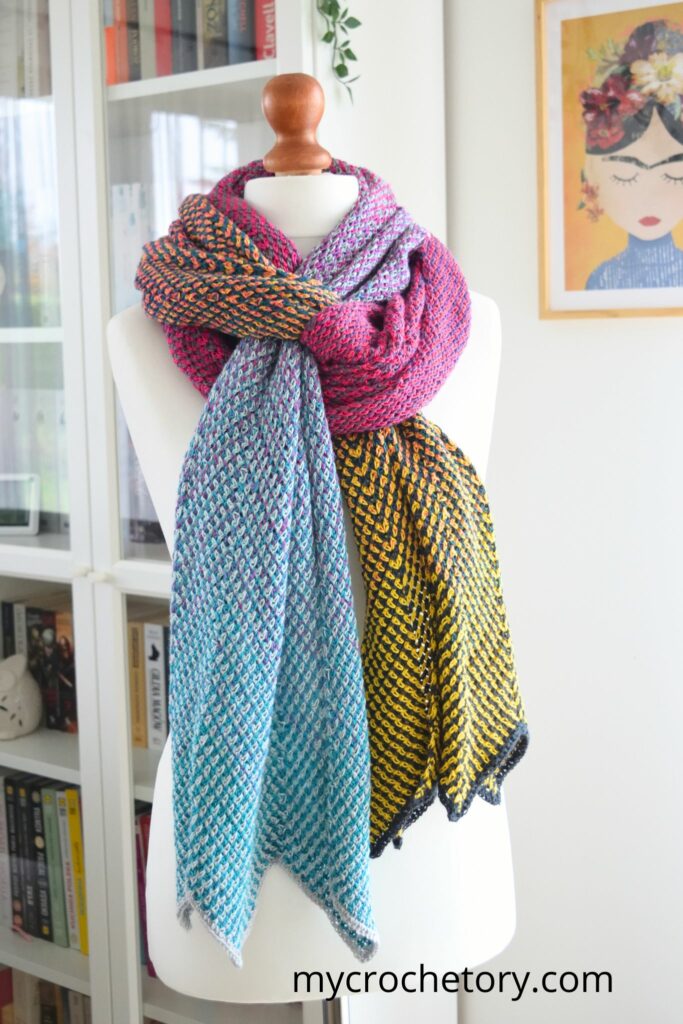
What you get is a long, striped wrap with tall chevrons and colors that drift slowly from one end to the other. Wear it wrapped twice around your neck, or let it hang open over your coat.
The free pattern and a video tutorial are below. But first, the little trick that makes the whole thing work.
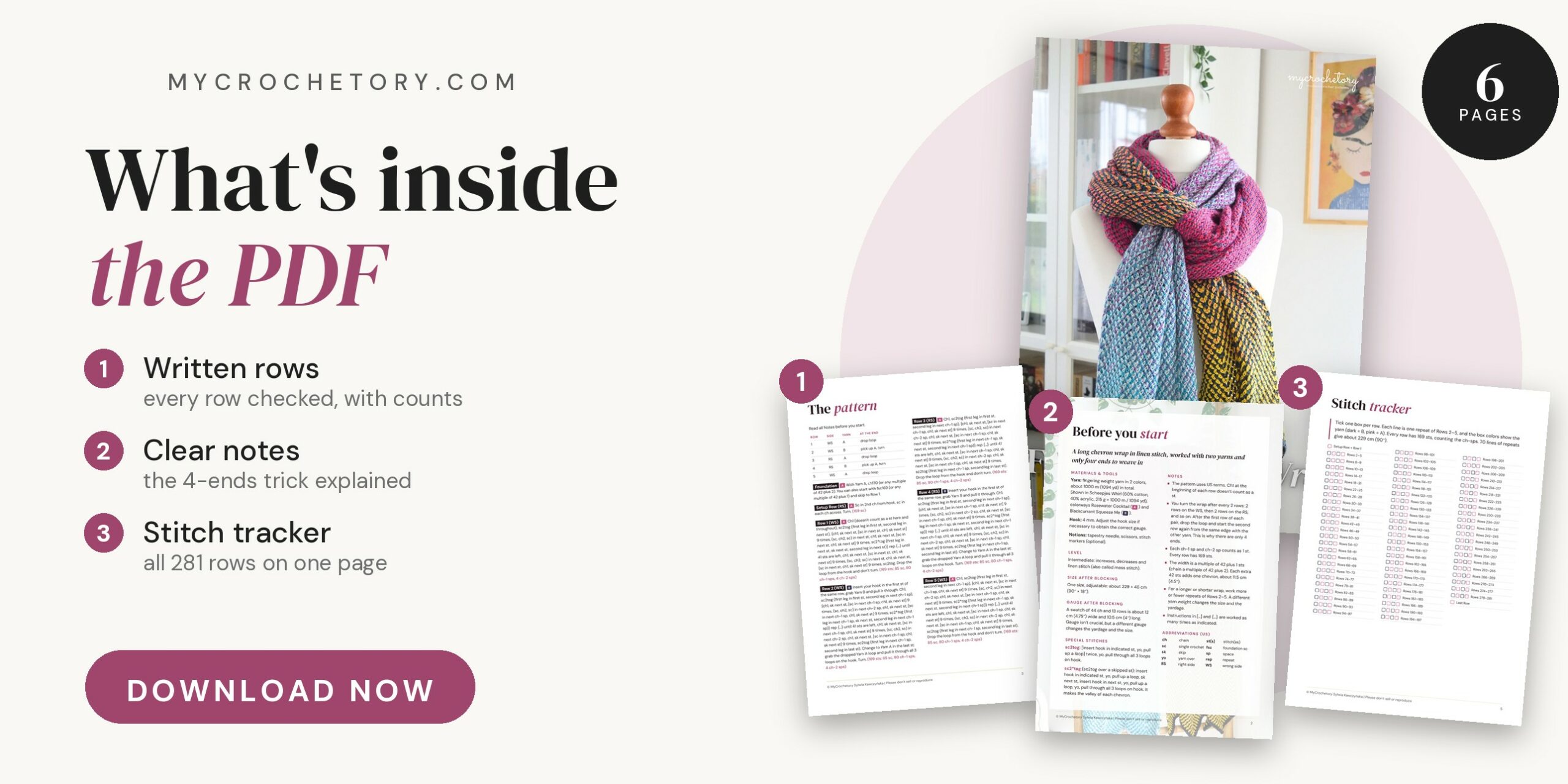
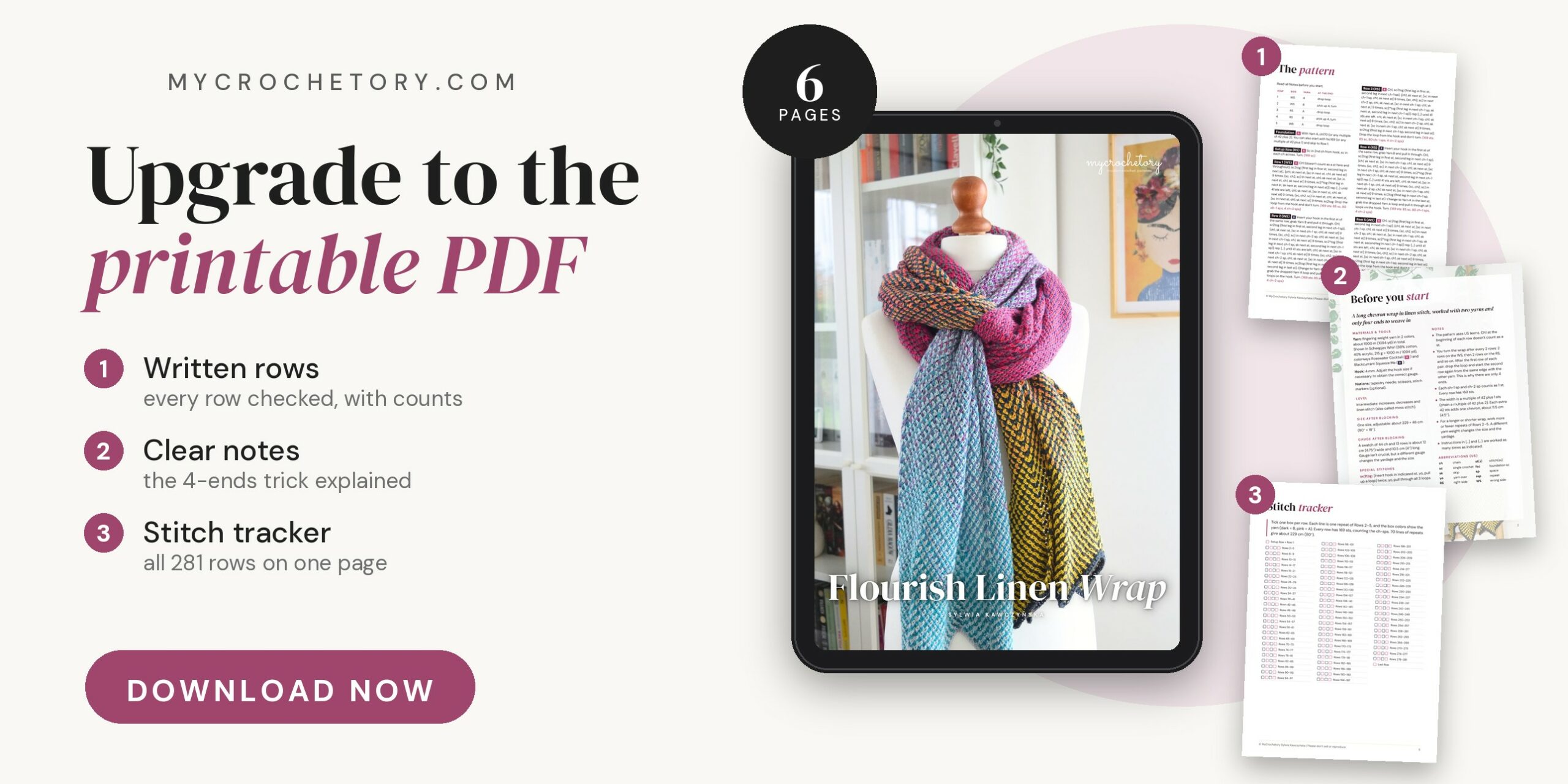
Jump to the Flourish Linen Wrap free pattern, or get the ad-free printable PDF with a row table and a stitch tracker on Etsy or on Ravelry.
Join my Facebook Group and Official Ravelry Group to ask questions and share your finished projects.
You can also follow me on Instagram, Facebook and Pinterest.
Why This Linen Stitch Crochet Scarf Has Only Four Ends
Stripes usually come at a price. You change color, you cut the yarn, and at the end you’re staring at a fringe of tails that all need a needle.
With almost 300 rows, that would mean hundreds of ends. No, thank you.
So I work two rows from the same edge before I turn. After the first row I simply drop the loop, go back to the start and crochet the second row with the other yarn, and both yarns stay right where I need them.
Two ends at the start, two at the finish. That’s all you’ll ever weave in.

Linen Stitch, Chevrons and a Little Tweed
Linen stitch (you might know it as moss stitch) is beautifully simple. One single crochet, one chain, and on the next row each sc goes into a chain space, so the stitches sit like little bricks.
Here I shaped it into chevrons. A (sc, ch2, sc) corner builds each peak, and a sc2tog over a skipped stitch dips into each valley.
Because the two yarns take turns every single row, the color breaks into tiny dashes. From far away you see stripes, and up close it looks almost like tweed.
Never tried linen stitch? My moss stitch tutorial walks you through the basic version first.

Is This Linen Stitch Crochet Scarf Hard to Make?
I’d call it intermediate, and the chevrons are the reason. You increase at every peak and decrease in every valley, so counting matters for the first few rows.
After that, the four-row repeat carries you. It never changes from the first row to the last, and soon you’ll know it by heart.
The only part that feels odd at first is dropping the loop. Watch the video once, and you’ll see exactly where it goes and how to pick it up again.
And if a 170-chain start sounds like torture, begin with a foundation single crochet row instead.

Yarn and Colors for Your Linen Stitch Crochet Scarf
My Flourish is made in Scheepjes Whirl, a fingering weight cotton and acrylic blend wound into huge gradient cakes. I paired Rosewater Cocktail with Blackcurrant Squeeze Me, and I still recommend Whirl for this wrap.
Keep an eye on the colors as you go. One cake drifts from pink to turquoise, the other from deep purple to mustard, so no two stripes are quite the same.
In total you’ll need about 1094 yards.

How I Steam Block This Linen Stitch Crochet Scarf
Blocking makes a huge difference with this wrap. Because Whirl is cotton and acrylic, I use steam.
I pin the wrap flat, hold my steam iron about 1/2 inch above it and move slowly from one end to the other. Then I leave it pinned for at least 20 minutes.
When the pins come out, the linen stitch has opened up and the chevron points are crisp. The finished wrap is about 90 by 18 inches.
Not ready to start yet? Pin it to your scarf board, and follow MyCrochetory on Pinterest for more wraps like this one.
Flourish Linen Wrap Free Pattern
- Get the ad-free, printable PDF on Etsy or on Ravelry.
- Add this pattern to your Ravelry queue.
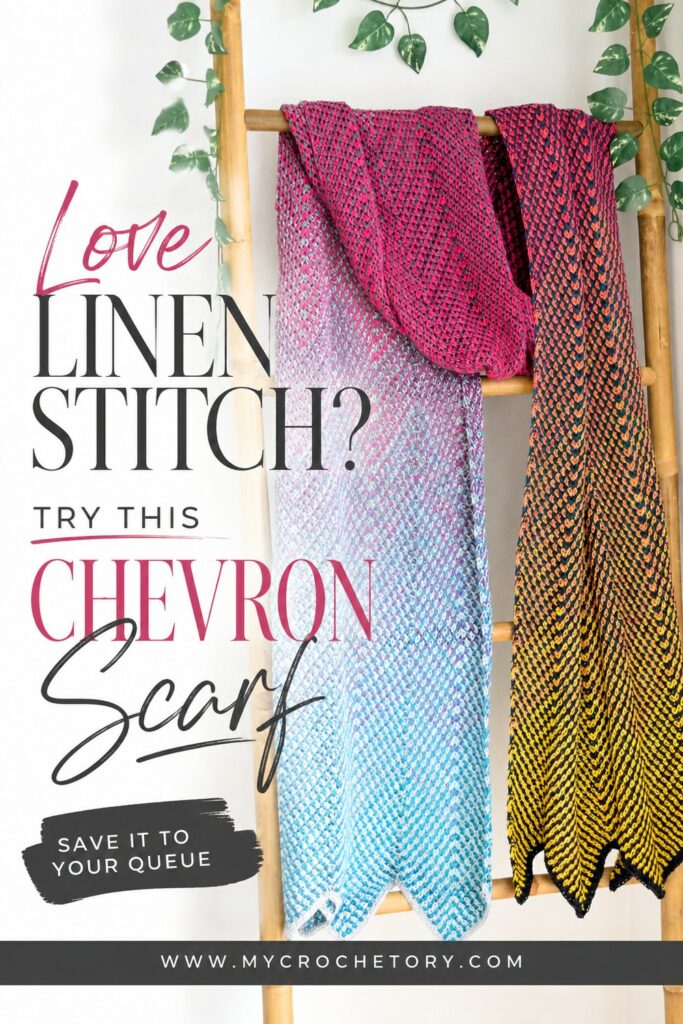
- Pin it for later.
Copyright 2024–2026 MyCrochetory. All rights reserved. This pattern is property of Sylwia Kawczyńska @MyCrochetory. Please DO NOT sell the pattern and claim this pattern as your own. The pattern is for personal use only and may not be translated or reproduced in another language. Please respect my rights, DO NOT share or publish this pattern anywhere without my permission.
The wrap you make following this pattern is yours, and you are free to sell it, as long as you credit MyCrochetory as the original designer. For more information, please read the Terms Page.

Materials & Tools
- Yarn: fingering weight yarn in 2 colors, about 1000 m (1094 yd) in total. Shown in Scheepjes Whirl (60% cotton, 40% acrylic, 215 g = 1000 m / 1094 yd), colorways Rosewater Cocktail (A) and Blackcurrant Squeeze Me (B).
- Hook: 4 mm. Adjust the hook size if necessary to obtain the correct gauge.
- Tapestry needle (to weave in the ends).
- Scissors.
- Stitch markers (optional).
Level
Intermediate. Increases, decreases and linen stitch (also called moss stitch).
Size (adjustable)
One size, adjustable. About 229 x 46 cm (90″ x 18″) after blocking.
Gauge
A swatch of 44 ch and 13 rows is about 12 cm (4.75″) wide and 10.5 cm (4″) long after blocking.
Gauge isn’t important for this wrap, but a different gauge changes the yardage and the size.
Notes
- The pattern uses US crochet terms.
- Ch1 at the beginning of each row doesn’t count as a st.
- You turn the wrap after every 2 rows: 2 rows on the WS, then 2 rows on the RS, and so on. After the first row of each pair, drop the loop and start the second row again from the same edge with the other yarn. This is why there are only 4 ends.
- Each ch-1 sp and ch-2 sp counts as 1 st. Every row has 169 sts.
- The width is a multiple of 42 plus 1 sts (chain a multiple of 42 plus 2). Each extra 42 sts adds one chevron, about 11.5 cm (4.5″).
- For a longer or shorter wrap, work more or fewer repeats of Rows 2–5.
- You can use a different yarn weight, but it changes the size and the yardage.
- Instructions in […] and {…} are worked as many times as indicated.
Special Stitches
sc2tog (single crochet 2 together) – [insert hook in indicated st, yo, pull up a loop] twice, yo, pull through all 3 loops on hook.
sc2*tog (sc2tog over a skipped st) – insert hook in indicated st, yo, pull up a loop, sk next st, insert hook in next st, yo, pull up a loop, yo, pull through all 3 loops on hook. It makes the valley of each chevron.
Abbreviations (US terms)
ch-sp – chain space
st(s) – stitch(es)
fsc – foundation single crochet
sk – skip
sp – space
yo – yarn over
rep – repeat
RS – right side
WS – wrong side
Video Tutorial
Drop-the-loop rows are much easier to understand when you see them. The video shows the setup, the chevron peaks and valleys, and how to pick up the dropped yarn. If it doesn’t load, please turn off your ad blocker for this page.
Written Pattern
Read all Notes before you start. This table shows which yarn you use on each row of the repeat.
| Row | Side | Yarn | At the end |
|---|---|---|---|
| 1 | WS | A | drop loop |
| 2 | WS | B | pick up A, turn |
| 3 | RS | A | drop loop |
| 4 | RS | B | pick up A, turn |
| 5 | WS | A | drop loop |
Foundation: With Yarn A, ch170 (or any multiple of 42 plus 2). You can also start with fsc169 (or any multiple of 42 plus 1) and skip to Row 1.
Setup Row (RS), Yarn A: Sc in 2nd ch from hook, sc in each ch across. Turn. (169 sc)
Row 1 (WS), Yarn A: Ch1 (doesn’t count as a st here and throughout), sc2tog (first leg in first st, second leg in next st), {ch1, sk next st, [sc in next st, ch1, sk next st] 9 times, (sc, ch2, sc) in next st, ch1, sk next st, [sc in next st, ch1, sk next st] 9 times, sc2*tog (first leg in next st, sk next st, second leg in next st)} rep {…} until 41 sts are left, ch1, sk next st, [sc in next st, ch1, sk next st] 9 times, (sc, ch2, sc) in next st, ch1, sk next st, [sc in next st, ch1, sk next st] 9 times, sc2tog. Drop the loop from the hook and don’t turn. (169 sts: 85 sc, 80 ch-1 sps, 4 ch-2 sps)
Row 2 (WS), Yarn B: Insert your hook in the first st of the same row, grab Yarn B and pull it through. Ch1, sc2tog (first leg in first st, second leg in next ch-1 sp), {ch1, sk next st, [sc in next ch-1 sp, ch1, sk next st] 9 times, (sc, ch2, sc) in next ch-2 sp, ch1, sk next st, [sc in next ch-1 sp, ch1, sk next st] 9 times, sc2*tog (first leg in next ch-1 sp, sk next st, second leg in next ch-1 sp)} rep {…} until 41 sts are left, ch1, sk next st, [sc in next ch-1 sp, ch1, sk next st] 9 times, (sc, ch2, sc) in next ch-2 sp, ch1, sk next st, [sc in next ch-1 sp, ch1, sk next st] 9 times, sc2tog (first leg in next ch-1 sp, second leg in last st). Change to Yarn A in the last st: grab the dropped Yarn A loop and pull it through all 3 loops on the hook. Turn. (169 sts: 85 sc, 80 ch-1 sps, 4 ch-2 sps)
Row 3 (RS), Yarn A: Ch1, sc2tog (first leg in first st, second leg in next ch-1 sp), {ch1, sk next st, [sc in next ch-1 sp, ch1, sk next st] 9 times, (sc, ch2, sc) in next ch-2 sp, ch1, sk next st, [sc in next ch-1 sp, ch1, sk next st] 9 times, sc2*tog (first leg in next ch-1 sp, sk next st, second leg in next ch-1 sp)} rep {…} until 41 sts are left, ch1, sk next st, [sc in next ch-1 sp, ch1, sk next st] 9 times, (sc, ch2, sc) in next ch-2 sp, ch1, sk next st, [sc in next ch-1 sp, ch1, sk next st] 9 times, sc2tog (first leg in next ch-1 sp, second leg in last st). Drop the loop from the hook and don’t turn. (169 sts: 85 sc, 80 ch-1 sps, 4 ch-2 sps)
Row 4 (RS), Yarn B: Insert your hook in the first st of the same row, grab Yarn B and pull it through. Ch1, sc2tog (first leg in first st, second leg in next ch-1 sp), {ch1, sk next st, [sc in next ch-1 sp, ch1, sk next st] 9 times, (sc, ch2, sc) in next ch-2 sp, ch1, sk next st, [sc in next ch-1 sp, ch1, sk next st] 9 times, sc2*tog (first leg in next ch-1 sp, sk next st, second leg in next ch-1 sp)} rep {…} until 41 sts are left, ch1, sk next st, [sc in next ch-1 sp, ch1, sk next st] 9 times, (sc, ch2, sc) in next ch-2 sp, ch1, sk next st, [sc in next ch-1 sp, ch1, sk next st] 9 times, sc2tog (first leg in next ch-1 sp, second leg in last st). Change to Yarn A in the last st: grab the dropped Yarn A loop and pull it through all 3 loops on the hook. Turn. (169 sts: 85 sc, 80 ch-1 sps, 4 ch-2 sps)
Row 5 (WS), Yarn A: Ch1, sc2tog (first leg in first st, second leg in next ch-1 sp), {ch1, sk next st, [sc in next ch-1 sp, ch1, sk next st] 9 times, (sc, ch2, sc) in next ch-2 sp, ch1, sk next st, [sc in next ch-1 sp, ch1, sk next st] 9 times, sc2*tog (first leg in next ch-1 sp, sk next st, second leg in next ch-1 sp)} rep {…} until 41 sts are left, ch1, sk next st, [sc in next ch-1 sp, ch1, sk next st] 9 times, (sc, ch2, sc) in next ch-2 sp, ch1, sk next st, [sc in next ch-1 sp, ch1, sk next st] 9 times, sc2tog (first leg in next ch-1 sp, second leg in last st). Drop the loop from the hook and don’t turn. (169 sts: 85 sc, 80 ch-1 sps, 4 ch-2 sps)
Rows 6–281: Repeat Rows 2–5 another 69 times, or until the wrap is as long as you like. End with a Row 5, and this time turn as usual instead of dropping the loop. (169 sts: 85 sc, 80 ch-1 sps, 4 ch-2 sps)
Last Row (WS), Yarn A: Ch1, sc2tog (first leg in first st, second leg in next ch-1 sp), sc in each sc, ch-1 sp and ch-2 sp until the last ch-1 sp and the last st remain, sc2tog (first leg in ch-1 sp, second leg in last st). (167 sc)
Fasten off, weave in all 4 ends and block your wrap.
If you have any suggestions or have found a mistake, please email me at mycrochetory@gmail.com.
Finished your wrap? Share it on Instagram with #mycrochetory and tag @mycrochetory, I can’t wait to see which two colors you picked.
Lost track of the dropped loop? Post a photo in my Facebook Group or Ravelry Group, or email me at mycrochetory@gmail.com.
More Linen Stitch Crochet Patterns
If linen stitch has won you over, here it is in shawls, a wrap, a cowl and a hat. My moss stitch tutorial covers the basics for all of them.


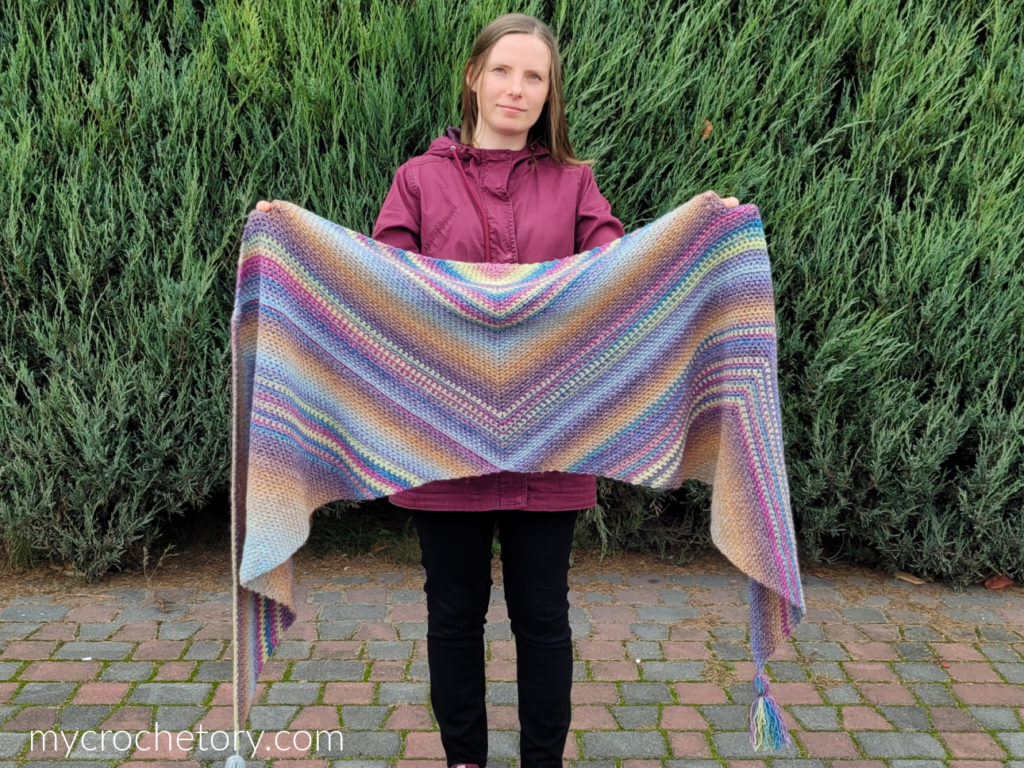

- Willow Shawl, a moss stitch triangle in a gradient cake, with a picot edge.
- Triangle Moss Stitch Shawl, four colors of moss stitch, worked from the top down.
- Bandos Wrap, three moss stitch triangles sewn into one big wrap.
- Greus Cowl, an asymmetric cowl worked on the bias in two colors.
- Ombre Moss Stitch Cowl, three colors of moss stitch in the round, with a ribbed edge.
- Ombre Moss Stitch Beanie, the matching hat, worked without cutting the yarn.
More Crochet Scarf and Wrap Patterns
When this wrap is off your hook, here’s what to make next. Each of these scarves and wraps uses a completely different stitch.
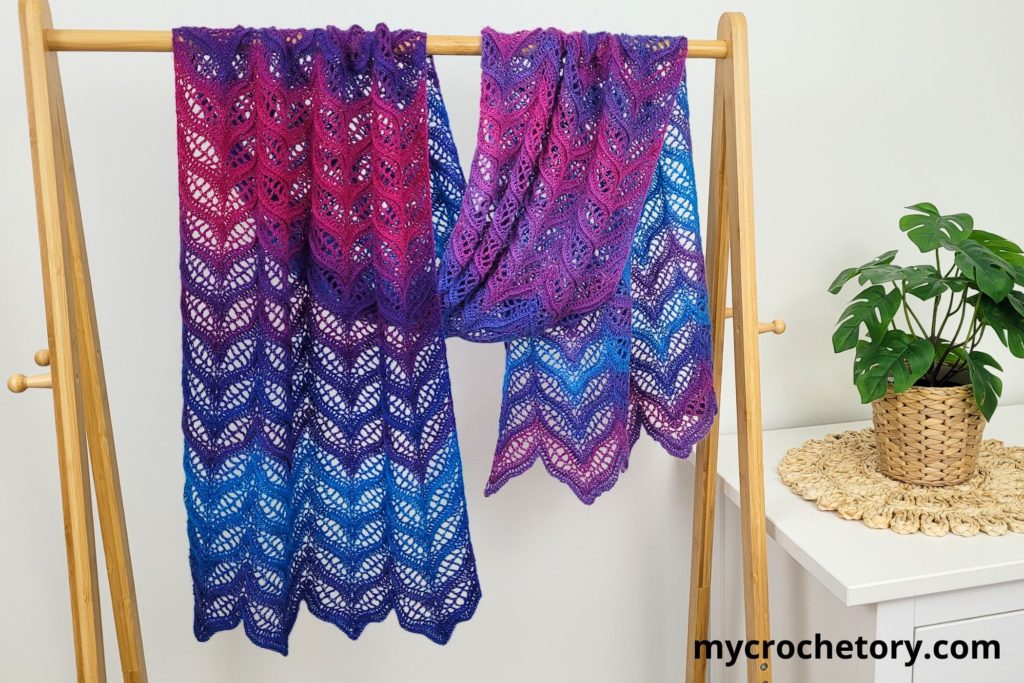


- Tonnta Lightweight Scarf, a wave stitch scarf in lace weight yarn.
- Havra Wrap, a chevron wrap worked on the bias in Scheepjes Whirl and Whirlette.
- Kalinda Wrap, the Kalinda wave stitch as a long parallelogram, made from one Whirl cake.
- Monochrome Bias Wrap, a 3-color wrap with a long mosaic section.
- Havra Infinity Scarf, six colors of chevron lace, seamed into a loop.
- Valentina Infinity Scarf, an easy reversible scarf for beginners.
- Zarina Scarf, a corner to corner lace scarf from one yarn cake.
Linen Stitch Crochet Scarf FAQ
How do I make this linen stitch crochet scarf wider or narrower?
Add or remove 42 chains at the start. Each 42 stitches is one chevron, about 4.5 inches wide.
Why do I drop the loop instead of turning?
Dropping the loop lets you start the next row from the same edge with the other yarn. Both yarns stay at one side, which is why you end up with only four ends.
Can I use a different yarn for this linen stitch crochet scarf?
Any two fingering weight yarns with good contrast will work. Gradient cakes give the slow color change you see in my photos, while solid colors make crisp stripes.
My chevron points look rounded. What helps?
Check that you work (sc, ch2, sc) into each ch-2 sp at the peaks, because that corner is what makes the point. Then pin every single point while you steam block, and they’ll stay sharp.
I’m so I’m love with this and the color combination. Which colorways from scheepjes whirl did you use for this project?
Thank you so much! I used Rosewater Coctail and Blackcurranr Squeeze Me colorways.
Hello, I am a visual learner and I’m unable to play the video you posted with the pattern. I went directly to your site on YouTube and couldn’t find the pattern. Any other suggestions?
This is a really neat pattern and I would love to try making it. Thank you for your time . Melodie Cameron
I agree wholeheartedly with Amanda. It’s stunningly beautiful. Thank you for letting us know the colours you used. Just gorgeous!