Updated: 5 November 2026 by Sylwia (MyCrochetory)
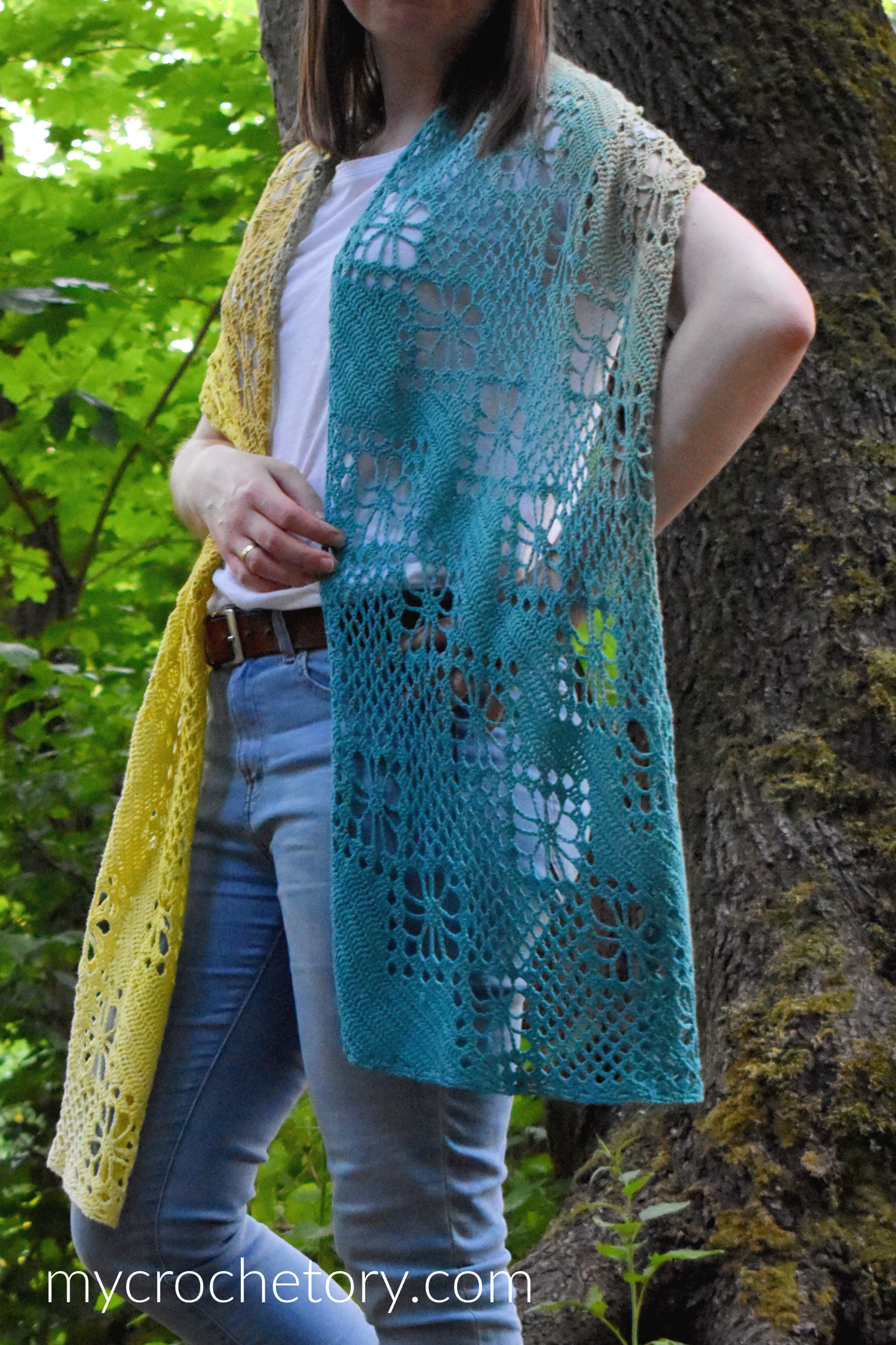
This diagonal crochet scarf starts with just 6 chains in one corner and grows, row by row, all the way to the opposite corner. By the time you get there, it’s 76 inches long and full of little lace flowers.
I’m Sylwia, and those flowers are the reason Zarina exists. I designed the lace flower first and then built a whole scarf around it, about 15.75 inches wide after blocking.
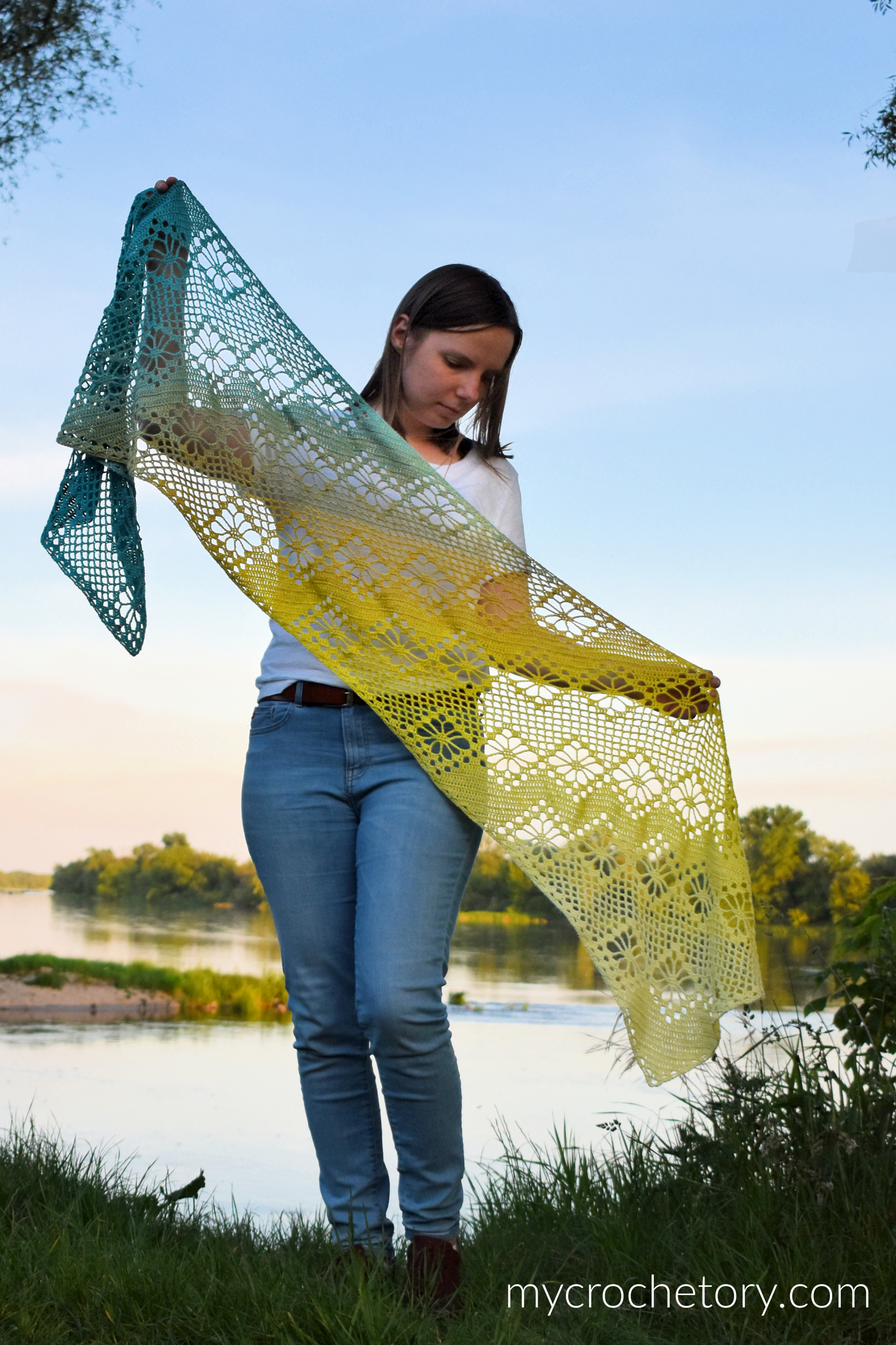
Zarina Diagonal Scarf free pattern in 3 parts
- Part 1, Rows 1 to 28, the starting triangle (you’re here)
- Part 2, Rows 29 to 52, the long middle section
- Part 3, Rows 1b to 27b, the end triangle
Scroll down to the free pattern for Rows 1 to 28, or get the ad-free, printable PDF with all three parts and the stitch charts HERE on Etsy or HERE on Ravelry.
This post contains affiliate links. If you buy through them, I may earn a small commission at no extra cost to you. Read my affiliate disclosure.
Join my Facebook Group and Official Ravelry Group, where you can ask questions and share your finished projects. You can also follow me on Instagram, Facebook and Pinterest.
How My Diagonal Crochet Scarf Started With a Lace Flower
Some scarves start with a shape. This diagonal crochet scarf started with one little lace flower, made of chain loops for petals and a few single crochets in the middle.
Once the flower was ready, it needed a home. So I put each flower inside a diamond of double crochet and surrounded the diamonds with open mesh, which makes every flower easy to spot.
And one flower was never going to be enough. Part 1 alone gives you two bands of them, first three side by side and then six, because the scarf gets wider with every row.
Where the Name Zarina Comes From
Every pattern needs a name, and this one came from my daughter’s favorite movies at the time. Zarina is one of the fairies in Tinker Bell.
While I was designing this scarf, she watched Tinker Bell on repeat. If you have little kids at home, you know exactly what that means, and that’s how a lace scarf ended up with a fairy’s name.
How the Diagonal Crochet Scarf Grows From Corner to Corner
This diagonal crochet scarf grows from the bottom right corner to the top left corner, all in one piece. There are no seams and no panels to join, just three stages that follow each other.
In Part 1 you increase on both edges, so your piece grows as a triangle. In Part 2 you keep increasing on one edge but decrease on the other, and that triangle turns into a long, slanted parallelogram.
Part 3 decreases on both edges until they meet in the last corner, so the end mirrors the start. And because every row runs on the bias, the flowers and the lace lines all sit at an angle.
How the Lace Flowers Are Made
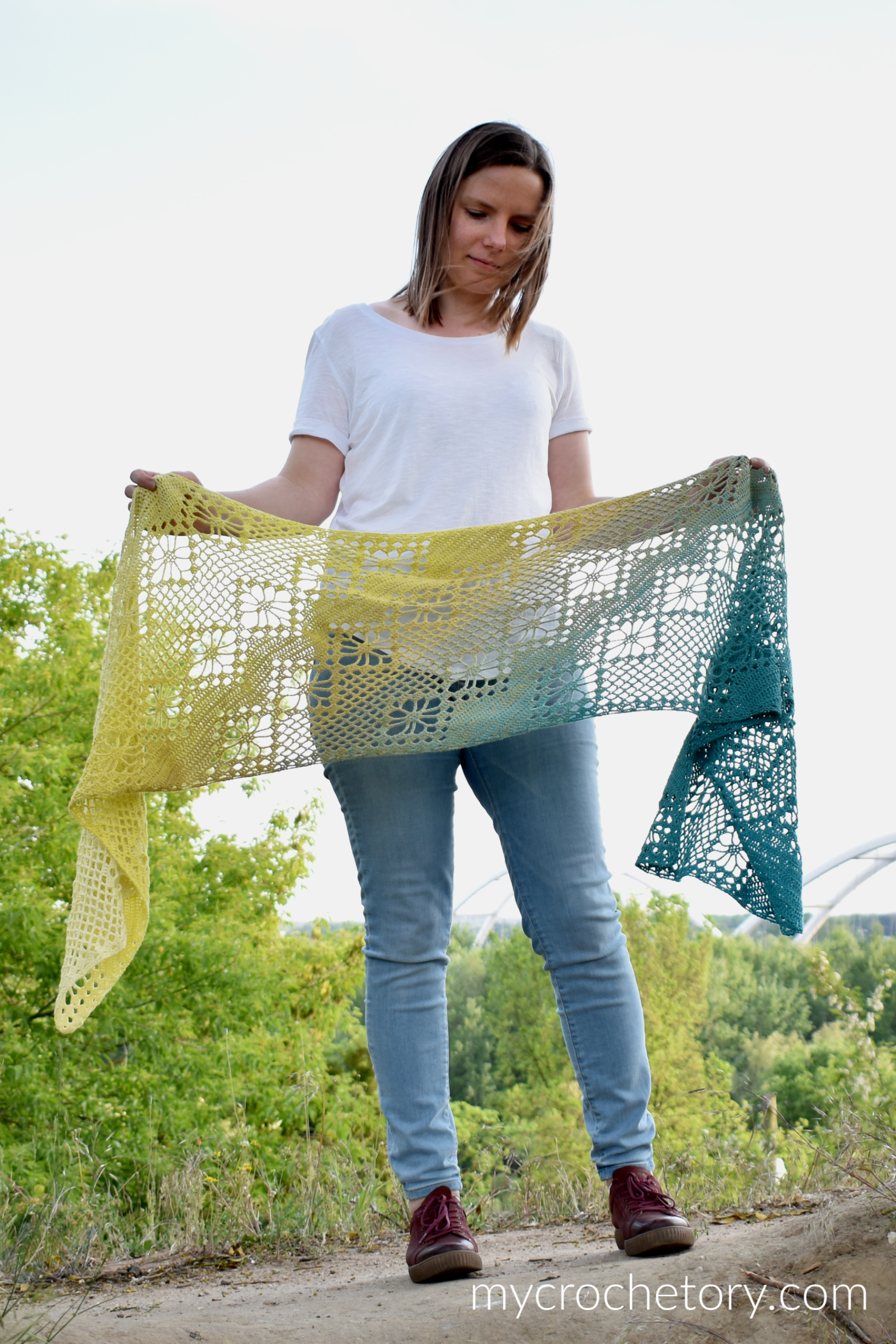
Each lace flower in this diagonal crochet scarf grows over six rows, so you see it open up bit by bit. It starts as a single treble crochet between two chain loops.
In the next rows, single crochets and longer chain loops build the petals around that center. Then the flower closes up again, until only a small chain space is left on top.
Blocks of double crochet and ch-2 spaces outline the diamond around each flower. Between the bands of flowers you get three rows of plain mesh, and those quick rows are a nice little break before the next band.
Yarn for the Diagonal Crochet Scarf
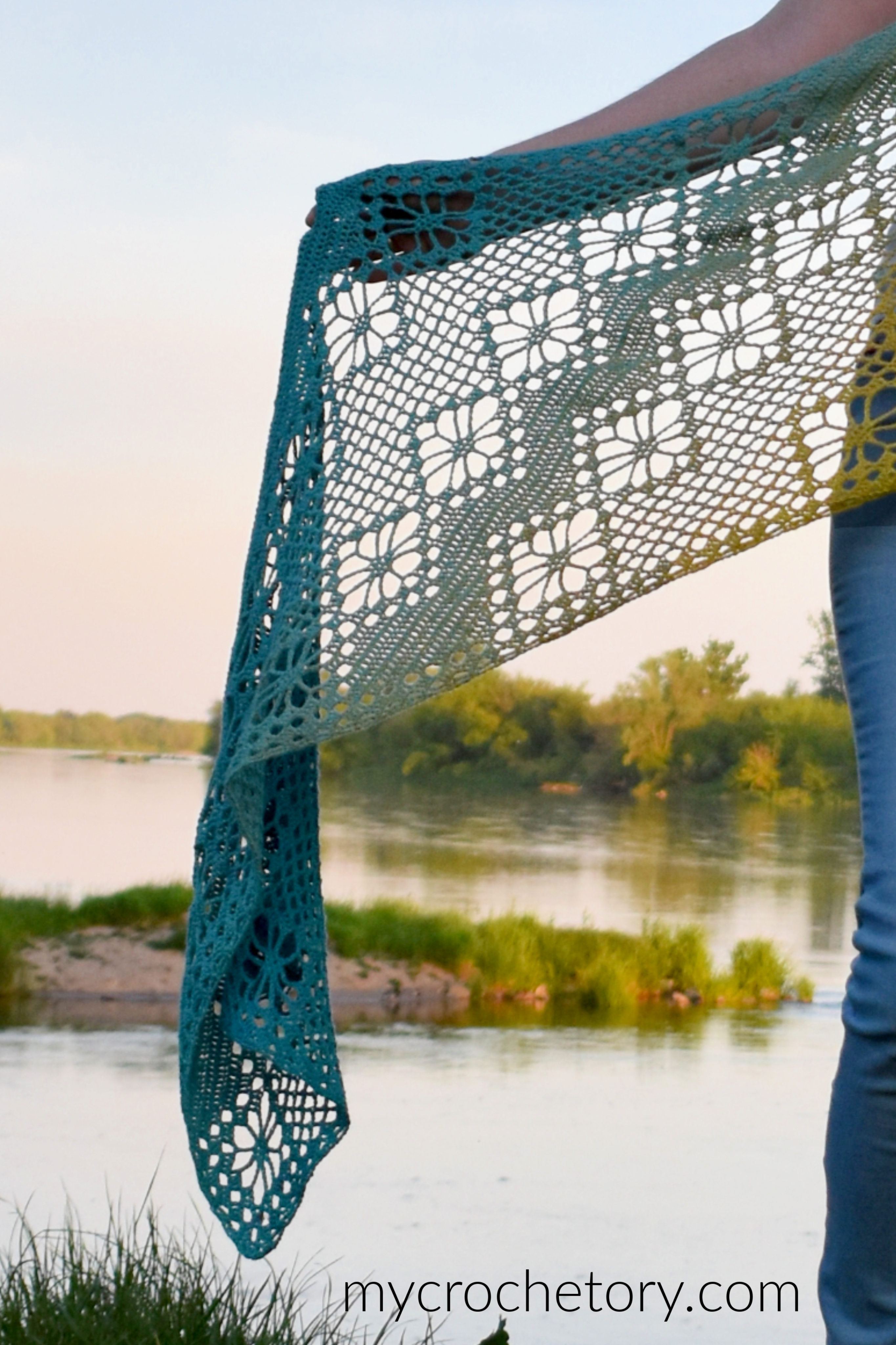
The best part about the yarn? You only need one cake. I made my diagonal crochet scarf with one cake of Scheepjes Woolly Whirl, and I still recommend it for this pattern.
Woolly Whirl is a fingering weight yarn, 70% cotton and 30% wool, with 1093 yards (1000 m) in every cake. My colorway is Custard Cream Centre, which fades from soft yellow to teal.
Since the scarf grows on the bias, the colors change on a diagonal too, so one end comes out yellow and the other teal. If your gauge is a little off, keep an extra cake of Whirlette in a matching color nearby.
Yarn substitutes
Woolly Whirl is sold out at LoveCrafts right now, but Scheepjes Whirl is a great swap. It has the same 1000 m (1093 yards) in one gradient cake, and it’s 60% cotton and 40% acrylic instead of cotton and wool.
So your scarf will feel a little lighter and less warm, but the colors still fade on the diagonal. One cake is enough, just like with Woolly Whirl.
Is This Diagonal Crochet Scarf Hard to Crochet?
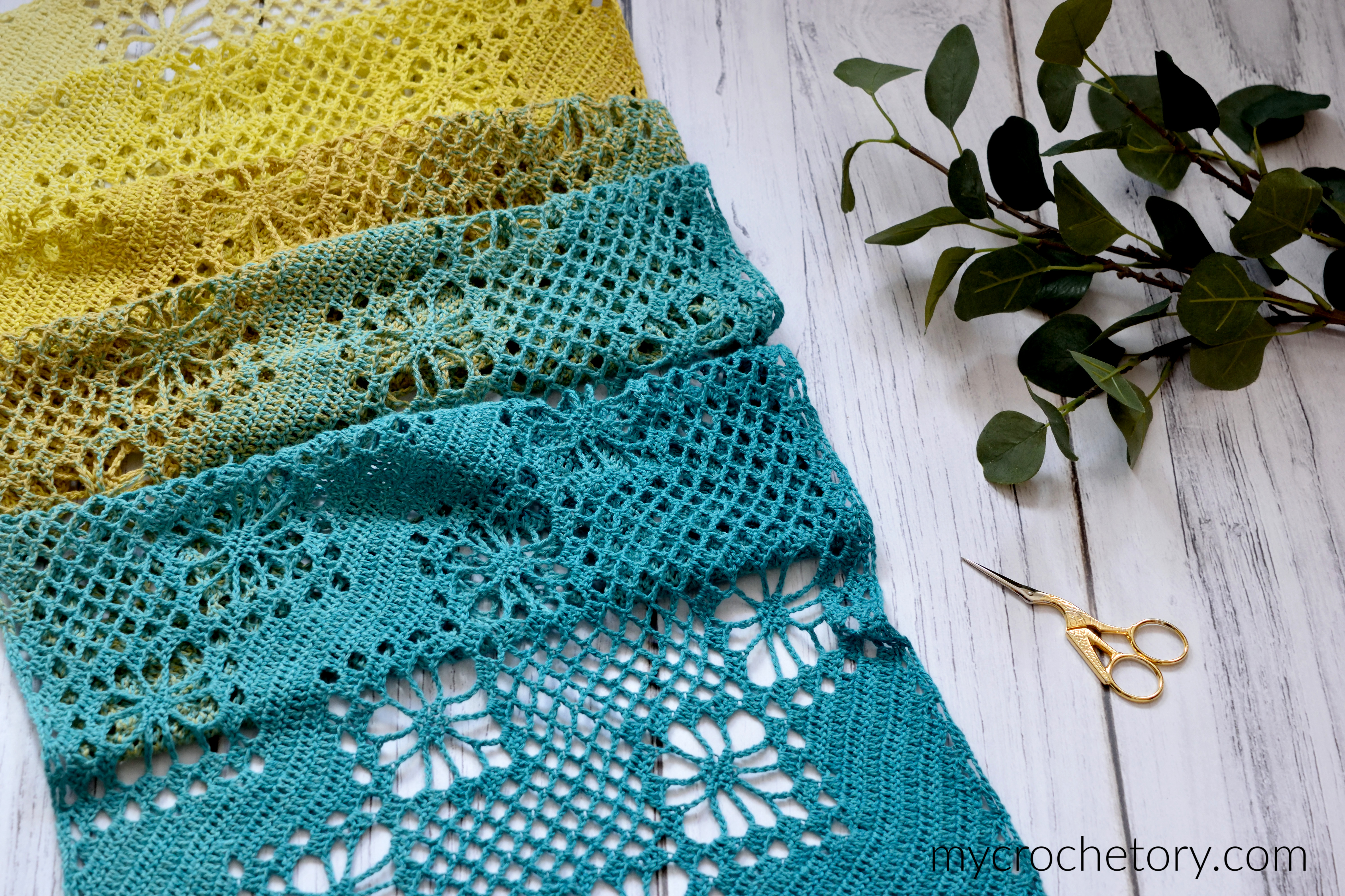
This diagonal crochet scarf is an intermediate pattern, so it’s not the best first project. You should already be fine with increases, decreases and lace, because the edges change in every part and the flower rows need careful counting.
To keep you on track, every row is written out in full, with exact stitch counts for the solid parts. If you lose your place, count the stitches up to the next ch-2 space and compare them with the row.
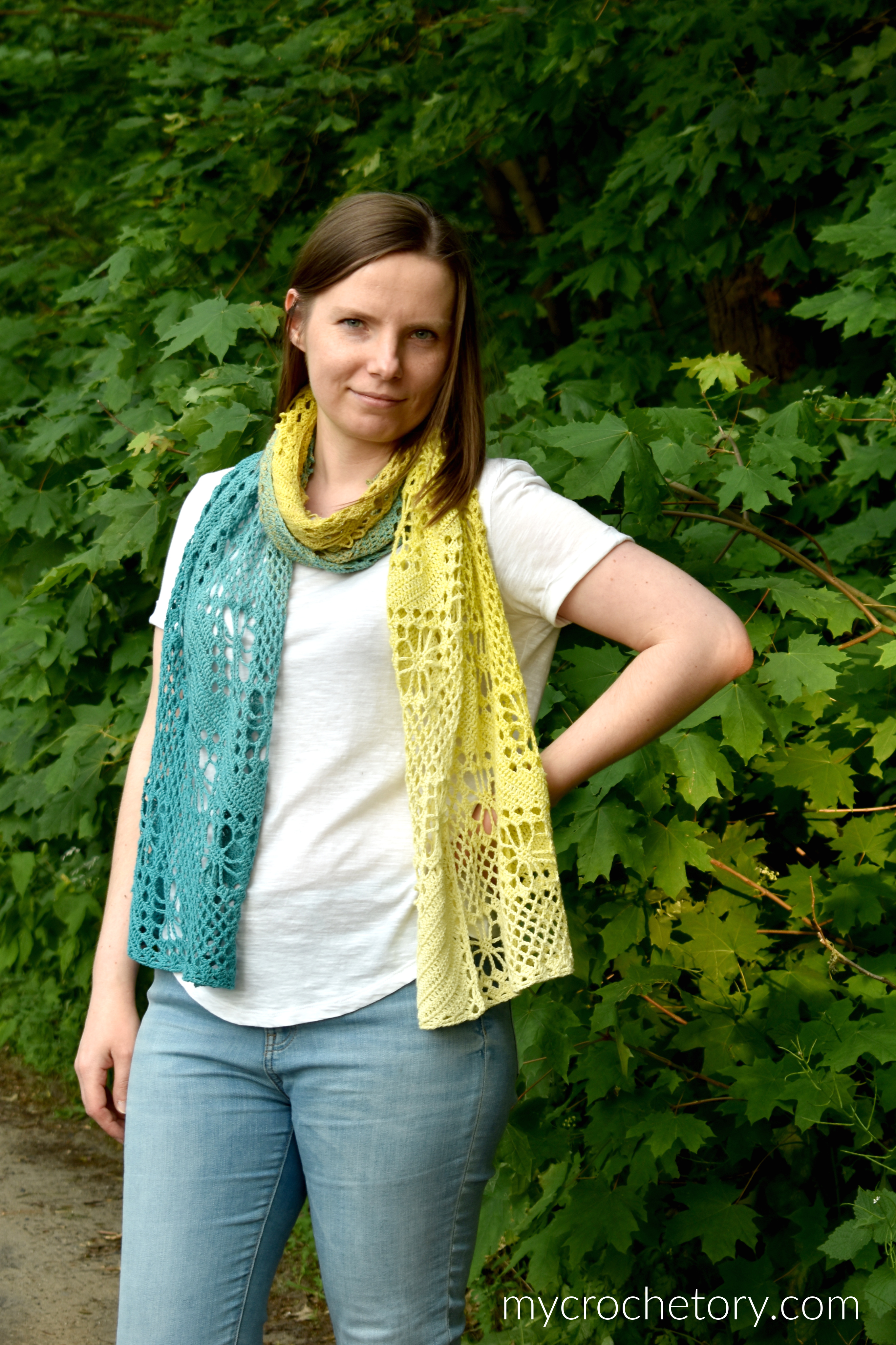
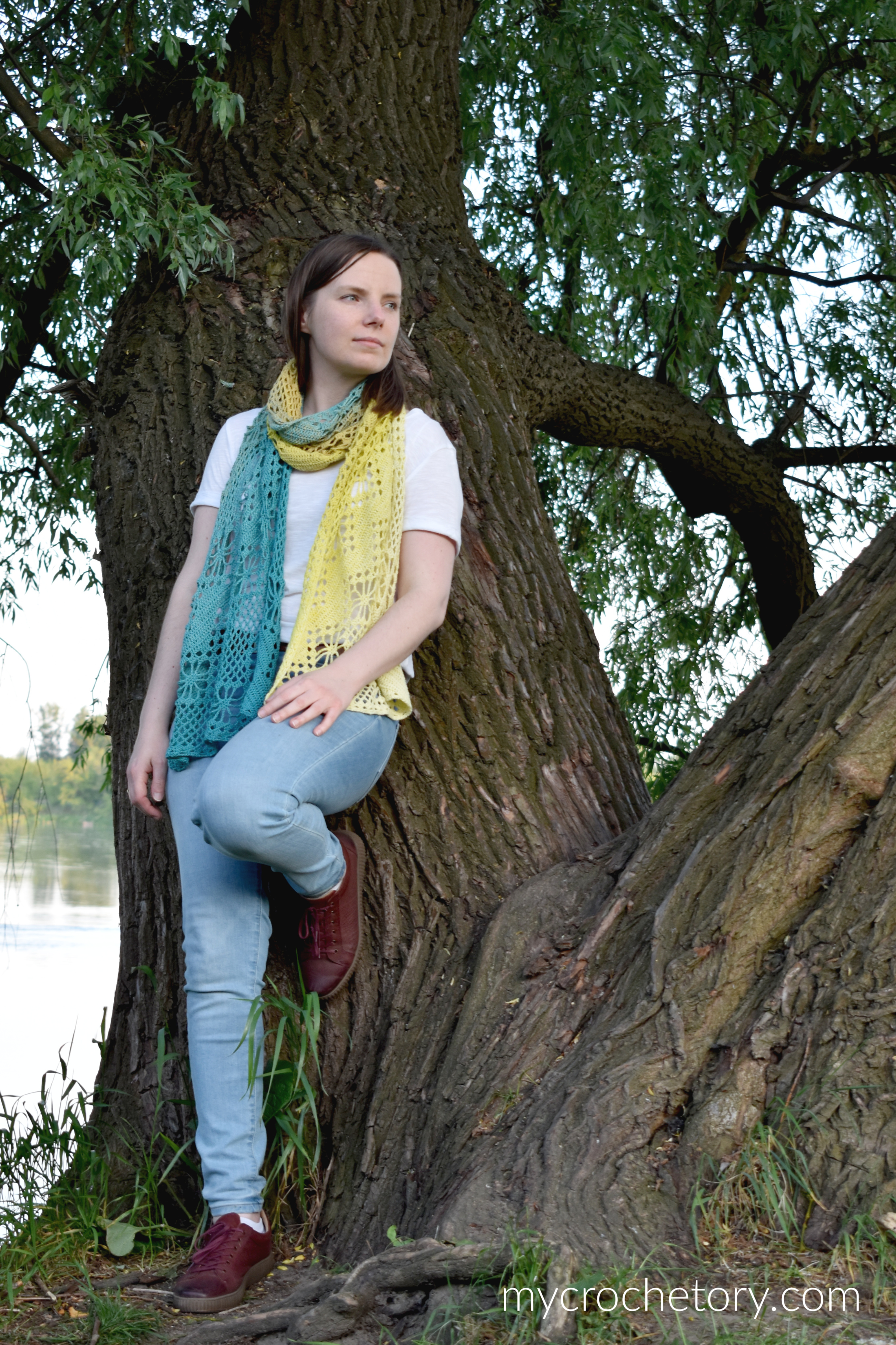
Before release, testers crocheted the whole pattern with me, and I’m so grateful to them. And yes, that’s me wearing the scarf in all the photos, by the river and between the trees.
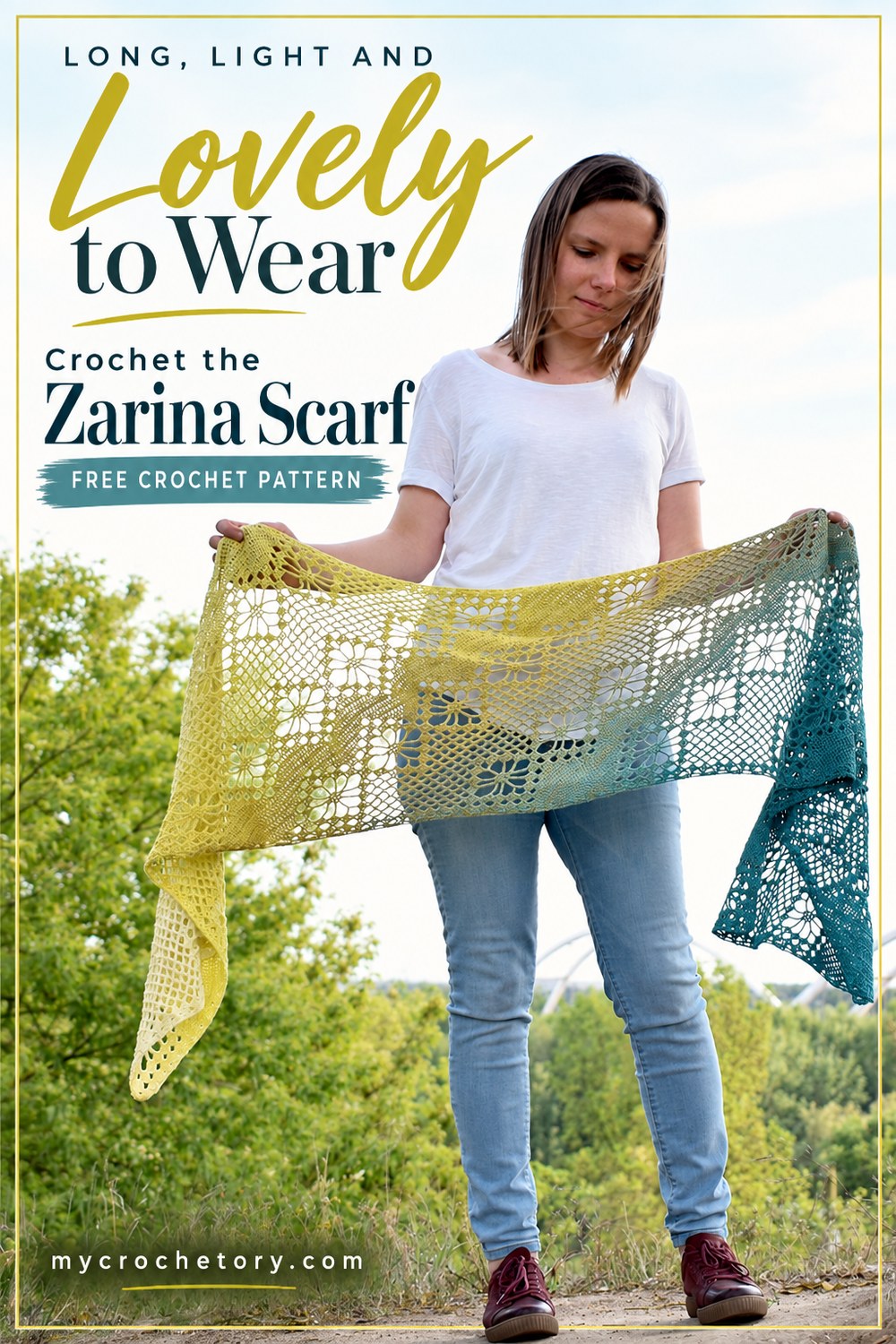
Not starting today? Save the diagonal crochet scarf on Pinterest so it’s there when you have yarn and a free evening.
Zarina Diagonal Crochet Scarf Free Pattern, Part 1
- Purchase the complete ad-free, printable PDF with crochet stitch chart here on ETSY or here on Ravelry.
- Add this pattern to your Ravelry Queue HERE.
- Grab the MyCrochetory Shawl Pattern BUNDLE that includes 14 patterns for one low price HERE.
- Pin it for later.
Copyright 2020 – 2026 MyCrochetory. All rights reserved. This pattern is property of Sylwia Kawczyńska @MyCrochetory. Please DO NOT sell the pattern and claim this pattern as your own. The pattern is for personal use only and may not be translated or reproduced in another language. Please respect my rights, DO NOT share or publish this pattern anywhere without my permission.
The scarf you make following this pattern is yours, and you are free to sell it, as long as you credit MyCrochetory as the original designer. For more information, please read the Terms Page.
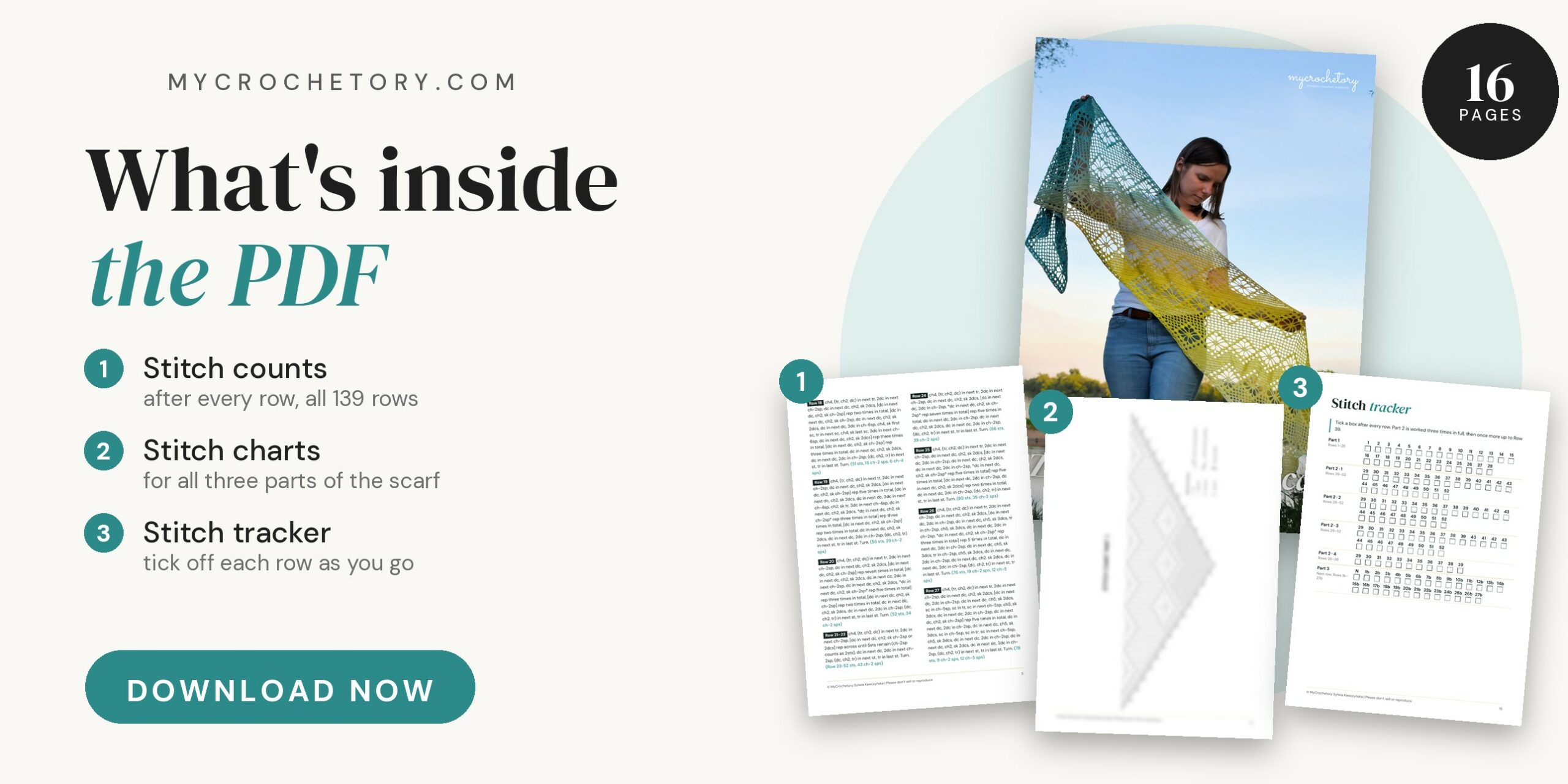
As a bonus in the ad-free, printable PDF, I’ve provided stitch charts. If you’re a visual learner or if you just want to support my work you can purchase this crochet pattern HERE on ETSYor HERE on Ravelry. Thank you!

Materials & Tools:
- Yarn SCHEEPJES Woolly Whirl 215 g = 1000 m (1093 yd), 70% Cotton and 30% Wool, 1 cake. For the scarf sample I used (476) Custard Cream Centre colorway. Yarn substitute: Scheepjes Whirl 215 g = 1000 m (1093 yd), 60% Cotton, 40% Acrylic, 1 cake.
You might need one extra cake of Whirlette yarn in matching color if your gauge is a little bit off.
- Hook size 3.5 mm. Adjust hook size if necessary to obtain correct gauge.
- Tapestry needle (to weave and hide yarn ends).
- Scissors.
Level:
Intermediate
Size after blocking:
Approx. 40cm (15.75”) wide x 194cm (76.25”) long.
Gauge after blocking:
After Row 10 the triangle is approx. 10cm/4” high.
Gauge is not important for this project. However, changes might result in different yardage requirements and a different finished size.
Notes:
- The pattern uses US crochet terminology.
- Scarf is worked in one piece diagonally from bottom right corner to top left corner.
- dc in next dc in the pattern means dc in next 1dc.
- Instructions in square brackets […] are worked as many times as indicated.
- Instructions in *…* are worked as many times as indicated.
- The pattern includes the stitch charts.
Stitches & Abbreviations (US terms):
st(s) – stitch(es)
yo – yarn over
sp – space
prev – previous
sk – skip
tr2tog – treble crochet 2 together
tr in last st – tr in 4th ch of ch4 at beg of prev row
DEC1 – (double crochet and treble crochet 2 together with 2 stitches unworked/skipped between them) – yo, insert hook in indicated st, yo, draw up a loop, yo, pull through 2 loops, yo twice, sk 2 sts and insert hook in next st, yo, draw up a loop, [yo, pull through 2 loops] twice, yo, pull through 3 loops on hook.
DEC2 – (treble crochet and double crochet 2 together with 2 stitches unworked/skipped between them) – yo twice, insert hook in indicated st, yo, draw up a loop, [yo, pull through 2 loops] twice, yo, skip 2 sts and insert hook in next st, yo, draw up a loop, yo, pull through 2 loops, yo pull through 3 loops on hook.
Pattern, Part 1
Row 1: ch6*, tr in 5th ch from hook, ch2, 2tr in last unworked ch. Turn.
*The first 4 chains of the ch6 count as a tr.
Row 2: ch4 (counts as a tr here and throughout), (tr, ch2, dc) in next tr, 2dc in next ch-2sp, (dc, ch2, tr) in next st, tr in last st. Turn.
Row 3: ch4, (tr, ch2, dc) in next tr, 2dc in next ch-2sp, dc in each dc across until ch-2sp, 2dc in ch-2sp, (dc, ch2, tr) in next st, tr in last st. Turn.
Rows 4 – 10: Repeat Row 3
Row 11: ch4, (tr, ch2, dc) in next tr, 2dc in next ch-2sp, dc in next dc, [ch2, sk 2dcs, dc in next 22dcs] rep two times in total, ch2, sk 2dcs, dc in next dc, 2dc in ch-2sp, (dc, ch2, tr) in next st, tr in last st. Turn.
Row 12: ch4, (tr, ch2, dc) in next tr, 2dc in next ch-2sp, dc in next dc, [ch2, sk 2dcs, dc in next dc, 2dc in ch-2sp, dc in next dc, ch2, sk 2dcs, dc in next 16dcs] rep two times in total, ch2, sk 2dcs, dc in next dc, 2dc in ch-2sp, dc in next dc, ch2, sk 2dcs, dc in next dc, 2dc in ch-2sp, (dc, ch2, tr) in next st, tr in last st. Turn.
Row 13: ch4, (tr, ch2, dc) in next tr, 2dc in next ch-2sp, dc in next dc, [*ch2, sk 2dcs, dc in next dc, 2dc in ch-2sp, dc in next dc* rep two times in total, ch2, sk 2dcs, dc in next 10dcs] rep two times in total, [ch2, sk 2dcs, dc in next dc, 2dc in ch-2sp, dc in next dc] rep two times in total, ch2, sk 2dcs, dc in next dc, 2dc in ch-2sp, (dc, ch2, tr) in next st, tr in last st. Turn.
Row 14: ch4, (tr, ch2, dc) in next tr, 2dc in next ch-2sp, dc in next dc, [ch2, sk 2dcs, dc in next dc, 2dc in ch-2sp, dc in next dc, ch5, sk 3dcs, tr in ch-2sp, ch5, sk 3dcs, dc in next dc, 2dc in ch-2sp, dc in next dc, ch2, sk 2dcs, dc in next 4dcs] rep two times in total, ch2, sk 2dcs, dc in next dc, 2dc in ch-2sp, dc in next dc, ch5, sk 3dcs, tr in ch-2sp, ch5, sk 3dcs, dc in next dc, 2dc in ch-2sp, dc in next dc, ch2, sk 2dcs, dc in next dc, 2dc in ch-2sp, (dc, ch2, tr) in next st, tr in last st. Turn.
Row 15: ch4, (tr, ch2, dc) in next tr, 2dc in next ch-2sp, dc in next dc, [ch2, sk 2dcs, dc in next dc, 2dc in ch-2sp, dc in next dc, ch5, sk 3dcs, sc in ch-5sp, sc in tr, sc in next ch-5sp, ch5, sk 3dcs, dc in next dc, 2dc in ch-2sp, dc in next dc] rep three times in total, ch2, sk 2dcs, dc in next dc, 2dc in ch-2sp, (dc, ch2, tr) in next st, tr in last st. Turn.
Row 16: ch4, (tr, ch2, dc) in next tr, 2dc in next ch-2sp, dc in next dc, ch2, sk 2dcs, [dc in next dc, 2dc in ch-2sp, dc in next dc, ch7, sk 3dcs, sc in ch-5sp, sc in next 3scs, sc in next ch-5sp, ch7, sk 3dcs] rep three times in total, dc in next dc, 2dc in ch-2sp, dc in next dc, ch2, sk 2dcs, dc in next dc, 2dc in ch-2sp, (dc, ch2, tr) in next st, tr in last st. Turn.
Row 17: ch4, (tr, ch2, dc) in next tr, 2dc in next ch-2sp, dc in next dc, ch2, sk 2dcs, dc in next dc, ch2, sk ch-2sp, dc in next dc, ch2, sk 2dcs, [dc in next dc, 3dcs in ch-7sp, ch6, sk first sc, sc in next 3scs, ch6, sk last sc, 3dcs in next ch-7sp, dc in next dc, ch2, sk 2dcs] rep three times in total, dc in next dc, ch2, sk ch-2sp, dc in next dc, ch2, sk 2dcs, dc in next dc, 2dc in ch-2sp, (dc, ch2, tr) in next st, tr in last st. Turn.
Row 18: ch4, (tr, ch2, dc) in next tr, 2dc in next ch-2sp, dc in next dc, ch2, sk 2dcs, [dc in next dc, ch2, sk ch-2sp] rep two times in total, [dc in next dc, ch2, sk ch-2sp, dc in next dc, ch2, sk 2dcs, dc in next dc, 3dcs in ch-6sp, ch4, sk first sc, tr in next sc, ch4, sk last sc, 3dcs in next ch-6sp, dc in next dc, ch2, sk 2dcs] rep three times in total, [dc in next dc, ch2, sk ch-2sp] rep three times in total, dc in next dc, ch2, sk 2dcs, dc in next dc, 2dc in ch-2sp, (dc, ch2, tr) in next st, tr in last st. Turn.
Row 19: ch4, (tr, ch2, dc) in next tr, 2dc in next ch-2sp, dc in next dc, ch2, sk 2dcs, [dc in next dc, ch2, sk ch-2sp] rep five times in total, [dc in next dc, ch2, sk 2dcs, dc in next dc, 3dc in next ch-4sp, ch2, sk tr, 3dcs in next ch-4sp, dc in next dc, ch2, sk 2dcs, *dc in next dc, ch2, sk ch-2sp* rep three times in total] rep three times in total, [dc in next dc, ch2, sk ch-2sp] rep two times in total, dc in next dc, ch2, sk 2dcs, dc in next dc, 2dc in ch-2sp, (dc, ch2, tr) in next st, tr in last st. Turn.
Row 20: ch4, (tr, ch2, dc) in next tr, 2dc in next ch-2sp, dc in next dc, ch2, sk 2dcs, [dc in next dc, ch2, sk ch-2sp] rep seven times in total, [dc in next dc, ch2, sk 2dcs, dc in next dc, 2dc in next ch-2sp, dc in next dc, ch2, sk 2dcs, *dc in next dc, ch2, sk ch-2sp* rep five times in total] rep three times in total, [dc in next dc, ch2, sk ch-2sp] rep two times in total, dc in next dc, ch2, sk 2dcs, dc in next dc, 2dc in ch-2sp, (dc, ch2, tr) in next st, tr in last st. Turn.
Rows 21 – 23: ch4, (tr, ch2, dc) in next tr, 2dc in next ch-2sp, [dc in next dc, ch2, sk ch-2sp or 2dcs] rep across until 5sts remain (ch-2sp counts as 2sts), dc in next dc, 2dc in next ch-2sp, (dc, ch2, tr) in next st, tr in last st. Turn.
Row 24: ch4, (tr, ch2, dc) in next tr, 2dc in next ch-2sp, dc in next dc, ch2, sk 2dcs, [dc in next dc, 2dc in ch-2sp, *dc in next dc, ch2, sk ch-2sp* rep seven times in total] rep five times in total, dc in next dc, 2dc in ch-2sp, dc in next dc, ch2, sk 2dcs, dc in next dc, 2dc in ch-2sp, (dc, ch2, tr) in next st, tr in last st. Turn.
Row 25: ch4, (tr, ch2, dc) in next tr, 2dc in next ch-2sp, dc in next dc, ch2, sk 2dcs, [dc in next dc, 2dc in ch-2sp, dc in next dc, ch2, sk 2dcs, dc in next dc, 2dc in ch-2sp, *dc in next dc, ch2, sk ch-2sp* rep five times in total] rep five times in total, [dc in next dc, 2dc in ch-2sp, dc in next dc, ch2, sk 2dcs] rep two times in total, dc in next dc, 2dc in ch-2sp, (dc, ch2, tr) in next st, tr in last st. Turn.
Row 26: ch4, (tr, ch2, dc) in next tr, 2dc in next ch-2sp, dc in next dc, ch2, sk 2dcs, [dc in next dc, 2dc in ch-2sp, dc in next dc, ch5, sk 3dcs, tr in ch-2sp, ch5, sk 3dcs, dc in next dc, 2dc in ch-2sp, *dc in next dc, ch2, sk ch-2sp* rep three times in total] rep 5 times in total, dc in next dc, 2dc in ch-2sp, dc in next dc, ch5, sk 3dcs, tr in ch-2sp, ch5, sk 3dcs, dc in next dc, 2dc in ch-2sp, dc in next dc, ch2, sk 2dcs, dc in next dc, 2dc in ch-2sp, (dc, ch2, tr) in next st, tr in last st. Turn.
Row 27: ch4, (tr, ch2, dc) in next tr, 2dc in next ch-2sp, dc in next dc, ch2, sk 2dcs, [dc in next dc, 2dc in ch-2sp, dc in next dc, ch5, sk 3dcs, sc in ch-5sp, sc in tr, sc in next ch-5sp, ch5, sk 3dcs, dc in next dc, 2dc in ch-2sp, dc in next dc, ch2, sk ch-2sp] rep five times in total, dc in next dc, 2dc in ch-2sp, dc in next dc, ch5, sk 3dcs, sc in ch-5sp, sc in tr, sc in next ch-5sp, ch5, sk 3dcs, dc in next dc, 2dc in ch-2sp, dc in next dc, ch2, sk 2dcs, dc in next dc, 2dc in ch-2sp, (dc, ch2, tr) in next st, tr in last st. Turn.
Row 28: ch4, dc in next tr, 2dc in next ch-2sp, dc in next dc, ch2, sk 2dcs, dc in next dc, 2dc in ch-2sp, dc in next dc, [ch7, sk 3dcs, sc in ch-5sp, sc in next 3scs, sc in next ch-5sp, ch7, sk 3dcs, dc in next dc, 2dc in ch-2sp, dc in next dc] rep six times in total, ch2, sk 2dcs, dc in next dc, 2dc in ch-2sp, (dc, ch2, tr) in next st, tr in last st. Turn.
Done with Row 28? Part 2 continues with Rows 29 to 52 and turns your triangle into the long middle of the scarf.
Stuck on a row? Ask in my Facebook Group or Ravelry Group, or email me at mycrochetory@gmail.com.
Started your Zarina? Share your progress on Instagram with #mycrochetory and tag @mycrochetory so I can see it.
More Crochet Patterns Worked on the Bias
Liked growing a piece from one corner? These patterns of mine are worked on the bias too, so the stitches run diagonally across them.
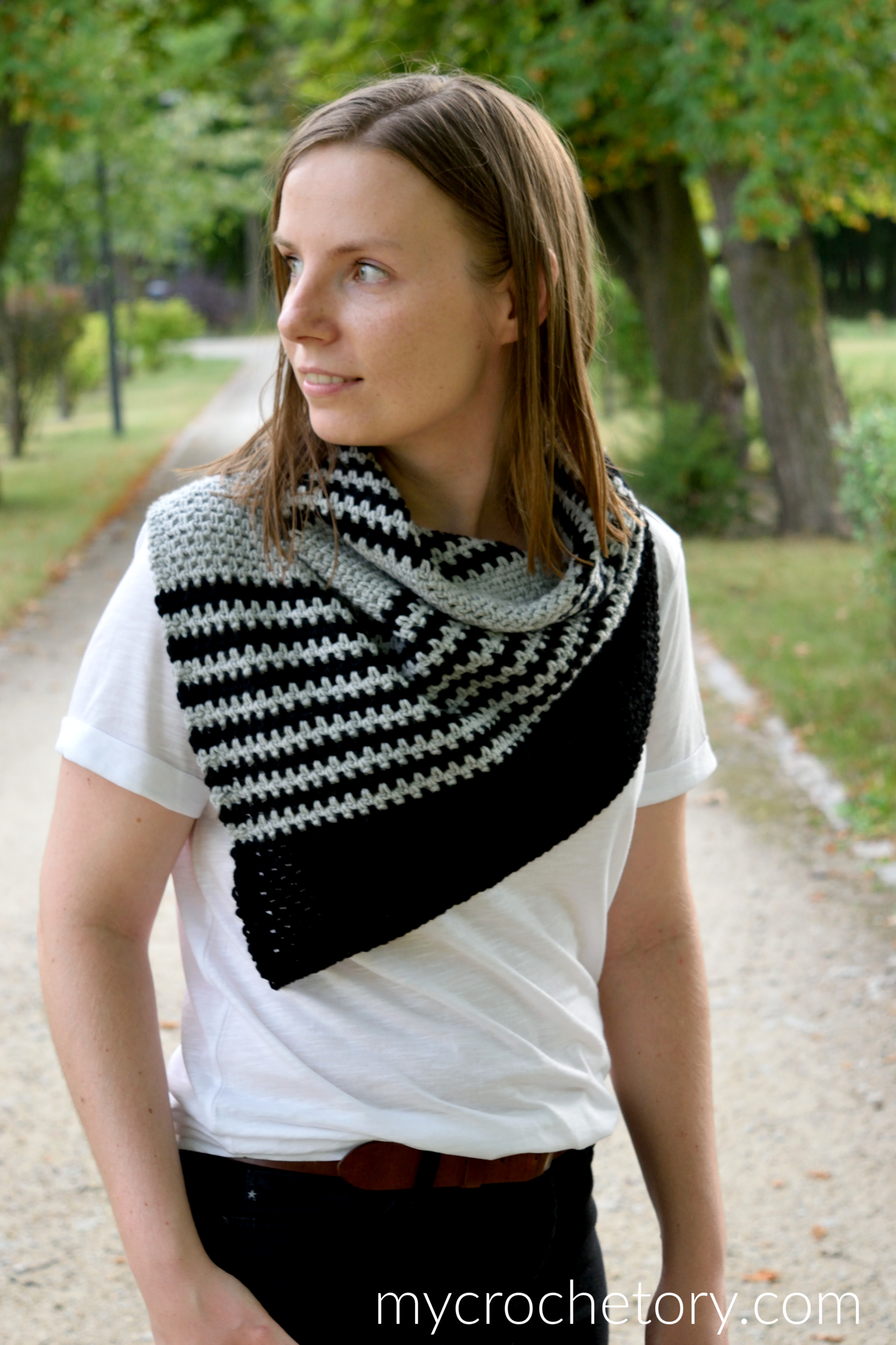

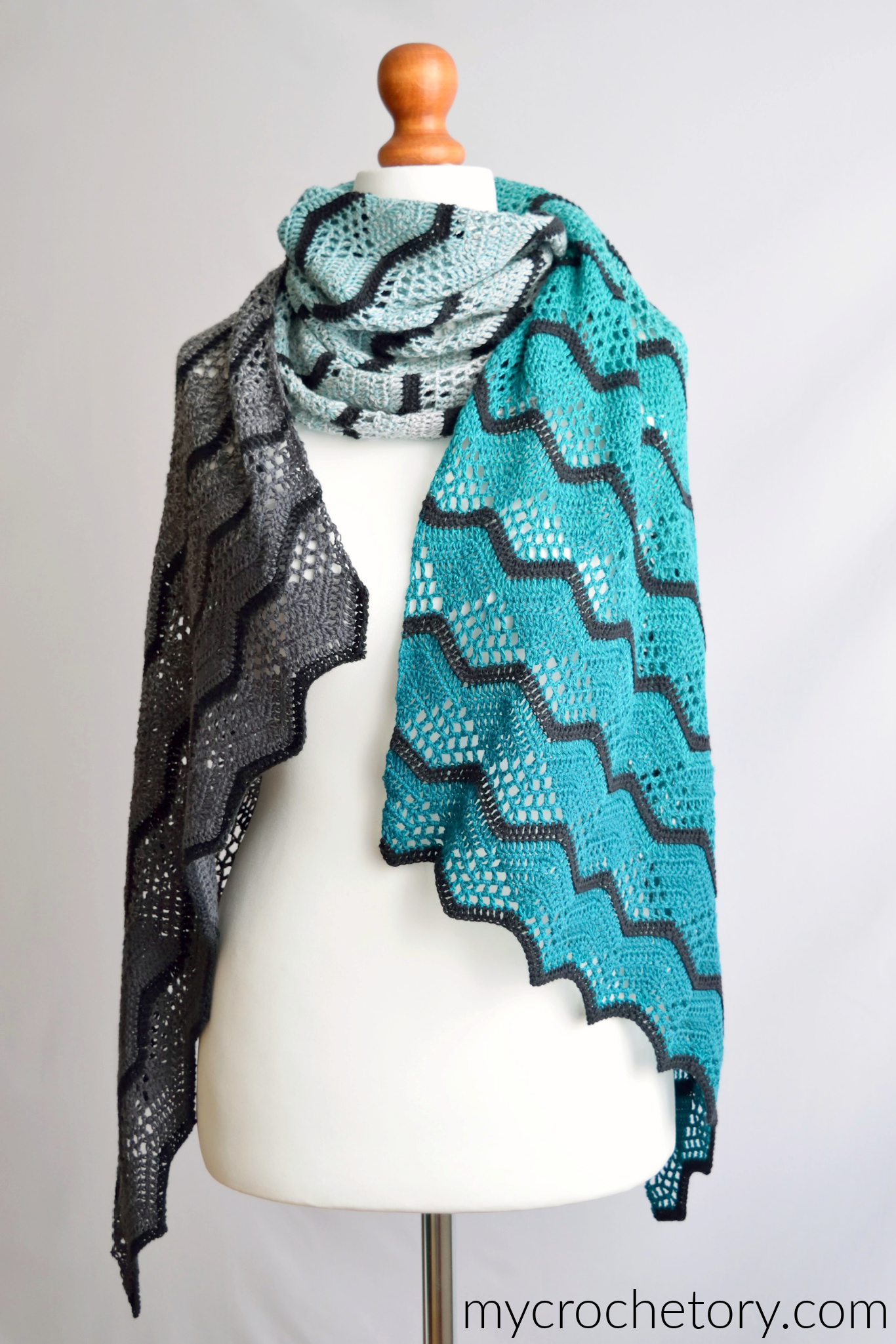
- Greus Cowl, an asymmetric moss stitch cowl in two colors, built like Zarina with a triangle first and then a parallelogram.
- Monochrome Bias Wrap, a three-color mosaic wrap with diagonal shaping, made in Scheepjes Whirlette.
- Havra Wrap, a bias chevron wrap in two colors of Scheepjes Whirl and Whirlette.
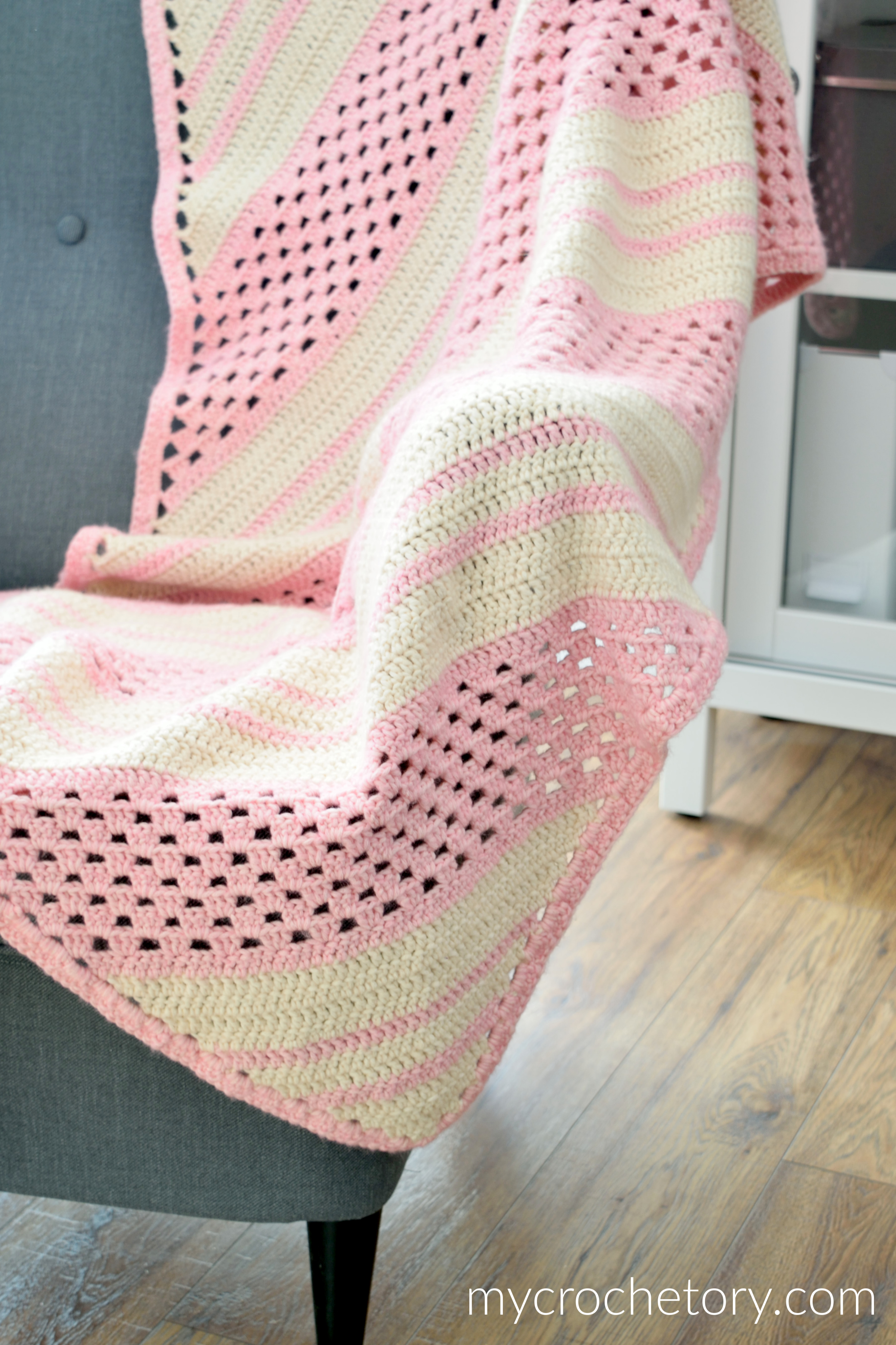
- Diagonal Stone Blanket, a two-color corner to corner afghan with double crochet and granny clusters.
More Lightweight Crochet Scarf and Wrap Patterns
These scarves and wraps are long and light too, and every one of them uses fingering or lace weight yarn.
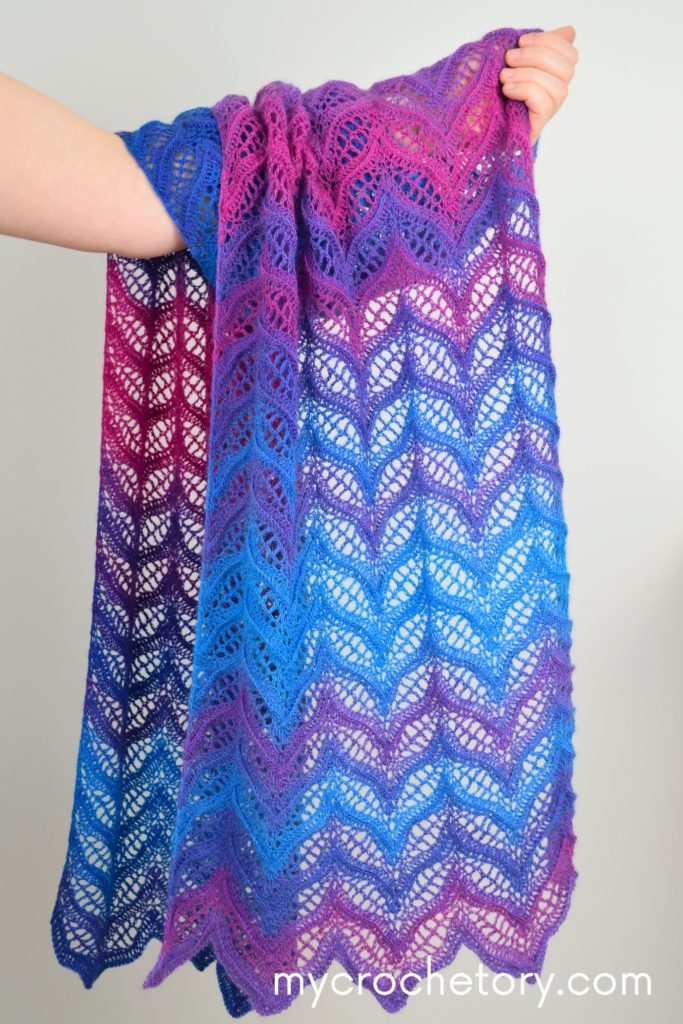

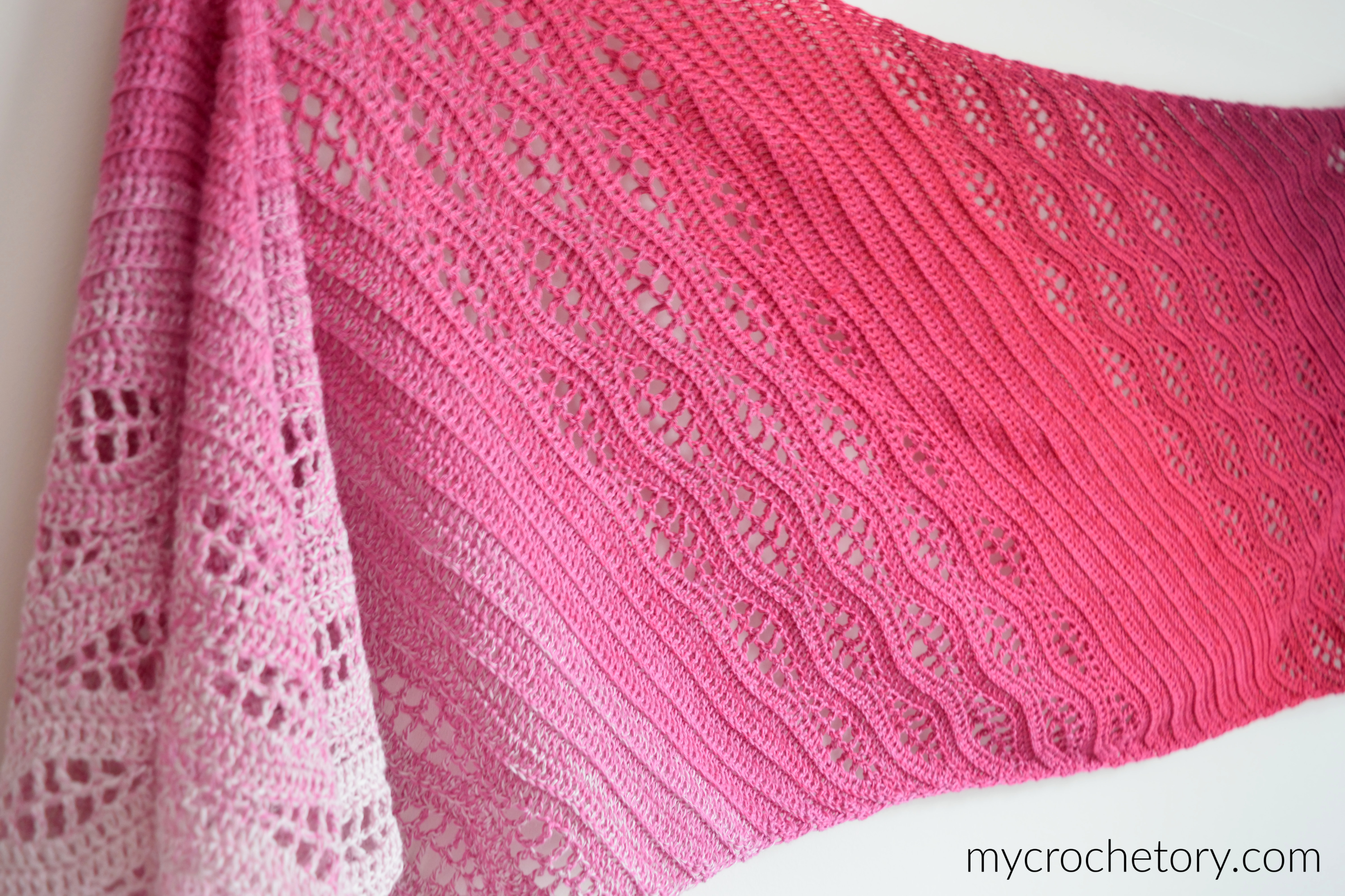
- Tonnta Scarf, a wavy lace scarf in lace weight yarn, and you can change its width and length.
- Flourish Linen Wrap, a two-color chevron wrap in linen stitch with only 4 yarn ends to weave in.
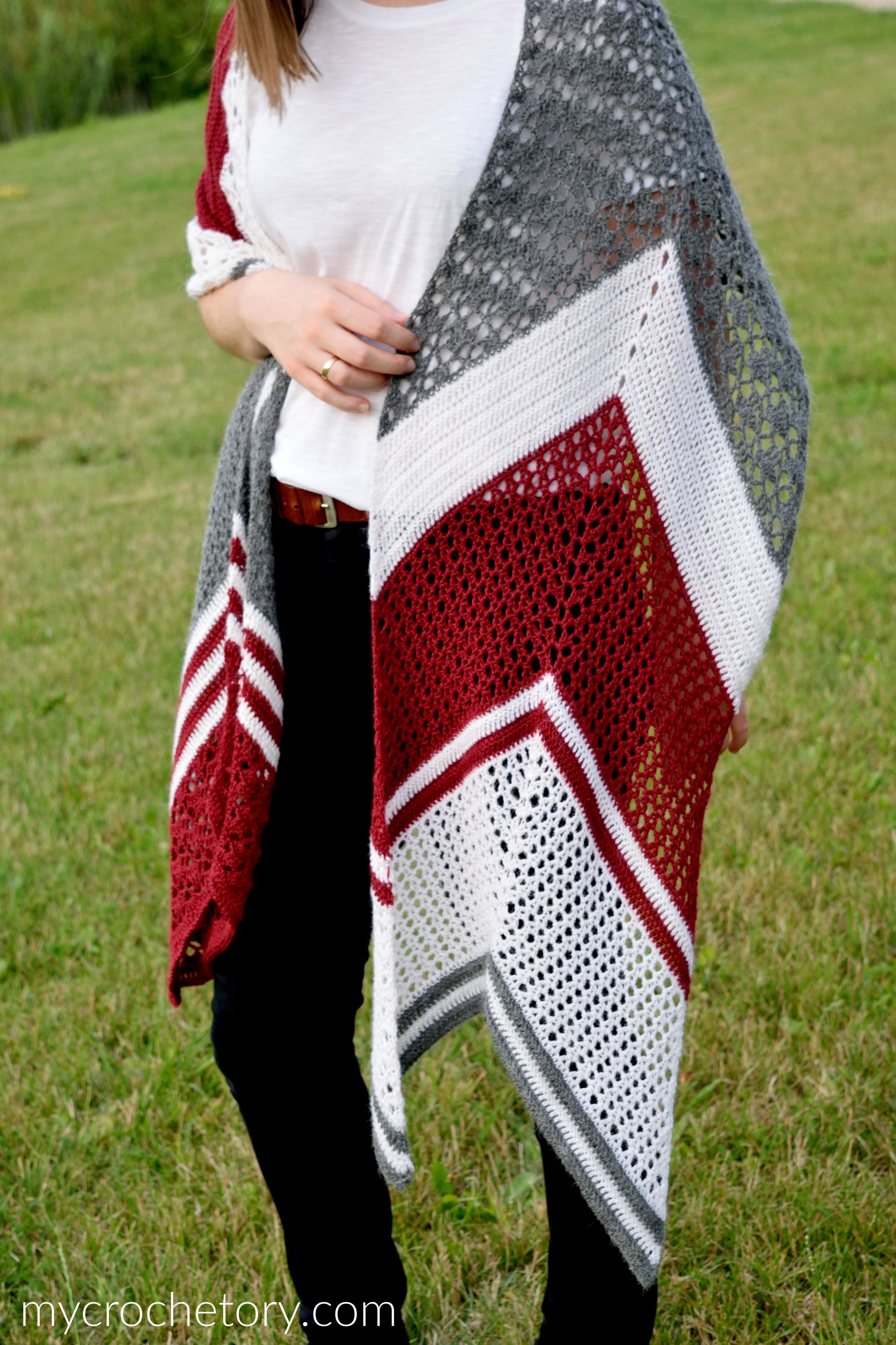
- Arrow Wrap, a reversible striped lace wrap with one pointy end and one V-shaped end.
- Kalinda Wrap, a parallelogram wrap in the Kalinda wave stitch, made with Scheepjes Whirl.
Diagonal Crochet Scarf FAQ
Can I make the diagonal crochet scarf longer?
Yes. The length comes from Part 2, where you repeat the same set of rows, so more repeats give you a longer scarf. Just keep in mind that a longer scarf needs more than one cake of yarn.
Can I use a different yarn for this diagonal crochet scarf?
Yes, any fingering weight yarn works. A gradient cake gives you the same diagonal color change, and a solid color puts all the attention on the lace flowers. A different yarn can change the finished size and the yardage you need.
Do I have to block the Zarina Scarf?
Yes, please do. The size and gauge in the pattern are measured after blocking, and I wet block my scarf so the lace opens up and the flowers lie flat.
How many rows does the whole Zarina Scarf have?
The whole scarf has 138 rows. Part 1 has 28 rows, Part 2 has 83 (Rows 29 to 52 three times, then Rows 29 to 39 once more), and Part 3 has 27 rows.

This is so stunning. Love king for the right yarn to use and make sure I have enough. Yarn shops are not yet open in Ecuador.
Thanks! Stay safe!
This is absolutely gorgeous, just bought the pattern on Ravelry. Love to work with chart!
Thank you so much for supporting my work!
Love the work you’re making! Truly inspiring!
Thank you!
I’m currently working on Zarina but am having a problem with rows 49-50. My question, is does your pattern on raverly include a graph? I really prefer to work off a graph than a written pattern. If the graph is available, I will gladly purchase it. Thank you
Hey Sylwia, just wondering where you got the name “Zarina” for the Zarina Diagonal Scarf