Updated: 22 October 2026 by Sylwia (MyCrochetory)
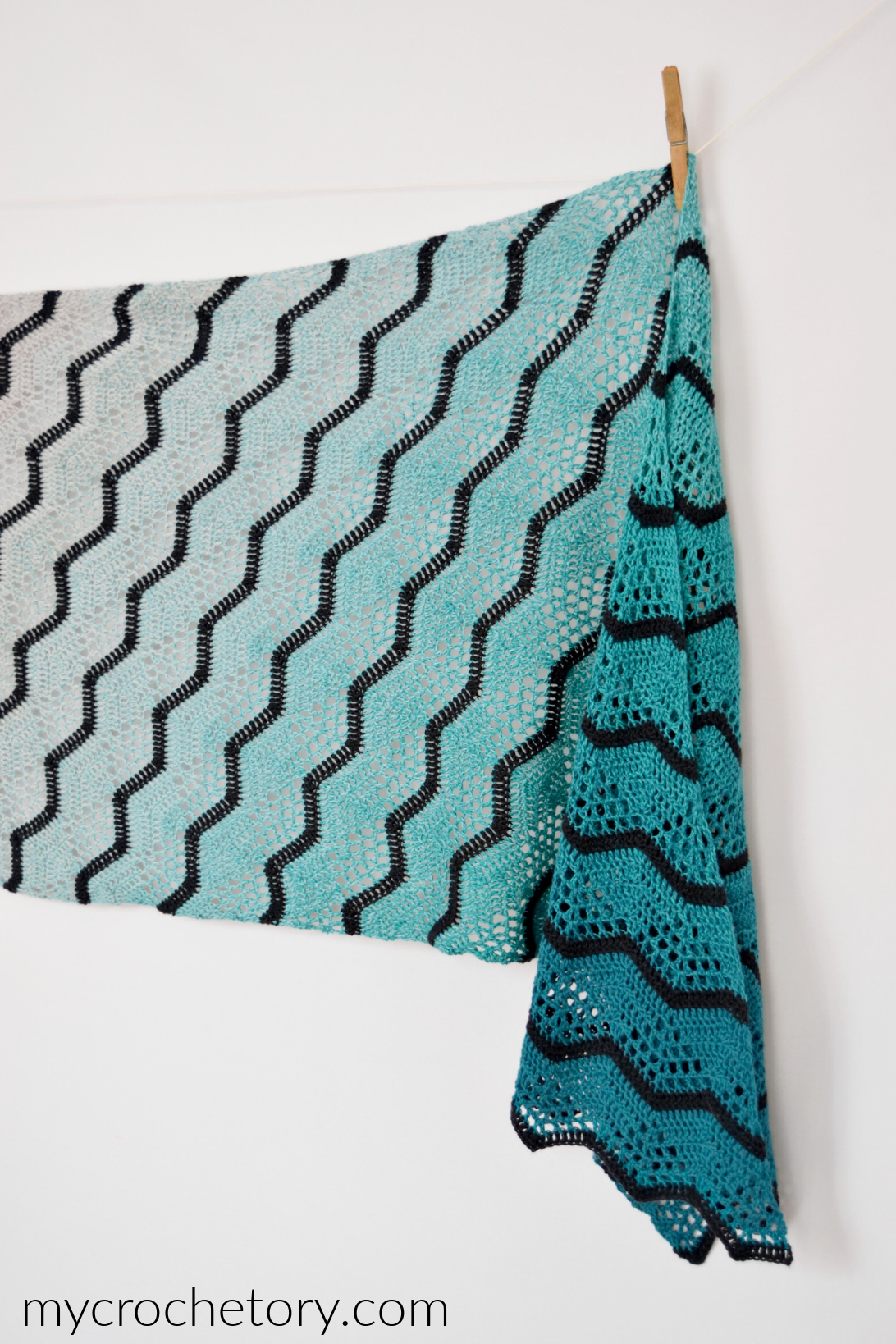
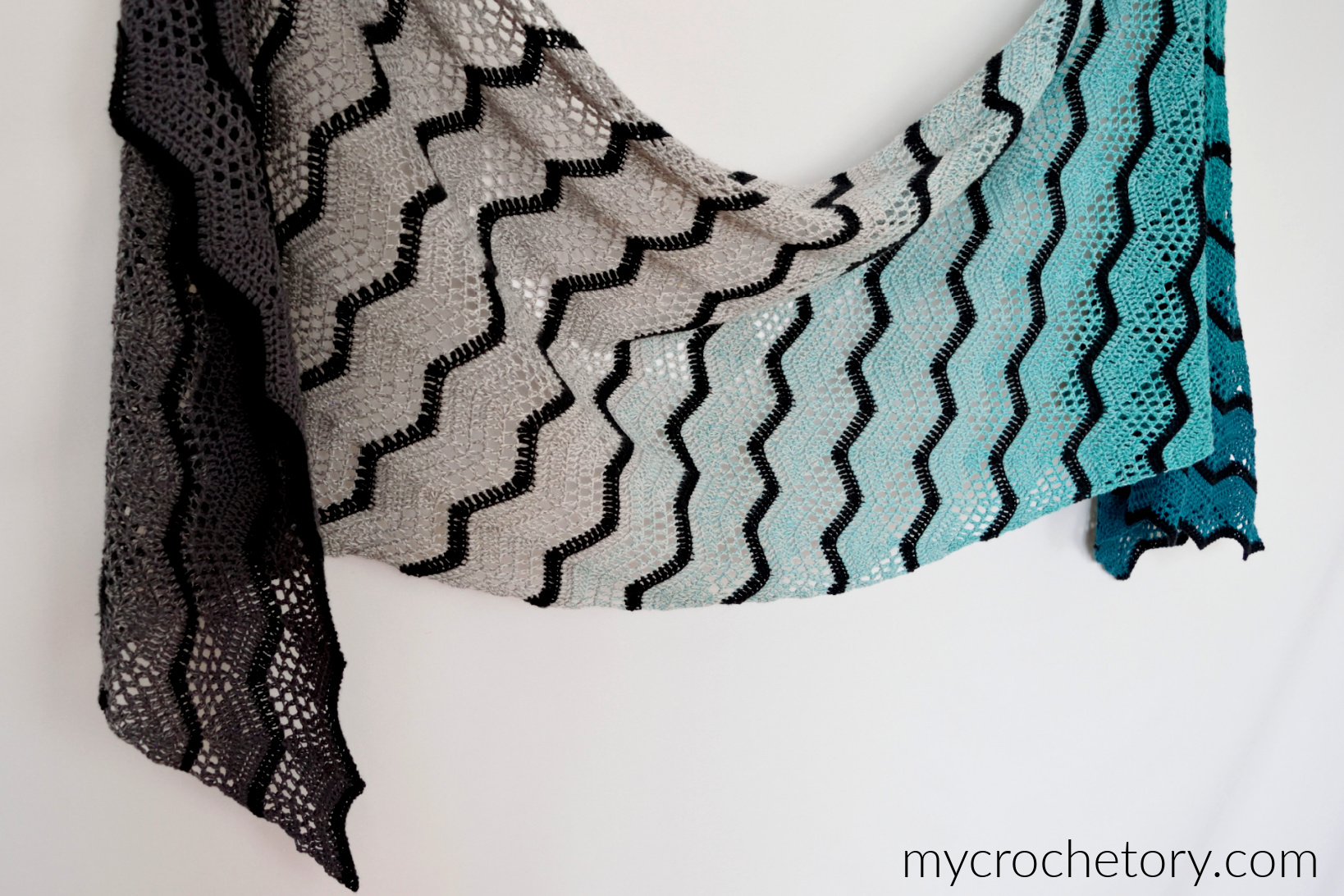
This ombre crochet wrap takes my Havra Infinity Scarf and turns it on the bias, so the zigzags run diagonally from one end to the other. One cake of Scheepjes Whirl fades from dark gray to turquoise, and thin black stripes keep every zigzag sharp.
After blocking it’s about 71 inches long and 19.5 inches wide. And if that’s not your size, you can make it longer or wider without any math headaches.
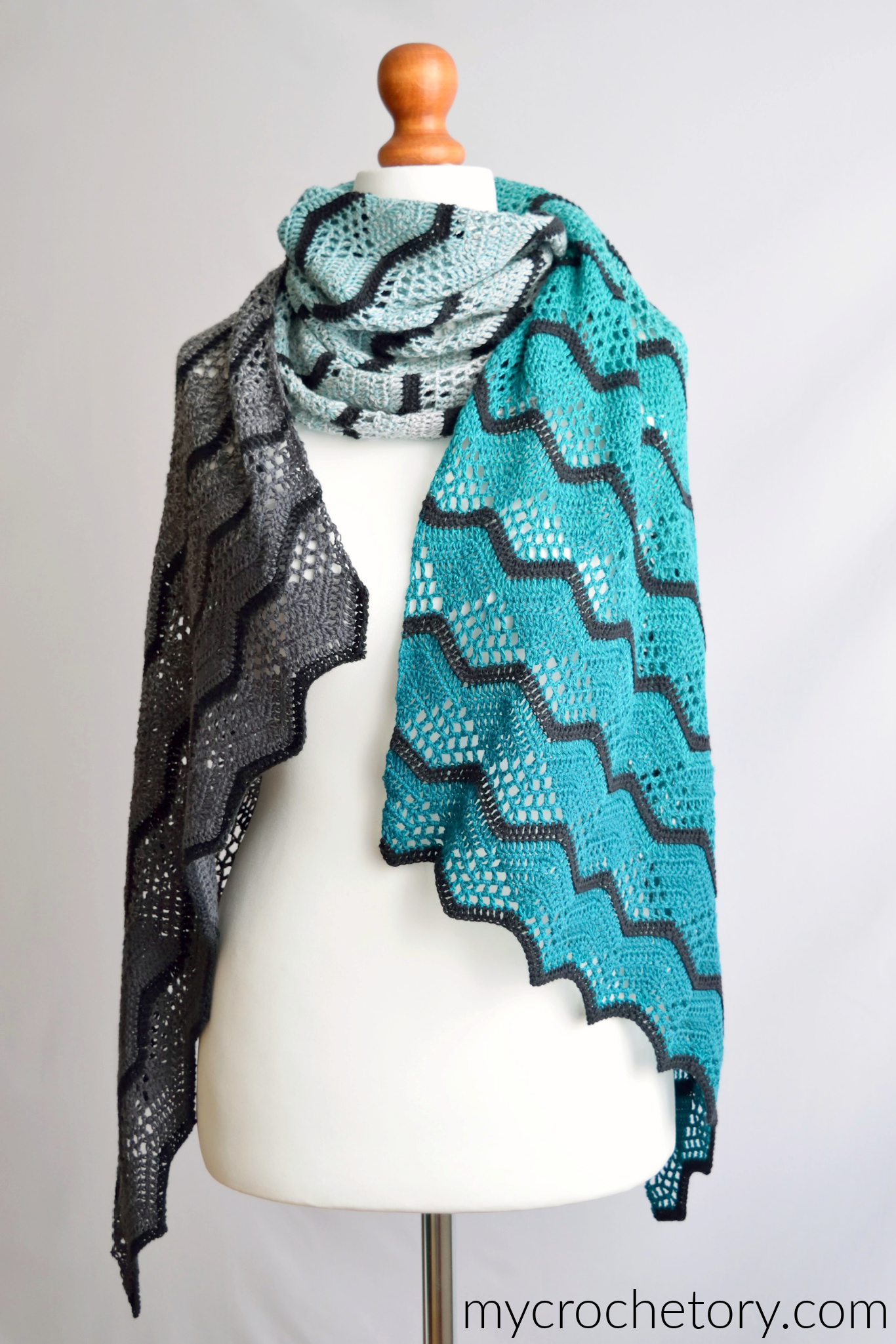
Scroll down to the free Havra Wrap pattern, or get the ad-free, printable PDF with the stitch chart HERE on Etsy or HERE on Ravelry.
Join my Facebook Group and Official Ravelry Group, where you can ask questions and share your finished projects. You can also follow me on Instagram, Facebook and Pinterest.
Where This Ombre Crochet Wrap Came From
Knitting gave me the idea for this ombre crochet wrap, just like it did for a few of my other designs. Bias wraps are everywhere in knitting, and this one is my crochet take on that slanted shape.
I already had the perfect stitch for it. The Havra chevron first appeared in my Havra Infinity Scarf, worked in straight rows and seamed into a loop.
So I took the same chevron and tilted it. The zigzags stayed, but now they run across the wrap at an angle, and the gradient moves with them.
How the Ombre Crochet Wrap Grows on the Bias
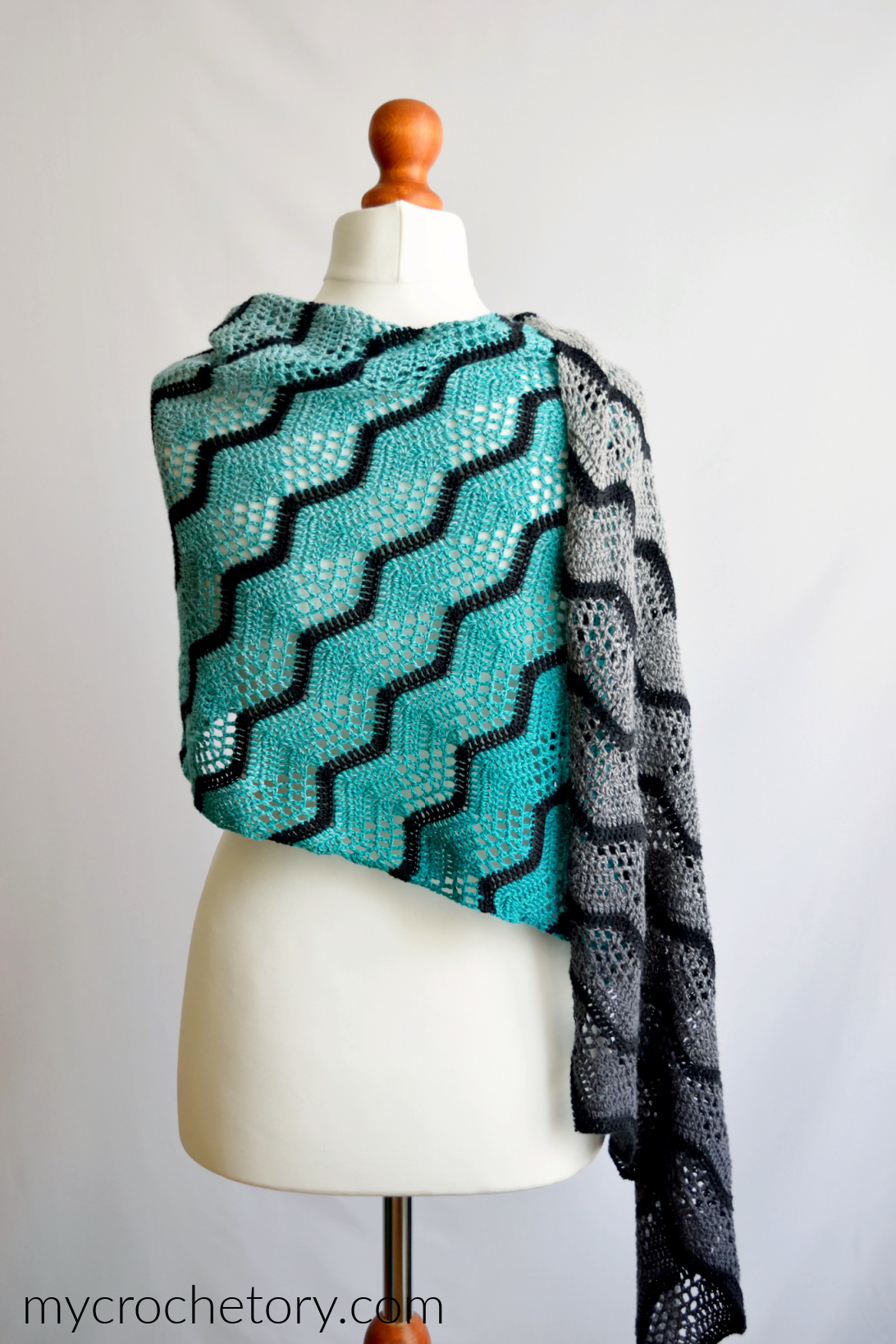
This ombre crochet wrap is worked back and forth in rows, starting at one short edge. In every row you increase on one edge and decrease on the other, so the stitch count stays the same while the piece leans.
Lying flat, it looks like a long parallelogram. That slant is the reason the chevrons run diagonally instead of straight across.
Never crocheted on the bias? The increases and decreases sit at the row ends, and the pattern tells you exactly what goes where, so you just follow the rows.
How the Chevron Stripes Work
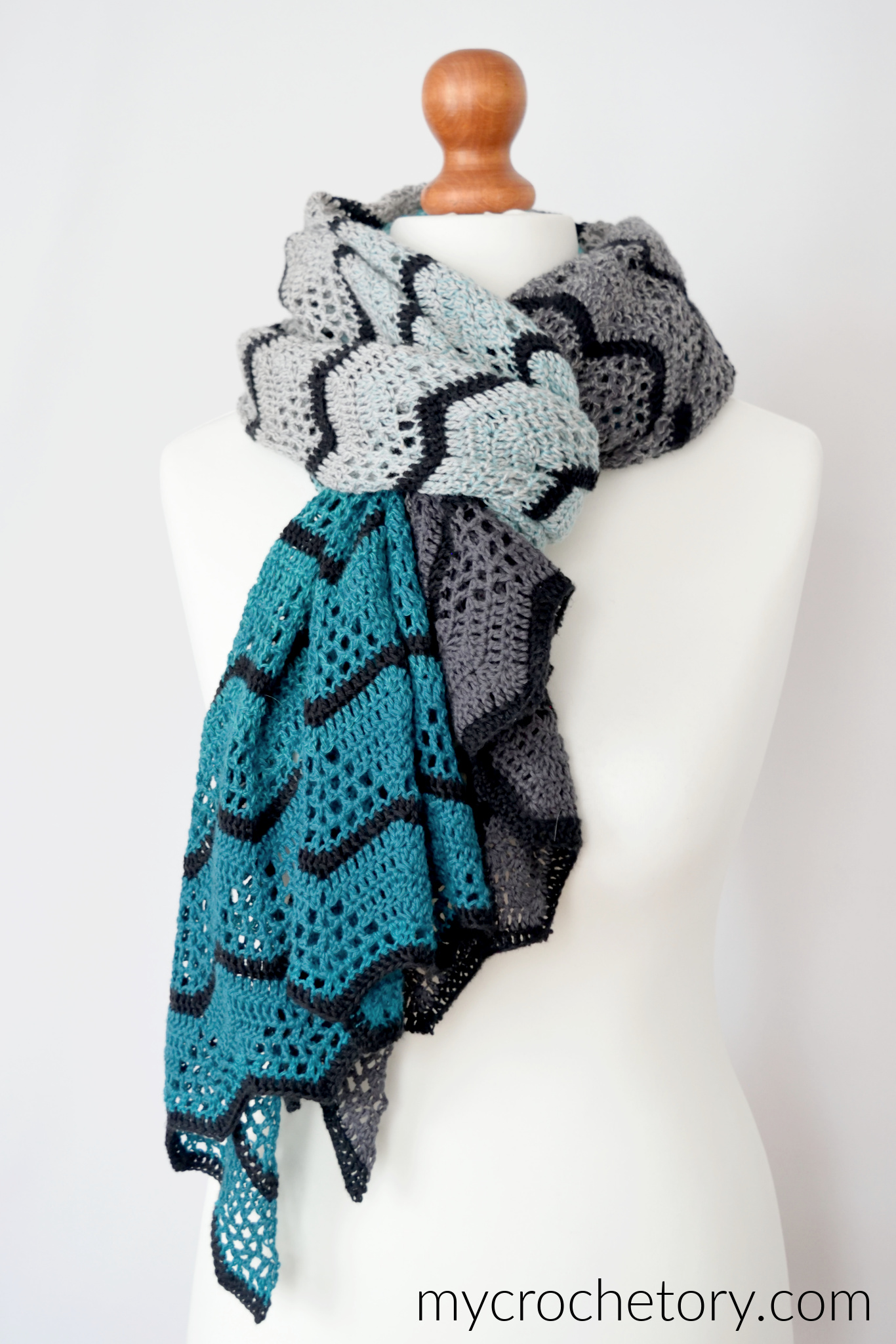
The ombre crochet wrap has an 18-row repeat, and each repeat follows the same plan. Rows 1 to 5 use the main color, and Row 6 is a stripe of black.
The first main color row is worked in the back loops. In the next four rows, ch-1 spaces open up into a light mesh between blocks of double crochet.
The points come from dc3tog decreases in the valleys and (dc, ch1, dc) increases at the peaks. With a black row every sixth row, the zigzags stay crisp against the gradient.
Yarn for the Ombre Crochet Wrap
For my ombre crochet wrap I used one cake of Scheepjes Whirl, in the same colorway as my Kalinda Shawl, and I still recommend it. It fades from dark gray through light gray to turquoise, and you use the whole cake, about 1093 yards (1000 m).
The stripes are black Scheepjes Whirlette, and you need only about 343 yards (314 m) of it. Both yarns are fingering weight, 60% cotton and 40% acrylic.
Since you change color every sixth row, crochet over your yarn ends as you go. That way there’s almost nothing left to weave in when you finish.
Is This Ombre Crochet Wrap Beginner Friendly?
This ombre crochet wrap is an adventurous beginner pattern. If you can work double crochet, back loop stitches and simple increases and decreases, you can make it.
The rows look long on paper, but most of each row is the same 18-stitch repeat, over and over. Once the first chevron is done, you know exactly what’s coming.

Make Your Ombre Crochet Wrap Wider or Longer
You can change both the width and the length of your ombre crochet wrap. For the width, chain any multiple of 18 plus 12, and for the length, add or skip repeats of Rows 1 to 18.
A bigger wrap needs more yarn, so get an extra cake of Whirl before you go wider or longer. A smaller one is a nice way to use up a part of a cake you already have.
Love it already? Save the ombre crochet wrap on Pinterest so it’s easy to find when you’re ready to start.
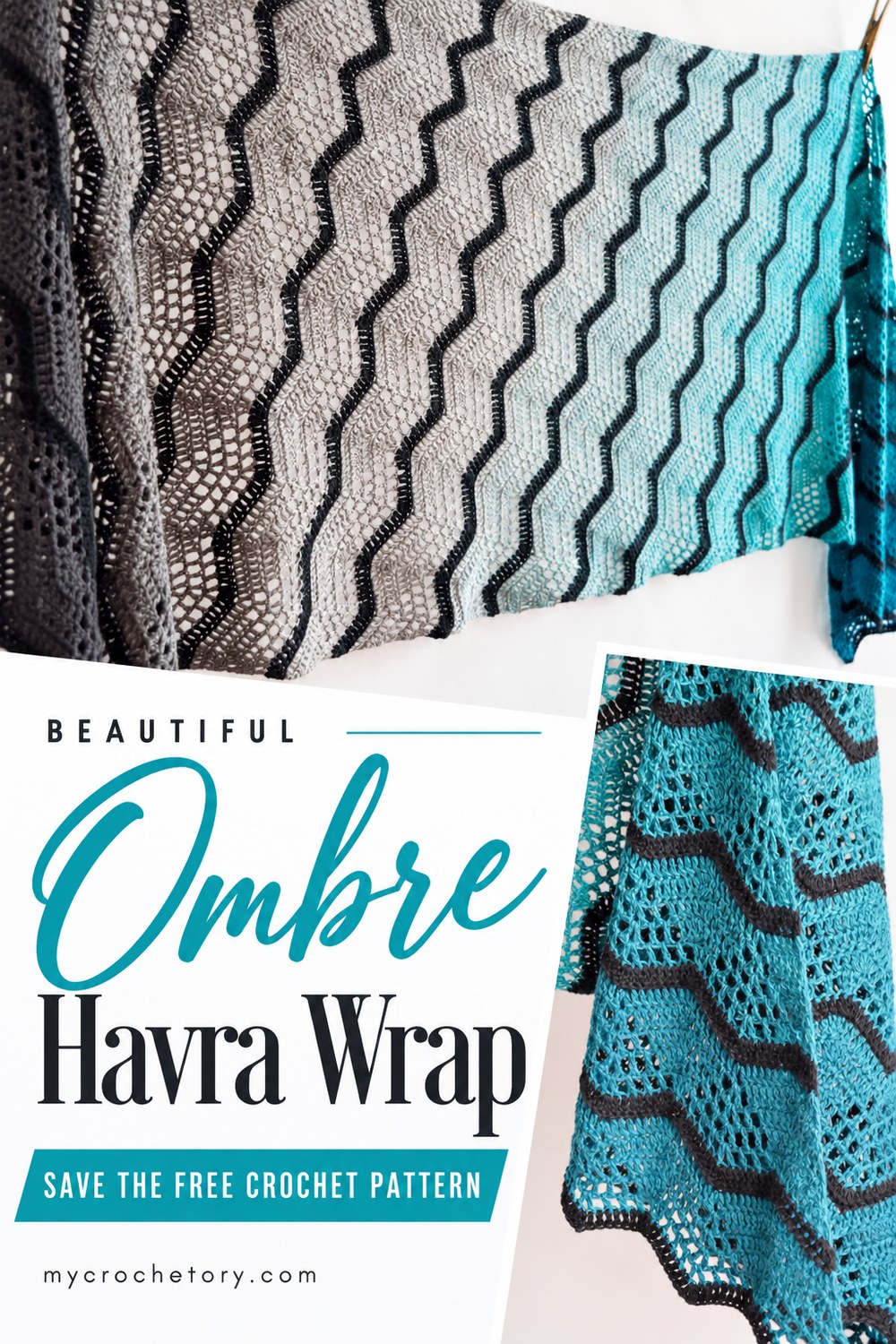
Havra Ombre Crochet Wrap Free Pattern
- Purchase the ad-free, printable PDF with stitch chart here on ETSY or here on Ravelry.
- Add this pattern to your Ravelry Queue HERE.
- Grab the MyCrochetory Shawl Pattern BUNDLE that includes 14 patterns for one low price HERE.
- Pin it for later.
Copyright 2021 – 2026 MyCrochetory. All rights reserved. This pattern is property of Sylwia Kawczyńska @MyCrochetory. Please DO NOT sell the pattern and claim this pattern as your own. The pattern is for personal use only and may not be translated or reproduced in another language. Please respect my rights, DO NOT share or publish this pattern anywhere without my permission.
The wrap you make following this pattern is yours, and you are free to sell it, as long as you credit MyCrochetory as the original designer. For more information, please read the Terms Page.

As a bonus in the ad-free, printable PDF, I’ve provided a stitch chart. If you’re a visual learner or if you just want to support my work you can purchase this crochet pattern for a rectangular shawl HERE on ETSY or HERE on Ravelry. Thank you!

Materials & Tools:
- Yarn: Fingering weight yarn in 2 colors:
Main Color (MC): Scheepjes Whirl 215 g = 1000 m (1093 yd), (60% Cotton, 40% Acrylic) – approx. 215 g (1000 m / 1093 yd).
Contrast Color (CC): Scheepjes Whirlette 100 g = 455 m (498 yd), (60% Cotton and 40% Acrylic) – approx. 69 g (314 m / 343 yd).
- Hook size 3.5 mm. Adjust hook size if necessary to obtain correct gauge.
- Tapestry needle (to weave and hide yarn ends).
- Scissors.
Level:
Adventurous beginner – decreases, increases.
Size after blocking (adjustable):
Length 180cm/71”
Width 50cm/19.5” (see schematic)

Gauge after blocking:
24sts x 11rows in 4”/10cm.
If necessary, adjust hook size to obtain the correct gauge.
Before you measure, please take the time to block your swatch in the same manner that you will block your wrap.
Notes:
- The pattern uses US crochet terminology.
- The wrap is worked back and forth in rows.
- Pattern is a multiple of 18 plus 12 stitches.
- The Havra Wrap is easily adjustable. To increase the width of the wrap, increase the number of initial chains. To decrease the width of the wrap, decrease the number of initial chains.
- You can make this wrap as long as you like by adding or subtracting pattern repeats.
- Instructions in square brackets […] are worked as many times as indicated.
- Crochet over your ends as you go along to minimize finishing.
- The stitch chart is included in the ad-free printable PDF here on ETSY or here on Ravelry.
Stitches & Abbreviations (US terms):
st(s) – stitch(es)
BLdc – back loop only double crochet
yo – yarn over
dc2tog (double crochet 2 together) – [yo, insert hook in indicated st, yo, draw up a loop, yo, pull through 2 loops] twice, yo, pull through all 3 loops on hook.
dc3tog (double crochet 3 together) – [yo, insert hook in indicated st, yo, draw up a loop, yo, pull through 2 loops] three times, yo, pull through all 4 loops on hook.
BLdc3tog – back loop only double crochet 3 together
BLdc2tog – back loop only double crochet 2 together
sp – space
beg – beginning
prev – previous
sk – skip

Pattern
Read all Notes before you start.
You can also make any multiple of 18 plus 12 stitches to make your desired width, but changes might result in different yardage requirements.
With CC, chain 138.
Setup Row 1: 2dc in 4th ch from hook (ch3 at the beg counts as a stitch), dc in next 5chs, [dc in next 1ch, dc3tog, dc in next 7chs, 3dc in next 1ch, dc in next 6chs] rep until 3chs remain, dc3tog. Turn.
With MC,
Row 1: ch3 (doesn’t count as a st), BLdc2tog (1st leg in second st and 2nd leg in the next st), BLdc in next 5sts, [(BLdc, ch1, BLdc) in next 1st, BLdc in next 7sts, BLdc3tog, BLdc in next 7sts] rep until last st remain, (dc, ch1, dc) in 1st ch in the beg of the prev row. Turn.
Row 2: ch3 (counts as a st), (dc, ch1, dc) in next ch-1sp, ch1, sk next st, dc in next 3sts, [dc in next 3sts, dc3tog, dc in next 6sts, ch1, sk next st, (dc, ch1, dc) in next ch-1sp, ch1, sk next st, dc in next 3sts] rep until 3sts remain, dc3tog. Turn.
Row 3: ch3 (doesn’t count as a st), dc2tog (1st leg in second st and 2nd leg in the next st), ch1, sk next st, dc in next 1st, ch1, sk next st, (dc, ch1, dc) in next ch-1sp, [ch1, sk next st, dc in next 1st, ch1, sk next st, dc in next 4sts, dc3tog, dc in next 4sts, ch1, sk next st, dc in next 1st, ch1, sk next st, (dc, ch1, dc) in next ch-1sp] rep until 2sts remain, ch1, sk next st, dc in 3rd ch in the beg of the prev row. Turn.
Row 4: ch3 (counts as a st), dc in next 1st, ch1, sk next st, (dc, ch1, dc) in next ch-1sp, ch1, sk next st, dc in next 1st, [ch1, sk next st, dc in next 1st, ch1, sk next st, dc in next 2sts, dc3tog, dc in next 2sts, ch1, sk next st, dc in next 1st, ch1, sk next st, dc in next 1st, ch1, sk next st, (dc, ch1, dc) in next ch-1sp, ch1, sk next st, dc in next 1st] rep until 3sts remain, dc3tog (1st leg in next st, 2nd leg in next ch-1sp, 3rd leg in dc2tog). Turn.
Row 5: ch3 (doesn’t count as a st), dc2tog (1st leg in second st and 2nd leg in next ch-1sp), ch1, sk next st, (dc, ch1, dc) in next ch-1sp, ch1, sk next st, dc in next 1st, [ch1, sk next st, dc in next 1st, ch1, sk next st, dc in next 1st, ch1, sk next st, dc3tog, ch1, sk next st, dc in next 1st, ch1, sk next st, dc in next 1st, ch1, sk next st, dc in next 1st, ch1, sk next st, (dc, ch1, dc) in next ch-1sp, ch1, sk next st, dc in next 1st] rep until 2sts remain, ch1, sk next st, dc in 3rd ch in the beg of the prev row. Turn.
With CC,
Row 6: ch3 (counts as a st), dc in next 4sts, 3dc in next ch-1sp, [dc in next 7sts, dc3tog (1st leg in ch-1sp, 2nd leg in next dc, 3rd leg in next ch-1sp), dc in next 7sts, 3dc in next ch-1sp] rep until 3sts remain, dc3tog (1st leg in next st, 2nd leg in next ch-1sp, 3rd leg in last dc2tog). Turn.
With MC,
Row 7: ch3 (doesn’t count as a st), BLdc in next 1st, ch1 (do not sk any st), BLdc in next 6sts, [BLdc in next 2sts, BLdc3tog, BLdc in next 7sts, (BLdc, ch1, BLdc) in next 1st, dc in next 5sts] rep until last st remain, dc in 3rd ch in the beg of the prev row. Turn.
Row 8: ch3 (counts as a st), dc in next 5sts, ch1, sk next st, [(dc, ch1, dc) in next ch-1sp, ch1, sk next st, dc in next 6sts, dc3tog, dc in next 6sts, ch1, sk next st] rep until 2sts remain, dc in next ch-1sp, dc in last dc. Turn.
Row 9: ch3 (counts as a st), ch1, sk 2nd st, dc in next 1st, ch1, sk next st, dc in next 4sts, [dc3tog, dc in next 4sts, ch1, sk next st, dc in next 1st, ch1, sk next st, (dc, ch1, dc) in next ch-1sp, ch1, sk next st, dc in next 1st, ch1, sk next st, dc in next 4sts] rep until last st remain, dc in 3rd ch in the beg of the prev row. Turn.
Row 10: ch3 (counts as a st), dc in next 3sts, ch1, sk next st, dc in next 1st, ch1, sk next st, [dc in next 1st, ch1, sk next st, (dc, ch1, dc) in next ch-1sp, ch1, sk next st, dc in next 1st, ch1, sk next st, dc in next 1st, ch1, sk next st, dc in next 2sts, dc3tog, dc in next 2sts, ch1, sk next st, dc in next 1st, ch1, sk next st] rep until ch-4sp remain (ch1 plus ch3 in the beg of the prev row), dc in ch-4sp, dc in 3rd ch of ch4 in the beg of the prev row. Turn.
Row 11: ch3 (counts as a st), ch1, sk 2nd st, dc in next 1st, ch1, sk next st, dc in next 1st, ch1, sk next st, [dc3tog, ch1, sk next st, dc in next 1st, ch1, sk next st, dc in next 1st, ch1, sk next st, dc in next 1st, ch1, sk next st, (dc, ch1, dc) in next ch-1sp, ch1, sk next st, dc in next 1st, ch1, sk next st, dc in next 1st, ch1, sk next st, dc in next 1st, ch1, sk next st] rep until 3sts remain, dc2tog, ch1 (do not sk any st), dc in 3rd ch in the beg of the prev row. Turn.
With CC,
Row 12: ch3 (counts as a st), 2dc in first st, dc3tog (1st leg in ch-1sp, 2nd leg in next dc, 3rd leg in next ch-1sp), dc in next 4sts, [dc in next 3sts, 3dc in next ch-1sp, dc in next 7sts, dc3tog (1st leg in next ch-1sp, 2nd leg in next dc, 3rd leg in next ch-1sp), dc in next 4sts] rep until last st remain, dc in 3rd ch in the beg of the prev row. Turn.
With MC,
Row 13: ch3 (counts as a st), BLdc in next 3sts, BLdc3tog, BLdc in next 1st, [BLdc in next 6sts, (BLdc, ch1, BLdc) in next 1st, BLdc in next 7sts, BLdc3tog, BLdc in next 1st] rep until last st remain, 3dc in 3rd ch in the beg of the prev row. Turn.

Row 14: ch3 (counts as a st), 2dc in first st, dc in next 2sts, dc3tog, dc in next 2sts, [dc in next 4sts, ch1, sk next st, (dc, ch1, dc) in next ch-1sp, ch1, sk next st, dc in next 6sts, dc3tog, dc in next 2sts] rep until last st remain, dc in 3rd ch in the beg of the prev row. Turn.
Row 15: ch3 (counts as a st), dc in next 1st, dc3tog, dc in next 2sts, [dc in next 2sts, ch1, sk next st, dc in next 1st, ch1, sk next st, (dc, ch1, dc) in next ch-1sp, ch1, sk next st, dc in next 1st, ch1, sk next st, dc in next 4sts, dc3tog, dc in next 2sts] rep until last st remain, (dc, ch1, dc) in 3rd ch in the beg of the prev row. Turn.
Row 16: ch3 (counts as a st), dc in first st, ch1, dc in next ch-1sp, ch1, sk next st, dc in next 2sts, dc3tog, [dc in next 2sts, ch1, sk next st, dc in next 1st, ch1, sk next st, dc in next 1st, ch1, sk next st, (dc, ch1, dc) in next ch-1sp, ch1, sk next st, dc in next 1st, ch1, sk next st, dc in next 1st, ch1, sk next st, dc in next 2sts, dc3tog] rep until last st remain, dc in 3rd ch in the beg of the prev row. Turn.
Row 17: ch3 (doesn’t count as a st), dc2tog (1st leg in second st, 2nd leg in next st), ch1, sk next st, dc in next 1st, ch1, sk next st, dc in next 1st, ch1, sk next st, [dc in next 1st, ch1, sk next st, (dc, ch1, dc) in next ch-1sp, ch1, sk next st, dc in next 1st, ch1, sk next st, dc in next 1st, ch1, sk next st, dc in next 1st, ch1, sk next st, dc3tog, ch1, sk next st, dc in next 1st, ch1, sk next st, dc in next 1st, ch1, sk next st] rep until last st remain, (dc, ch1, dc) in 3rd ch in the beg of the prev row. Turn.
With CC,
Row 18: ch3 (counts as a st), 2dc in first st, dc in next 5sts, [dc in next 1st, dc3tog (1st leg in next ch-1sp, 2nd leg in next dc, 3rd leg in next ch-1sp), dc in next 7sts, 3dc in next ch-1sp, dc in next 6sts] rep until 3sts remain, dc3tog (1st leg in next st, 2nd leg in next ch-1sp, 3rd leg in next dc2tog). Turn.
Repeat Rows 1 – 18 seven more times or until desired length.
Fasten off yarn, weave in all ends and block your wrap.
If you have any suggestions or have detected any mistakes, please feel free to email me at mycrochetory@gmail.com
Stuck on a row? Ask in my Facebook Group or Ravelry Group, or email me at mycrochetory@gmail.com.
Finished your Havra? Share it on Instagram with #mycrochetory and tag @mycrochetory so I can see it.
More Crochet Patterns Worked on the Bias
Liked the slant? These patterns of mine grow on the bias too, so their stitches run diagonally across them.


- Monochrome Bias Wrap, a three-color mosaic wrap with diagonal shaping, made in Scheepjes Whirlette.
- Zarina Diagonal Scarf, a lace scarf with bands of little flowers, worked corner to corner from one cake of Woolly Whirl.
- Greus Cowl, an asymmetric moss stitch cowl in two colors that starts as a triangle and grows into a parallelogram.
- Diagonal Stone Blanket, a two-color corner to corner afghan with double crochet and granny clusters.
More Rectangular Crochet Wraps and Scarves
These long pieces are just as easy to throw over your shoulders, and every one of them uses fingering or lace weight yarn.


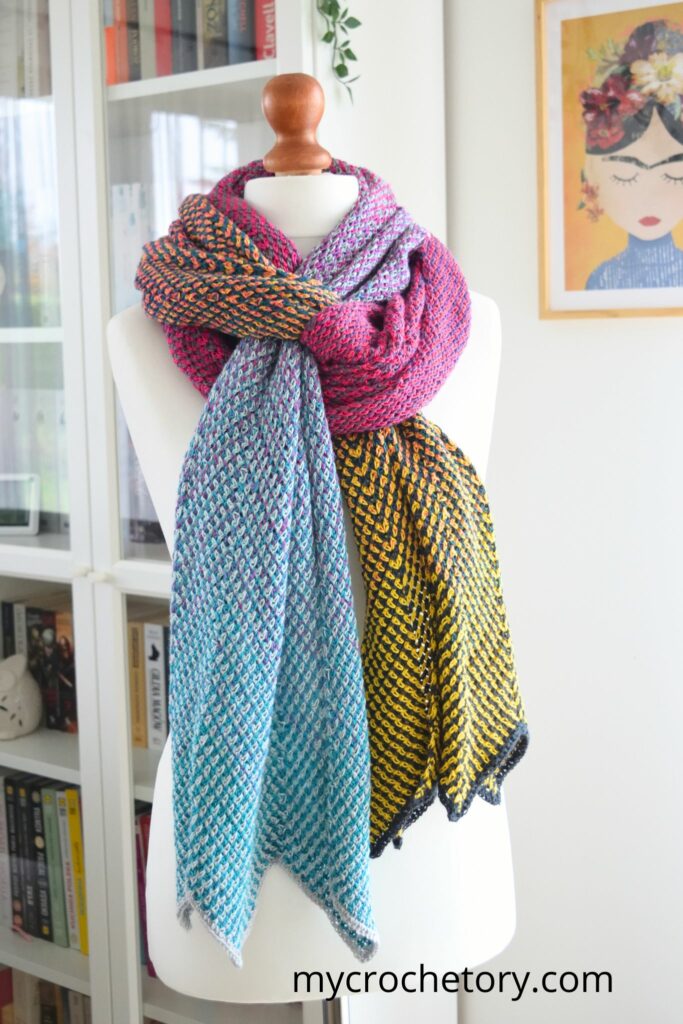
- Havra Infinity Scarf, the original Havra chevron in six colors, worked flat and seamed into a loop.
- Kalinda Wrap, a parallelogram wrap in the Kalinda wave stitch, made with Scheepjes Whirl.
- Arrow Wrap, a reversible striped lace wrap with one pointy end and one V-shaped end.
- Flourish Linen Wrap, a two-color chevron wrap in linen stitch with only 4 yarn ends to weave in.
Ombre Crochet Wrap FAQ
How many repeats does the ombre crochet wrap have?
My wrap has the setup row and then 8 repeats of Rows 1 to 18. That gives you the full length from the photos, and you can add or skip repeats to change it.
Can I use a different ombre yarn?
Yes, any fingering weight gradient cake works. Pick a contrast color that is darker or lighter than every shade in your cake, so the stripes stay visible from end to end.
Why are my chevrons drifting out of line?
Usually one valley or peak has an extra stitch. Each repeat has 18 stitches, so count them every few rows, and the zigzags will stay stacked on top of each other.
How do I block the ombre crochet wrap?
Whirl and Whirlette are cotton and acrylic, so I pin the wrap to my blocking mat and steam it with an iron held about 1/2 inch above it. Wet blocking works too, it just takes longer to dry.

Hello! I’m loving working this pattern! I wanted to let you know of an error I found in the written instructions in Row 15. The two places it says to “dc in next 3sts” it should be next 2sts. So it’s a total of 4 sts in a row before the increase and decrease, not 5.
This truly is a beautiful pattern.