
Updated: 11 November 2026 by Sylwia (MyCrochetory)
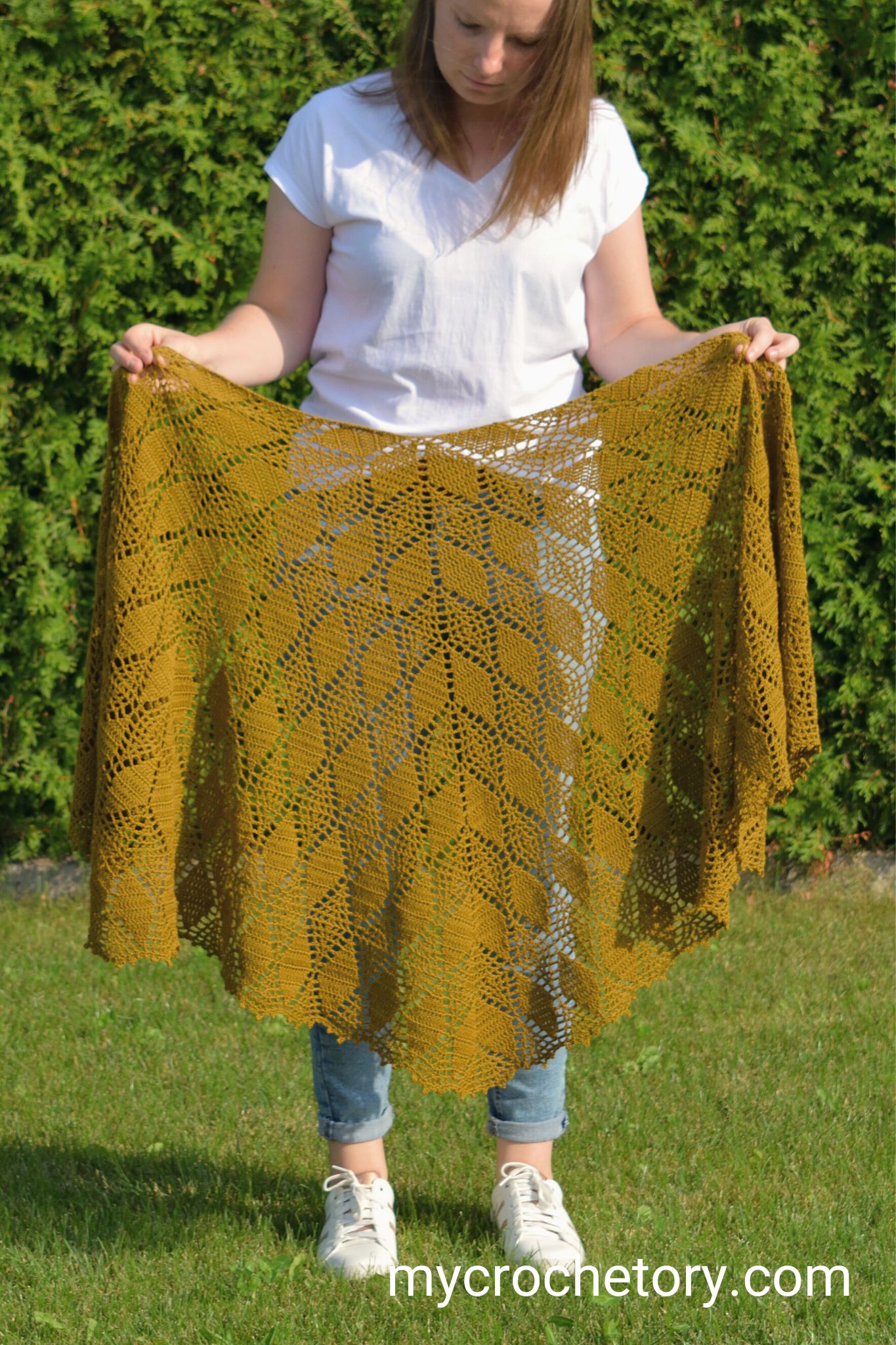
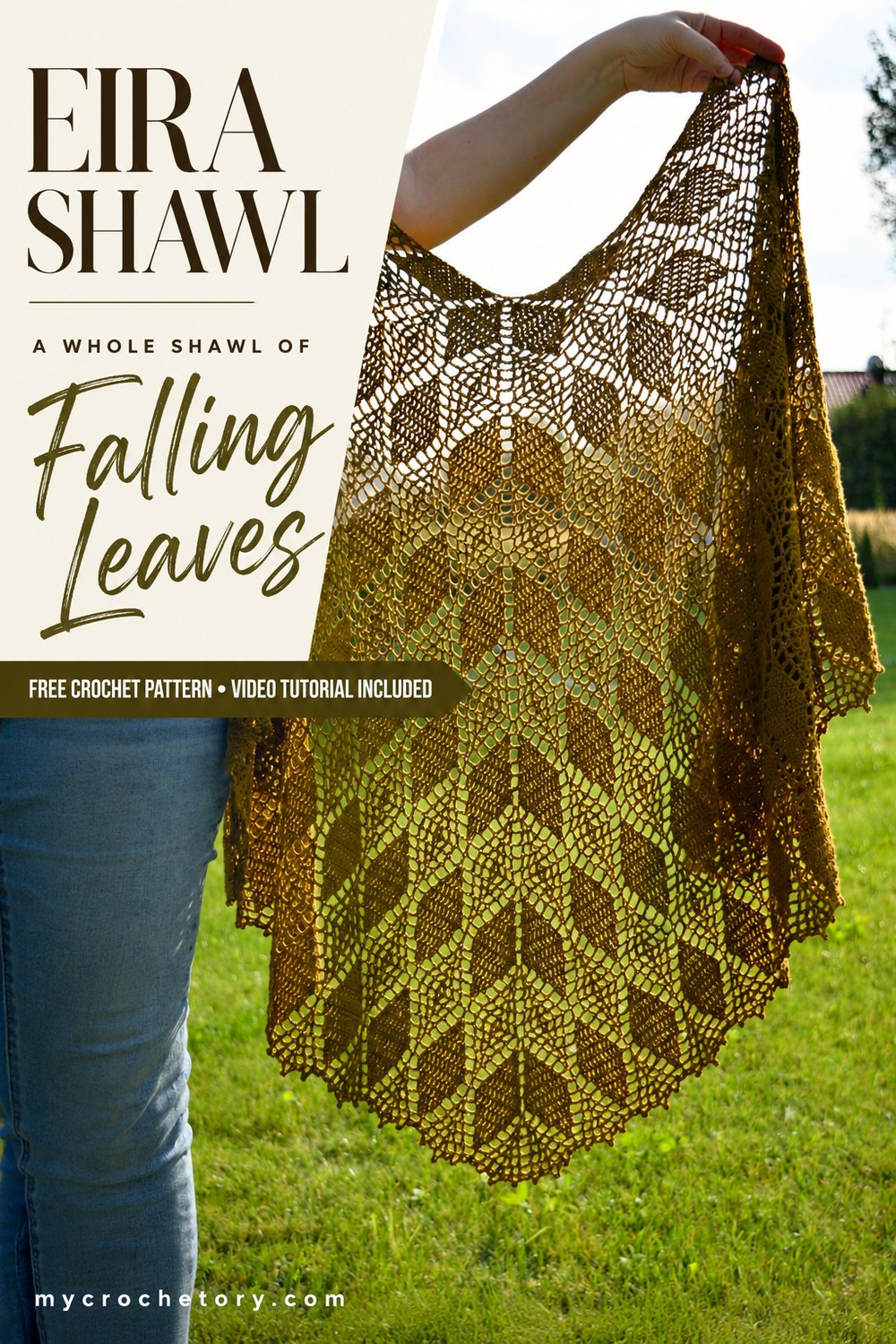
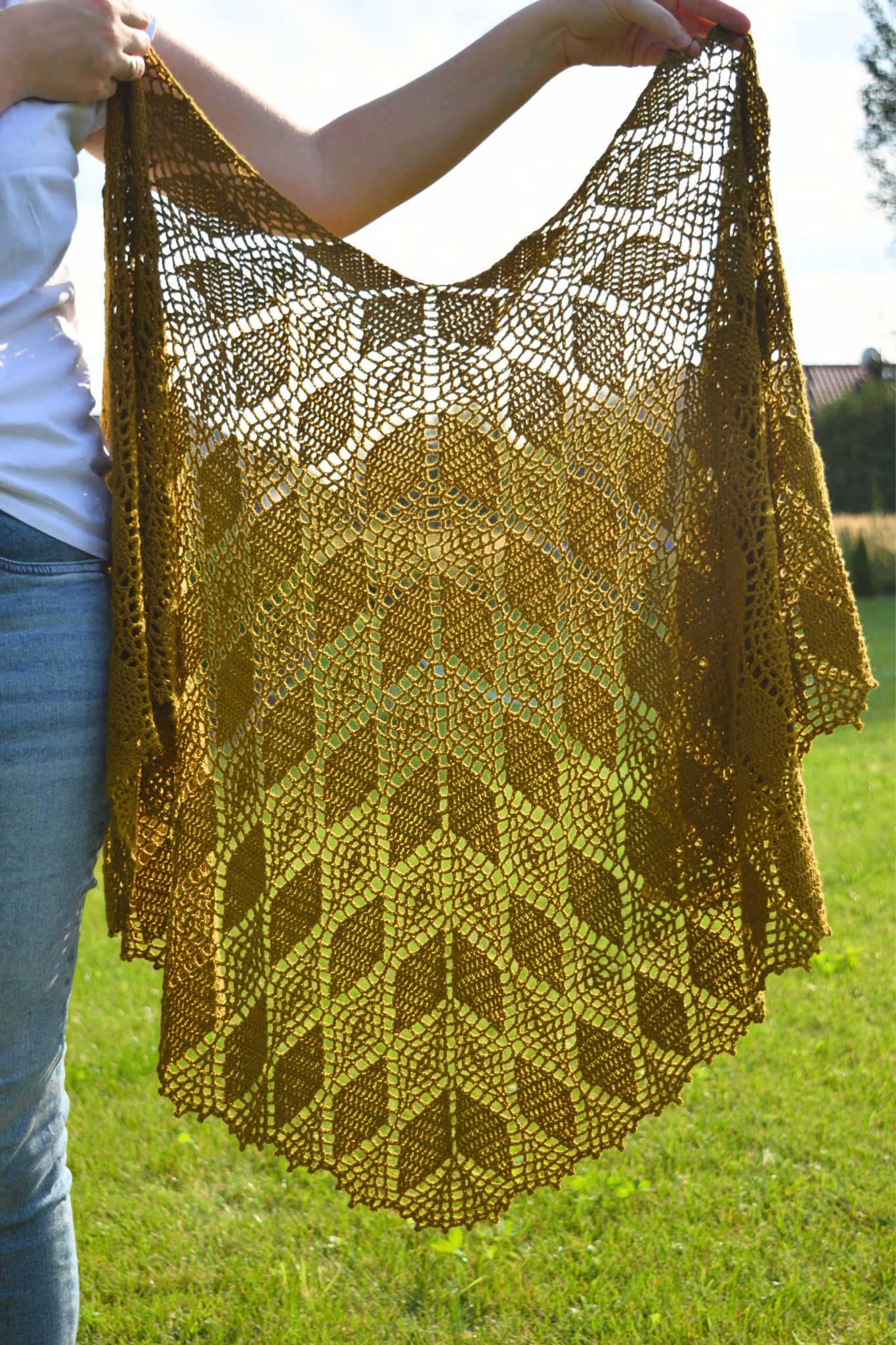
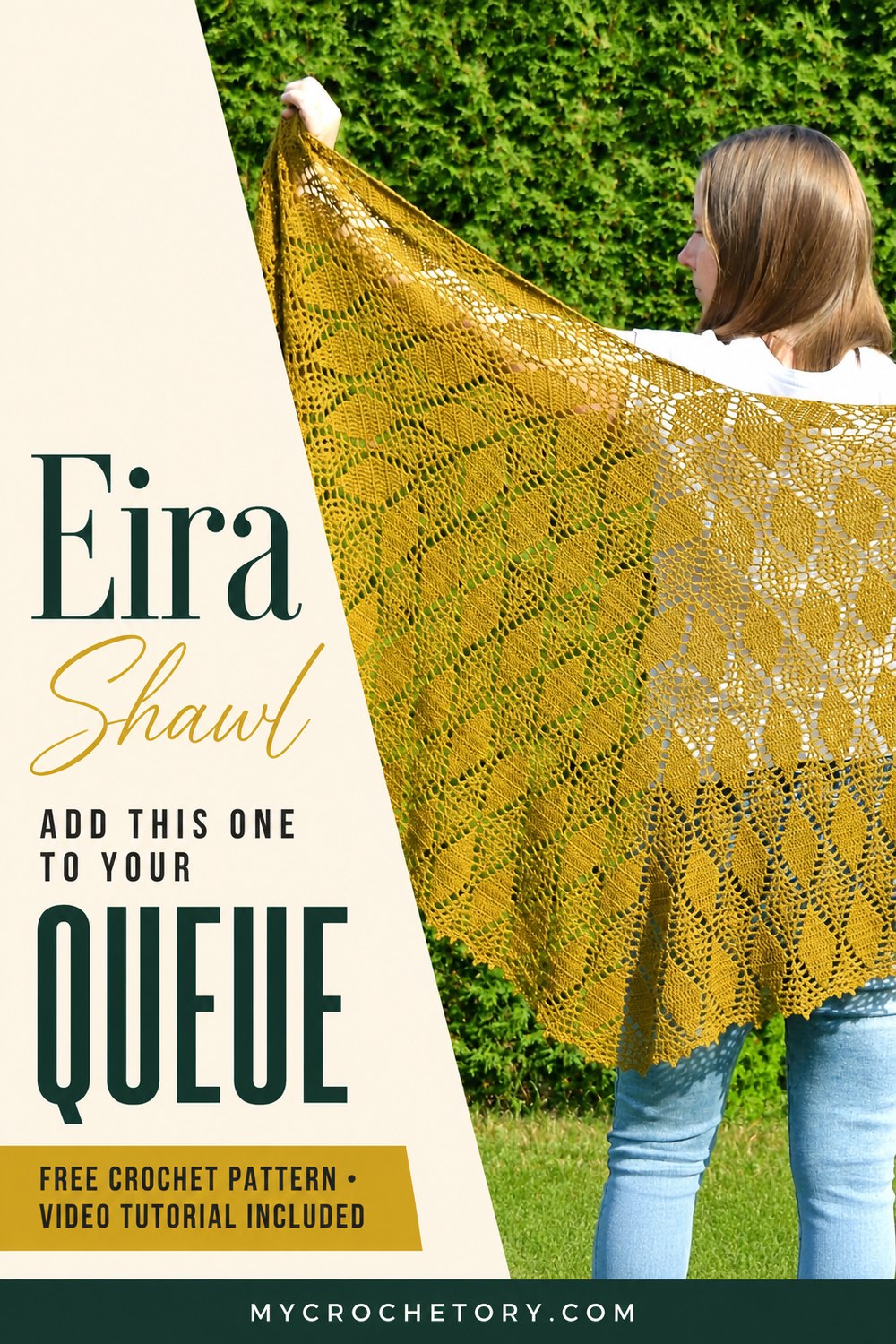
This crochet crescent shawl was inspired by falling leaves, and once you look closely, you’ll see them everywhere. Little lace leaves grow in bands from the top all the way down to a soft picot edge.
And the color? It just had to be ochre. I’ve always loved it, and that warm golden shade is exactly what a shawl full of leaves needs.
You work it top-down in one piece, and three little stitch markers keep the curve nice and even. After the first rows it’s one 12-row leaf repeat, so you’ll know what’s coming before you know it.
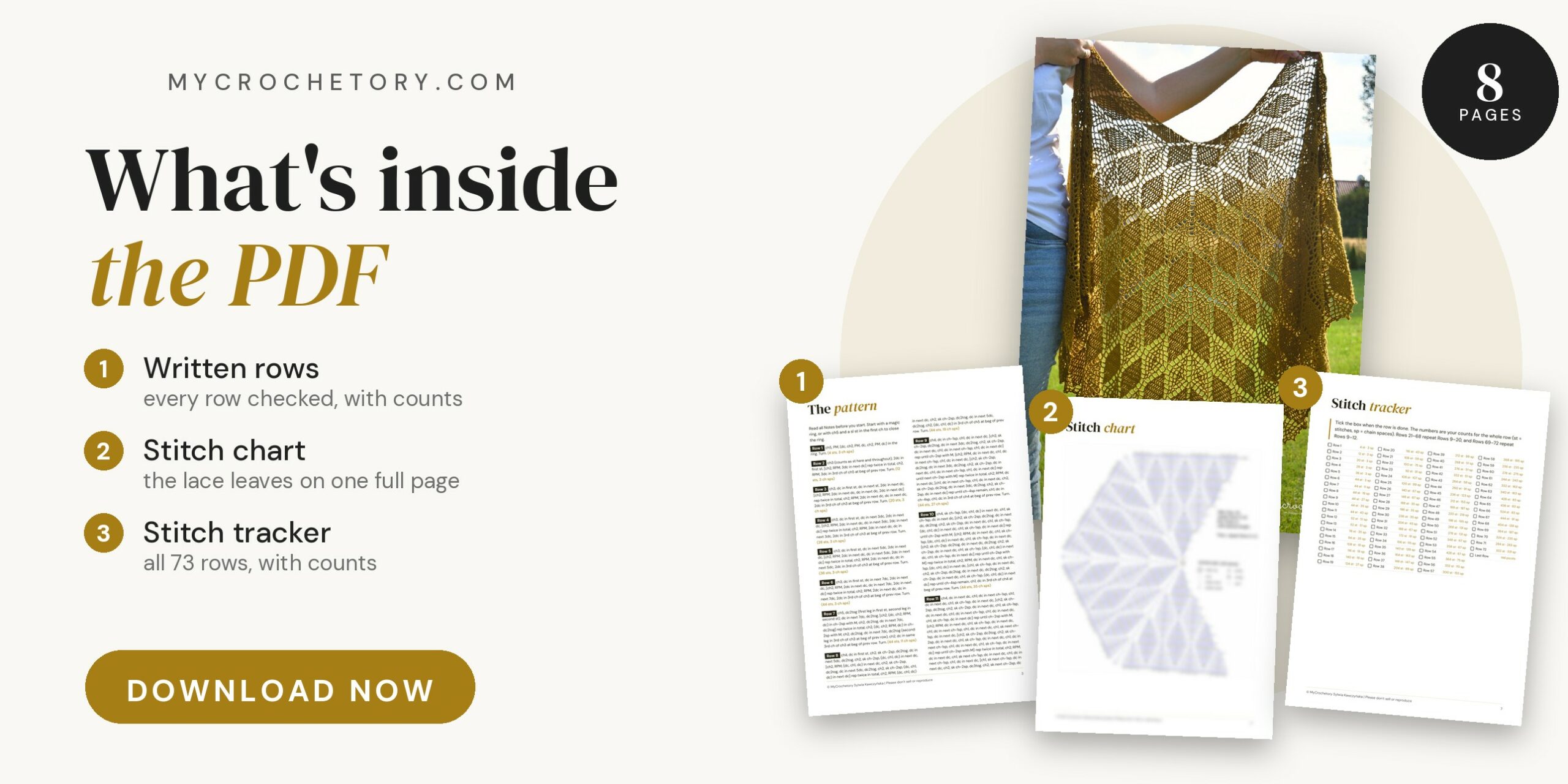
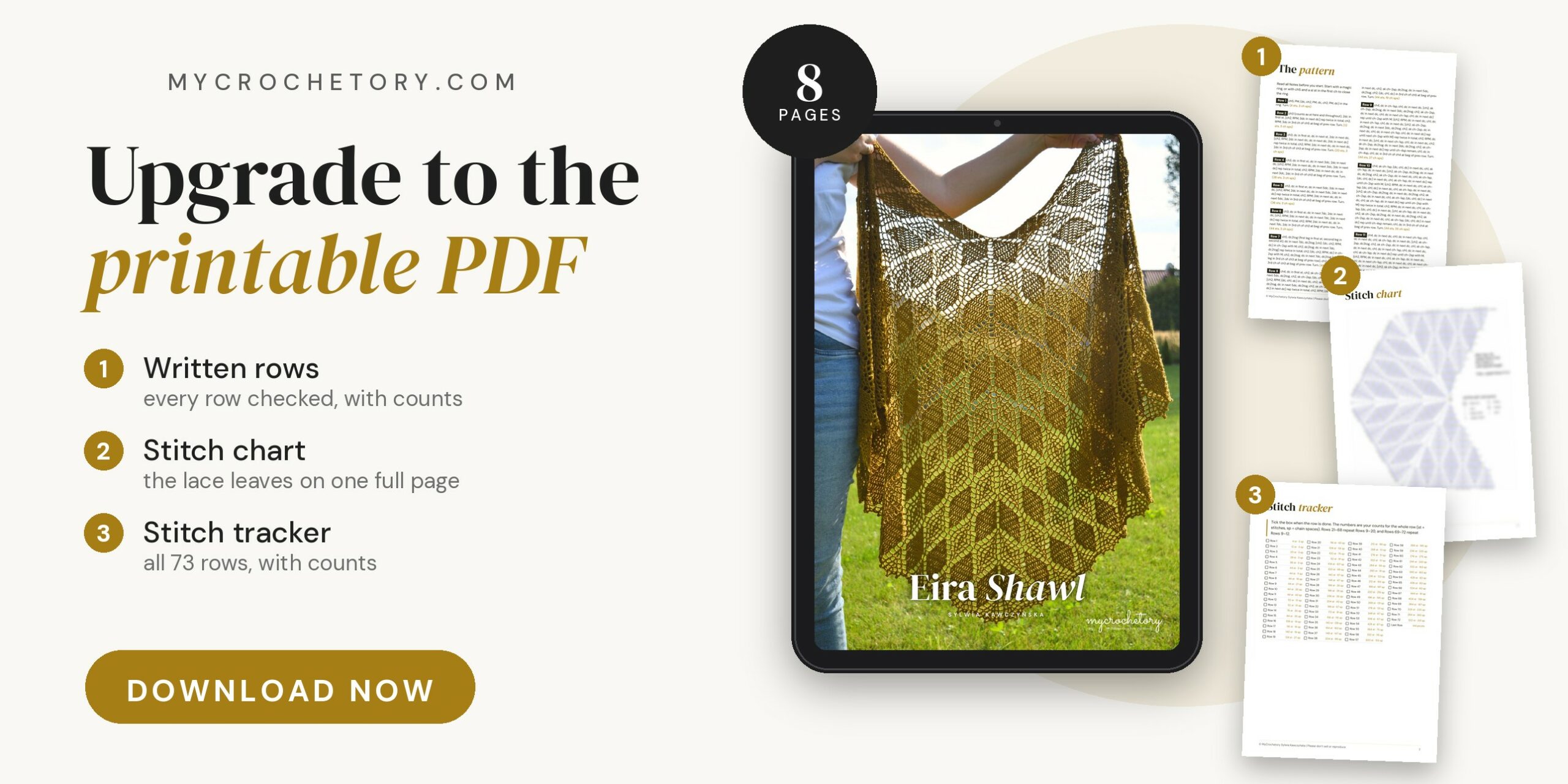
Jump to the free Eira Shawl pattern and video tutorial. Want it as one printable file? The ad-free PDF with the stitch chart is on Etsy and Ravelry.
Join my Facebook Group and Ravelry Group to ask questions and share your work in progress. You can also follow me on Instagram, Facebook and Pinterest.
How a crochet crescent shawl grows from the top
Ever wondered where the curve of a crescent comes from? This crochet crescent shawl starts in a magic ring, and three markers split it into four equal sections right from the start.
You add stitches at the edges and next to every marker, so the shawl grows wider much faster than it grows deep. That’s the secret behind the long, soft curve that sits so well on your shoulders.
The markers sit in chain spaces, and you move them up every row. Keep an eye on them, and the shape pretty much takes care of itself.
The lace leaves in this crochet crescent shawl
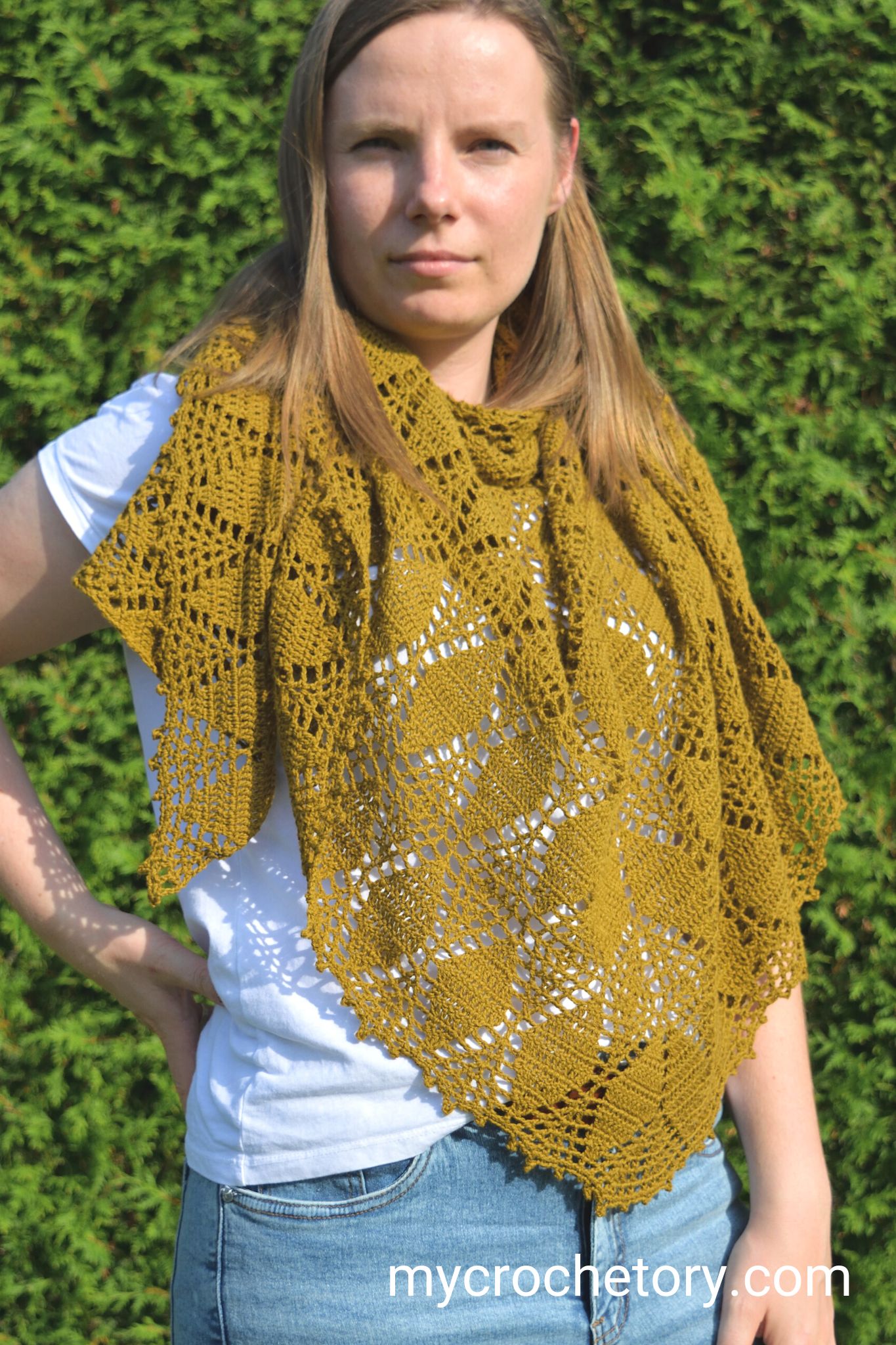
Now for the pretty part. Blocks of double crochet get narrower row by row with dc2tog, until each one ends in a single point, and there’s your first leaf.
Then new blocks pop up between them, and the next leaves begin. After Row 20 you repeat Rows 9 to 20, so the leaves keep stacking up all the way down.
Sounds like a lot? It’s mostly double crochet, chains and a few decreases. And every row now ends with a stitch count, so you’ll know right away if something’s off.
A picot edge to finish the leaves
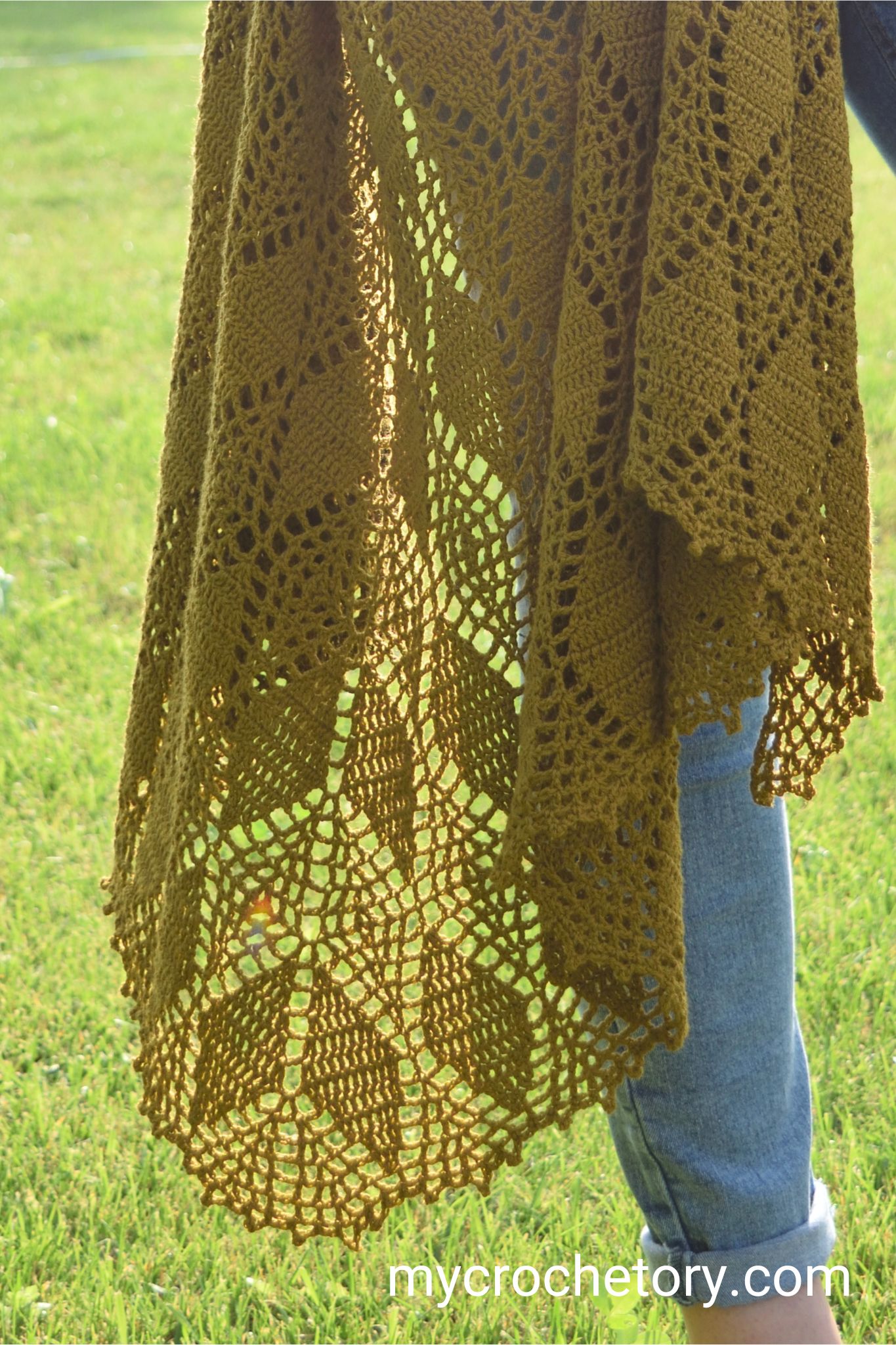
And the finish? The last row is single crochet with little chain loops and picots, 144 of them in total, and they give the bottom edge the softest lacy look.
Never made picots? My picot stitch tutorial shows the classic way and a trick for closing the loop with no gap at the base.
Yarn and blocking for your crescent shawl
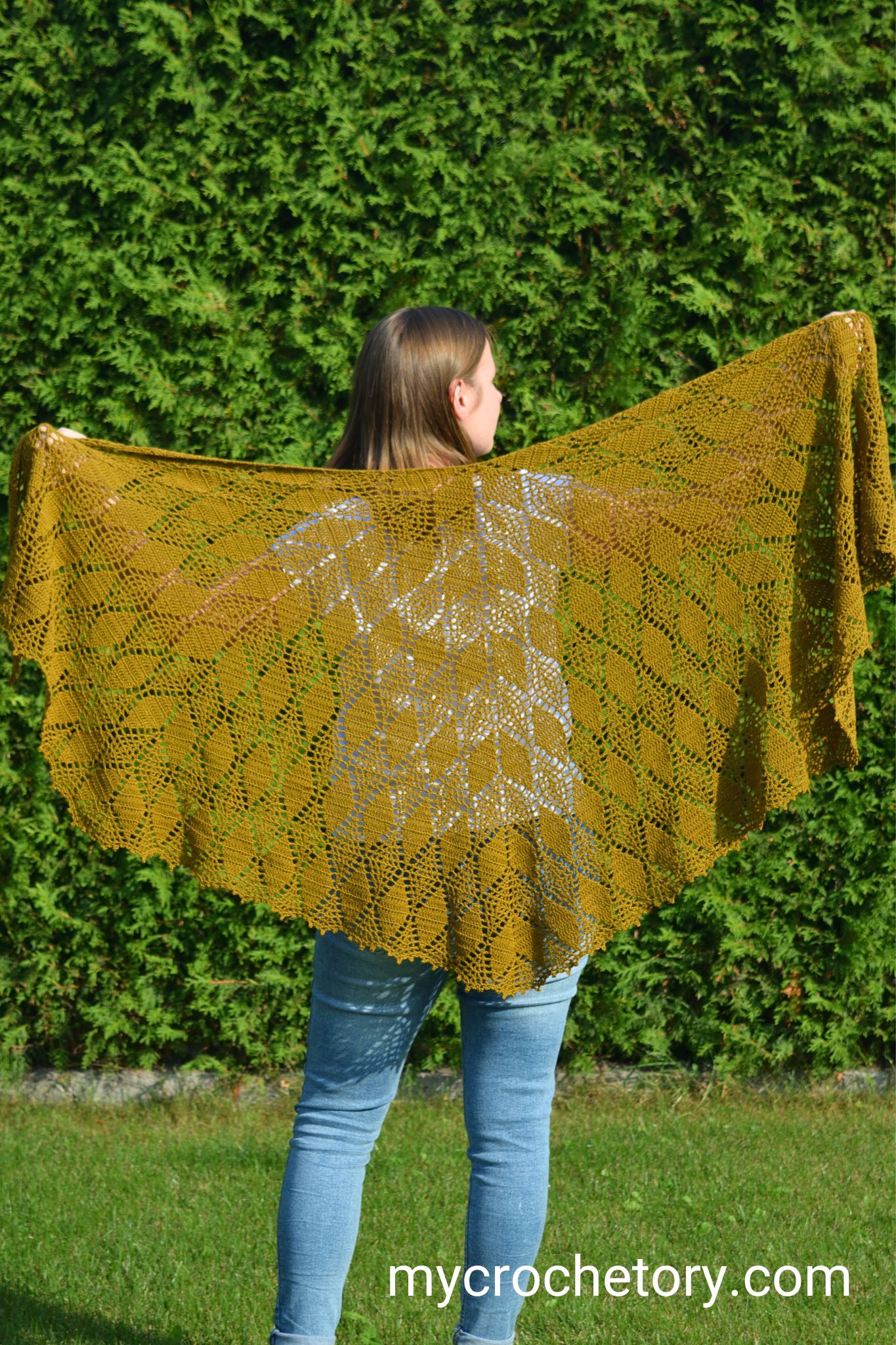
I made Eira in Knitting for Olive Cotton Merino, colorway Dark Ochre, and I’d still pick it today. It’s 70% cotton and 30% merino, so it’s light, but still soft and a little warm.
You’ll need about 1591 yards of light fingering yarn and a 3 mm hook. Fingering weight works too, just know the shawl will come out a bit bigger.
Fresh off the hook, lace always looks a bit crumpled, so please don’t skip blocking. I wet block, I soak the shawl, pin it out into a crescent on a mat and let it dry, and that’s the moment every leaf opens up.

Is this crochet crescent shawl hard?
It’s an intermediate pattern, but don’t let that scare you. You’ll use chains, single crochet, double crochet, dc2tog, dc3tog and picots, nothing exotic.
The only tricky part is keeping track of the markers and the leaf rows. Like to see it done? The video tutorial walks you through the whole shawl, and adventurous beginners can follow along too.
Not starting today? Pin this crochet crescent shawl to your Pinterest board, so you can find it when you’re ready.
Free Eira crochet crescent shawl pattern
- Get the ad-free, printable PDF with the stitch chart on Etsy or Ravelry.
- Add the Eira Shawl to your Ravelry queue.
Copyright 2023 – 2026 MyCrochetory. All rights reserved. This pattern is the property of Sylwia Kawczyńska @MyCrochetory. Please DO NOT sell the pattern or claim it as your own. The pattern is for personal use only and may not be translated or reproduced in another language. Please respect my rights and DO NOT share or publish this pattern anywhere without my permission.
The shawl you make following this pattern is yours, and you are free to sell it, as long as you credit MyCrochetory (Sylwia Kawczyńska) as the original designer. For more information, please read my Terms page.
Materials & Tools
- Yarn: light fingering weight yarn, about 1455 m (1591 yd). Shown in Knitting for Olive Cotton Merino (70% cotton, 30% merino wool), colorway Dark Ochre.
- Hook: 3 mm. Adjust the hook size if necessary to obtain the correct gauge.
- 3 stitch markers, tapestry needle, scissors.
Level
Intermediate.
Size after blocking
One size, adjustable: about 170 × 76 cm (67″ × 30″).
Gauge after blocking
After Row 10, the shawl is about 10.5 cm (4″) high and 24.25 cm (9.5″) wide. Gauge is not important for this project, but a different gauge changes the yardage and the finished size.
Notes
- The pattern uses US terms. The shawl is worked top-down in one piece, in rows back and forth.
- The 3 markers sit in ch-2 sps, not in a ch. They divide the shawl into 4 equal sections.
- Instructions in [ ] and in { } are worked as many times as indicated. The numbers in ( ) are the counts for the whole row.
- For a smaller or bigger shawl, work fewer or more repeats of Rows 9–20. Always end with Rows 9–12 before the Last Row.
- A different yarn weight changes the size and the yardage.
Stitches & Abbreviations (US terms)
- ch – chain
- st(s) – stitch(es)
- sl st – slip stitch
- sc – single crochet
- dc – double crochet
- yo – yarn over
- sk – skip
- sp – space
- beg – beginning
- prev – previous
- rep – repeat
- M – marker
- PM – place marker
- RPM – reposition marker
Special stitches
- dc2tog – [yo, insert hook in indicated st, yo, draw up a loop, yo, pull through 2 loops] twice, yo, pull through all 3 loops on hook.
- dc3tog – [yo, insert hook in indicated st, yo, draw up a loop, yo, pull through 2 loops] 3 times, yo, pull through all 4 loops on hook.
- Picot – ch3, insert your hook in the 3rd ch from the hook, yo and draw the yarn through the st and the loop on the hook.
Eira crochet crescent shawl video tutorial
Want to see every step? This video tutorial walks you through the Eira Shawl, leaves and all. To see it, please turn off any ad blocker you have running.
Eira Shawl pattern
Read all Notes before you start. Start with a magic ring, or with ch5 and a sl st in the first ch to close the ring.
Row 1: ch5, PM, (dc, ch2, PM, dc, ch2, PM, dc) in the ring. Turn. (4 sts, 3 ch sps)
Row 2: ch3 (counts as st here and throughout), 2dc in first st, [ch2, RPM, 3dc in next dc] rep twice in total, ch2, RPM, 3dc in 3rd ch of ch5 at beg of prev row. Turn. (12 sts, 3 ch sps)
Row 3: ch3, dc in first st, dc in next st, 2dc in next dc, [ch2, RPM, 2dc in next dc, dc in next dc, 2dc in next dc] rep twice in total, ch2, RPM, 2dc in next dc, dc in next dc, 2dc in 3rd ch of ch3 at beg of prev row. Turn. (20 sts, 3 ch sps)
Row 4: ch3, dc in first st, dc in next 3dc, 2dc in next dc, [ch2, RPM, 2dc in next dc, dc in next 3dc, 2dc in next dc] rep twice in total, ch2, RPM, 2dc in next dc, dc in next 3dc, 2dc in 3rd ch of ch3 at beg of prev row. Turn. (28 sts, 3 ch sps)
Row 5: ch3, dc in first st, dc in next 5dc, 2dc in next dc, [ch2, RPM, 2dc in next dc, dc in next 5dc, 2dc in next dc] rep twice in total, ch2, RPM, 2dc in next dc, dc in next 5dc, 2dc in 3rd ch of ch3 at beg of prev row. Turn. (36 sts, 3 ch sps)
Row 6: ch3, dc in first st, dc in next 7dc, 2dc in next dc, [ch2, RPM, 2dc in next dc, dc in next 7dc, 2dc in next dc] rep twice in total, ch2, RPM, 2dc in next dc, dc in next 7dc, 2dc in 3rd ch of ch3 at beg of prev row. Turn. (44 sts, 3 ch sps)
Row 7: ch5, dc2tog (first leg in first st, second leg in second st), dc in next 7dc, dc2tog, [ch2, (dc, ch2, RPM, dc) in ch-2 sp with M, ch2, dc2tog, dc in next 7dc, dc2tog] rep twice in total, ch2, (dc, ch2, RPM, dc) in ch-2 sp with M, ch2, dc2tog, dc in next 7dc, dc2tog (second leg in 3rd ch of ch3 at beg of prev row), ch2, dc in same 3rd ch of ch3 at beg of prev row. Turn. (44 sts, 11 ch sps)
Row 8: ch4, dc in first st, ch2, sk ch-2 sp, dc2tog, dc in next 5dc, dc2tog, ch2, sk ch-2 sp, (dc, ch1, dc) in next dc, [ch2, RPM, (dc, ch1, dc) in next dc, ch2, sk ch-2 sp, dc2tog, dc in next 5dc, dc2tog, ch2, sk ch-2 sp, (dc, ch1, dc) in next dc] rep twice in total, ch2, RPM, (dc, ch1, dc) in next dc, ch2, sk ch-2 sp, dc2tog, dc in next 5dc, dc2tog, ch2, (dc, ch1, dc) in 3rd ch of ch5 at beg of prev row. Turn. (44 sts, 19 ch sps)
Row 9: ch4, dc in ch-1 sp, ch1, dc in next dc, [ch2, sk ch-2 sp, dc2tog, dc in next 3dc, dc2tog, ch2, sk ch-2 sp, dc in next dc, ch1, dc in next ch-1 sp, ch1, dc in next dc] rep until ch-2 sp with M, {ch2, RPM, dc in next dc, ch1, dc in next ch-1 sp, ch1, dc in next dc, [ch2, sk ch-2 sp, dc2tog, dc in next 3dc, dc2tog, ch2, sk ch-2 sp, dc in next dc, ch1, dc in next ch-1 sp, ch1, dc in next dc] rep until next ch-2 sp with M} rep {…} twice in total, ch2, RPM, dc in next dc, [ch1, dc in next ch-1 sp, ch1, dc in next dc, ch2, sk ch-2 sp, dc2tog, dc in next 3dc, dc2tog, ch2, sk ch-2 sp, dc in next dc] rep until ch-4 sp remain, ch1, dc in ch-4 sp, ch1, dc in 3rd ch of ch4 at beg of prev row. Turn. (44 sts, 27 ch sps)
Row 10: ch4, sk ch-1 sp, (dc, ch1, dc) in next dc, ch1, sk ch-1 sp, dc in next dc, [ch2, sk ch-2 sp, dc2tog, dc in next dc, dc2tog, ch2, sk ch-2 sp, dc in next dc, ch1, sk ch-1 sp, (dc, ch1, dc) in next dc, ch1, sk ch-1 sp, dc in next dc] rep until ch-2 sp with M, {ch2, RPM, dc in next dc, ch1, sk ch-1 sp, (dc, ch1, dc) in next dc, ch1, sk ch-1 sp, dc in next dc, [ch2, sk ch-2 sp, dc2tog, dc in next dc, dc2tog, ch2, sk ch-2 sp, dc in next dc, ch1, sk ch-1 sp, (dc, ch1, dc) in next dc, ch1, sk ch-1 sp, dc in next dc] rep until ch-2 sp with M} rep {…} twice in total, ch2, RPM, dc in next dc, ch1, sk ch-1 sp, (dc, ch1, dc) in next dc, [ch1, sk ch-1 sp, dc in next dc, ch2, sk ch-2 sp, dc2tog, dc in next dc, dc2tog, ch2, sk ch-2 sp, dc in next dc, ch1, sk ch-1 sp, (dc, ch1, dc) in next dc] rep until ch-4 sp remain, ch1, dc in 3rd ch of ch4 at beg of prev row. Turn. (44 sts, 35 ch sps)
Row 11: ch4, dc in next dc, ch1, dc in next ch-1 sp, ch1, dc in next dc, ch1, sk ch-1 sp, dc in next dc, [ch2, sk ch-2 sp, dc3tog, ch2, sk ch-2 sp, dc in next dc, ch1, sk ch-1 sp, dc in next dc, ch1, dc in next ch-1 sp, ch1, dc in next dc, ch1, sk ch-1 sp, dc in next dc] rep until ch-2 sp with M, {ch2, RPM, dc in next dc, ch1, sk ch-1 sp, dc in next dc, ch1, dc in next ch-1 sp, ch1, dc in next dc, ch1, sk next ch-1 sp, dc in next dc, [ch2, sk ch-2 sp, dc3tog, ch2, sk ch-2 sp, dc in next dc, ch1, sk ch-1 sp, dc in next dc, ch1, dc in next ch-1 sp, ch1, dc in next dc, ch1, sk ch-1 sp, dc in next dc] rep until ch-2 sp with M} rep {…} twice in total, ch2, RPM, dc in next dc, ch1, sk next ch-1 sp, dc in next dc, ch1, dc in next ch-1 sp, ch1, dc in next dc, [ch1, sk next ch-1 sp, dc in next dc, ch2, sk ch-2 sp, dc3tog, ch2, sk next ch-2 sp, dc in next dc, ch1, sk next ch-1 sp, dc in next dc, ch1, dc in next ch-1 sp, ch1, dc in next dc] rep until ch-4 sp remain, ch1, dc in 3rd ch of ch4 at beg of prev row. Turn. (44 sts, 43 ch sps)
Row 12: ch4, dc in next dc, ch1, sk ch-1 sp, (dc, ch1, dc) in next dc, ch1, sk ch-1 sp, dc in next dc, ch1, sk ch-1 sp, dc in next dc, [ch2, sk ch-2 sp, dc in dc3tog, ch2, sk ch-2 sp, dc in next dc, ch1, sk ch-1 sp, dc in next dc, ch1, sk next ch-1 sp, (dc, ch1, dc) in next dc, ch1, sk next ch-1 sp, dc in next dc, ch1, sk ch-1 sp, dc in next dc] rep until ch-2 sp with M, {ch2, RPM, dc in next dc, ch1, sk ch-1 sp, dc in next dc, ch1, sk ch-1 sp, (dc, ch1, dc) in next dc, ch1, sk ch-1 sp, dc in next dc, ch1, sk ch-1 sp, dc in next dc, [ch2, sk ch-2 sp, dc in dc3tog, ch2, sk ch-2 sp, dc in next dc, ch1, sk ch-1 sp, dc in next dc, ch1, sk next ch-1 sp, (dc, ch1, dc) in next dc, ch1, sk next ch-1 sp, dc in next dc, ch1, sk ch-1 sp, dc in next dc] rep until ch-2 sp with M} rep {…} twice in total, ch2, RPM, dc in next dc, ch1, sk ch-1 sp, dc in next dc, ch1, sk ch-1 sp, (dc, ch1, dc) in next dc, ch1, sk ch-1 sp, dc in next dc, [ch1, sk ch-1 sp, dc in next dc, ch2, sk ch-2 sp, dc in dc3tog, ch2, sk ch-2 sp, dc in next dc, ch1, sk ch-1 sp, dc in next dc, ch1, sk ch-1 sp, (dc, ch1, dc) in next dc, ch1, sk ch-1 sp, dc in next dc] rep until ch-4 sp remain, ch1, dc in 3rd ch of ch4 at beg of prev row. Turn. (52 sts, 51 ch sps)
Row 13: ch5, dc in first st, ch1, sk ch-1 sp, dc in next dc, ch1, sk next ch-1 sp, dc2tog (first leg in next dc, sk next ch-1 sp and second leg in next dc), [ch1, sk next ch-1 sp, dc in next dc] rep twice in total, [ch2, sk ch-2 sp, dc in next dc, ch2, sk ch-2 sp, dc in next dc, ch1, sk ch-1 sp, dc in next dc, ch1, sk next ch-1 sp, dc2tog (first leg in next dc, sk next ch-1 sp and second leg in next dc), ch1, sk next ch-1 sp, dc in next dc, ch1, sk next ch-1 sp, dc in next dc] rep until ch-2 sp with M, {ch2, dc in ch-2 sp with M, ch2, RPM, dc in same ch-2 sp, ch2, dc in next dc, ch1, sk ch-1 sp, dc in next dc, ch1, sk next ch-1 sp, dc2tog (first leg in next dc, sk next ch-1 sp and second leg in next dc), ch1, sk next ch-1 sp, dc in next dc, ch1, sk next ch-1 sp, dc in next dc, [ch2, sk ch-2 sp, dc in next dc, ch2, sk next ch-2 sp, dc in next dc, ch1, sk ch-1 sp, dc in next dc, ch1, sk next ch-1 sp, dc2tog (first leg in next dc, sk next ch-1 sp and second leg in next dc), ch1, sk next ch-1 sp, dc in next dc, ch1, sk next ch-1 sp, dc in next dc] rep until next ch-2 sp with M} rep {…} twice in total, ch2, dc in ch-2 sp with M, ch2, RPM, dc in same ch-2 sp, ch2, [dc in next st, ch1, sk ch-1 sp] rep twice, dc2tog (first leg in next dc, sk next ch-1 sp and second leg in next dc), ch1, sk next ch-1 sp, dc in next dc, [ch1, sk ch-1 sp, dc in next dc, ch2, sk ch-2 sp, dc in next dc, ch2, sk ch-2 sp, dc in next dc, ch1, sk ch-1 sp, dc in next dc, ch1, sk next ch-1 sp, dc2tog (first leg in next dc, sk next ch-1 sp and second leg in next dc), ch1, sk next ch-1 sp, dc in next dc] rep until ch-4 sp remain, ch1, sk ch-1 sp, (dc, ch2, dc) in 3rd ch of ch4 at beg of prev row. Turn. (52 sts, 51 ch sps)
Row 14: ch3, 2dc in first st, [ch2, sk ch-2 sp, dc in next dc, ch1, sk ch-1 sp, dc in next dc, sk next ch-1 sp, dc in next dc2tog, sk next ch-1 sp, dc in next dc, ch1, sk ch-1 sp, dc in next dc, ch2, sk next ch-2 sp, 3dc in next dc] rep until ch-2 sp with M, {ch2, RPM, 3dc in next dc, [ch2, sk ch-2 sp, dc in next dc, ch1, sk ch-1 sp, dc in next dc, sk next ch-1 sp, dc in next dc2tog, sk next ch-1 sp, dc in next dc, ch1, sk ch-1 sp, dc in next dc, ch2, sk next ch-2 sp, 3dc in next dc] rep until ch-2 sp with M} rep {…} twice in total, ch2, RPM, 3dc in next dc, ch2, sk ch-2 sp, dc in next dc, ch1, sk ch-1 sp, dc in next dc, sk next ch-1 sp, dc in next dc2tog, sk next ch-1 sp, dc in next dc, ch1, sk ch-1 sp, dc in next dc, [ch2, sk next ch-2 sp, 3dc in next dc, ch2, sk ch-2 sp, dc in next dc, ch1, sk ch-1 sp, dc in next dc, sk next ch-1 sp, dc in next dc2tog, sk next ch-1 sp, dc in next dc, ch1, sk ch-1 sp, dc in next dc] rep until ch-5 sp remain, ch2, 3dc in 3rd ch of ch5 at beg of prev row. Turn. (76 sts, 35 ch sps)
Row 15: ch3, dc in first st, dc in next dc, 2dc in next dc, [ch2, sk ch-2 sp, dc in next dc, ch1, sk next ch-1 sp, dc2tog (first leg in first dc, sk next dc, second leg in next dc), ch1, sk next ch-1 sp, dc in next dc, ch2, sk ch-2 sp, 2dc in next dc, dc in next dc, 2dc in next dc] rep until ch-2 sp with M, {ch2, RPM, 2dc in next dc, dc in next dc, 2dc in next dc, [ch2, sk ch-2 sp, dc in next dc, ch1, sk next ch-1 sp, dc2tog (first leg in first dc, sk next dc, second leg in next dc), ch1, sk next ch-1 sp, dc in next dc, ch2, sk ch-2 sp, 2dc in next dc, dc in next dc, 2dc in next dc] rep until ch-2 sp with M} rep {…} twice in total, ch2, RPM, 2dc in next dc, dc in next dc, [2dc in next dc, ch2, sk ch-2 sp, dc in next dc, ch1, sk next ch-1 sp, dc2tog (first leg in first dc, sk next dc, second leg in next dc), ch1, sk next ch-1 sp, dc in next dc, ch2, sk ch-2 sp, 2dc in next dc, dc in next dc] rep until last ch3 remain, 2dc in 3rd ch of ch3 at beg of prev row. Turn. (84 sts, 35 ch sps)
Row 16: ch3, dc in first st, dc in next 3dc, 2dc in next dc, [ch2, sk ch-2 sp, dc in next dc, sk ch-1 sp, dc in next dc2tog, sk ch-1 sp, dc in next dc, ch2, sk ch-2 sp, 2dc in next dc, dc in next 3dc, 2dc in next dc] rep until ch-2 sp with M, {ch2, RPM, 2dc in next dc, dc in next 3dc, 2dc in next dc, [ch2, sk ch-2 sp, dc in next dc, sk ch-1 sp, dc in next dc2tog, sk ch-1 sp, dc in next dc, ch2, sk ch-2 sp, 2dc in next dc, dc in next 3dc, 2dc in next dc] rep until ch-2 sp with M} rep {…} twice in total, ch2, RPM, 2dc in next dc, dc in next 3dc, [2dc in next dc, ch2, sk ch-2 sp, dc in next dc, sk ch-1 sp, dc in next dc2tog, sk ch-1 sp, dc in next dc, ch2, sk ch-2 sp, 2dc in next dc, dc in next 3dc] rep until last ch3 remain, 2dc in 3rd ch of ch3 at beg of prev row. Turn. (108 sts, 19 ch sps)
Row 17: ch3, dc in first st, dc in next 5dc, 2dc in next dc, [ch2, sk ch-2 sp, dc2tog (first leg in next dc, sk next dc, second leg in next dc), ch2, sk ch-2 sp, 2dc in next dc, dc in next 5dc, 2dc in next dc] rep until ch-2 sp with M, {ch2, RPM, 2dc in next dc, dc in next 5sts, 2dc in next dc, [ch2, sk ch-2 sp, dc2tog (first leg in next dc, sk next dc, second leg in next dc), ch2, sk ch-2 sp, 2dc in next dc, dc in next 5dc, 2dc in next dc] rep until ch-2 sp with M} rep {…} twice in total, ch2, RPM, 2dc in next dc, dc in next 5sts, [2dc in next dc, ch2, sk ch-2 sp, dc2tog (first leg in next dc, sk next dc, second leg in next dc), ch2, sk ch-2 sp, 2dc in next dc, dc in next 5dc] rep until last ch3 remain, 2dc in 3rd ch of ch3 at beg of prev row. Turn. (116 sts, 19 ch sps)
Row 18: ch3, dc in first st, dc in next 7dc, 2dc in next dc, [ch2, sk ch-2 sp, dc in next dc2tog, ch2, sk ch-2 sp, 2dc in next dc, dc in next 7dc, 2dc in next dc] rep until ch-2 sp with M, {ch2, RPM, 2dc in next dc, dc in next 7dc, 2dc in next dc, [ch2, sk ch-2 sp, dc in next dc2tog, ch2, sk ch-2 sp, 2dc in next dc, dc in next 7dc, 2dc in next dc] rep until ch-2 sp with M} rep {…} twice in total, ch2, RPM, 2dc in next dc, dc in next 7dc, [2dc in next dc, ch2, sk ch-2 sp, dc in next dc2tog, ch2, sk ch-2 sp, 2dc in next dc, dc in next 7dc] rep until last ch3 remain, 2dc in 3rd ch of ch3 at beg of prev row. Turn. (140 sts, 19 ch sps)
Row 19: ch5, dc2tog (first leg in first st, second leg in next dc), dc in next 7dc, dc2tog, [ch2, sk ch-2 sp, dc in next dc, ch2, sk ch-2 sp, dc2tog (first leg in first dc, second leg in second dc), dc in next 7dc, dc2tog] rep until ch-2 sp with M, {ch2, dc in ch-2 sp with M, ch2, RPM, dc in same ch-2 sp, ch2, dc2tog (first leg in first dc, second leg in next dc), dc in next 7dc, dc2tog, [ch2, sk ch-2 sp, dc in next dc, ch2, sk ch-2 sp, dc2tog (first leg in first dc, second leg in next dc), dc in next 7dc, dc2tog] rep until ch-2 sp with M}, rep {…} twice in total, ch2, dc in ch-2 sp with M, ch2, RPM, dc in same ch-2 sp, ch2, dc2tog (first leg in first dc, second leg in next dc), dc in next 7dc, [dc2tog, ch2, sk ch-2 sp, dc in next dc, ch2, sk ch-2 sp, dc2tog, dc in next 7dc] rep until 2sts remain, dc2tog (first leg in next dc, second leg in 3rd ch of ch3 at beg of prev row), ch2, dc in same 3rd ch of ch3 at beg of prev row. Turn. (124 sts, 27 ch sps)
Row 20: ch4, dc in first st, [ch2, sk ch-2 sp, dc2tog (first leg in first st, second leg in next dc), dc in next 5dc, dc2tog, ch2, sk ch-2 sp, (dc, ch1, dc) in next dc] rep until ch-2 sp with M, {ch2, RPM, (dc, ch1, dc) in next dc, [ch2, sk ch-2 sp, dc2tog (first leg in first st, second leg in next dc), dc in next 5dc, dc2tog, ch2, sk ch-2 sp, (dc, ch1, dc) in next dc] rep until next ch-2 sp with M} rep {…} twice in total, ch2, RPM, (dc, ch1, dc) in next dc, ch2, sk ch-2 sp, dc2tog, dc in next 5dc, dc2tog, [ch2, sk ch-2 sp, (dc, ch1, dc) in next dc, ch2, sk ch-2 sp, dc2tog, dc in next 5dc, dc2tog] rep until ch-5 sp remain, ch2, (dc, ch1, dc) in 3rd ch of ch5 at beg of prev row. Turn. (116 sts, 43 ch sps)
Rows 21 – 68: Repeat Rows 9–20 four more times, or until the shawl is as big as you like. (Row 68: 404 sts, 139 ch sps)
Rows 69 – 72: Repeat Rows 9–12. (Row 72: 332 sts, 331 ch sps)
Last Row (73): ch1 (doesn’t count as a st), sc in first st, ch1, picot, ch1, sc in next dc, ch2, sc in next dc, ch1, picot, ch1, sc in next dc, ch2, sc in next dc, ch1, picot, ch1, sc in next dc, [ch2, sc in next dc, ch2, sc in next dc, ch1, picot, ch1, sc in next dc, ch2, sc in next dc, ch1, picot, ch1, sc in next dc, ch2, sc in next dc, ch1, picot, ch1, sc in next dc] rep until ch-2 sp with M, {remove M, ch2, sc in next dc, ch1, picot, ch1, sc in next dc, ch2, sc in next dc, ch1, picot, ch1, sc in next dc, ch2, sc in next dc, ch1, picot, ch1, sc in next dc, [ch2, sc in next dc, ch2, sc in next dc, ch1, picot, ch1, sc in next dc, ch2, sc in next dc, ch1, picot, ch1, sc in next dc, ch2, sc in next dc, ch1, picot, ch1, sc in next dc] rep until next ch-2 sp with M} rep {…} twice in total, remove M, ch2, sc in next dc, ch1, picot, ch1, sc in next dc, ch2, sc in next dc, ch1, picot, ch1, sc in next dc, ch2, sc in next dc, [ch1, picot, ch1, sc in next dc, ch2, sc in next dc, ch2, sc in next dc, ch1, picot, ch1, sc in next dc, ch2, sc in next dc, ch1, picot, ch1, sc in next dc, ch2, sc in next dc] rep until last ch4 remain, ch1, picot, ch1, sc in 3rd ch of ch4 at beg of prev row. (332 sc, 144 picots)
Fasten off, weave in all ends and block your shawl to shape.
If you have any suggestions or have found a mistake, please email me at mycrochetory@gmail.com.
Finished your Eira? I’d love to see your leaves, so share it on Instagram with #mycrochetory and tag @mycrochetory.
Stuck on a row? Ask in my Facebook Group or Ravelry Group, or email me at mycrochetory@gmail.com.
More crescent and lace crochet shawls
Hooked on lace now? These shawls of mine are just as airy.
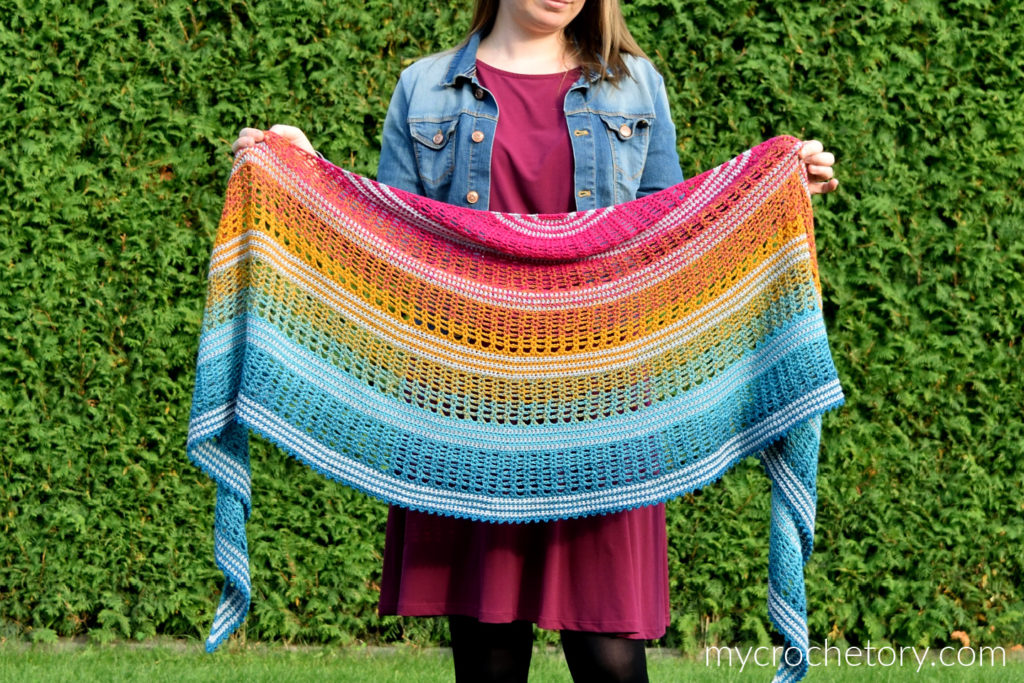


- Sigrid Shawl. Another crescent shawl, great for showing off a gradient yarn.
- Greta Shawl. A bottom-up lace triangle in lace weight yarn.
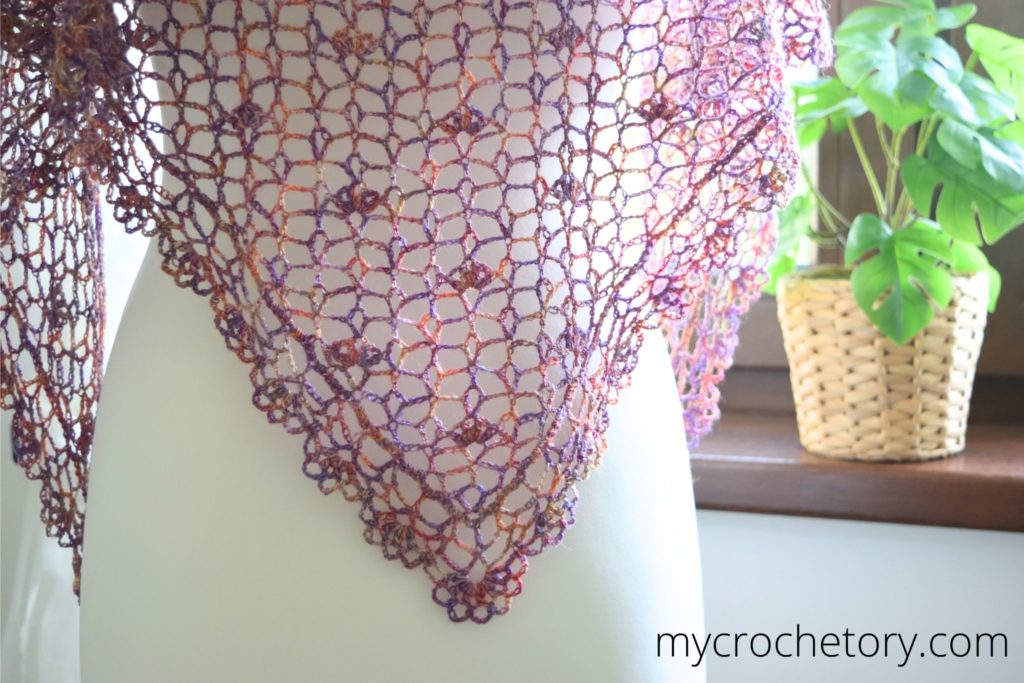
- Lace Shawlette. A small bat-wing shawlette with a mesh and picot lattice.
- Aprilace Shawl. A top-down triangle with a simple 4-row lace repeat and a picot edge.
More crochet shawls inspired by nature
Love a shawl with a little nature in it? Here are more of mine.


- Forsythia Shawl. A spring shawl with lace clusters, inspired by nature.
- Field of Flowers Shawl. My flower meadow on a shawl, worked top-down.
- Willow Shawl. A calm moss stitch shawl that feels like meditation to make.
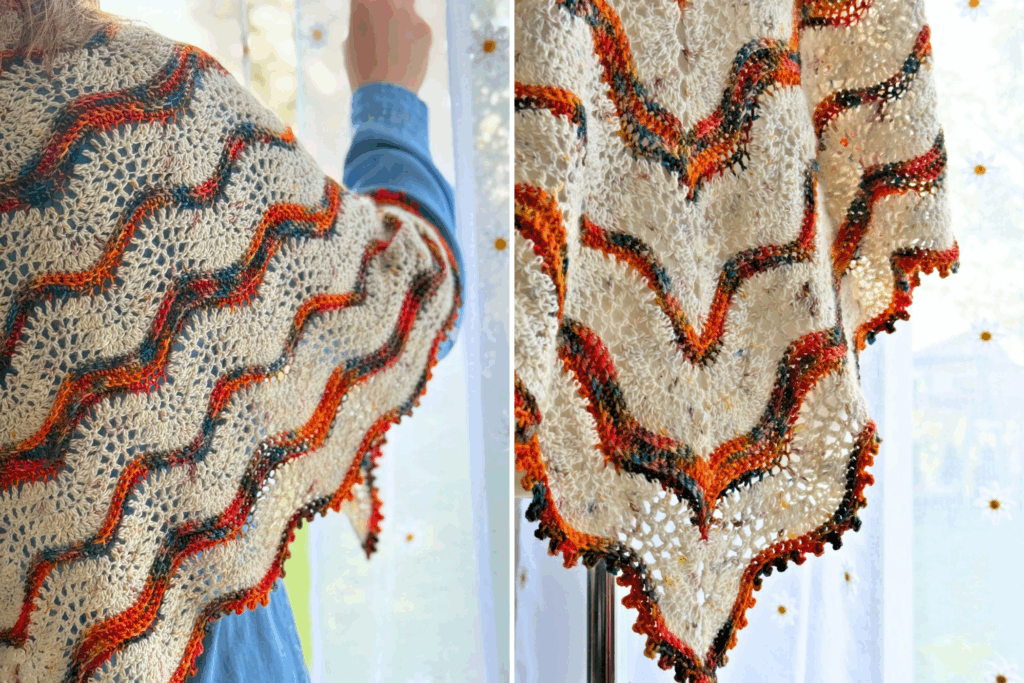
- Norra Shawl. Cream stripes and hand-dyed ripples in warm autumn colors.
Crochet crescent shawl FAQ
Can I make this crochet crescent shawl smaller or bigger?
Yes. Work fewer or more repeats of Rows 9 to 20, and always end with Rows 9 to 12 before the Last Row, so the leaves finish neatly.
Can I use a cotton or wool yarn instead?
Yes, any light fingering or fingering weight yarn works. Pure cotton gives crisp, cool leaves, and a wool blend makes the shawl softer and warmer.
Where can I find the stitch chart?
The full stitch chart is in the ad-free PDF on Etsy and Ravelry. The picture in the pattern section gives you a little preview.
This looks pretty easy and straightforward but I don’t understand why the markers are needed when the spaces are quite obvious. I’m watching the tutorial as I’m writing this and I’m at row 8 so if the reason for the markers comes up I apologize for my haste.