Updated: 11 November 2026 by Sylwia (MyCrochetory)
Some of my designs are named after a color or a flower. This crescent shawl crochet pattern is named after a singer. Yes, really, a singer.
Sigrid’s songs were playing while I designed the very first version of this shawl. By the time the last row was done, the name was obvious.
I’d wanted to design a crescent shawl for ages. That first Sigrid finally made it happen, in soft shades of green.
Later I came back to it with fresh eyes. Stripes and lace like these really come alive in ombre or gradient yarn, so I wanted a version full of color.
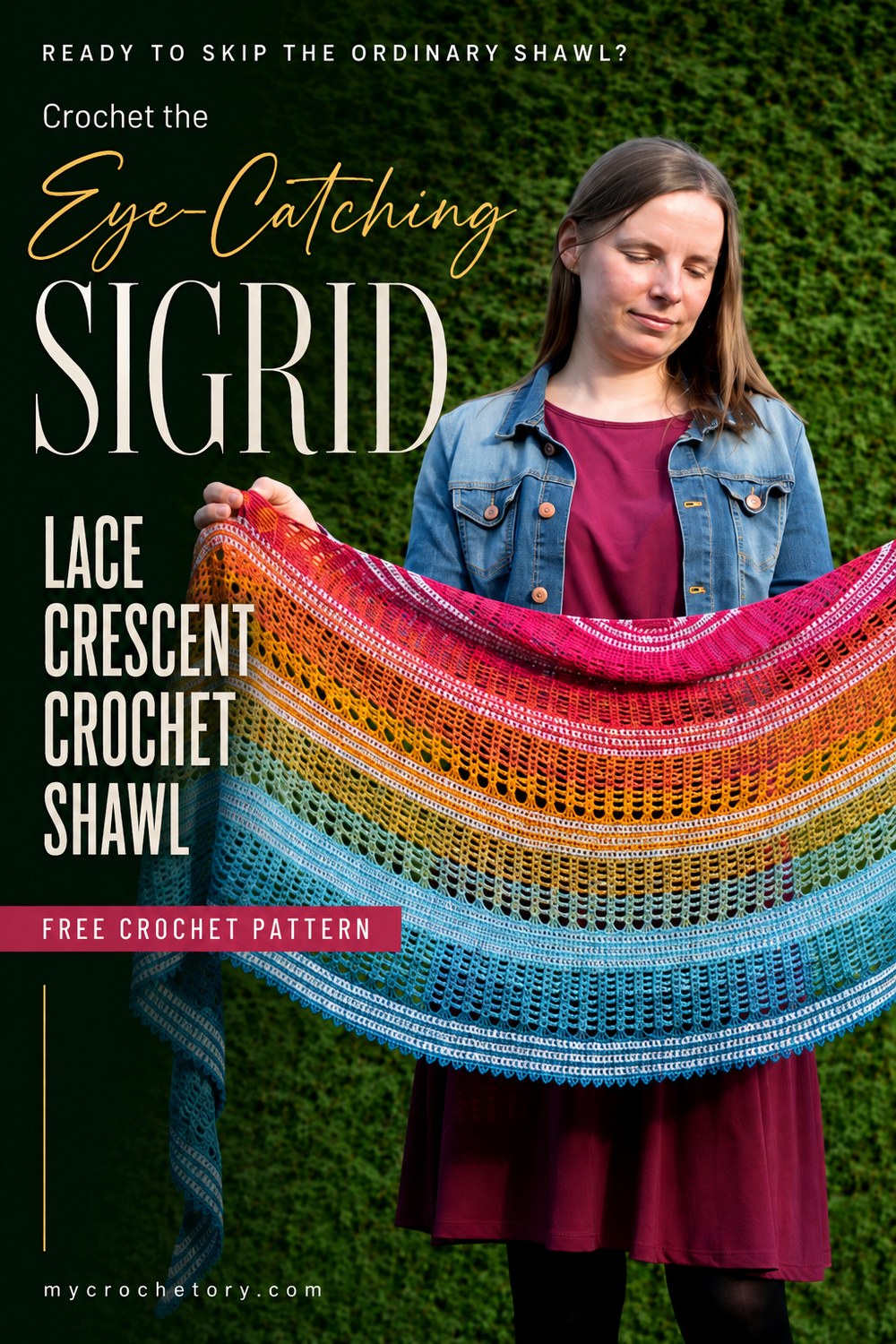
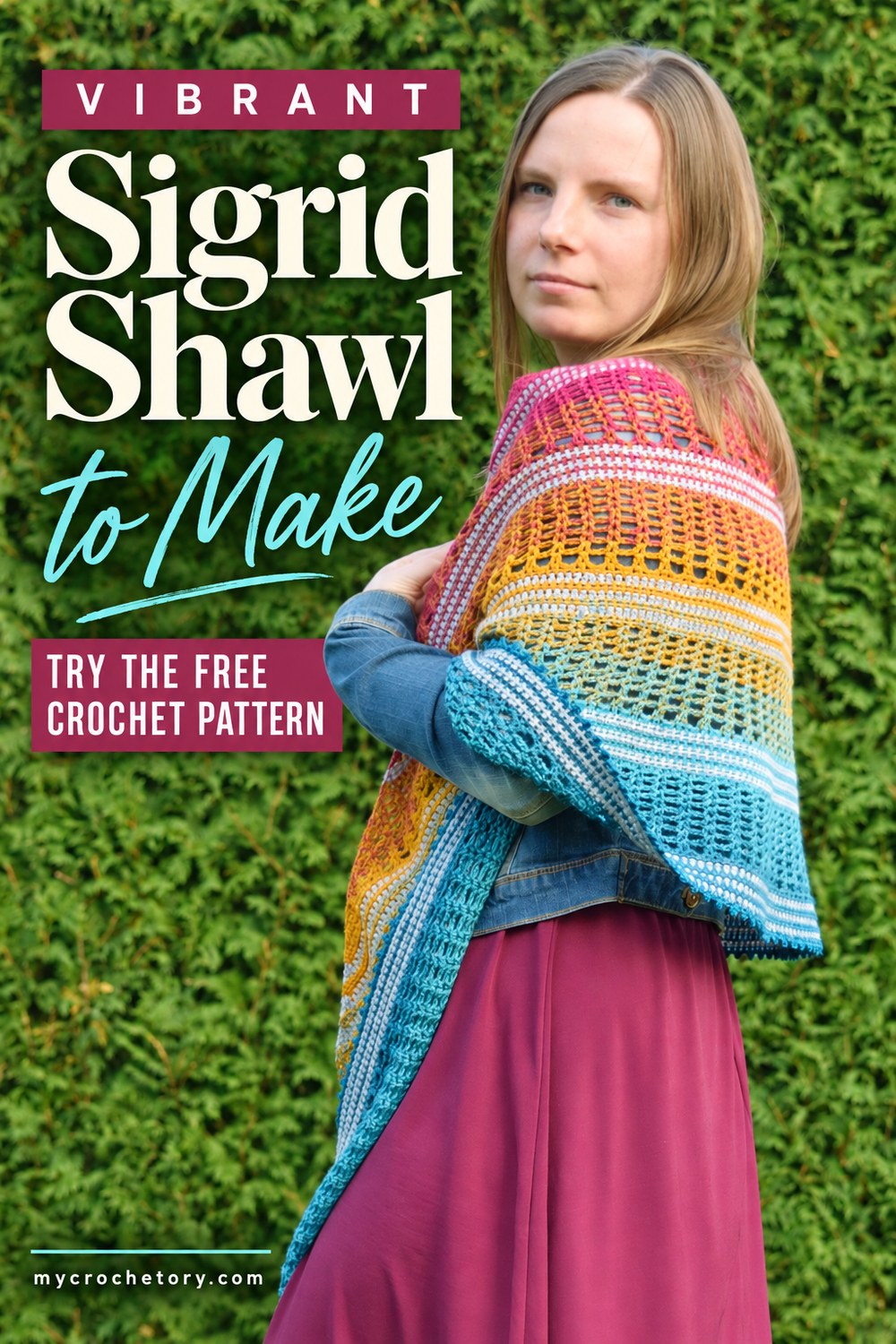
So here she is, the colorful Sigrid. Bands of half double crochet take turns with airy lace, and a tiny picot edge runs along the whole curve.
The full crescent shawl crochet pattern is free, right below. Want a printable PDF with a stitch chart for the lace? You’ll find it on Etsy and Ravelry.

Pin it now so you can find this crescent shawl crochet pattern again when your hook is free.
Want to see it move first? Here’s a short video of this crescent shawl crochet pattern. If it doesn’t show up, try turning off your ad blocker.
Why I Love a Crescent Shawl
Can I tell you my problem with triangle shawls? That big point always ends up somewhere weird on your back.
A crescent curves instead. It sits softly on your shoulders and just stays there, which I love.
And those long, narrow ends? Wrap them around your neck like a scarf, or let them hang loose over a summer dress.

Stripes, Then Lace, Then Stripes Again
If you get bored easily, you’ll like this one. This crescent shawl crochet pattern keeps changing things, so there’s always something new coming up.
First come the stripes. You change color every row, and the hdc bands grow so fast it almost feels like cheating.
Then the lace shows up, and it’s such a fun change. Little (hdc, ch1, hdc) shells and chain spaces open up the fabric, and every lace part is a bit airier than the one before.
You work in rows from the top center down, and the shawl gets wider with every increase row. Six stitch markers keep those increases exactly where they belong.

New to some of these stitches? Here’s how to half double crochet, and my picot stitch tutorial for the very last row.
The Yarn I Bought for It
Yarn can make or break a shawl like this. For this version I bought a cake of Kokonek Pure, 100% merino in fingering weight, and I still happily recommend it.
Merino feels so soft against your neck. For anything that touches skin, I always pick soft yarn that doesn’t itch, and this one passed easily.
This crescent shawl crochet pattern uses two colors, A and B. With a gradient cake, the colors change slowly as you go, and watching each new shade appear is half the fun.

Blocking Gives It the Crescent Shape
Fresh off the hook, your shawl won’t look like a crescent yet. Don’t panic, blocking fixes that.
Since this is merino, I wet block it. I soak the shawl, stretch it into a curve, pin it to a mat and let it dry.
The lace opens up, the curve appears, and suddenly it looks like the photos. It’s so satisfying to watch.
Make This Crescent Shawl Crochet Pattern Your Own
Got a gradient cake hiding in your stash? This is its moment. Any fingering weight yarn works for this crescent shawl crochet pattern, but ombre and gradient yarns look so good with the stripes.
Want a lighter, more open look? Go up a hook size, and plan for a slightly bigger shawl and a little more yarn.
SIGRID CRESCENT SHAWL CROCHET PATTERN
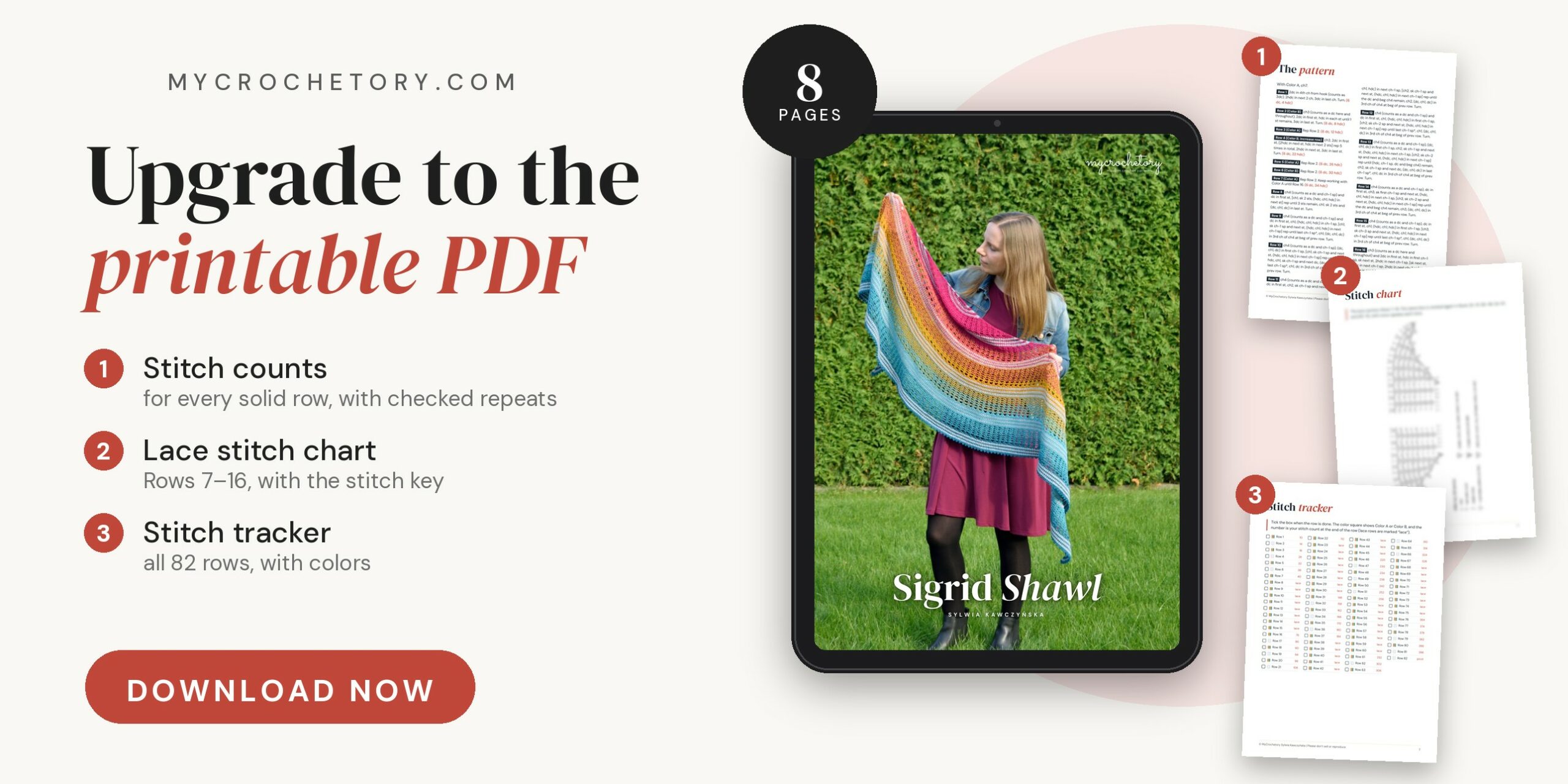
- Purchase the ad-free, printable PDF here on ETSY or here on Ravelry.
- Add this pattern to your Ravelry Queue HERE.
- Pin it for later.
Copyright 2018 – 2026 MyCrochetory. All rights reserved. This pattern is property of Sylwia Kawczyńska @MyCrochetory. Please DO NOT sell the pattern and claim this pattern as your own. The pattern is for personal use only and may not be translated or reproduced in another language. Please respect my rights, DO NOT share or publish this pattern anywhere without my permission.
The crochet crescent shawl you make following this pattern is yours you are free to sell it, as long as you credit MyCrochetory as original designer. For more information, please, read Terms Page.
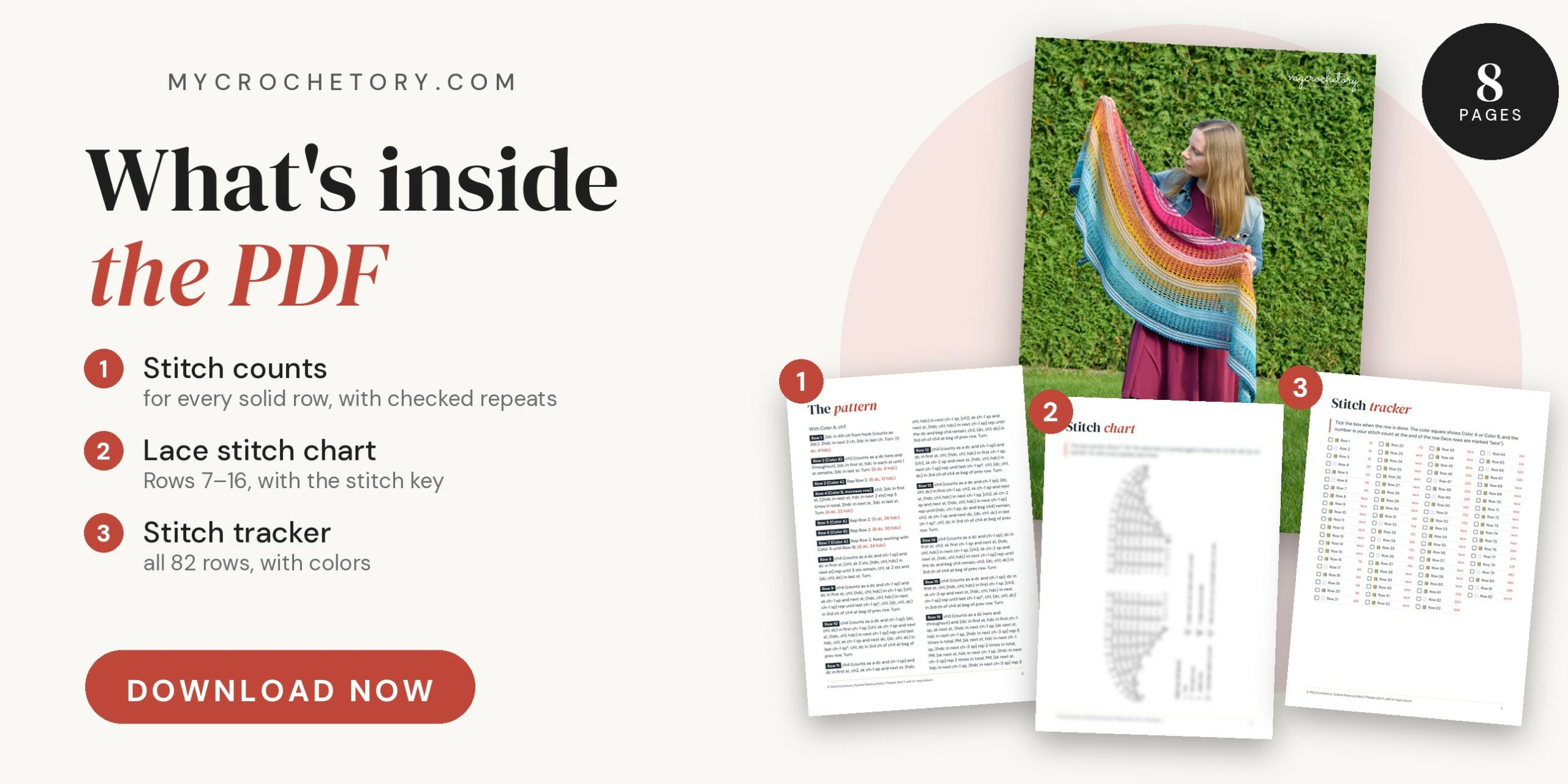
As a bonus I have included a stitch chart for lace panel in the ad-free, printable PDF crochet pattern for anyone, who want to support my work and purchase this crochet pattern here on ETSY or here on Ravelry.

Materials & Tools:
- Yarn Kokonek Pure (100% merino wool, fingering weight) in 2 different colors:
Color A – 830m,
Color B – 210m.
- Hook size 3.5 mm. Adjust hook size if necessary to obtain correct gauge.
- Tapestry needle (to weave and hide yarn ends).
- Scissors.
- 6 removable stitch markers.
Level:
Intermediate.
Gauge after blocking:
After Row 16 the shawl is approx. 10cm high and 46.5cm wide.
Gauge is not important for this project. However, changes might result in a different yardage requirements and the finished size.
Size after blocking:
Approx. 230cm from side to side and 51cm from top to bottom at deepest point.
Notes:
- The pattern uses US Terminology.
- This crescent shawl crochet pattern is worked in rows back and forth.
- The pattern includes the stitch chart for lace section only.
Stitches & Abbreviations (US terms):
st(s) – stitch(es)
rep – repeat
sk – skip
beg – beginning
prev – previous
PM – place marker
M – marker
RPM – reposition marker
picot – ch3, insert your hook in the third chain from the hook, yarn over and draw the yarn through the stitch and through the loop on the hook.
Instructions in square brackets […] are worked as many times as indicated.
PATTERN
With color A, Chain 7.
Row 1: 2dc in 4th ch from hook (counts as 3dc), 2hdc in next 2ch, 3dc in last ch. Turn. Stitch count: (6dc, 4hdc)
Row 2 (Color B): ch3 (counts as dc here and throughout), 2dc in first st, hdc across until last st remain, 3dc in last st. Turn. Stitch count: (6dc, 8hdc)
Row 3 (Color A): repeat Row 2. Stitch count: (6dc, 12hdc)
Row 4 (Color B, increasing row): ch3, 2dc in first st, [2hdc in next st, hdc in next 2sts] rep 5 times in total, 2hdc in next st, 3dc in last st. Turn. Stitch count: (6dc, 22hdc)
Row 5 (Color A): repeat Row 2. Stitch count: (6dc, 26hdc)
Row 6 (Color B): repeat Row 2. Stitch count: (6dc, 30hdc)
With Color A
Row 7: repeat Row 2. Stitch count: (6dc, 34hdc)
Row 8: ch4 (counts as a dc and ch1-sp) and dc in first st, [ch1, sk 2sts, (hdc, ch1, hdc) in next st] rep until 3sts remain, ch1, sk 2sts and (dc, ch1, dc) in last st. Turn.
Row 9: ch4 (counts as a dc and ch1-sp) and dc in first st, ch1, (hdc, ch1, hdc) in ch-1sp, [ch1, sk ch-1sp and next st, (hdc, ch1, hdc) in next ch-1sp] rep until last ch-1sp*, ch1, (dc, ch1, dc) in 3rd ch of ch4 at beg of prev row. Turn.
*last ch-1sp is created by ch4 at beg of prev row
Row 10: ch4 (counts as dc and ch1-sp), (dc, ch1, dc) in first ch-1sp, [ch1, sk ch-1sp and next st, (hdc, ch1, hdc) in next ch-1sp] rep until last hdc, ch1, sk ch-1sp and next dc, (dc, ch1, dc) in last ch-1sp*, ch1, dc in 3rd ch of ch4 at beg of prev row. Turn.
*last ch-1sp is created by ch4 at beg of prev row
Row 11: ch4 (counts as dc and ch1-sp) and dc in first st, ch2, sk ch-1sp and next st, (hdc, ch1, hdc) in next ch-1sp, [ch2, sk ch-1sp and next st, (hdc, ch1, hdc) in next ch-1sp] rep until dc and beg ch4 remain, ch2, (dc, ch1, dc) in 3rd ch of ch4 at beg of prev row. Turn.
Row 12: ch4 (counts as dc and ch1-sp) and dc in first st, ch1, (hdc, ch1, hdc) in first ch-1sp, [ch2, sk ch-2sp and next st, (hdc, ch1, hdc) in next ch-1sp] rep until last ch-1sp*, ch1, (dc, ch1, dc) in 3rd ch of ch4 at beg of prev row. Turn.
*last ch-1sp is created by ch4 at beg of prev row
Row 13: ch4 (counts as dc and ch1-sp), (dc, ch1, dc) in first ch-1sp, ch2, sk ch-1sp and next st, (hdc, ch1, hdc) in next ch-1sp, [ch2, sk ch-2sp and next st, (hdc, ch1, hdc) in next ch-1sp] rep until (hdc, ch-1sp, dc and beg ch4) remain, ch2, sk ch-1sp and next dc, (dc, ch1, dc) in last ch-1sp*, ch1, dc in 3rd ch of ch4 at beg of prev row. Turn.
*last ch-1sp is created by ch4 at beg of prev row
Row 14: ch4 (counts as dc and ch1-sp), dc in first st, ch3, sk first ch-1sp and next st, (hdc, ch1, hdc) in next ch-1sp, [ch3, sk ch-2sp and next st, (hdc, ch1, hdc) in next ch-1sp] rep until dc and beg ch4 remain, ch3, (dc, ch1, dc) in 3rd ch of ch4 at beg of prev row. Turn.
Row 15: ch4 (counts as dc and ch1-sp), dc in first st, ch1, (hdc, ch1, hdc) in first ch-1sp, [ch3, sk ch-3sp and next st, (hdc, ch1, hdc) in next ch-1sp] rep until last ch-1sp*, ch1, (dc, ch1, dc) in 3rd ch of ch4 at beg of prev row. Turn.
*last ch-1sp is created by ch4 at beg of prev row
Row 16: ch3 (counts as a dc here and throughout) and 2dc in first st, hdc in first ch-1sp, sk next st, 2hdc in next ch-1sp, [sk next st, hdc in next ch-1sp, 2hdc in next ch-3sp] rep 5 times in total, PM, [sk next st, hdc in next ch-1sp, 2hdc in next ch-3sp] rep 2 times in total, PM, [sk next st, hdc in next ch-1sp, 2hdc in next ch3-sp] rep 2 times in total, PM, [sk next st, hdc in next ch-1sp, 2hdc in next ch3-sp] rep 3 times in total, sk next st, hdc in next ch-1sp, sk next st, hdc in next ch-3sp, PM and second hdc in the same ch-3sp, [sk next st, hdc in next ch-1sp, 2hdc in next ch-3sp, sk next st, hdc in next ch-1sp, hdc in next ch-3sp, PM and second hdc in the same ch-3sp] rep 2 times in total, [sk next st, hdc in next ch-1sp, 2hdc in next ch-3sp] rep 4 times in total, sk next st, hdc in next ch-1sp, 2hdc in next ch-1sp, sk next st, hdc in last ch-1sp*, 3dc in 3rd ch of ch4 at beg of prev row. Change to color B in final stitch. Turn.
*last ch-1sp is created by ch4 at beg of prev row
Row 17 (Color B, increasing row): ch3 and 2dc in first st, [hdc in every st to M, RPM, 2hdc in next st] rep 3 times in total, hdc in every st until 1st remain before M, [2hdc in next st, hdc in next st, RPM, hdc in every st until 1st remain before M] rep 2 times in total, 2hdc in next st, hdc in next st, RPM, hdc in every st until last st, 3dc in last st. Turn.
Row 18 (Color A): Rep Row 2. Reposition markers as you go. Turn.
Row 19 (Color B): Rep Row 2. Reposition markers as you go. Turn.
Row 20 (Color A): Rep Row 2. Reposition markers as you go. Turn.
Row 21 (Color B): Rep Row 17. Turn.
Row 22 (Color A): Rep Row 2. Remove markers. Turn.
Row 23 – Row 30: Repeat Row 8 – Row 15.
Row 31: ch3 (counts as a dc here and throughout) and 2dc in first st, hdc in first ch-1sp, sk next st, 2hdc in next ch-1sp, [sk next st, hdc in next ch-1sp, 2hdc in next ch-3sp] rep 14 times in total, PM, [sk next st, hdc in next ch-1sp, 2hdc in next ch-3sp] rep 3 times in total, PM, [sk next st, hdc in next ch-1sp, 2hdc in next ch3-sp] rep 3 times in total, PM, [sk next st, hdc in next ch-1sp, 2hdc in next ch3-sp] rep 5 times in total, sk next st, hdc in next ch-1sp, sk next st, hdc in next ch-3sp, PM and second hdc in the same ch-3sp, [sk next st, hdc in next ch-1sp, 2hdc in next ch-3sp] rep 2 times in total, sk next st, hdc in next ch-1sp, sk next st, hdc in next ch-3sp, PM and second hdc in the same ch-3sp, [sk next st, hdc in next ch-1sp, 2hdc in next ch-3sp] rep 2 times in total, sk next st, hdc in next ch-1sp, sk next st, hdc in next ch-3sp, PM and second hdc in the same ch-3sp, [sk next st, hdc in next ch-1sp, 2hdc in next ch-3sp] rep 13 times in total, sk next st, hdc in next ch-1sp, sk next st, 2hdc in next ch-1sp, sk next st, hdc in last ch-1sp*, 3dc in 3rd ch of ch4 at beg of prev row. Change to color B in final stitch. Turn.
*last ch-1sp is created by ch4 at beg of prev row
Row 32 – Row 37: Repeat Row 17 – Row 22.
Row 38 – Row 45: Repeat Row 8 – Row 15.
Row 46: ch3 (counts as a dc here and throughout) and 2dc in first st, hdc in first ch-1sp, sk next st, 2hdc in next ch-1sp, [sk next st, hdc in next ch-1sp, 2hdc in next ch-3sp] rep 23 times in total, PM, [sk next st, hdc in next ch-1sp, 2hdc in next ch-3sp] rep 4 times in total, PM, [sk next st, hdc in next ch-1sp, 2hdc in next ch3-sp] rep 4 times in total, PM, [sk next st, hdc in next ch-1sp, 2hdc in next ch3-sp] rep 7 times in total, sk next st, hdc in next ch-1sp, sk next st, hdc in next ch-3sp, PM and second hdc in the same ch-3sp, [sk next st, hdc in next ch-1sp, 2hdc in next ch-3sp] rep 3 times in total, sk next st, hdc in next ch-1sp, sk next st, hdc in next ch-3sp, PM and second hdc in the same ch-3sp, [sk next st, hdc in next ch-1sp, 2hdc in next ch-3sp] rep 3 times in total, sk next st, hdc in next ch-1sp, sk next st, hdc in next ch-3sp, PM and second hdc in the same ch-3sp, [sk next st, hdc in next ch-1sp, 2hdc in next ch-3sp] rep 22 times in total, sk next st, hdc in next ch-1sp, sk next st, 2hdc in next ch-1sp, sk next st, hdc in last ch-1sp*, 3dc in 3rd ch of ch4 at beg of prev row. Change to color B in final stitch. Turn.
*last ch-1sp is created by ch4 at beg of prev row
Row 47 – Row 52: Repeat Row 17 – Row 22
Row 53 – Row 60: Repeat Row 8 – Row 15
Row 61: ch3 (counts as a dc here and throughout) and 2dc in first st, hdc in first ch-1sp, sk next st, 2hdc in next ch-1sp, [sk next st, hdc in next ch-1sp, 2hdc in next ch-3sp] rep 32 times in total, PM, [sk next st, hdc in next ch-1sp, 2hdc in next ch-3sp] rep 5 times in total, PM, [sk next st, hdc in next ch-1sp, 2hdc in next ch3-sp] rep 5 times in total, PM, [sk next st, hdc in next ch-1sp, 2hdc in next ch3-sp] rep 9 times in total, sk next st, hdc in next ch-1sp, sk next st, hdc in next ch-3sp, PM and second hdc in the same ch-3sp, [sk next st, hdc in next ch-1sp, 2hdc in next ch-3sp] rep 4 times in total, sk next st, hdc in next ch-1sp, sk next st, hdc in next ch-3sp, PM and second hdc in the same ch-3sp, [sk next st, hdc in next ch-1sp, 2hdc in next ch-3sp] rep 4 times in total, sk next st, hdc in next ch-1sp, sk next st, hdc in next ch-3sp, PM and second hdc in the same ch-3sp, [sk next st, hdc in next ch-1sp, 2hdc in next ch-3sp] rep 31 times in total, sk next st, hdc in next ch-1sp, sk next st, 2hdc in next ch-1sp, sk next st, hdc in last ch-1sp*, 3dc in 3rd ch of ch4 at beg of prev row. Change to color B in final stitch. Turn.
*last ch-1sp is created by ch4 at beg of prev row
Row 62 – Row 67: Repeat Row 17 – Row 22
Row 68 – Row 75: Repeat Row 8 – Row 15
Row 76: ch3 (counts as a dc here and throughout) and 2dc in first st, hdc in first ch-1sp, sk next st, 2hdc in next ch-1sp, [sk next st, hdc in next ch-1sp, 2hdc in next ch-3sp] rep 41 times in total, PM, [sk next st, hdc in next ch-1sp, 2hdc in next ch-3sp] rep 6 times in total, PM, [sk next st, hdc in next ch-1sp, 2hdc in next ch3-sp] rep 6 times in total, PM, [sk next st, hdc in next ch-1sp, 2hdc in next ch3-sp] rep 11 times in total, sk next st, hdc in next ch-1sp, sk next st, hdc in next ch-3sp, PM and second hdc in the same ch-3sp, [sk next st, hdc in next ch-1sp, 2hdc in next ch-3sp] rep 5 times in total, sk next st, hdc in next ch-1sp, sk next st, hdc in next ch-3sp, PM and second hdc in the same ch-3sp, [sk next st, hdc in next ch-1sp, 2hdc in next ch-3sp] rep 5 times in total, sk next st, hdc in next ch-1sp, sk next st, hdc in next ch-3sp, PM and second hdc in the same ch-3sp, [sk next st, hdc in next ch-1sp, 2hdc in next ch-3sp] rep 40 times in total, sk next st, hdc in next ch-1sp, sk next st, 2hdc in next ch-1sp, sk next st, hdc in last ch-1sp*, 3dc in 3rd ch of ch4 at beg of prev row. Change to color B in final stitch. Turn.
*last ch-1sp is created by ch4 at beg of prev row
Row 77 – Row 81: Repeat Row 17 – Row 21
Row 82: ch3, (dc, picot, 2dc) in first st, [hdc in next st, picot, hdc in next st] rep across until last st remain, (dc, picot, 2dc) in last st.
Fasten off yarn, weave in all ends and block to crescent shape.
If you have any suggestions or have detected any mistakes, please feel free to email me at mycrochetory@gmail.com
More Crescent and Lace Shawls From Me
Loved this crescent shawl crochet pattern? I’ve designed lots of lace shawls, so here are a few more to try next.
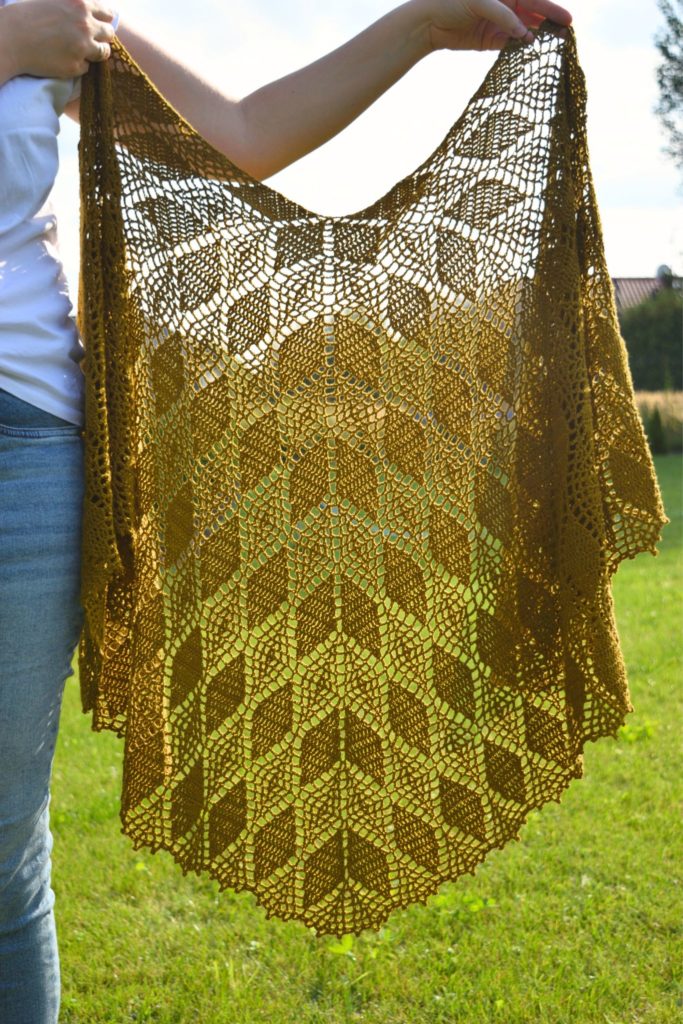


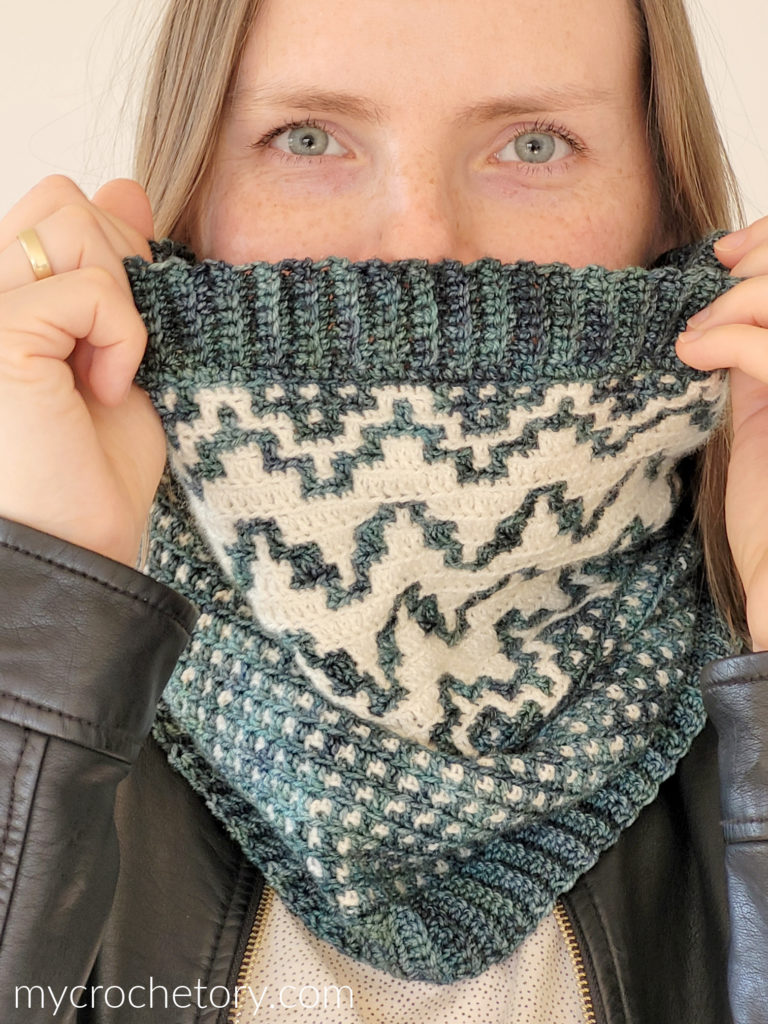
- Eira Shawl. Another crescent shawl, with leafy lace and a picot edge.
- Forsythia Shawl. A top-down triangle with lace clusters, inspired by nature.
- Havra Wrap. A rectangular wrap made for ombre yarn.
- Namari Mosaic Shawl. Dots and a zigzag in mosaic crochet.
- Goldenrod Shawl. A triangle shawl in a warm golden color.
Curious about other shawl shapes? My guide to how to crochet a shawl shows three easy ways.
Sigrid Shawl FAQ
What weight of yarn do I need?
Fingering weight. I used Kokonek Pure, a 100% merino fingering yarn, but any fingering weight yarn will work.
Is this crescent shawl crochet pattern good for beginners?
It’s an intermediate pattern. If you know hdc and dc and you’re happy working into chain spaces, an adventurous beginner can make it.
Can I make this crescent shawl crochet pattern in one color?
Yes. The stripes will disappear, but the lace still shows. Two colors or a gradient yarn give you the striped look from the photos.
Where is the stitch chart?
The chart for the lace parts of this crescent shawl crochet pattern is in the printable PDF on Etsy and Ravelry.
Can I sell the shawls I make?
Yes, as long as you credit MyCrochetory as the designer. The details are on my Terms page.
Show Me Your Sigrid
Made your own Sigrid? I’d love to see which colors you picked. Tag #mycrochetory on Instagram, or share it in my Facebook Group or Ravelry Group.
Stuck on a row? Ask in the comments below. You can also follow me on Instagram, Facebook and Pinterest.

Hi, what weight is the recommended yarn? I can’t see where it says on the website linked. Thanks.