Updated: 12 October 2026 by Sylwia (MyCrochetory)
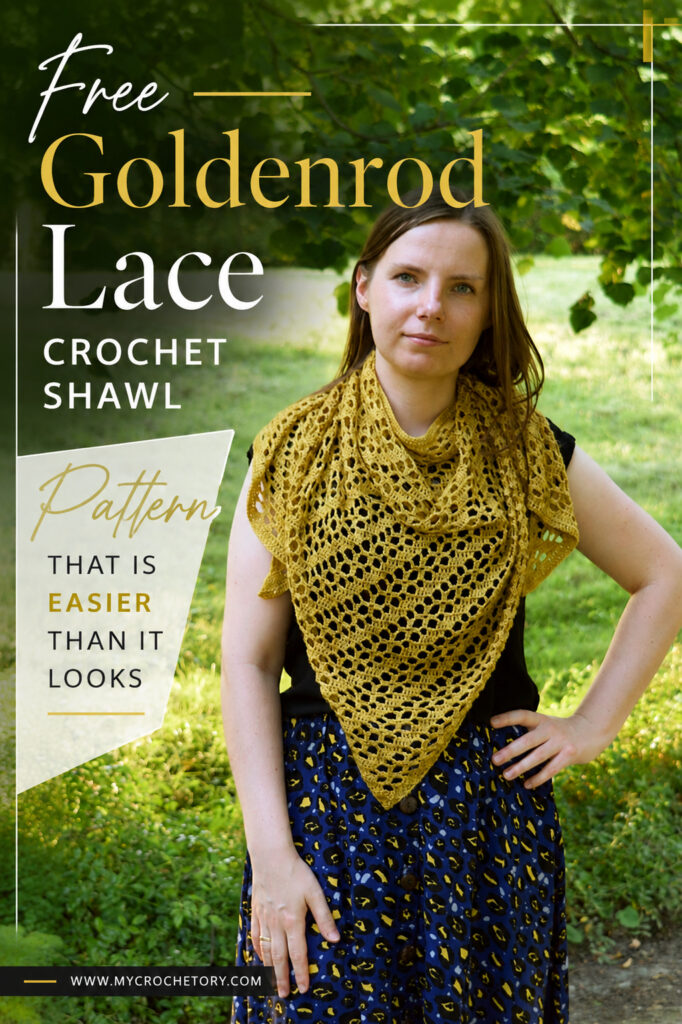
This gold crochet shawl comes from one of my busiest summers ever. Back in 2020, I was designing and crocheting shawl after shawl, and Goldenrod was one of them. With its sunny mustard color, it’s really hard to miss!
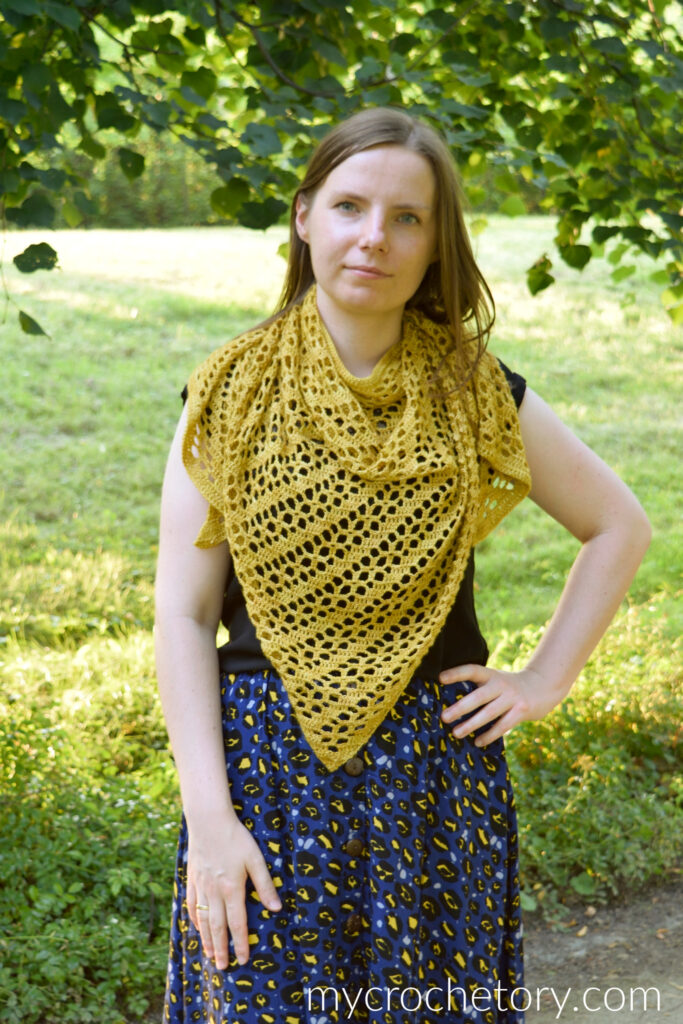
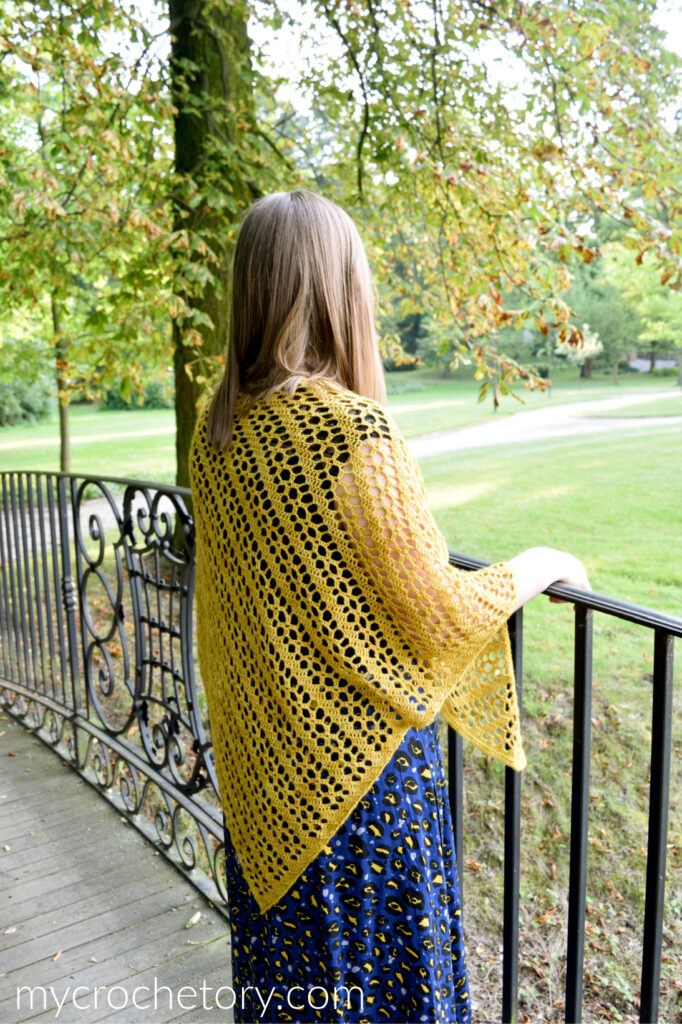
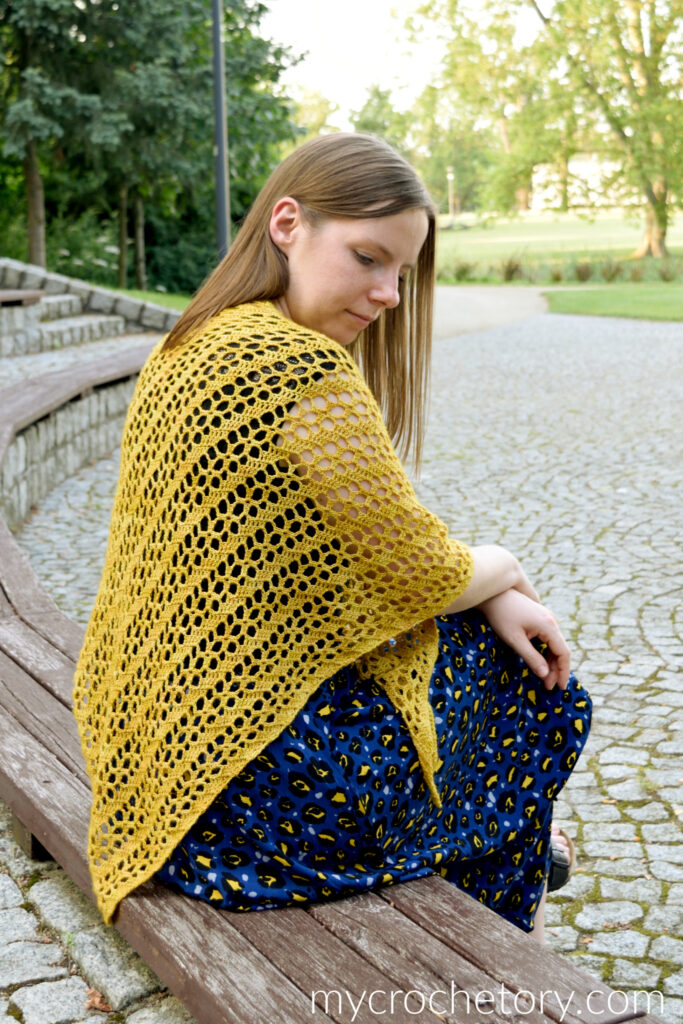
At first glance it looks like a classic triangle, but take a closer look at the lace. The open bands lean to one side and cross the whole shawl on a diagonal. That little twist makes this free triangle shawl crochet pattern anything but boring.
You start at the bottom point and work your way up, adding stitches at both edges of every row. Two skeins of soft merino are all you need, and after a few rows the lace repeat is easy to remember.
Scroll down for the free gold crochet shawl pattern.
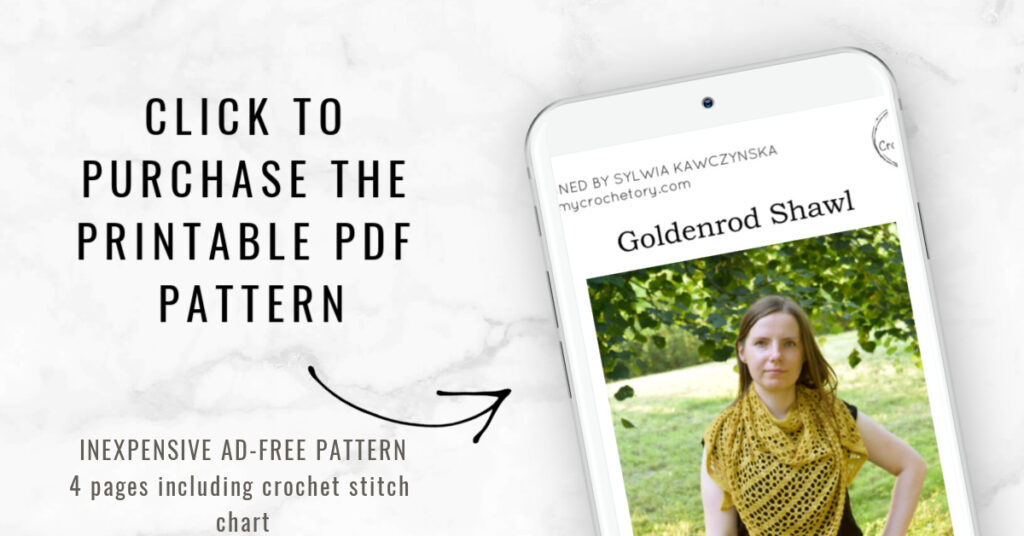
Want a printable version with a stitch chart? Get the ad-free PDF on Etsy or Ravelry.
What makes this gold crochet shawl different
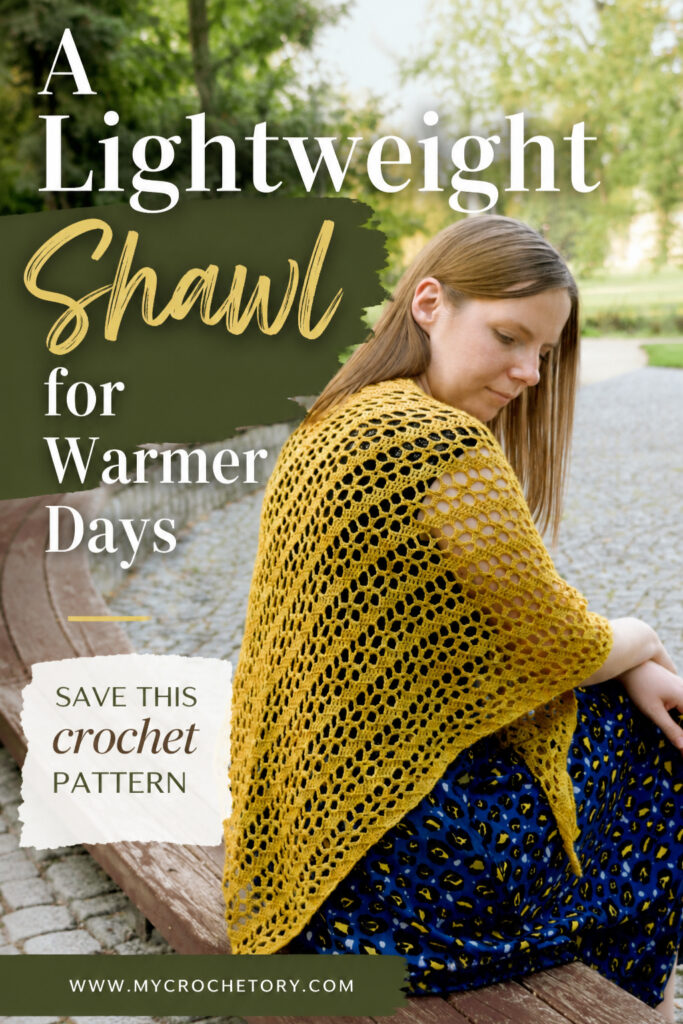
What makes this gold crochet shawl different? The lace! Each band is a mix of open chain spaces and tiny groups of single crochet, with solid stripes of double crochet on both sides.
And here’s the fun part. Row by row, every band moves a little to the side, so by the top of the shawl they cross the whole triangle on a slant.
The deep mustard gold makes all of this easy to see. Every hole and stripe pops against darker clothes, like the black top and navy skirt in my photos.
How this triangle shawl is made
This triangle shawl is made from the bottom up, and you start with only three double crochet stitches! Then in every row you work 3dc near both edges, so the shawl gets wider with each row you add.
The first six rows set up the lace. From Row 7 on, you just repeat the same four rows, and my shawl has 18 of those repeats. So once you know Rows 7 to 10, you basically know the whole pattern!
At the very end, two rows of double crochet with a few dc2tog give the top edge a neat, straight finish.
It’s an adventurous beginner to intermediate pattern, so you should feel at home with single crochet and double crochet. And if this is your first shawl ever, start with my guide on how to crochet a shawl, where I show you three easy ways.
2 ways to wear your gold crochet shawl
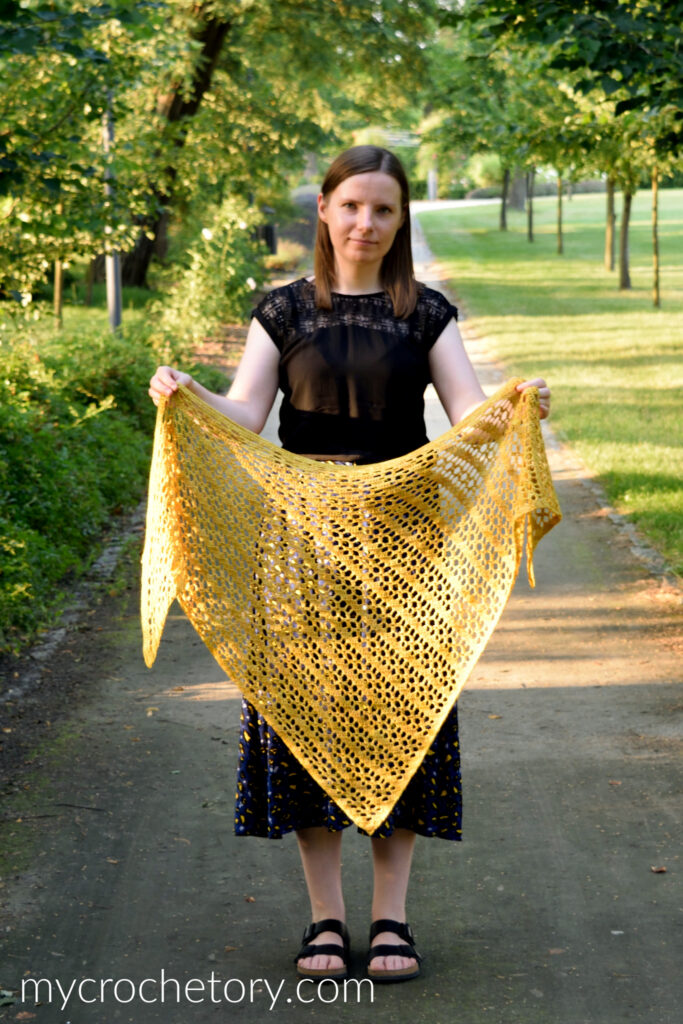
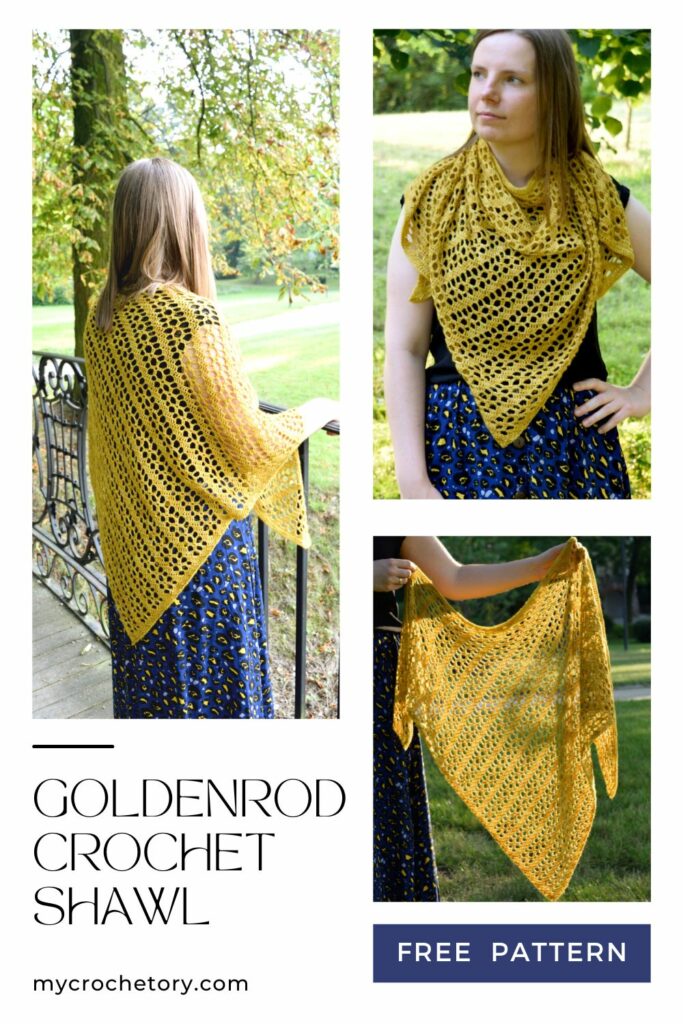
So how do you wear a gold crochet shawl this size? My photos show two easy ways, and both show off the diagonal lace. At about 63 inches wide and 29.5 inches deep, it’s big enough for both.
Point in front, like a bandana. Put the point right under your chin, then wrap the long ends around your neck. You’ll see this look in most of my photos, and it’s a quick way to add a pop of gold to a plain black top.
Over your shoulders, point at the back. Want the classic look instead? Drape it over your shoulders so the point hangs down your back, and the lace shows best from behind. It looks lovely over a sleeveless top, just like in my park photos.
Yarn and blocking tips for this triangle shawl
For this triangle shawl I picked 7oczek SoSoft Singles, a soft 100% superwash merino. Two skeins are enough, which is about 800 yards of yarn.
Two skeins also mean one join, somewhere in the middle of the shawl. That’s why it’s worth learning how to join yarn ends neatly, so the join hides in the lace.
Got some merino from an old project you never finished? You can reuse frogged yarn for this shawl too, just make sure you have enough of it.
Once you’re done, wet block your shawl, since merino is an animal fiber. Soak it, stretch it gently and pin it to a mat, with extra pins along the top edge and at the point. Let it dry completely, and every diagonal band will open up.
How to make this triangle shawl bigger or smaller
Want a bigger or smaller triangle shawl? Good news, you only need to change one thing, the number of times you repeat Rows 7 to 10. Every extra repeat adds about 1.5 inches of depth and about 3 inches of wingspan.
And however many repeats you make, the ending stays the same. You work Rows 7 and 8 one more time, and then the two last rows give your shawl its neat top edge.
Bigger shawl, more yarn, of course! My two skeins were just right for the size in the photos, so grab a third one if you plan to go bigger.
Gold crochet shawl FAQ
Is this gold crochet shawl good for beginners?
Yes, if you’re an adventurous beginner who knows the basic crochet stitches! The 4-row repeat is easy to learn, and after that the pattern pretty much runs on its own. Just take Rows 1 to 6 a bit slower, because that’s where the lace starts.
Why is the lace asymmetric?
Because I designed it that way! Every repeat moves the lace bands a little to the side, so they cross the shawl on a diagonal. That’s also why Row 6 looks different at each end, and yes, that’s correct.
What does “dc in last st” mean?
It means your last double crochet goes into the top of the ch3 from the start of the row. That ch3 counts as a dc, so treat it like a real stitch and work right into it.
Can I use a different yarn weight for this free triangle shawl crochet pattern?
Sure! A thinner yarn gives you a smaller, lighter shawl, and a thicker yarn makes it bigger and warmer. To check your size, measure your first 11 rows, because in my shawl they’re about 4 inches high.
Ready to make your own gold crochet shawl? Then pin this pattern first, so you can find it again whenever you need it.
And when your shawl is done, I’d love to see it! Share it on Instagram with #mycrochetory, so I can find it and cheer you on.
Goldenrod crochet shawl free pattern
- Purchase the ad-free, printable PDF with crochet stitch chart here on ETSY or here on Ravelry.
- Add this pattern to your Ravelry Queue HERE.
- Grab the MyCrochetory Shawl Pattern BUNDLE that includes 14 patterns for one low price HERE.
- Pin it for later.
Copyright 2020–2026 MyCrochetory. All rights reserved. This pattern is property of Sylwia Kawczyńska @MyCrochetory. Please DO NOT sell the pattern and claim this pattern as your own. The pattern is for personal use only and may not be translated or reproduced in another language. Please respect my rights, DO NOT share or publish this pattern anywhere without my permission.
The gold crochet shawl you make following this pattern is yours, and you are free to sell it, as long as you credit MyCrochetory as the original designer. For more information, please read the Terms Page.
As a bonus in the ad-free, printable PDF, I’ve provided a stitch chart. If you’re a visual learner or if you just want to support my work, you can purchase this crochet pattern HERE on ETSY or HERE on Ravelry. Thank you and I hope you find it useful!
Materials & tools
- Yarn: 7oczek Yarn SoSoft Singles 100g = 366m (400 yd), 100% Merino Superwash, 2 skeins.
- Hook size 3.5mm (US E/4). Adjust hook size if necessary to obtain correct gauge.
- Tapestry needle (to weave and hide yarn ends).
- Scissors.
Level
Adventurous beginner / Intermediate
Size after blocking (adjustable)
Wingspan 160cm/63″, center depth 75cm/29.5″.
Gauge after blocking
After Row 11 the triangle is approx. 10cm/4″ high.
Gauge is not important for this project. However, changes might result in different yardage requirements and finished size.
Notes
- The pattern uses US crochet terminology.
- The shawl is worked bottom up in rows. Increases are made at the start and end of the rows.
- You can also use yarn in different weights, but just know that the measurements will be different depending on your gauge.
- dc in last st means work double crochet stitch in top of beginning ch3, unless otherwise stated.
- Instructions in square brackets […] are worked as many times as indicated.
- The stitch chart is included in the ad-free printable PDF.
Stitches & abbreviations (US terms)
- ch(s) – chain(s) stitch
- st(s) – stitch(es)
- sc – single crochet
- dc – double crochet
- yo – yarn over
- sp – space
- sk – skip
- rep – repeat
- dc2tog – double crochet 2 stitches together – [yarn over, insert hook in indicated stitch, yarn over, draw up a loop, yarn over, pull through 2 loops] twice, yarn over, pull through all 3 loops on hook.
Pattern
Read Notes before you start.
Setup Row: ch4, 2dc in 4th ch from hook. Turn.
Row 1: ch3 (counts as dc here and throughout), 5dc in next dc, dc in last st. Turn.
Row 2: ch3, 3dc in next dc, dc in next 3dcs, 3dc in next dc, dc in last st. Turn.
Row 3: ch3, 3dc in next dc, dc in next 2dcs, ch3, sk 3dcs, dc in next 2dcs, 3dc in next dc, dc in last st. Turn.
Row 4: ch3, 3dc in next dc, dc in next 2dcs, ch3, sk next 2dcs, 2dc in ch-3sp, ch3, sk next 2dcs, dc in next 2dcs, 3dc in next dc, dc in last st. Turn.
Row 5: ch3, 3dc in next dc, dc in next 2dcs, ch3, sk next 2dcs, 3sc in ch-3sp, ch1, sk 2dcs, 3sc in next ch-3sp, ch3, sk next 2dcs, dc in next 2dcs, 3dc in next dc, dc in last st. Turn.
Row 6: ch3, 3dc in next dc, dc in next 2dcs, ch3, sk next 2dcs, 2dc in first ch-3sp, ch3, sk 3scs, 2dc in ch-1sp, ch3, sk 3scs, 2dc in next ch-3sp, dc in next 4dcs, 3dc in next dc, dc in last st. Turn.
Row 7: ch3, 3dc in next dc, dc in next 2dcs, ch3, sk 3dcs, [dc in next 3dcs, 2dc in first ch-3sp, ch3, sk 2dcs, 3sc in next ch-3sp, ch1, sk 2dcs, 3sc in next ch-3sp, ch3, sk next 2dcs] rep across until 4sts remain, dc in next 2dcs, 3dc in next dc, dc in last st. Turn.
Row 8: ch3, 3dc in next dc, dc in next 2dcs, [ch3, sk next 2dcs, 2dc in first ch-3sp, ch3, sk 3scs, 2dc in ch-1sp, ch3, sk 3scs, 2dc in next ch-3sp, dc in next 3dcs] rep across until 2dcs remain before last ch-3sp, ch3, sk next 2dcs, 2dc in last ch-3sp, ch3, sk next 2dcs, dc in next 2dcs, 3dc in next dc, dc in last st. Turn.
Row 9: ch3, 3dc in next dc, dc in next 2dcs, ch3, sk next 2dcs, 3sc in ch-3sp, ch1, sk 2dcs, 3sc in next ch-3sp, ch3, sk next 2dcs, [dc in next 3dcs, 2dc in next ch-3sp, ch3, sk 2dcs, 3sc in next ch-3sp, ch1, sk 2dcs, 3sc in next ch-3sp, ch3, sk next 2dcs] rep across until 4sts remain, dc in next 2dcs, 3dc in next dc, dc in last st. Turn.
Row 10: ch3, 3dc in next dc, dc in next 2dcs, [ch3, sk next 2dcs, 2dc in next ch-3sp, ch3, sk 3scs, 2dc in ch-1sp, ch3, sk 3scs, 2dc in next ch-3sp, dc in next 3dcs] rep across until 3sts remain, dc in next dc, 3dc in next dc, dc in last st. Turn.
Repeat Rows 7 – 10 17 more times or until desired length.
Next, repeat Rows 7 – 8.
Last Row 1: ch3, 3dc in next dc, dc in next 4dcs, 3dc in first ch-3sp, dc2tog, 3dc in next ch-3sp, [dc in next 5dcs, 3dc in next ch-3sp, dc2tog, 3dc in next ch-3sp, dc2tog, 3dc in next ch-3sp] rep across until 6sts remain, dc in next 4dcs, 3dc in next dc, dc in last st. Turn.
Last Row 2: ch3, 3dc in next st, dc in each st across until 2sts remain, 3dc in next st, dc in last st.
Fasten off yarn, weave in all ends and block your shawl.
If you have any suggestions or have found any mistakes, please feel free to email me at mycrochetory@gmail.com.
Stuck on a row, or want to show off your finished shawl? Come say hi in my Facebook Group or Ravelry Group, where crocheters help each other every day.
Loved this pattern? Then join my newsletter, and I’ll send my new patterns straight to your inbox.
More free lace triangle shawl patterns
Loved making a triangle from the bottom up? Then you’ll feel right at home with these three, because they’re all worked the same way!
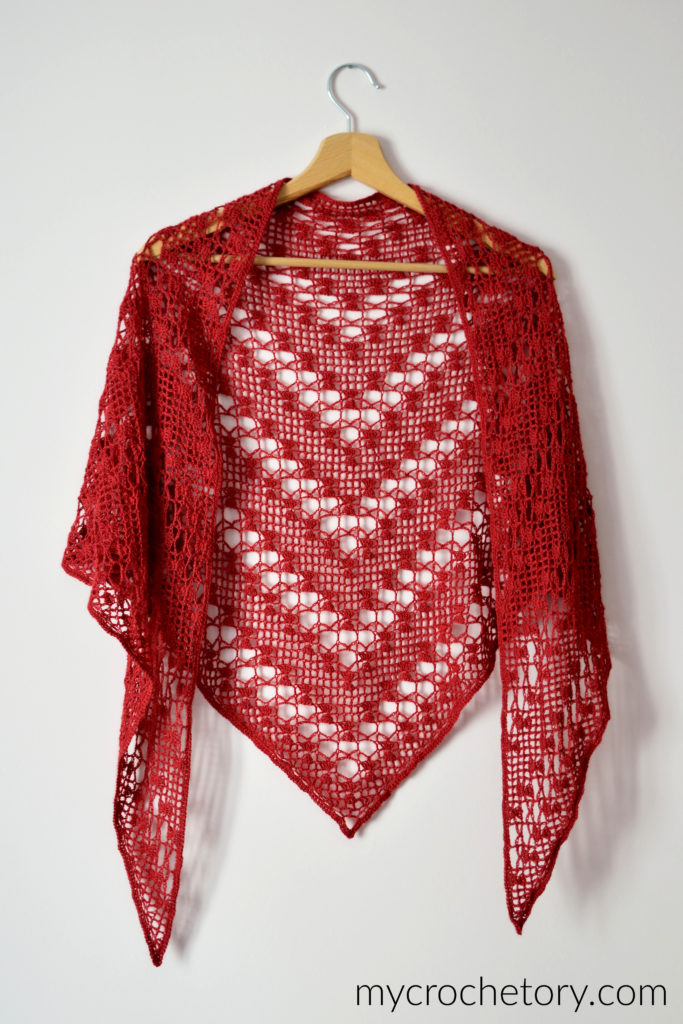
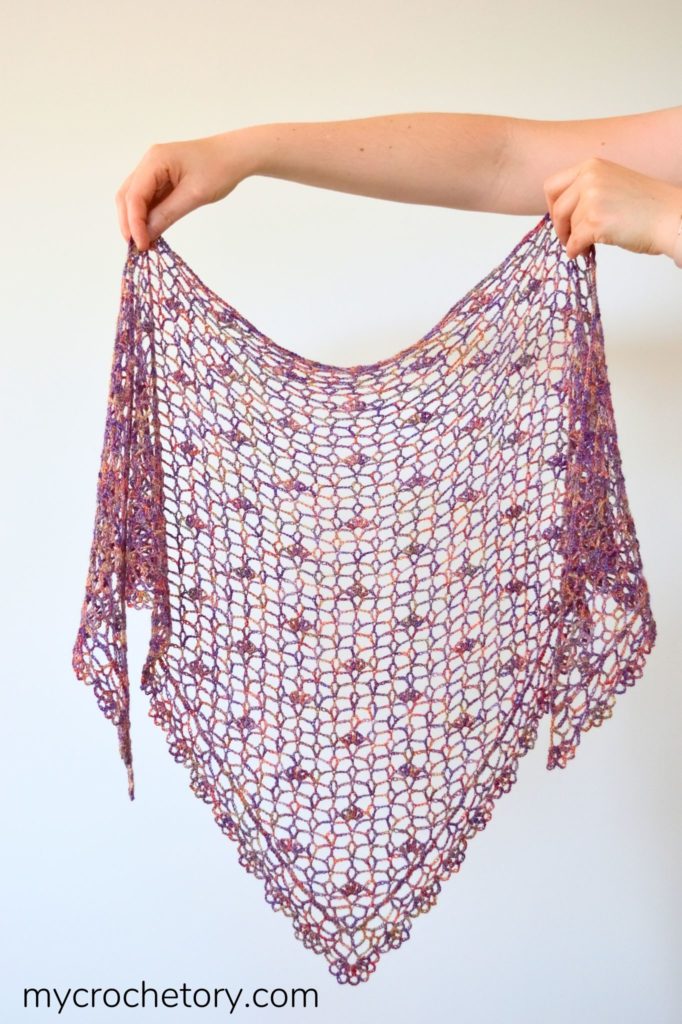
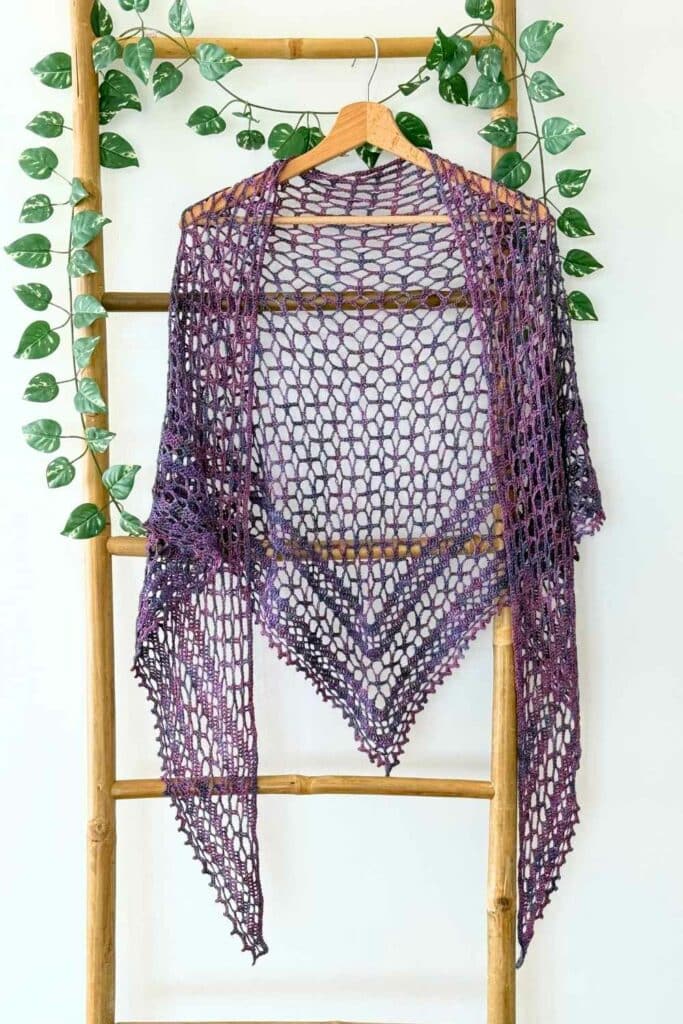
- Sarin Lace Shawl. Ready for a little more lace? Sarin has big lace motifs and a neat single crochet edge, and it’s lovely for special days like weddings.
- Greta Lace Shawl. Want something even lighter? Greta is made with lace weight yarn, and lacy clusters cover the whole triangle.
- Nightfall Shawl. Nightfall is one of my most popular lace shawls. It’s a big triangle, about 83 inches wide, made with a soft silk and alpaca yarn.
Looking for more? Browse all my free crochet shawl patterns.
So, are you going for gold like me, or picking a totally different color? Tell me in the comments! And if a row gives you trouble, ask me there too, so the next person with the same question finds the answer right away.
Leave a Reply