
Updated: 24 September 2026 by Sylwia (MyCrochetory)
This gradient crochet shawl pattern started because I got a little jealous of knitters. A few years ago, I kept seeing knitted shawls made with two yarns: one gradient and one solid. The colors changed so slowly and looked so good. So I picked up my hook and tried to get the same look in crochet.
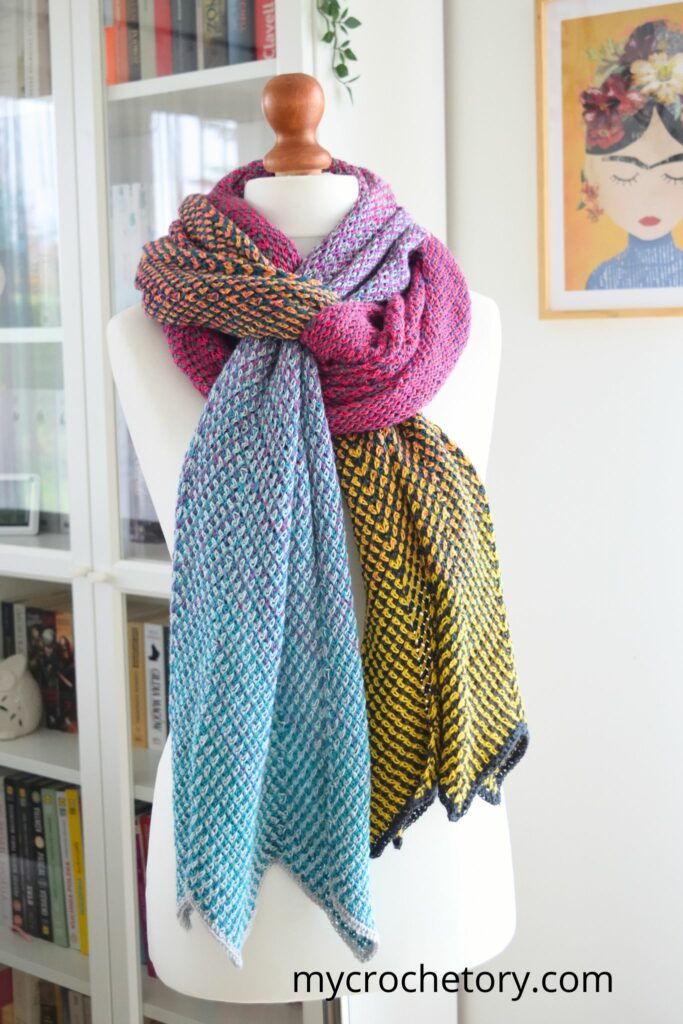
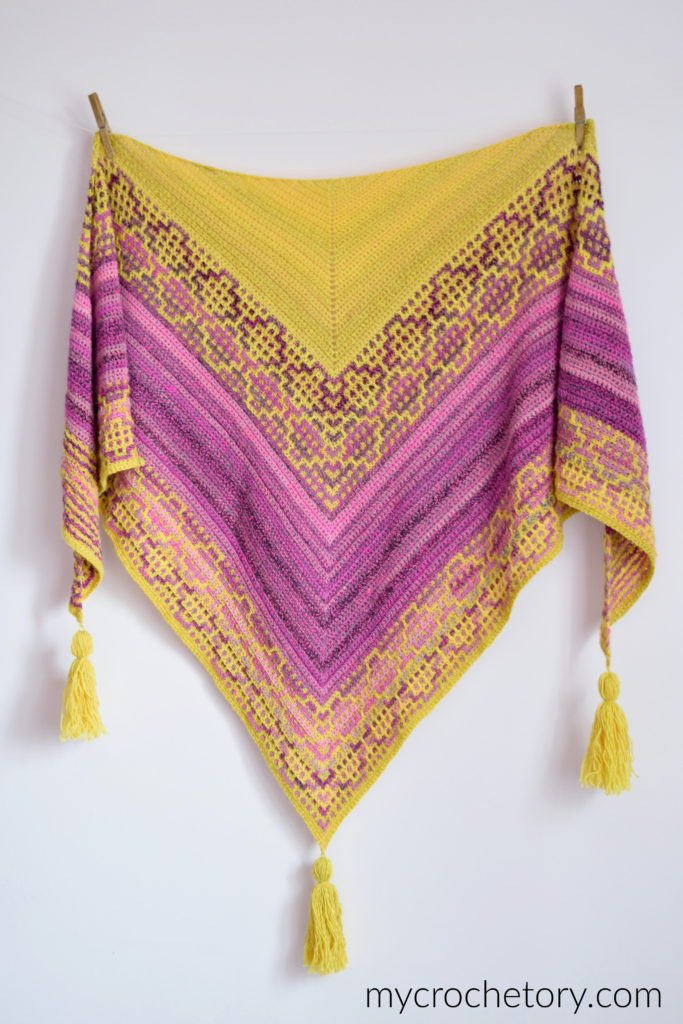
That’s how I made Crax, my gradient crochet shawl pattern in mosaic crochet. For my shawl, I used a cream solid yarn and a gradient cake that goes from blue to berry red, then to olive green and mustard yellow. The cream yarn makes tiny diamonds in diagonal lines, and the colors change slowly between them. One side of the shawl grows longer than the other, so it ends in a long tail.
Do you have a gradient cake in your stash and no idea what to crochet with it? In Crax, you can see every color change. Below, I show you how to pick a second yarn that works with it and how I block the shawl. New to mosaic crochet? I also share a few tips for your first rows.
It’s a free mosaic crochet shawl pattern, so the full pattern with a photo tutorial is below. Just scroll down.
If you want an ad-free printable PDF with the mosaic diagram, you can buy it on Etsy or Ravelry.

Want to make Crax later? Save it to your Pinterest board now, and you’ll find it fast when you have the right two yarns.
Why gradient yarn looks so good in mosaic crochet
Gradient yarn looks so good in mosaic crochet because of contrast. The stitches of your gradient yarn always sit right next to stitches of your solid yarn. So in this gradient crochet shawl, every shade has cream around it, and your eye sees each color much more clearly.
This comes from how mosaic crochet works. You use only one color in each row: one row gradient, one row cream. In some places you skip stitches, and two rows later you fill them with a double crochet that goes down into the skipped stitch.
With these long stitches, the gradient color shows up between the cream rows and the cream shows up between the gradient rows. That’s how the diamonds appear.

The cream stays the same from the first row to the last, and only the gradient changes. So the diamond pattern is the same all over this mosaic crochet shawl, but it looks new in every color. Blue diamonds look calm and cool, while mustard ones look bright and warm.
There’s a bonus too. Mosaic looks complicated, but you never hold two yarns at the same time or carry a strand behind your work. You only ever crochet with one color, and because the gradient changes slowly, you’ll probably catch yourself checking the yarn cake to see which color comes next.
How to pick yarn for your gradient crochet shawl
To pick yarn for your gradient crochet shawl, you need two yarns: one gradient (or ombre) yarn and one solid yarn. They should be the same weight and have about the same meters per 100 g. Any weight works for this pattern, but I don’t recommend lace.
After that, look at the colors, because contrast matters most. The bigger the difference between your two yarns, the clearer the diamonds will be. A pale solid with a dark or bright gradient works great, and so does the opposite.

For my Crax, I used Scheepjes Whirl as the gradient yarn and Scheepjes Whirlette in cream as the solid. Both are 60% cotton and 40% acrylic, and they’re almost the same thickness, so they work well together. You don’t need these exact yarns, though. Any pair that follows the tips above will look good.
Here’s a thing that’s easy to miss: you need about the same amount of both yarns. The colors change every row, so for my shawl I used the same meters of cream as of gradient yarn. Keep that in mind when you shop, and buy the same length of each.
For the hook, use the size on your yarn label. If your yarn is thicker or thinner than mine, your shawl will be bigger or smaller, and you’ll need a different amount of yarn. Gauge doesn’t matter much for this shawl, so don’t stress about it. That gradient cake you bought only because it looked pretty can finally become something.
Tips for your first mosaic crochet rows
Before your first mosaic crochet rows, it helps to know how this mosaic crochet shawl turns, how many chains to make, and where your mosaic stitches go. None of it is hard, but each part is a little different from regular crochet. Read this once, and the first rows of the pattern will make much more sense. New to crochet basics too? My free crochet tutorials for beginners show the basic stitches you’ll use here.
This shawl doesn’t turn after every row. You turn after every two rows, so you work two rows on the right side, then two rows on the wrong side, and so on. At the end of the first row in each pair, you drop the loop off the hook and don’t turn. Then you go back to the first stitch of the same row and start the next row with your other yarn.

At the end of that second row, you change back to the first yarn. Just grab the loop you dropped earlier and pull it through the two loops on your hook. Now you can turn your work.
When you skip stitches, count them carefully, because your chains depend on them. Make one chain more than the number of skipped stitches: ch2 for one skipped stitch, ch3 for two, ch4 for three. These extra chains keep the shawl flat so it doesn’t pucker.
The mosaic stitches go around those chains. On the right side, you work BLmosaicdc in front of the chains. On the wrong side, you work FLmosaicdc behind them. The chains stay unworked, so don’t crochet into them by mistake. If something looks wrong, compare your work with the step-by-step photos below the pattern.
How to make your Crax crochet shawl bigger or smaller
To make your Crax crochet shawl bigger or smaller, repeat Rows 13 to 52 more or fewer times. The pattern comes in one size, about 185 cm (72.75″) wide and 92 cm (36.25″) long at the center. But you don’t have to stop there.
Rows 13 to 52 are the pattern repeat. Each time you work them, your shawl gets wider and longer, and the long tail grows too. So if you want a smaller shawl to wear like a scarf, stop after fewer repeats. If you want a big wrap, keep going until you like the size, and buy extra of both yarns before you start.
In a gradient shawl, the size also changes which colors you’ll see. A bigger shawl uses more of the cake, so you get more colors. A smaller one may end before the last color, so check your cake first if you really want to reach that final shade.

How I block my gradient crochet shawl
I block my gradient crochet shawl in one of two ways, depending on the yarn. For cotton or acrylic yarn, I pin the shawl to a blocking mat and steam it with my iron. For merino, alpaca or other animal fibers, I use wet blocking.
Why bother? Because all the sizes in this pattern are after blocking. The gauge, the width and the length at the center only match my numbers once the shawl is blocked. So if you skip it, your shawl may look smaller than you expected.
My Crax is made with cotton and acrylic yarn, so I steam block it. First, I pin the whole shawl flat on the mat. Then I hold the iron about 1 cm above the shawl and move it over the whole piece with hot steam. The iron never touches the shawl, just the steam.
If your yarn has animal fibers, wet blocking works better. Soak the shawl in water, then gently stretch it to the right shape and pin it to the mat. Leave it there until it’s completely dry, and only then take the pins out.
More free crochet patterns for gradient yarn
If you still have gradient yarn after Crax, here are my other free crochet patterns made for it: the Flourish Linen Wrap, the Kalinda Shawl, the Leto Shawl and the Kalinda Wrap. Each one uses the color changes in a different way.
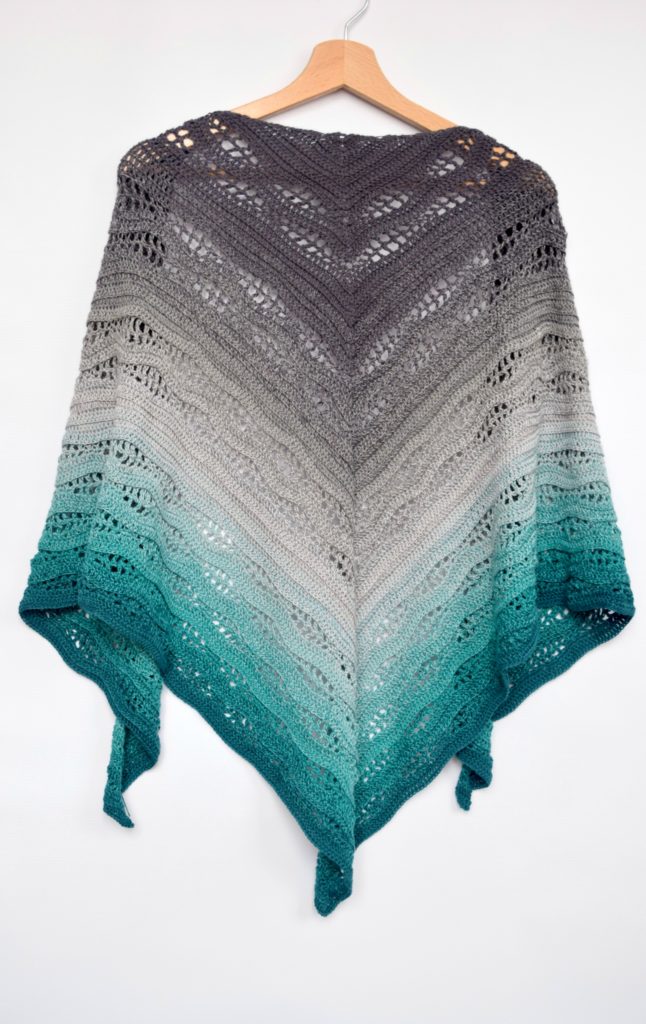

- Flourish Linen Wrap Same idea as Crax, different stitch. This wrap also pairs a gradient yarn with a solid one, but here the colors meet in a chevron made with the linen stitch (also called moss stitch). Thanks to my yarn-saving trick, you only have four ends to weave in at the end. You can change the width and length easily, and there’s a video tutorial to follow along.
- Kalinda Shawl Soft waves run across this triangle shawl, and they come from simple stitches worked in the back loop. It starts at the center of the top edge and grows down. Like Crax, it’s made with Scheepjes Whirl and Whirlette, so you can pick two or three colors. There’s a video tutorial, and it works well for adventurous beginners.
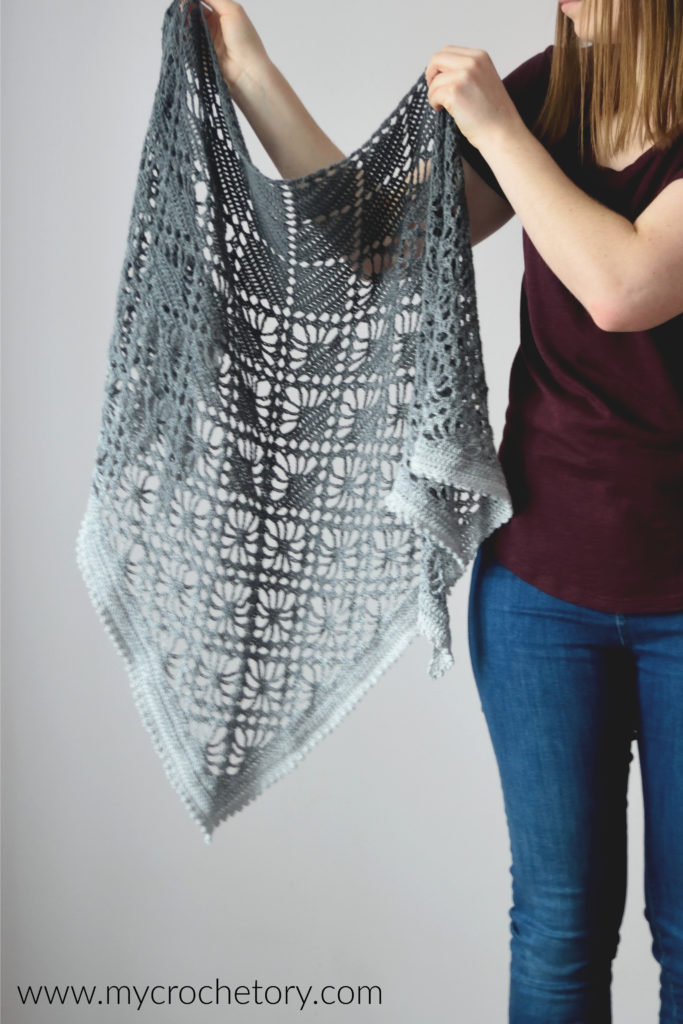
- Leto Shawl Here the gradient runs through geometric lace, with diamonds that open up more and more as the shawl grows. You start at the middle of the top edge and work two mirrored sides. I used one cake of Rico Creative Cotton Degrade for it. The pattern has written instructions and a chart, so you can follow whichever you like.
- Kalinda Wrap Want the Kalinda waves in a bigger piece? This wrap mixes them with simple double crochet sections, and you can change the size easily. It’s made with Scheepjes Whirl and comes with a video tutorial.
Want more shapes and stitches? Browse all my free crochet shawl patterns.
I love seeing your Crax shawls, so please share your progress and finished shawls on social media with the hashtag #mycrochetory.
If you get stuck or want to show off your colors, come join my Facebook Group or my Ravelry Group. You can also find me on Instagram, Facebook and Pinterest.
CRAX MOSAIC CROCHET SHAWL FREE PATTERN
- Purchase the ad-free, printable PDF here on ETSY or here on Ravelry.
- Add this pattern to your Ravelry Queue HERE.
- Grab the MyCrochetory Shawl Pattern BUNDLE that includes 14 patterns for one low price HERE.
- Pin it for later.
Copyright 2020 – 2026 MyCrochetory. All right reserved. This pattern is property of Sylwia Kawczyńska @MyCrochetory. Please DO NOT sell the pattern and claim this pattern as your own. The pattern is for personal use only and may not be translated or reproduced in another language. Please respect my rights, DO NOT share or publish this pattern anywhere without my permission.
The Gradient Crochet Shawl you make following this pattern is yours you are free to sell it, as long as you credit MyCrochetory as original designer. For more information, please, read Terms Page.
PIN IN FOR LATER

Materials & Tools:
Yarn A: Scheepjes Whirl 215g = 1000m, (60% Cotton, 40% Acrylic) – approx. 175g (814m).
Yarn B: Scheepjes Whirlette 100g = 455m, (60% Cotton and 40% Acrylic) – approx. 175g (814m) .
- Hook size 3.5mm. Adjust hook size if necessary to obtain correct gauge,
- Tapestry needle (to weave and hide yarn ends),
- Scissors.
Level:
Intermediate – mosaic crochet technique.
Size:
Approx. 185cm/72.75” wide and 92cm/36.25” long at center.
Gauge after blocking:
After row 14: 10cm/4” wide and 5cm/2” long at center.
Gauge isn’t very important for this project, but a different gauge will change the amount of yarn you need and the finished size.
General notes
- The pattern uses US crochet terminology.
- Shawl is worked top-down in rows, back and forth, with one color used for each row.
- Shawl is turned after every two rows. This means, you will work two rows on the RS, two rows on WS, and then again two rows on RS, and so on.
- STITCHES: When in the instructions you have a stitch followed by a number, eg sc14, this means you have to work 1sc stitch into each of the next 14 sts. When in the instructions you have a number followed by a stitch, eg 2sc, this means you have to work 2 sc stitches into the next (same) stitch.
- Instructions in square brackets […] are worked as many times as indicated.
Mosaic section notes
- You can either follow the chart or written instructions.
- You will work two rows on the RS, two rows on WS, and then again two rows on RS, and so on.
How to read the mosaic chart
- Chart is read from bottom to top and each row of squares represents one row of the shawl.
- All RS rows are read from right to left. All WS rows are read from left to right.
- Each square of the chart represents 1 stitch or 1 skipped stitch.
- Two red squares represent 2 single crochet worked in one stitch.
- Whenever you see a square of color dedicated to that round, work single crochet.
- Whenever you see a square of different color in that round, skip that stitch (make chain). To prevent puckering, make the same number of chain as the number of skipped sts plus ch1. For example, for 1 skipped st – make ch2, for 2 skipped sts – make ch3, for 3 skipped sts – make ch4, etc.
- Pay special attention to number of skipped stitches.
- BLmosaicdc and FLmosaicdc will be worked in these skipped sts from two rows below.
- BLmosaicdc and BLsc are worked on RS of your work and FLmosaicdc and FLsc are worked on WS of your work.
- Remember, BLmosaicdc are always worked in front of chains of previous row and FLmosaicdc are always worked behind the chains of previous row.
Stitches & Abbreviations (US terms):
st(s) – stitch(es)
BLsc – back loop only single crochet
FLsc – front loop only single crochet
BLdc – back loop only double crochet
FLdc – front loop only double crochet
yo – yarn over
BLmosaicdc (back loop only mosaic double crochet) – work regular BLdc in unworked/skipped st of the same color two rows below in front of chain space (in front of work). These chains will stay behind BLmosaicdc and will stay unworked.
FLmosaicdc (front loop only mosaic double crochet) – work regular FLdc in unworked/skipped st of the same color two rows below behind chain space (behind the work). These chains will stay in front of FLmosaicdc and will stay unworked.
M – marker
PM – place marker
RPM – reposition marker
sp – space
sk – skip
RS – right ride
WS – wrong side
![Mosaic crochet chart for the Crax gradient shawl, Rows 1 to 52, with Rows 13 to 52 marked as the repeat]](https://i1.wp.com/mycrochetory.com/wp-content/uploads/2020/03/gradientmosaicschematic3.jpg?fit=640%2C480&ssl=1)
PATTERN
With Yarn A and 3.5mm hook, ch2.
Row 1 (RS): 2sc in second ch from hook. Drop loop off the hook and don’t turn.
Row 2 (RS): Insert your hookin the first st of the same row, grab Yarn B and pull it through first st.
Ch1 (doesn’t count as a st here and throughout), 2sc in first st, sc in last st. Change to Yarn A in final st by grabbing the loop in the end of the row and pulling it through two loops on the hook. Turn.
Row 3 (WS): ch1, sc in first st, ch2, sk 1st, 2sc in last st. Drop loop off the hook and don’t turn.
Row 4 (WS): Insert your hookin the first st of the same row, grab Yarn B and pull it through first st.
Ch1, sc in first st, FLmosaicdc1 (in unworked st of same color two rows below, behind chains – here and throughout), FLsc1, 2sc in last st. Change to Yarn A in final st by grabbing the loop in the end of the row and pulling it through two loops on the hook. Turn.
Row 5 (RS): ch1, 2sc in first st, ch2, sk 1st, BLsc2, sc in last st. Drop loop off the hook and don’t turn.
Row 6 (RS): Insert your hookin the first st of the same row, grab Yarn B and pull it through first st.
Ch1, 2sc in first st, BLsc1, BLmosaicdc1 (in unworked st of same color two rows below, in front of chains – here and throughout), ch2, sk 1st, BLsc1, sc in last st. Change to Yarn A in final st by grabbing the loop in the end of the row and pulling it through two loops on the hook. Turn.
Row 7 (WS): ch1, sc in first st, FLsc1, FLmosaicdc1, FLsc1, ch2, sk 1st, FLsc1, 2sc in last st. Drop loop off the hook and don’t turn.
Row 8 (WS): Insert your hookin the first st of the same row, grab Yarn B and pull it through first st.
Ch1, sc in first st, FLsc2, ch2, sk 1st, FLmosaicdc1, FLsc2, 2sc in last st. Change to Yarn A in final st by grabbing the loop in the end of the row and pulling it through two loops on the hook. Turn.
Row 9 (RS): ch1, 2sc in first st, BLsc4, BLmosaicdc1, ch3, sk 2sts, sc in last st. Drop loop off the hook and don’t turn.
Row 10 (RS): Insert your hookin the first st of the same row, grab Yarn B and pull it through first st.
Ch1, 2sc in first st, BLsc1, ch2, sk 1st, BLsc1, ch2, sk 1st, BLsc1, ch2, sk 1st, BLmosaicdc2, sc in last st. Change to Yarn A in final st by grabbing the loop in the end of the row and pulling it through two loops on the hook. Turn.
Row 11 (WS): ch1, sc in first st, FLsc2, FLmosaicdc1, FLsc1, FLmosaicdc1, FLsc1, FLmosaicdc1, FLsc2, 2sc in last st. Drop loop off the hook and don’t turn.
Row 12 (WS): Insert your hookin the first st of the same row, grab Yarn B and pull it through first st.
Ch1, sc in first st, FLsc in every st until last st remain, 2sc in last st. Change to Yarn A in final st by grabbing the loop in the end of the row and pulling it through two loops on the hook. Turn.
Row 13 (RS): ch1, 2sc in first st, ch2, sk 1st, BLsc1, ch2, sk 1st, [BLsc1, ch2, sk 1st, BLsc3, ch2, sk 1st, BLsc1, ch2, sk 1st]rep until last st remain, sc in last st. Drop loop off the hook and don’t turn.
Row 14 (RS): Insert your hookin the first st of the same row, grab Yarn B and pull it through first st.
Ch1, 2sc in first st, ch2, sk 1st, BLmosaicdc1, BLsc1, BLmosaicdc1, [BLsc1, BLmosaicdc1, ch4, sk 3sts, BLmosaicdc1, BLsc1, BLmosaicdc1] rep until last st remain, sc1 in last st. Change to Yarn A in final st by grabbing the loop in the end of the row and pulling it through two loops on the hook. Turn.
Row 15 (WS): ch1, sc in first st, FLsc2, ch2, sk 1st, FLmosaicdc1, [FLmosaicdc2, ch2, sk 1st, FLsc3, ch2, sk 1st, FLmosaicdc1] rep until 2sts remain, FLsc1, 2sc in last st. Drop loop off the hook and don’t turn.
Row 16 (WS): Insert your hookin the first st of the same row, grab Yarn B and pull it through first st.
Ch1, sc in first st, FLsc1, ch2, sk 1st, FLmosaicdc1, [FLsc3, FLmosaicdc1, ch2, sk 1st, FLsc1, ch2, sk 1st, FLmosaicdc1] rep until 4sts remain, FLsc3, 2sc in last st. Change to Yarn A in final st by grabbing the loop in the end of the row and pulling it through two loops on the hook. Turn.
Row 17 (RS): ch1, 2sc in first st, BLsc1, ch2, sk 1st, BLsc1, ch2, sk 1st, BLsc1, BLmosaicdc1, BLsc1, [BLmosaicdc1, BLsc1, ch2, sk 1st, BLsc1, ch2, sk 1st, BLsc1, BLmosaicdc1, BLsc1] rep until last st remain, sc in last st. Drop loop off the hook and don’t turn.
Row 18 (RS): Insert your hookin the first st of the same row, grab Yarn B and pull it through first st.
Ch1, 2sc in first st, [BLsc1, ch2, sk 1st, BLmosaicdc1, BLsc1, BLmosaicdc1, ch2, sk 1st, BLsc2] rep until last st remain, sc in last st. Change to Yarn A in final st by grabbing the loop in the end of the row and pulling it through two loops on the hook. Turn.
Row 19 (WS): ch1, sc in first st, ch3, sk 2sts, FLmosaicdc1, FLsc3, FLmosaicdc1, [ch4, sk 3sts, FLmosaicdc1, FLsc3, FLmosaicdc1] rep until 3sts remain, ch3, sk 2sts, 2sc in last st. Drop loop off the hook and don’t turn.
Row 20 (WS): Insert your hookin the first st of the same row, grab Yarn B and pull it through first st.
Ch1, sc in first st, FLmosaicdc1, [FLmosaicdc1, ch2, sk 1st, FLsc1, ch2, sk 1st, FLsc1, ch2, sk 1st, FLmosaicdc2] rep until 2sts remain, FLsc1, 2sc in last st. Change to Yarn A in final st by grabbing the loop in the end of the row and pulling it through two loops on the hook. Turn.
Row 21 (RS): ch1, 2sc in first st, BLsc3, [BLsc1, BLmosaicdc1, BLsc1, BLmosaicdc1, BLsc1, BLmosaicdc1, BLsc2] rep until last st remain, sc in last st. Drop loop off the hook and don’t turn.
Row 22 (RS): Insert your hookin the first st of the same row, grab Yarn B and pull it through first st.
Ch1, 2sc in first st, BLsc in each st across until last st remain, sc in last st. Change to Yarn A in final st by grabbing the loop in the end of the row and pulling it through two loops on the hook. Turn.
Row 23 (WS): ch1, sc in first st, ch2, sk 1st, FLsc1, ch2, sk 1st, FLsc2, [FLsc1, ch2, sk 1st, FLsc1, ch2, sk 1st, FLsc1, ch2, sk 1st, FLsc2] rep until last st remain, 2sc in last st. Drop loop off the hook and don’t turn.
Row 24 (WS): Insert your hookin the first st of the same row, grab Yarn B and pull it through first st.
Ch1, sc in first st, FLmosaicdc1, FLsc1, FLmosaicdc1, ch4, sk 3sts, [FLmosaicdc1, FLsc1, FLmosaicdc1, FLsc1, FLmosaicdc1, ch4, sk 3sts] rep until last st remain, 2sc in last st. Change to Yarn A in final st by grabbing the loop in the end of the row and pulling it through two loops on the hook. Turn.
Row 25 (RS): ch1, 2sc in first st, ch2, sk 1st, BLmosaicdc3, ch2, sk 1st, BLsc2, [BLsc1, ch2, sk 1st, BLmosaicdc3, ch2, sk 1st, BLsc2] rep until last st remain, sc in last st. Drop loop off the hook and don’t turn.
Row 26 (RS): Insert your hookin the first st of the same row, grab Yarn B and pull it through first st.
Ch1, 2sc in first st, [ch2, sk 1st, BLmosaicdc1, BLsc3, BLmosaicdc1, ch2, sk 1st, BLsc1] rep until last st remain. Change to Yarn A in final st by grabbing the loop in the end of the row and pulling it through two loops on the hook. Turn.
Row 27 (WS): ch1, sc in first st, [FLsc1, FLmosaicdc1, FLsc1, ch2, sk 1st, FLsc1, ch2, sk 1st, FLsc1, FLmosaicdc1] rep until 2sts remain, FLsc1, 2sc in last st. Drop loop off the hook and don’t turn.
Row 28 (WS): Insert your hookin the first st of the same row, grab Yarn B and pull it through first st.
Ch1, sc in first st, FLsc2, [ch2, sk 1st, FLmosaicdc1, FLsc1, FLmosaicdc1, ch2, sk 1st, FLsc3] rep until last st remain, 2sc in last st. Change to Yarn A in final st by grabbing the loop in the end of the row and pulling it through two loops on the hook. Turn.
Row 29 (RS): ch1, 2sc in first st, BLsc1, [ch4, sk 3sts, BLmosaicdc1, BLsc3, BLmosaicdc1] rep until 3sts remain, ch3, sk 2sts, sc in last st. Drop loop off the hook and don’t turn.
Row 30 (RS): Insert your hookin the first st of the same row, grab Yarn B and pull it through first st.
Ch1, 2sc in first st, BLsc1, ch2, sk 1st, [BLmosaicdc3, ch2, sk 1st, BLsc1, ch2, sk 1st, BLsc1, ch2, sk 1st] rep until ch-3sp and last st remain, BLmosaicdc2, sc in last st. Change to Yarn A in final st by grabbing the loop in the end of the row and pulling it through two loops on the hook. Turn.
Row 31 (WS): ch1, sc in first st, FLsc2, FLmosaicdc1, FLsc1, [FLmosaicdc1, FLsc1, FLmosaicdc1, FLsc3, FLmosaicdc1, FLsc1] rep until 2sts remain, FLsc1, 2sc in last st. Drop loop off the hook and don’t turn.
Row 32 (WS): Insert your hookin the first st of the same row, grab Yarn B and pull it through first st.
Ch1, sc in first st, FLsc in each st across until last st remain, 2sc in last st. Change to Yarn A in final st by grabbing the loop in the end of the row and pulling it through two loops on the hook. Turn.
Row 33 (RS): ch1, 2sc in first st, ch2, sk 1st, BLsc3, [ch2, sk 1st, BLsc1, ch2, sk 1st, BLsc1, ch2, sk 1st, BLsc3] rep until 4sts remain, ch2, sk 1st, BLsc1, ch2, sk 1st, sc in last st. Drop loop off the hook and don’t turn.
Row 34 (RS): Insert your hookin the first st of the same row, grab Yarn B and pull it through first st.
Ch1, 2sc in first st, [BLsc1, BLmosaicdc1, ch4, sk 3sts, BLmosaicdc1, BLsc1, BLmosaicdc1] rep until last st remain, sc in last st. Change to Yarn A in final st by grabbing the loop in the end of the row and pulling it through two loops on the hook. Turn.
Row 35 (WS): ch1, sc in first st, [FLsc2, ch2, sk 1st, FLmosaicdc3, ch2, sk 1st, FLsc1] rep until 2sts remain, FLsc1, 2sc in last st. Drop loop off the hook and don’t turn.
Row 36 (WS): Insert your hookin the first st of the same row, grab Yarn B and pull it through first st.
Ch1, sc in first st, FLsc1, [ch2, sk 1st, FLmosaicdc1, FLsc3, FLmosaicdc1, ch2, sk 1st, FLsc1] rep until 2sts remain, ch2, sk 1st, 2sc in last st. Change to Yarn A in final st by grabbing the loop in the end of the row and pulling it through two loops on the hook. Turn.
Row 37 (RS): ch1, 2sc in first st, BLsc1, BLmosaicdc1, BLsc1, [BLmosaicdc1, BLsc1, ch2, sk 1st, BLsc1, ch2, sk 1st, BLsc1, BLmosaicdc1, BLsc1] rep until last st remain, sc in last st. Drop loop off the hook and don’t turn.
Row 38 (RS): Insert your hookin the first st of the same row, grab Yarn B and pull it through first st.
Ch1, 2sc in first st, BLsc1, ch2, sk 1st, BLsc2, [BLsc1, ch2, sk 1st, BLmosaicdc1, BLsc1, BLmosaicdc1, ch2, sk 1st, BLsc2] rep until last st remain, sc in last st. Change to Yarn A in final st by grabbing the loop in the end of the row and pulling it through two loops on the hook. Turn.
Row 39 (WS): ch1, sc in first st, ch3, sk 2sts, FLmosaicdc1, [FLsc3, FLmosaicdc1, ch4, sk 3sts, FLmosaicdc1] rep until 3sts remain, FLsc2, 2sc in last st. Drop loop off the hook and don’t turn.
Row 40 (WS): Insert your hookin the first st of the same row, grab Yarn B and pull it through first st.
Ch1, sc in first st, FLmosaicdc2, ch2, sk 1st, FLsc1, ch2, sk 1st, FLsc1, [ch2, sk 1st, FLmosaicdc3, ch2, sk 1st, FLsc1, ch2, sk 1st, FLsc1] rep until last st remain, 2sc in last st. Change to Yarn A in final st by grabbing the loop in the end of the row and pulling it through two loops on the hook. Turn.
Row 41 (RS): ch1, 2sc in first st, BLsc2, BLmosaicdc1, BLsc1, BLmosaicdc1, BLsc2, [BLsc1, BLmosaicdc1, BLsc1, BLmosaicdc1, BLsc1, BLmosaicdc1, BLsc2] rep until last st remain, sc in last st. Drop loop off the hook and don’t turn.
Row 42 (RS): Insert your hookin the first st of the same row, grab Yarn B and pull it through first st.
Ch1, 2sc in first st, BLsc in each st across until last st remain, sc in last st. Change to Yarn A in final st by grabbing the loop in the end of the row and pulling it through two loops on the hook. Turn.
Row 43 (WS): ch1, sc in first st, [ch2, sk 1st, FLsc1, ch2, sk 1st, FLsc3, ch2, sk 1st, FLsc1] rep until 2sts remain, ch2, sk 1st, 2sc in last st. Drop loop off the hook and don’t turn.
Row 44 (WS): Insert your hookin the first st of the same row, grab Yarn B and pull it through first st.
Ch1, sc in first st, FLmosaicdc1, FLsc1, [FLmosaicdc1, ch4, sk 3sts, FLmosaicdc1, FLsc1, FLmosaicdc1, FLsc1] rep until last st remain, 2sc in last st. Change to Yarn A in final st by grabbing the loop in the end of the row and pulling it through two loops on the hook. Turn.
Row 45 (RS): ch1, 2sc in first st, ch2, sk 1st, BLsc2, [BLsc1, ch2, sk 1st, BLmosaicdc3, ch2, sk 1st, BLsc2] rep until last st remain, sc in last st. Drop loop off the hook and don’t turn.
Row 46 (RS): Insert your hookin the first st of the same row, grab Yarn B and pull it through first st.
Ch1, 2sc in first st, BLsc1, BLmosaicdc1, ch2, sk 1st, BLsc1, [ch2, sk 1st, BLmosaicdc1, BLsc3, BLmosaicdc1, ch2, sk 1st, BLsc1] rep until last st remain, sc in last st. Change to Yarn A in final st by grabbing the loop in the end of the row and pulling it through two loops on the hook. Turn.
Row 47 (WS): ch1, sc in first st, FLsc1, FLmosaicdc1, FLsc1, ch2, sk 1st, FLsc1, [ch2, sk 1st, FLsc1, FLmosaicdc1, FLsc1, FLmosaicdc1, FLsc1, ch2, sk 1st, FLsc1] rep until last st remain, 2sc in last st. Drop loop off the hook and don’t turn.
Row 48 (WS): Insert your hookin the first st of the same row, grab Yarn B and pull it through first st.
Ch1, sc in first st, FLsc2, ch2, sk 1st, FLmosaicdc1, FLsc1, [FLmosaicdc1, ch2, sk 1st, FLsc3, ch2, sk 1st, FLmosaicdc1, FLsc1] rep until 2sts remain, FLsc1, 2sc in last st. Change to Yarn A in final st by grabbing the loop in the end of the row and pulling it through two loops on the hook. Turn.
Row 49 (RS): ch1, 2sc in first st, BLsc4, BLmosaicdc1, [ch4, sk 3sts, BLmosaicdc1, BLsc3, BLmosaicdc1] rep until 3sts remain, ch3, sk 2sts, sc in last st. Drop loop off the hook and don’t turn.
Row 50 (RS): Insert your hookin the first st of the same row, grab Yarn B and pull it through first st.
Ch1, 2sc in first st, BLsc1, ch2, sk 1st, BLsc1, ch2, sk 1st, BLsc1, ch2, sk 1st, BLmosaicdc2, [BLmosaicdc1, ch2, sk 1st, BLsc1, ch2, sk 1st, BLsc1, ch2, sk 1st, BLmosaicdc2] rep until last st remain, sc in last st. Change to Yarn A in final st by grabbing the loop in the end of the row and pulling it through two loops on the hook. Turn.
Row 51 (WS): ch1, sc in first st, [FLsc2, FLmosaicdc1, FLsc1, FLmosaicdc1, FLsc1, FLmosaicdc1, FLsc1] rep until 2sts remain, FLsc1, 2sc in last st. Drop loop off the hook and don’t turn.
Row 52 (WS): Insert your hookin the first st of the same row, grab Yarn B and pull it through first st.
Ch1, sc in first st, FLsc in each st across until last st remain, 2sc in last st. Change to Yarn A in final st by grabbing the loop in the end of the row and pulling it through two loops on the hook. Turn.
Repeat Rows 13 – 52 until desired length.
TUTORIAL
The photos below show Rows 1 to 22 step by step. By Row 12 you’ve already used every stitch in this pattern, and Rows 13 to 22 show the start of the repeat. If your work looks different from a photo, stop and count your stitches in that row before you go on.
Row 1


Row 2


Row 3


Row 4


Row 5


Row 6


Row 7


Row 8


Row 9


Row 10


Row 11


Row 12

Row 13


Row 14


Row 15


Row 16


Row 17

Row 18


Row 19


Row 20


Row 21

Row 22


Crax shawl FAQ
(An FAQ block is fine for readers, but don’t expect FAQ rich results: Google shows them almost only for government and health sites since 2023.)
Is the Crax shawl pattern good for beginners? It’s written for intermediate crocheters, because in mosaic crochet you need to count skipped stitches carefully. If you know single and double crochet, the photo tutorial for Rows 1 to 22 will help you a lot. If you’ve never made a shawl before, start with my guide on how to crochet a triangle shawl.
What yarn weight can I use? You can use any yarn weight except lace. Pick one gradient yarn and one solid yarn in the same weight, and use the hook size from your yarn label. A thicker or thinner yarn will make your shawl bigger or smaller.
How much yarn do I need? For my shawl, I used about 814 m of each yarn: Scheepjes Whirl and Scheepjes Whirlette. That gave me a shawl about 185 cm wide and 92 cm long at the center. With a different yarn or size, you’ll need a different amount, but always about the same length of both yarns.
Is there a chart for this mosaic crochet shawl? Yes, the mosaic chart is right above the written pattern, so you can follow either one. The ad-free printable PDF on Etsy and Ravelry has the chart, the written rows and the photo tutorial in one file.
Do I need to block my Crax shawl? Yes, because all the sizes in the pattern are measured after blocking. I steam block cotton and acrylic yarn and wet block animal fibers like merino or alpaca. You’ll find both methods in the blocking section above.
Can I sell the shawls I make from this pattern? Yes, the shawl you make is yours to sell. Please credit MyCrochetory as the designer. You can’t sell or share the pattern itself.

OTHER MOSAIC CROCHET PATTERNS YOU MIGHT LOVE
Wow, just WOW!
Hi, just wanted to say your meterage figures seem to have the decimal point in the wrong place.
Also would love to adapt the chart for a square shawl. Is there a calculation (sts per pattern rpt) that could be used pls?
Just love the gradient idea coupled with mosiac crochet.
Thanks
Hi,
Remaking this pattern to a square shawl requires some time, so I’m sorry but I can’t do it at this moment. I will let you know when it happens.
Hi, this is my first try at mosaic crochet, so that you, the photos have really helped! Row 19’s written pattern doesn’t match up with the photo (I think). The last instruction is a Front post sc, but the photo indicates to skip 2 and 2 sc in the last stitch. Sorry if I have misread, I just wondered if the photo is correct? This is a beautiful shawl, I am hoping to make one for a family member! Thank you for the pattern.
Hi,
The photo is correct but in the written instruction is a small error.
Row 19 (WS) should read:
ch1, sc in first st, ch3, sk 2sts, FLmosaicdc1, FLsc3, FLmosaicdc1, [ch4, sk 3sts, FLmosaicdc1, FLsc3, FLmosaicdc1] rep until 3sts remain, ch3, sk 2sts, 2sc in last st. Drop loop off the hook and don’t turn.
Thank you!