
Updated: 23 October 2026 by Sylwia (MyCrochetory)
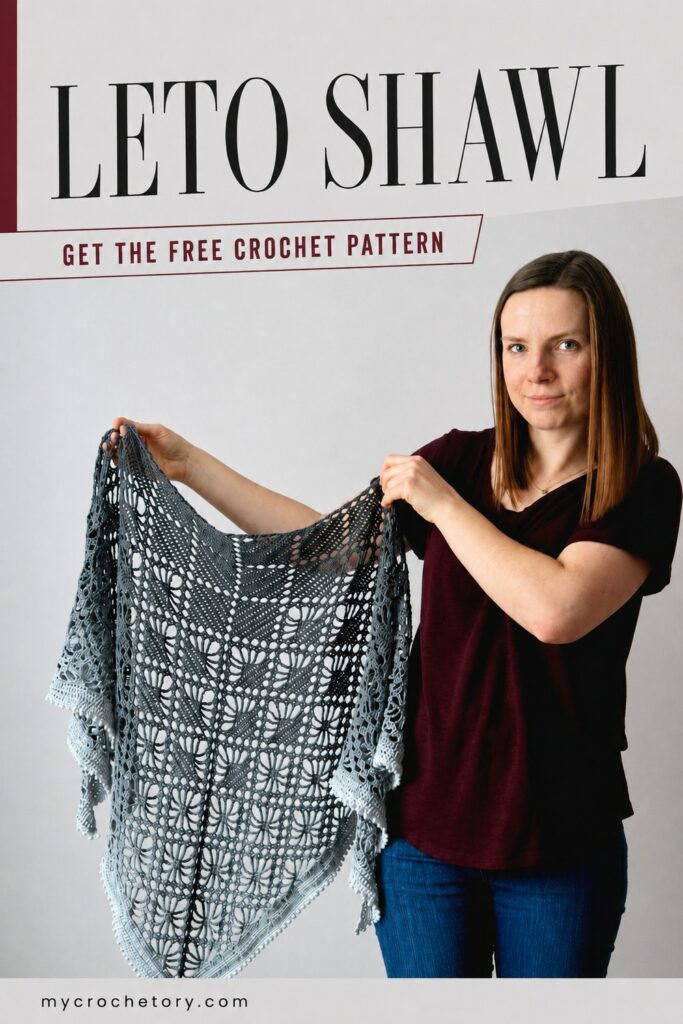
I designed this yarn cake crochet shawl with my mathematician’s love for geometric shapes. That’s why the lace is full of diamonds! Then I paired them with one gradient cake, and in my shawl they fade from dark gray to almost white.
The whole shawl grows from one tiny magic ring at the top center. You work outward row by row, and each row is a bit longer than the last. That’s why every new color spreads wider than the one before, until one cake turns into a lace triangle shawl about 67 inches wide.
Ready to start? The free pattern comes in four parts, and this is Part 1 with Rows 1 to 21. Parts 2, 3 and 4 are already on the blog, so nothing stops you from making the whole shawl in one go.
Leto Shawl free pattern in 4 parts
Jump to Part 1 of the free Leto Shawl pattern. Rather have the whole shawl in one file? Grab the complete ad-free, printable PDF with all stitch charts HERE on ETSY or HERE on Ravelry.

Want my next pattern before anyone else? Sign up below, and new patterns land straight in your inbox.
Join my Facebook Group and Official Ravelry Group where you can find necessary support, you can ask questions or share your finished projects.
You can also follow my Instagram, Facebook page and Pinterest.
Why I designed this yarn cake crochet shawl
I designed this yarn cake crochet shawl to be perfectly symmetrical, because symmetry is my favorite thing about geometry. So every row does the exact same thing on both sides of the center. Fold the shawl in half, and the diamonds on the left meet the diamonds on the right!
That’s also why a yarn cake works so well here. Its colors change slowly, so they never cut through the diamonds. Your shapes stay crisp, and the color changes quietly in the background.
And here’s the good news for you. Once you’ve worked the first half of a row, you already know the second half, because it’s the same steps in reverse. You just keep an eye on the marker in the center, and the rest of the row follows on its own.
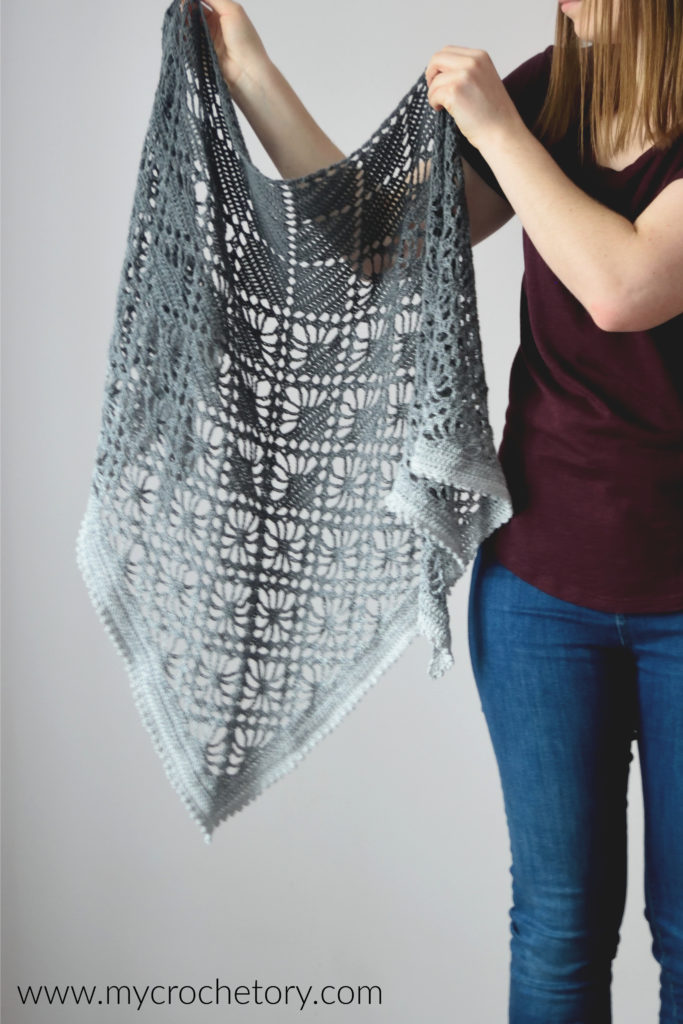
How one yarn cake turns into a gradient shawl
One yarn cake turns into a gradient shawl because its colors are already lined up inside, from one end to the other. I started from the dark end of mine, so the shawl is darkest at the neck and gets lighter toward the edges. If you want it the other way around, just start from the light end, and your shawl flips.
Peek at both ends of your cake before you start, because the outside end and the center end often show different colors. And here’s a bonus, one cake is enough for the whole Leto Shawl. So there are no joins and no extra ends to weave in halfway.

What makes the Leto lace triangle shawl
The Leto lace triangle shawl gets its look from two simple things, blocks of double crochet and little ch-2 spaces. The ch-2 spaces move a bit with every row, and they draw the outlines of the diamonds. Inside those outlines, the dc blocks fill the shapes with solid color.
Then, in Row 18, the lace gets airy. You make long ch-10 loops, and over the next three rows you catch them with ch-5 arches and a group of single crochet that grows from 1 to 5 stitches. That’s where Part 1 ends, right as the first lace motifs open up.
All this happens around one ch-5 space at the center, and the stitch marker in it keeps your triangle sharp. Just move the marker up as you go. If you know your dc and chain spaces, this intermediate pattern is a fun next step.

Yarn, size and blocking for your yarn cake crochet shawl
My yarn cake shawl is made with just one cake of Creative Cotton Degrade, half cotton and half acrylic. That one cake gives you about 875 yards, and I crocheted it all with a 3.5 mm (US E/4) hook. This blend suits lace really well, because the cotton keeps the lines clean and the acrylic keeps the shawl soft.
Can’t find this cake anymore? No problem, any gradient cake of a similar weight will do, as long as it has at least 875 yards. Just measure your work after Row 9, and if the triangle is about 4 inches high, you’re on track.
Once you’re done, block your shawl to open up the lace. With cotton blends I pin it to a mat and hold a hot steam iron about half an inch above it, without touching the stitches. After that, my Leto Shawl measured about 67 inches wide and 29 inches deep.

The Leto Shawl in seven different yarn cakes
Curious how a different yarn cake would look? The testers of this pattern made seven Leto Shawls, each one in its own cake. One is a bright rainbow, another is soft cream, and the diamonds look brand new in every single one.
Huge thanks to all of them for testing the pattern and sharing their shawls! Which color would you pick for yours?

Love this yarn cake crochet shawl but can’t start today? Pin it to your Pinterest board now, so all four parts are easy to find later. And while you’re there, come say hi at www.pinterest.com/mycrochetory!
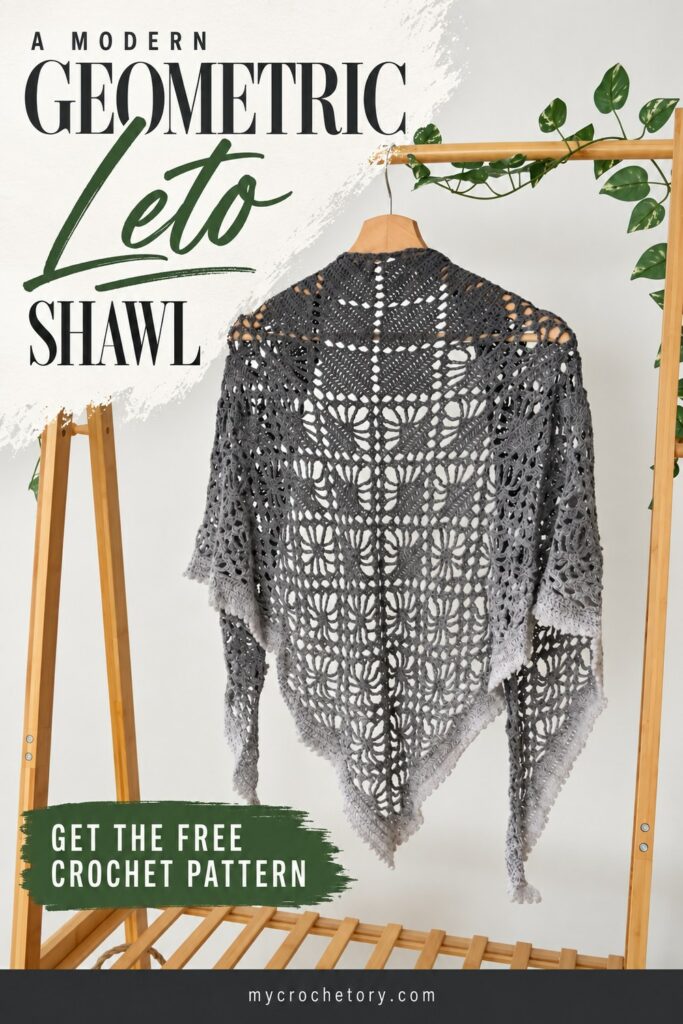
Leto yarn cake crochet shawl free pattern, Part 1
- Purchase the ad-free, COMPLETE printable PDF with stitch charts here on ETSY or here on Ravelry.
- Add this pattern to your Ravelry Queue HERE.
- Grab the MyCrochetory Shawl Pattern BUNDLE that includes 14 patterns for one low price HERE.
- Pin it for later.
Copyright 2018 – 2026 MyCrochetory. All rights reserved. This pattern is property of Sylwia Kawczyńska @MyCrochetory. Please DO NOT sell the pattern and claim this pattern as your own. The pattern is for personal use only and may not be translated or reproduced in another language. Please respect my rights, DO NOT share or publish this pattern anywhere without my permission.
The shawl you make following this pattern is yours, and you are free to sell it, as long as you credit MyCrochetory as the original designer. For more information, please read Terms Page.

Materials & Tools:
- Yarn Creative Cotton Degrade 200g = 800 meters (875 yd), 50% Cotton, 50% Acrylic, 1 cake.
- Hook size 3.5mm (US E/4 – UK 9). Adjust hook size if necessary to obtain correct gauge.
- Tapestry needle (to weave and hide yarn ends).
- Scissors.
- 1 Stitch marker.
Level:
Intermediate.
Size after blocking:
Wingspan – 170cm/67″, Center depth – 74cm/29″.
Gauge after blocking:
After Row 9 the triangle is approx. 10cm/4in high.
Gauge is not important for this project. However, changes might result in different yardage requirements and a different finished size.
Notes:
- The pattern uses US crochet terminology.
- The shawl is worked in rows back and forth.
- The stitch marker is placed in ch-5 space in the central corner.
- Ch4 in the beginning of every row counts as treble crochet and when working stitches in last stitch of every row make them into fourth ch of beginning ch4.
- When crocheting stitches into ch-spaces, you will work them around chains not in the particular chain stitches.
- The pattern includes the stitch charts.
Stitches & Abbreviations (US terms):
st(s) – stitch(es)
yo – yarn over
picot – ch3, insert your hook in the third chain from the hook, yarn over and draw the yarn through the stitch and through the loop on the hook.
sp – space
beg – beginning
prev – previous
sk – skip
pm – place marker
m – marker
rm – reposition marker
Instructions in square brackets […] are worked as many times as indicated.
PATTERN
The pattern contains both written instructions and a chart. Choose the most comfortable way to follow the pattern. Below are Rows 1 to 21 for Part 1.
Start with a magic ring.
Row 1: ch4 (counts as a tr here and throughout), 2dc, ch5, pm, 2dc and tr in the ring. Turn.
Row 2: ch4, 2dc in first st, ch2, sk next 2dcs, (3dc, ch5, rm, 3dc) in ch-5 sp, ch2, sk next 2dcs, (2dc, tr) in last st. Turn.
Rows 3, 4, 5, 6: ch4, 2dc in first st, ch2, sk next 2dcs, 2dc in ch-2 sp, dc in every dc until ch-5 sp, (2dc, ch5, rm, 2dc) in ch-5 sp, dc in every dc until ch-2 sp, 2dc in ch-2 sp, ch2, sk next 2 dcs, (2dc, tr) in last st. Turn.
Row 7: ch4, 2dc in first st, ch2, sk next 2dcs, 3dc in ch-2 sp, ch2, sk next 2dcs, dc in every st until 2 dcs remain before ch-5 sp, ch2, sk next 2dcs, (3dc, ch5, rm, 3dc) in ch-5 sp, ch2, sk next 2 dcs, dc in every dc until 2dcs remain before ch-2 sp, ch2, sk next 2dcs, 3dc in ch-2 sp, ch2, sk next 2dcs, (2dc, tr) in last st. Turn.
Rows 8, 9, 10: ch4, 2dc in first st, ch2, sk next 2dcs, 2dc in next ch-2 sp, dc in every dc until next ch-2 sp, 2dc in ch-2 sp, ch2, sk next 2dcs, dc in every st until 2dcs remain before next ch-2 sp, ch2, sk next 2dcs, 2dc in ch-2 sp, dc in every dc until ch-5 sp, (2dc, ch5, rm, 2dc) in ch-5 sp, dc in every dc until next ch-2sp, 2dc in ch-2 sp, ch2, sk next 2dcs, dc in every dc until 2dcs remain before next ch-2 sp, ch2, sk next 2dcs, 2dc in ch-2 sp, dc in every dc until last ch-2 sp, 2dc in last ch-2 sp, ch2, sk next 2dcs, (2dc, tr) in last st. Turn.
Row 11: ch4, 2dc in first st, ch2, sk next 2dcs, 2dc in next ch-2 sp, dc in every dc until next ch-2 sp, 2dc in ch-2 sp, ch2, sk next 3dcs, 2dc in next ch-2 sp, dc in every dc until ch-5 sp, (2dc, ch5, rm, 2dc) in ch-5 sp, dc in every dc until next ch-2sp, 2dc in ch-2 sp, ch2, sk next 3dcs, 2dc in next ch-2 sp, dc in every dc until last ch-2 sp, 2dc in last ch-2 sp, ch2, sk next 2dcs, (2dc, tr) in last st. Turn.
Row 12: ch4, 2dc in first st, ch2, sk next 2dcs, [3dc in ch-2 sp, ch2, sk next 2dcs, dc in every st until 2 dcs remain before next ch-2 sp, ch2, sk next 2dcs] rep until ch-5 sp, (3dc, ch5, rm, 3dc) in ch-5 sp, [ch2, sk next 2 dcs, dc in every dc until 2dcs remain before ch-2 sp, ch2, sk next 2dcs, 3dc in ch-2 sp] rep until last 3dcs remain, ch2, sk next 2dcs, (2dc, tr) in last st. Turn.
Rows 13 – 15: ch4, 2dc in first st, ch2, sk next 2dcs, 2dc in next ch-2 sp, dc in every dc until next ch-2 sp, [2dc in ch-2 sp, ch2, sk next 2dcs, dc in every st until 2dcs remain before next ch-2 sp, ch2, sk next 2dcs, 2dc in ch-2 sp, dc in every dc until next ch-2 sp] rep until ch-5 sp, (2dc, ch5, rm, 2dc) in ch-5 sp, dc in every dc until next ch-2sp, [2dc in ch-2 sp, ch2, sk next 2dcs, dc in every dc until 2dcs remain before next ch-2 sp, ch2, sk next 2dcs, 2dc in ch-2 sp, dc in every dc until next ch-2 sp] rep until last ch-2 sp, 2dc in last ch-2 sp, ch2, sk next 2dcs, (2dc, tr) in last st. Turn.
Row 16: ch4, 2dc in first st, ch2, sk next 2dcs, 2dc in next ch-2 sp, dc in every dc until next ch-2 sp, [2dc in ch-2 sp, ch2, sk next 3dcs, 2dc in next ch-2 sp, dc in every dc until next ch-2 sp] rep until ch-5 sp, (2dc, ch5, rm, 2dc) in ch-5 sp, dc in every dc until next ch-2sp, [2dc in ch-2 sp, ch2, sk next 3dcs, 2dc in next ch-2 sp, dc in every dc until next ch-2 sp] rep until last ch-2 sp, 2dc in last ch-2 sp, ch2, sk next 2dcs, (2dc, tr) in last st. Turn.
Row 17: Repeat Row 12
Row 18: ch4, 2dc in first st, ch2, sk next 2dcs, 2dc in next ch-2 sp, [dc in next dc, ch10, sk next dc, dc in next dc, 2dc in next ch-2 sp, ch2, sk next 2dcs, dc in every dc until 2dcs remain before next ch-2 sp, ch2, sk next 2dcs, 2dc in next ch-2 sp] rep until 3dcs remain before ch-5 sp, dc in next dc, ch10, sk next 1dc, dc in next dc, (2dc, ch5, rm, 2dc) in ch-5 sp, dc in next dc, ch10, sk next 1dc, dc in next dc, 2dc in next ch-2 sp, [ch2, sk next 2dcs, dc in every st until 2dcs remain before next ch-2 sp, ch2, sk next 2dcs, 2dc in next ch-2 sp, dc in next dc, ch10, sk next 1dc, dc in next dc, 2dc in next ch-2 sp] rep until last 3dcs remain, ch2, sk next 2dcs, (2dc, tr) in last st. Turn.
Row 19: ch4, 2dc in first st, ch2, sk next 2dcs, 2dc in next ch-2 sp, dc in next dc, ch5, sk next 2 dcs, sc in ch-10 sp, ch5, sk next 2 dcs, dc in next dc, [2dc in next ch-2 sp, ch2, sk next 2dcs, dc in every dc until 2dcs remain before next ch-2 sp, ch2, sk next 2dcs, 2dc in ch-2 sp, dc in next dc, ch5, sk next 2dcs, sc in ch-10 sp, ch5, sk next 2 dcs, dc in next dc] rep until ch-5 sp with m, (2dc, ch5, rm, 2dc) in ch-5 sp, dc in next dc, ch5, sk next 2 dcs, sc in ch-10 sp, ch5, sk next 2 dcs, dc in next dc, 2dc in next ch-2 sp, [ch2, sk next 2dcs, dc in every st until 2dcs remain before next ch-2 sp, ch2, sk next 2dcs, 2dc in next ch-2 sp, dc in next dc, ch5, sk next 2dcs, sc in ch-10 sp, ch5, sk next 2 dcs, dc in next dc, 2dc in next ch-2 sp] rep until last 3dcs remain, ch2, sk next 2dcs, (2dc, tr) in last st. Turn.
Row 20: ch4, 2dc in first st, ch2, sk next 2dcs, 2dc in next ch-2 sp, dc in next dc, ch5, sk next 2 dcs, sc in ch-5 sp, sc in next sc, sc in next ch-5 sp, ch5, sk next 2 dcs, dc in next dc, [2dc in next ch-2 sp, ch2, sk next 2dcs, dc in every dc until 2dcs remain before next ch-2 sp, ch2, sk next 2dcs, 2dc in ch-2 sp, dc in next dc, ch5, sk next 2 dcs, sc in ch-5 sp, sc in next sc, sc in next ch-5 sp, ch5, sk next 2 dcs, dc in next dc] rep until ch-5 sp with m, (2dc, ch5, rm, 2dc) in ch-5 sp, dc in next dc, ch5, sk next 2 dcs, sc in ch-5 sp, sc in next sc, sc in next ch-5 sp, ch5, sk next 2 dcs, dc in next dc, 2dc in next ch-2 sp, [ch2, sk next 2dcs, dc in every st until 2dcs remain before next ch-2 sp, ch2, sk next 2dcs, 2dc in next ch-2 sp, dc in next dc, ch5, sk next 2 dcs, sc in ch-5 sp, sc in next sc, sc in next ch-5 sp, ch5, sk next 2 dcs, dc in next dc, 2dc in next ch-2 sp] rep until last 3dcs remain, ch2, sk next 2dcs, (2dc, tr) in last st. Turn.
Row 21: ch4, 2dc in first st, ch2, sk next 2dcs, 2dc in next ch-2 sp, dc in next dc, ch5, sk next 2 dcs, sc in ch-5 sp, sc in next 3sc, sc in next ch-5 sp, ch5, sk next 2 dcs, dc in next dc, [2dc in next ch-2 sp, ch2, sk next 3dcs, 2dc in next ch-2 sp, dc in next dc, ch5, sk next 2 dcs, sc in ch-5 sp, sc in next 3sc, sc in next ch-5 sp, ch5, sk next 2 dcs, dc in next dc] rep until ch-5 sp with m, (2dc, ch5, rm, 2dc) in ch-5 sp, dc in next dc, ch5, sk next 2 dcs, sc in ch-5 sp, sc in next 3sc, sc in next ch-5 sp, ch5, sk next 2 dcs, dc in next dc, 2dc in next ch-2 sp, [ch2, sk next 3dcs, 2dc in next ch-2 sp, dc in next dc, ch5, sk next 2 dcs, sc in ch-5 sp, sc in next 3sc, sc in next ch-5 sp, ch5, sk next 2 dcs, dc in next dc, 2dc in next ch-2 sp] rep until last 3dcs remain, ch2, sk next 2dcs, (2dc, tr) in last st. Turn.
Done with Row 21? Then you’re ready for Part 2, where the lace keeps growing. Part 3 and Part 4 come right after it.
Stuck on a row? Leave a comment below, or ask in my Facebook Group or Ravelry Group, where other crocheters can help you too. And if you spot a mistake, email me at mycrochetory@gmail.com and I’ll fix it.
Yarn cake crochet shawl stitch chart, Part 1

Finished your Leto Shawl? I’d love to see which yarn cake you picked! Share it on Instagram or Facebook with #mycrochetory, or tag me @mycrochetory.

More yarn cake crochet shawls
Got more cakes in your stash? These three yarn cake crochet shawls are mine too, and each one shows off a gradient in a totally different way.
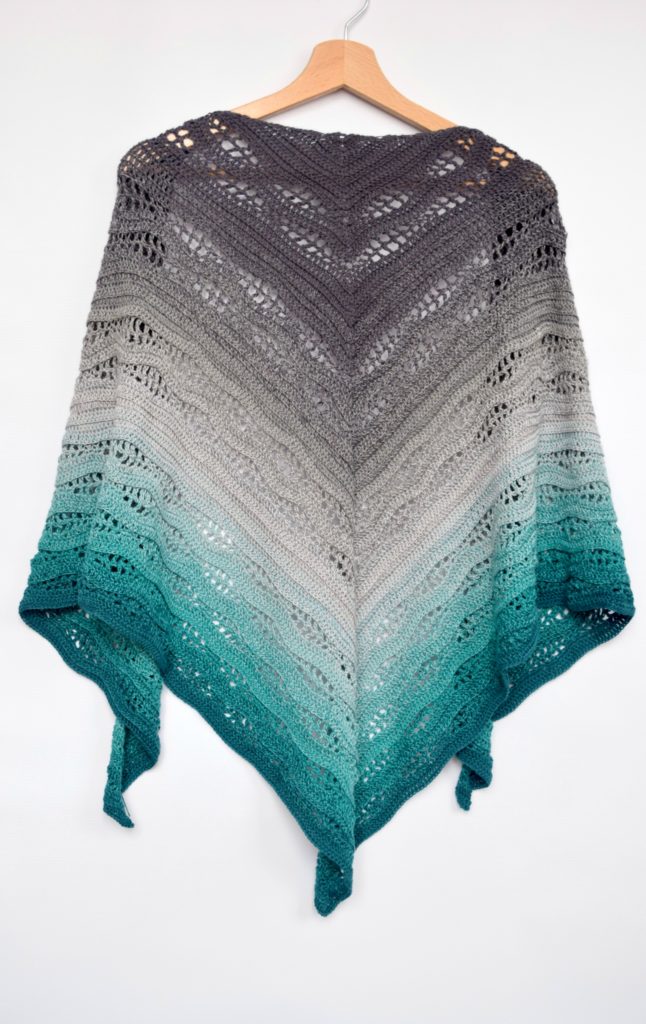

- Kalinda Shawl. Kalinda is where my wavy stitch was born, and it’s still one of my most popular patterns. One gradient cake turns into soft waves that roll across the whole triangle. Adventurous beginners can jump right in, and there’s a video to help.
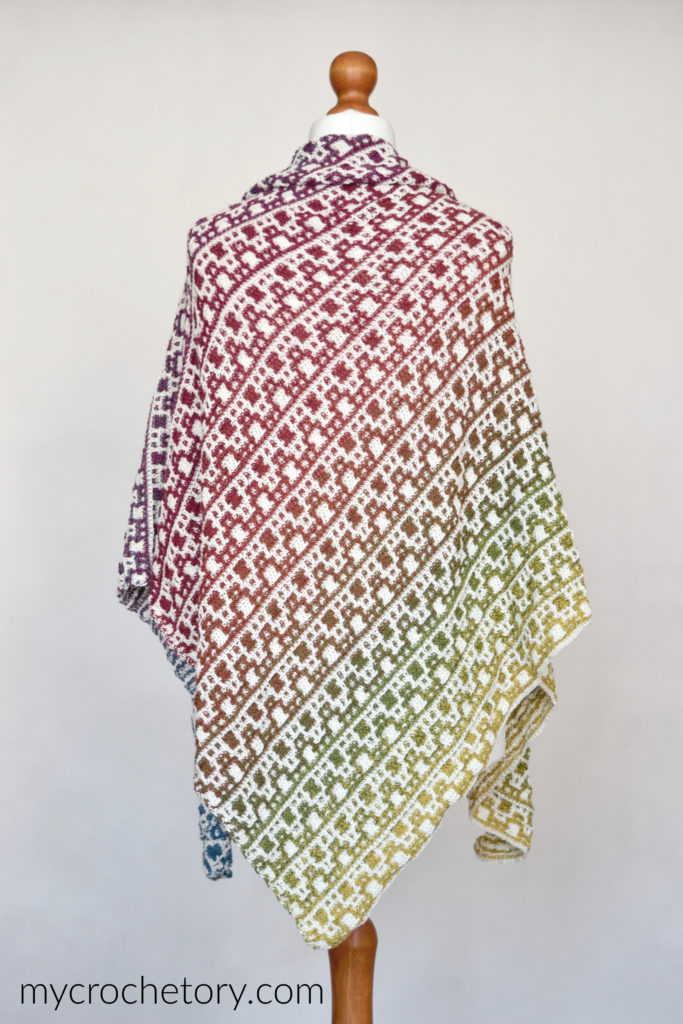
- Crax Gradient Shawl. Want two cakes to play together? Crax pairs them in mosaic crochet, so the colors change in two directions at once. It’s an asymmetric triangle with a big photo tutorial to guide you row by row.
- Aprilace Shawl. Aprilace keeps things simple, with an easy 4-row lace repeat and a pretty picot edge. It’s a symmetrical triangle just like Leto, so it makes a great next project for your gradient yarn.
More crochet patterns for gradient yarn
Not in the mood for another shawl? Gradient yarn looks just as good on scarves and blankets.

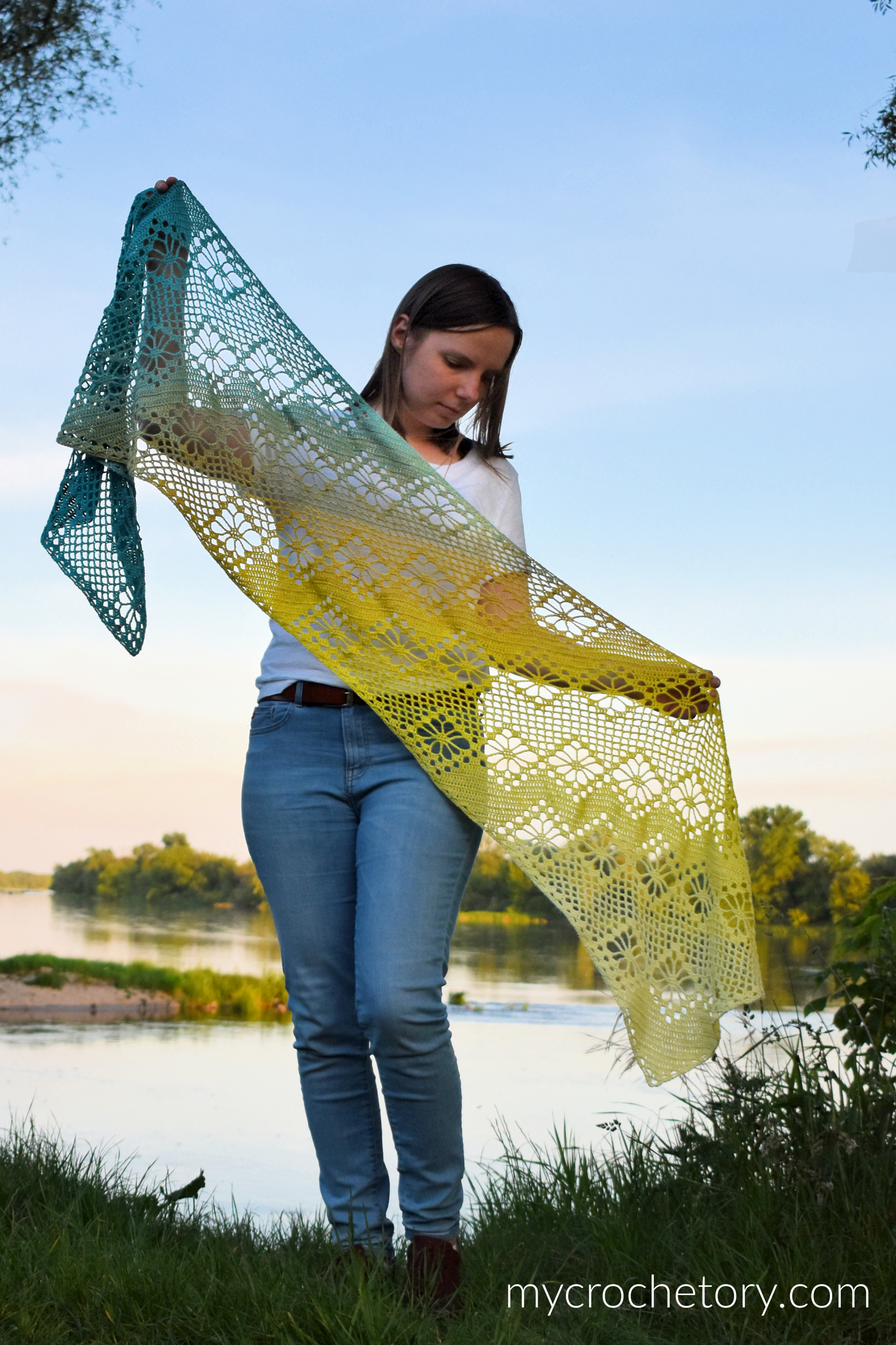
- Zarina Diagonal Scarf. Zarina is a lace scarf made from a single yarn cake and worked corner to corner. As it grows, the colors run across the scarf on a slant. And just like Leto, the free pattern comes in parts.
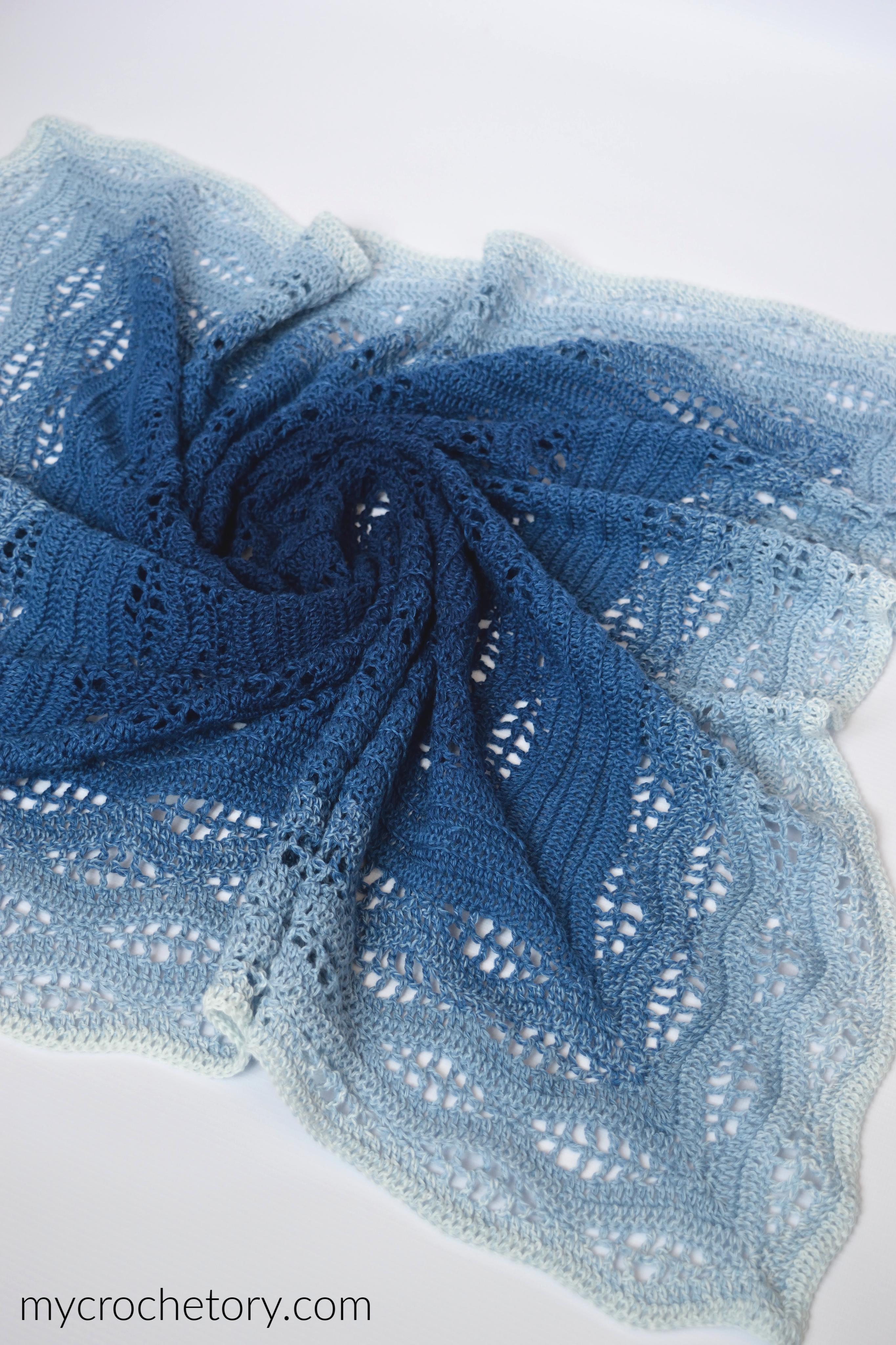
- Tonnta Blanket. Tonnta takes the waves from Kalinda and turns them into a blanket. Thanks to a simple 4-row repeat, the colors roll from one end to the other, and you can make it any size you like.
- Kalinda Blanket. Readers asked me for a Kalinda Blanket, so I turned the wavy shawl into a square! It’s worked from the center out, and the waves grow round by round along with the gradient.
Yarn cake crochet shawl FAQ
How many yarn cakes do I need for the Leto Shawl?
Just one! My whole shawl, all four parts, came from a single 7 oz cake with about 875 yards. So peek at the yardage on the label before you buy, and you’re good to go.
Is this yarn cake crochet shawl good for beginners?
It’s a better fit once you have a few projects under your belt. The pattern is intermediate, so you’ll be counting dc blocks and chain spaces in every row. If dc and ch-spaces already feel easy, grab your cake and give it a try!

What does “ch4 counts as tr” mean?
It means the ch4 at the start of each row works like a treble crochet. That’s why, at the end of the next row, your last stitch goes into the 4th chain of that ch4. Miss it, and you’ll lose a stitch at the edge.
Where can I find Parts 2, 3 and 4?
Good news, they’re all free on the blog already! Head to Part 2, Part 3 and Part 4, one after another. Or, if you’d rather have everything in one file, grab the complete ad-free PDF.
Is there a stitch chart?
Yes, and you’ll find the Part 1 chart right below the written rows. Every free part comes with its own chart, and the PDF has all of them together in one place.
Wish for you to know you are very talented young lady, and I love your patterns.
Sylvia Stauffer from Canada