
Updated: 6 November 2026 by Sylwia (MyCrochetory)
This crochet tee pattern was made for hot days. The Willow Tee is light and has short sleeves, and you crochet it from the top down in one piece, so there’s no sewing at the end.
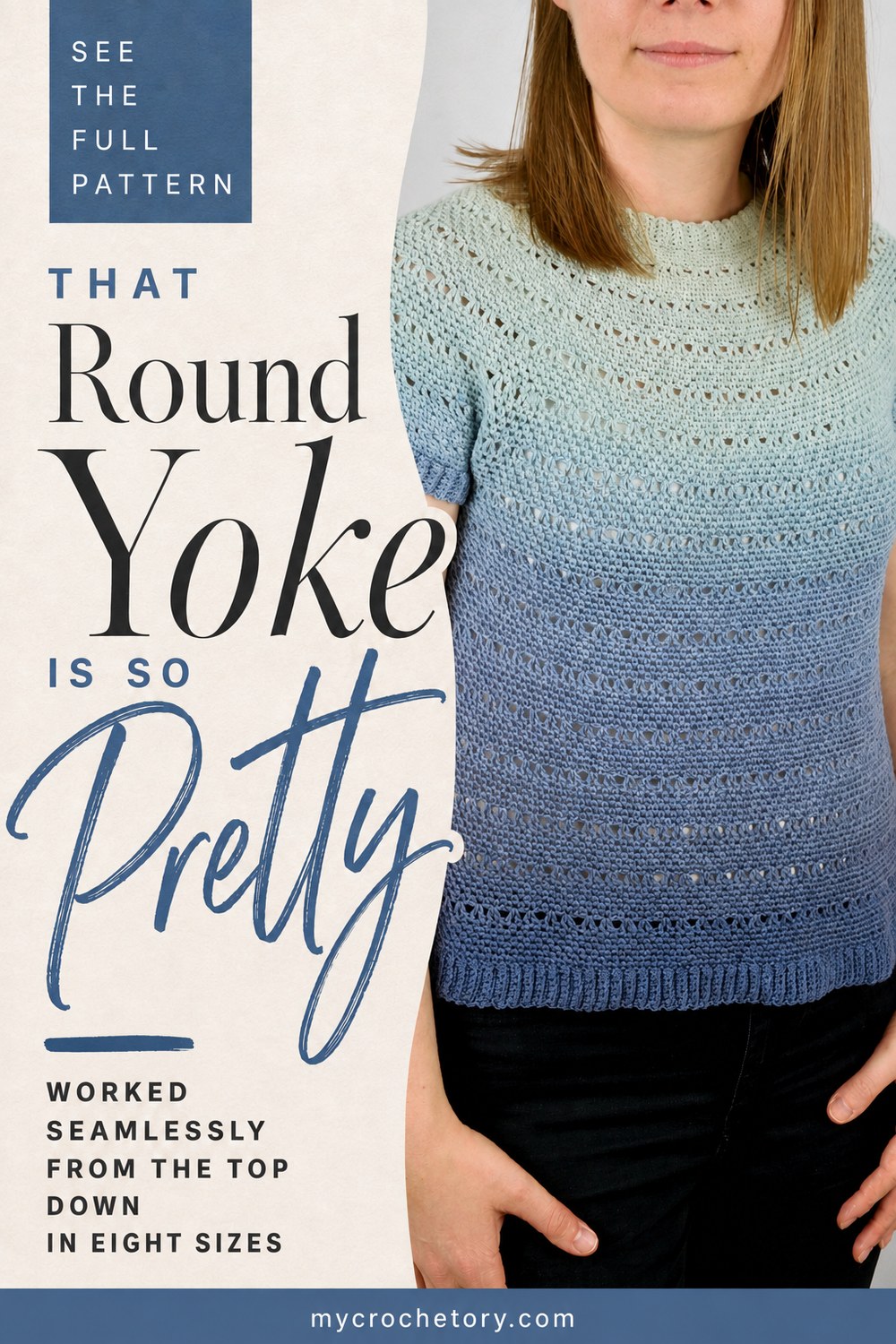
That’s me in the photos, wearing Size 3. Look at the color, it goes from pale mint at the neck to deep blue at the hem, and the yarn does all of that on its own.
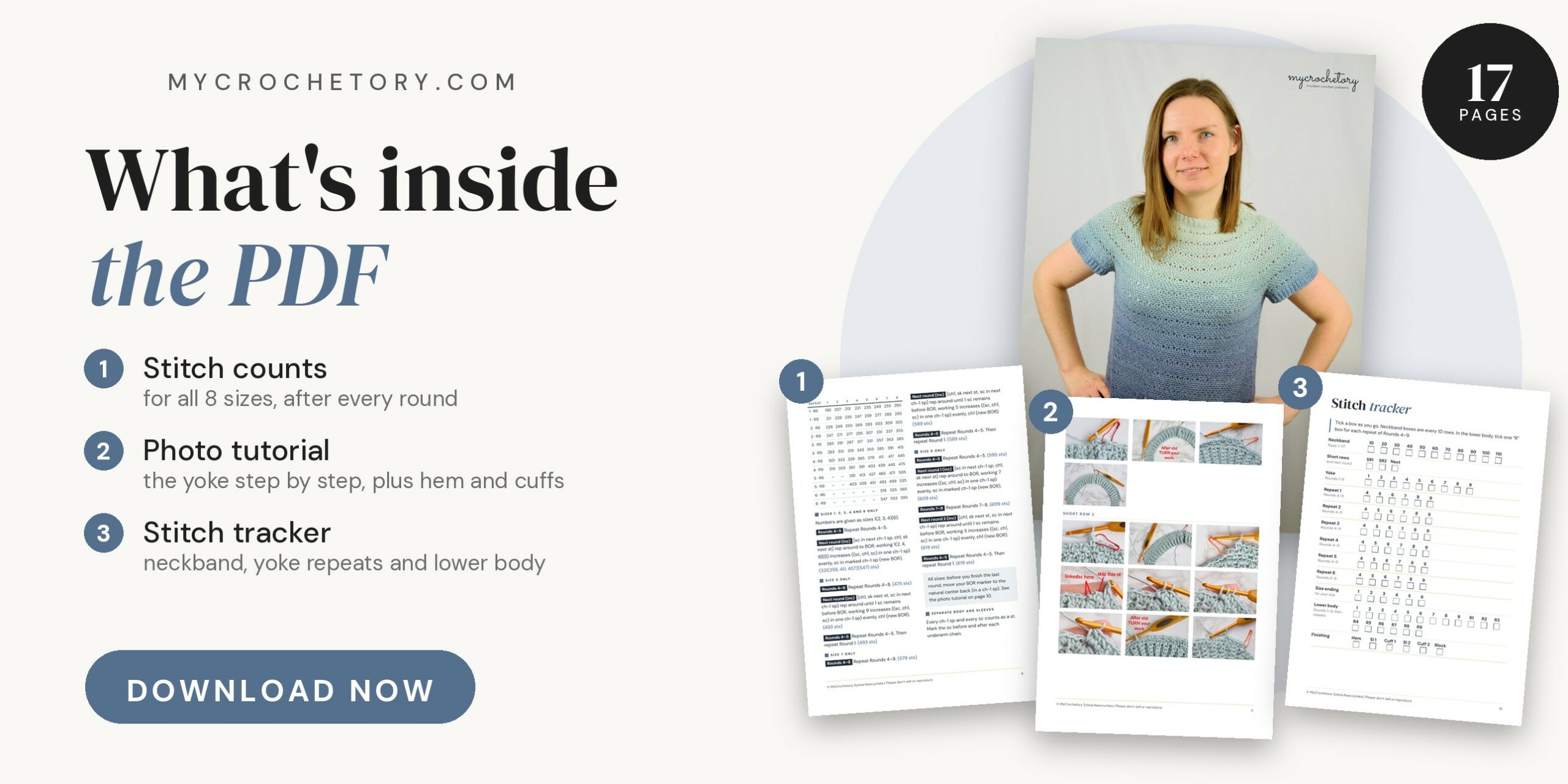
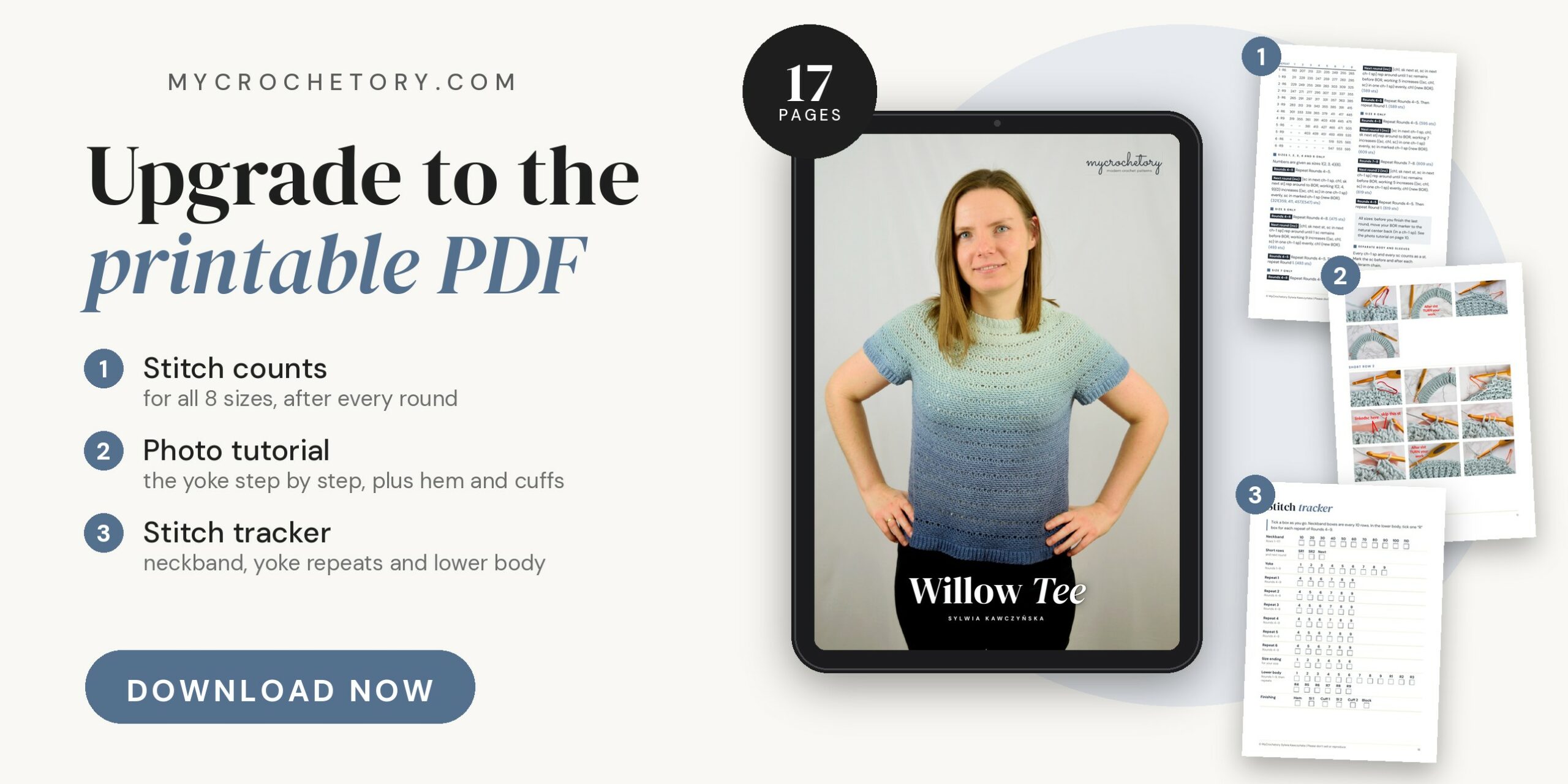
Scroll down to the free Willow Tee crochet pattern, or get the ad-free, printable PDF with the stitch count for every row and round HERE on Etsy or HERE on Ravelry.
This post contains affiliate links. If you buy through them, I may earn a small commission at no extra cost to you. Read my affiliate disclosure.

Join my Facebook Group and Official Ravelry Group where you can find necessary support, you can ask questions or share your finished projects.
You can also follow my Instagram, Facebook page and Pinterest.

Why a Top-Down Crochet Tee Pattern Is Easier to Fit
A top-down crochet tee pattern has one big bonus, you can try the tee on while you make it. You start at the neck and work down, so once the yoke is done you just slip it over your head and check the fit.
The length is your call too. Keep going for a longer tee to wear over a skirt, or stop early for a cropped one with high-waisted jeans.
And when you finish, you’re really finished. There are no side seams or shoulder seams, just a tiny hole under each arm to close if you see one.

How This Crochet Tee Pattern Is Built
This crochet tee pattern starts in a slightly unusual place, with a thin ribbed strip for the neckline. You crochet it sideways in back loop single crochet and close it into a ring, and that ring becomes the base for the whole tee.
Next you work a few short rows across the back. They lift the back neckline a little, just like on a store-bought tee.
From there it’s round after round with the right side facing you, no turning at all. The yoke grows, the sleeves split off, and the body heads down to the hem.
For the hem and cuffs I used my favorite way to add crochet ribbing. It’s worked sideways and joined to the edge with slip stitches as you go, so there’s nothing to sew and the edge comes out neat.

Moss Stitch and V-Stitch in This Crochet Tee Pattern
The texture in this crochet tee pattern comes from moss stitch, which is simply single crochet and chain 1 worked into the spaces below. It makes a flat, woven-looking fabric with tiny holes, so a bit of air gets through on a warm day.
Every sixth round, a row of V-stitches breaks up the moss stitch. Look at the photos and you’ll spot them as thin lacy lines around the yoke and the body.
New to these stitches in the round? My moss stitch tutorial shows moss stitch flat and in the round, and my V-stitch tutorial walks you through the V step by step.

Is This Crochet Tee Pattern Good for Beginners?
The Willow Tee is an intermediate crochet tee pattern. The stitches are easy, but the big rounds ask for patience, stitch markers and careful counting.
That’s why I photographed every tricky step. The neckband, both short rows and the first yoke rounds are all in the picture tutorial right under the written pattern.
My tip for a first top is to crochet the gauge swatch before anything else. It uses moss stitch and a V-stitch row, so you practice both stitches and check your size in one go.
Crochet Tee Pattern Sizes, Ease and How to Pick Yours
This crochet tee pattern comes in 8 sizes, with a finished bust from 30 to 58 inches. You can wear it with -2 to +2 inches of ease, so it can sit close to your body or a little relaxed.
In the photos I’m wearing Size 3. It measures 38 inches around and my bust is 36.25 inches, so that’s 1.75 inches of positive ease.
To find your size, measure your full bust, add the ease you like and pick the closest finished size. Before I published the pattern, testers made the tee in several sizes and checked every step.

Yarn and Blocking for a Summer Crochet Tee
I made this summer crochet tee in Scheepjes Woolly Whirl, and I still recommend it. It’s a fingering weight cake, 70% cotton and 30% wool, with 1094 yards that slowly change color from one end to the other.
Size 3 needs 1069 yards, which means it fits in one cake with about 25 yards left over. Bigger sizes need a second cake, and the pattern lists the yardage for each size.
Yarn substitutes
Woolly Whirl is out of stock at LoveCrafts these days, but for a summer tee Scheepjes Whirl might be even nicer. It has the same 1094 yards per cake with the same slow fade, and it’s 60% cotton and 40% acrylic with no wool at all.
The yardage matches, so buy the same number of cakes the pattern lists for your size. Swatch and block first, because a different fiber can change your gauge a little.
Because the yarn has wool in it, I wet block my tee. Soak it, gently stretch it to the measurements, pin it to a blocking mat and leave it to dry.
Not ready to start yet? Save the Willow Tee on Pinterest so you can find it in a second when you are.
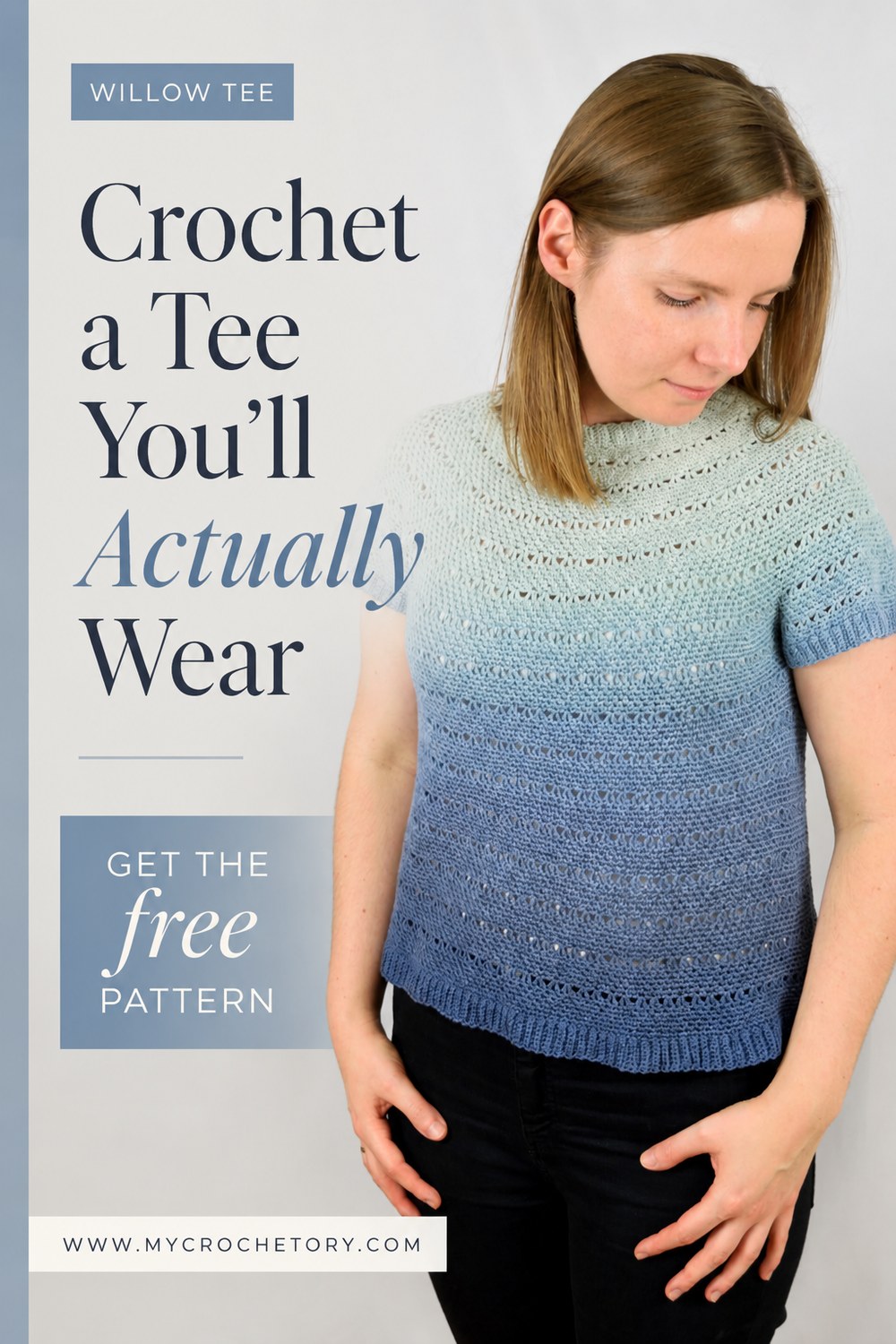
Willow Tee Free Crochet Tee Pattern
- Purchase the ad-free, printable PDF here on ETSY or here on Ravelry.
- Add this pattern to your Ravelry Queue HERE.
- Pin it for later.
Copyright 2021 – 2026 MyCrochetory. All rights reserved. This pattern is property of Sylwia Kawczyńska @MyCrochetory. Please DO NOT sell the pattern and claim this pattern as your own. The pattern is for personal use only and may not be translated or reproduced in another language. Please respect my rights, DO NOT share or publish this pattern anywhere without my permission.
The crochet tee you make following this pattern is yours, and you are free to sell it, as long as you credit MyCrochetory as the original designer. For more information, please read the Terms Page.
Materials & Tools
- Yarn Scheepjes Woolly Whirl 215g = 1000m (70% Cotton, 30% Wool). Substitute: Scheepjes Whirl 215g = 1000m (60% Cotton, 40% Acrylic), same number of cakes.
827(922, 977, 1174, 1363)(1485, 1698, 1807)m
905(1008, 1069, 1284, 1490)(1624, 1857, 1976)yds
Note that yardage may vary depending on yarn used, gauge variations or modifications.
- Hook size 3.5mm (US E/4) for the body and 2.5mm for the ribbing (1mm
smaller than for the body). Adjust
hook size if necessary to obtain correct gauge. - Tapestry needle (to weave and hide
yarn ends). - Scissors.
- Stitch markers.
Level
Intermediate
Sizes
1 (2, 3, 4, 5)(6, 7, 8)
Finished Measurements
Measurements given are for the finished garment.
Recommended ease is -2 to +2”/-5 to +5 cm. Sample is shown in Size 3 on a 36.25”/92 cm bust with 1.75”/4.5 cm positive ease.
To pick your best size, measure your full bust and add your desired ease, then pick the finished bust circumference closest to that number.
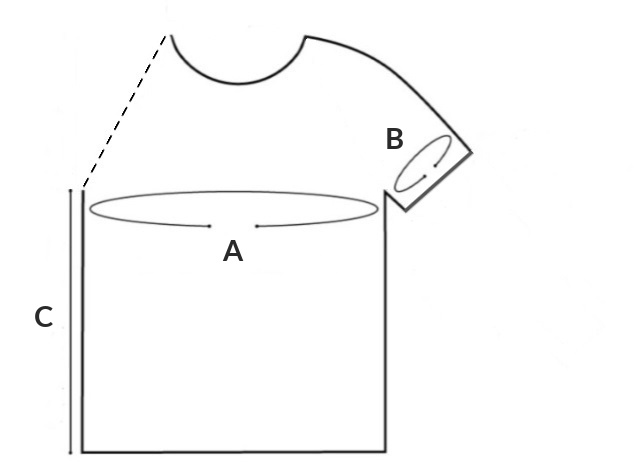
A: Bust circumference
76(86.5, 96.5, 107, 117)(127, 137, 147.5)cm
30(34, 38, 42, 46)(50, 54, 58)”
B: Upper sleeve circumference
25.5(26.5, 30.5, 33, 35.5)(41, 44.5, 48)cm
10(10.5, 12, 13, 14)(16, 17.5, 19)”
C: Hem to underarm (adjustable)
31cm
12”
Gauge After Blocking
27 sts and 19 rows to 10 x 10cm (4 x 4”) using 3.5mm hook with pattern repeats – blocked.
Make a gauge swatch (worked flat) with pattern repeats (ch1 in the beg of the Row doesn’t count as a st):
Ch38.
Row 1: sc in 4th ch from hook, [ch1, sk next ch, sc in next ch] rep to end. Turn. The last stitch should be a sc.
Row 2: ch2, sc in 1st ch-1 sp, [ch1, sk 1st, sc in next ch-1sp] – rep to end. The last sc should be placed in the ch-3sp at the start of Row 1. Turn.
Row 3: ch2, sc in 1st ch-1sp, [ch1, sk 1st, sc in next ch-1sp] – rep to end. The last sc should be placed in the ch-2 sp at the start of Row 2. Turn.
Rows 4-5: Repeat Row 3.
Row 6: ch3 (doesn’t count as a st), 2dc in first st, [sk next 2sts, V-st in next ch-1sp, sk next 2sts, V-st in next sc] – rep 5 times in total, sk next 2sts, V-st in next ch-1sp, sk next st, dc in ch-2sp at the start of prev Row. Turn.
Row 7: ch2, [sc in next dc, ch1, sk ch-1sp, sc in next dc, ch1, sk next dc, sc in ch-1sp, ch1, sk next dc] – rep 5 times in total, sc in next dc, ch1, sk ch-1sp, sc in next dc, ch1, sk next dc, sc in last dc. Turn.
Row 8: Repeat Row 3
Next, Repeat Rows 3 – 8 and make 25 rows in total.
If necessary, adjust hook size to obtain the correct gauge.
Before you measure, please take the time to wash and block your swatch in the same manner that you will wash and block your sweater.
General Notes
- The pattern uses US crochet terminology.
- You can find the picture tutorial below the written pattern.
- This crochet tee is worked seamlessly from the top down. First you make the neckband, then short rows are worked back and forth to create the higher back, and then the yoke is worked in unturned rounds to the sleeves separation.
- After joining the neckband together and working short rows, the remainder of your sweater is worked with the RS facing you all the time.
- The lower body is worked in unturned rounds to hem. The length of the lower body is easily adjustable. You will then add the hem.
- Stitch marker placement: When instructed to place your marker, place on the last st worked unless instructed. It should lie on a stitch, not between stitches.
- Due to the tilted nature of crochet worked in unturned rounds, you may find that your BOR marker tends to skew to one side. To find the center, lay your work flat and fold it in half vertically.
- When only one number is given, it applies to all sizes.
- Instructions in square brackets […] are worked as many times as indicated.
- The stitch count for each row/round is included in pattern PDF here on ETSY or here on Ravelry.
Stitches & Abbreviations (US Terms)
st(s) – stitch(es)
BOR – beginning of the row/round
BLsc – back loop only single crochet
yo – yarn over
V-st – (dc, ch1, dc) in one stitch.
linkedsc – insert hook in ch1-sp on the edge of prev short row, yo, draw up a loop, insert hook in same st where slst was made, yo, pull yarn through all three loops on the hook.
M – marker
PM – place marker
rep – repeat
sp – space
sk – skip
inc – increase
beg – beginning
prev – previous
RS – right side
WS – wrong side
Pattern
Read Notes before you start.
Scroll down to find the step-by-step yoke photo tutorial.
The stitch count for each row/round is included in pattern PDF available to purchase HERE or HERE.
Yoke
Neckband
With 2.5mm hook, ch6.
Row 1: sc in second ch from hook, sc in each ch to end. Turn.
Row 2: ch1 (doesn’t count as a sc), BLsc across to end. Turn.
You should have 5 BLsc stitches in each row.
Repeat Row 2 103 (103, 105, 105, 111)(113, 115, 115) times for a total of 105 (105, 107, 107, 113)(115, 117, 117) rows.
Use slip stitches to join last and first row together. Don’t fasten off.
Next round:
With 3.5mm hook make ch1 (does not count as a st) and sc in first neckband’s row, place BOR marker, sc in each neckband’s row around to BOR working 16(20, 22, 18, 26)(28, 30, 30) increases (2sc in one neckband’s row) evenly. Don’t close the round. – 121(125, 129, 125, 139)(143, 147, 147)sts.
Short Rows (Shaping the Back)
Note: on this and next rounds every sc and ch-1sp count as a st unless otherwise stated.
Short row 1: sc in BOR (mark this st as a new BOR), [ch1, sk next st, sc in next st] rep 14(14, 15, 15, 18)(19, 20, 20) times, ch1, sk next st, slst in next st, TURN, ch1, (mark it), sc in ch-1sp after slst, [ch1, sk next st, sc in next ch-1sp] rep to BOR, ch1 (mark it as a new BOR), sc in next st, [ch1, sk next st, sc in next st] rep 14(14, 15, 15, 18)(19, 20, 20) times, ch1, sk next st, slst in next st, TURN, ch1 (mark it), sc in ch-1sp after slst, [ch1, sk next st, sc in next ch-1sp] rep until BOR working last sc in marked ch-1sp (new BOR).
Short row 2: [ch1, sk next st, sc in next ch-1sp] rep until one sc remains before next M, ch1, sk next st, linkedsc (over marked ch-1sp and same st as slst), remove M, [ch1, sk next st, sc in next st] rep 4(4, 5, 5, 7)(8, 9, 9) times in total, ch1, sk next st, slst in next st, TURN, ch1, (mark it), sc in ch-1sp after slst, [ch1, sk next st, sc in next ch-1sp] rep to BOR, ch1 (mark it as a new BOR), sc in next ch-1sp, [ch1, sk next st, sc in next ch-1sp] rep until one sc remains before next M, ch1, sk next st, linkedsc (over marked ch-1sp and same st as slst), remove M, [ch1, sk next st, sc in next st] rep 4(4, 5, 5, 7)(8, 9, 9) times in total, ch1, sk next st, slst in next st, TURN, ch1, (mark it), sc in ch-1sp after slst, [ch1, sk next st, sc in next ch-1sp] rep until BOR working last sc in marked ch-1sp (new BOR).
Next round: [ch1, sk next st, sc in next ch-1sp] rep until one sc remains before next M, ch1, sk next st, linkedsc (over marked ch-1sp and same st as slst), remove M, [ch1, sk next st, sc in next st] rep until one sc remains before next M (the edge of previous short row), ch1, sk next st, linkedsc (over st where the slst was made and marked ch-1sp), remove M, [ch1, sk next st, sc in next ch-1sp] rep until BOR, ch1 (new BOR).
From now on, we are no longer working short rows.
Round 1: [sc in next ch-1sp, ch1, sk next st] rep around to BOR, sc in marked ch-1sp (new BOR).
Round 2: [ch1, sk next st, sc in next ch-1sp] rep around to BOR, ch1 (new BOR).
Round 3 (inc): sc in next ch-1sp, [ch1, sk next st, sc in next ch-1sp] rep around until last sc remains before BOR working 9(10, 11, 13, 12)(13, 14, 14) increases ((sc, ch1, sc) in one ch-1sp) evenly, ch1 (new BOR).
In the following Round 4, V-st is worked either in sc or ch-1sp. Also, when pattern calls for „sk next 2sts”, skip both sc and ch-1sp (or ch-1sp and sc accordingly).
Round 4 (V-st): V-st in next ch-1sp, [sk next 2sts, V-st in next st] rep around until 2sts remain before BOR (the last V-st should be placed in sc), sk 2 last sts before BOR, sc in marked ch-1sp (new BOR).
In the following Round 5, when pattern calls for „sk next st”, skip either sc or ch-1sp. When pattern calls for „sc in next st”, the sc is worked either in dc or ch-1sp.
Round 5: [ch1, sk next st, sc in next st] rep around to BOR (the last sc should be placed in last dc), ch1 (new BOR).
Round 6 (inc): [sc in next ch-1sp, ch1, sk next st] rep around to BOR working 9(10, 10, 11, 12)(13, 13, 15) increases ((sc, ch1, sc) in one ch-1sp) evenly, sc in marked ch-1sp (new BOR).
Round 7: Repeat Round 2.
Round 8: Repeat Round 1.
Round 9 (inc): [ch1, sk next st, sc in next ch-1sp] rep around to BOR working 9(11, 11, 13, 12)(14, 14, 15) increases ((sc, ch1, sc) in one ch-1sp) evenly, ch1 (new BOR).
Next, Repeat Rounds 4–9 4(4, 5, 5, 5)(6, 6, 6) more times
SIZES 1, 2, 3, 4, 6 ONLY
Repeat Rounds 4-5.
Next round (inc): [sc in next ch-1sp, ch1, sk next st] rep around to BOR working 1(2, 4, 9, -)(0, -, -) increases ((sc, ch1, sc) in one ch-1sp) evenly, sc in marked ch-1sp (new BOR)
You should have 321(359, 411, 457, -) (547, -, -)sts.
Before completing the last round, reposition your BOR marker to the natural center back (in ch-1sp). See the picture tutorial below.
Proceed to Separate Body and Sleeves.
SIZE 5 ONLY
Repeat Rounds 4-8.
Next Round (inc): [ch1, sk next st, sc in next ch-1sp] rep around until last sc remains before BOR working 9 increases((sc, ch1, sc) in one ch-1sp) evenly, ch1 (new BOR).
Repeat Rounds 4-5.
Repeat Round 1 – 493sts.
Before completing the last round, reposition your BOR marker to the natural center back (in ch-1sp). See the picture tutorial below.
Proceed to Separate Body and Sleeves.
SIZE 7 ONLY
Repeat Rounds 4-8.
Next Round (inc): [ch1, sk next st, sc in next ch-1sp] rep around until last sc remains before BOR working 5 increases ((sc, ch1, sc) in one ch-1sp) evenly, ch1 (new BOR).
Repeat Rounds 4-5.
Repeat Round 1 – 589sts.
Before completing the last round, reposition your BOR marker to the natural center back (in ch-1sp). See the picture tutorial below.
Proceed to Separate Body and Sleeves.
SIZE 8 ONLY
Repeat Rounds 4-5.
Next round 1 (inc): [sc in next ch-1sp, ch1, sk next st] rep around to BOR working 7 increases ((sc, ch1, sc) in one ch-1sp) evenly, sc in marked ch-1sp (new BOR).
Repeat Rounds 7-8.
Next Round 2 (inc): [ch1, sk next st, sc in next ch-1sp] rep around until last sc remains before BOR working 5 increases ((sc, ch1, sc) in one ch-1sp) evenly, ch1 (new BOR).
Repeat Rounds 4-5.
Repeat Round 1 – 619sts.
Before completing the last round, reposition your BOR marker to the natural center back (in ch-1sp). See the picture tutorial below.
Proceed to Separate Body and Sleeves.
Separate Body and Sleeves
Next the body and sleeves are separated.
Note: every ch-1sp and sc count as a st. Mark sc before and after each underarm chain.
Next round: [ch1, sk next st, sc in next ch-1sp] rep 24(28, 31, 35, 38)(41, 45, 49) times in total, ch5(ch5, ch3, ch3, ch3)(ch5, ch5, ch5), sk next 63(67, 79, 87, 93)(107, 113, 113)sts, sc in next ch-1sp, [ch1, sk next st, sc in next ch-1sp] rep 48(56, 63, 70, 76)(83, 90, 98) times in total, ch5(ch5, ch3, ch3, ch3)(ch5, ch5, ch5), sk next 63(67, 79, 87, 93)(107, 113, 113)sts, sc in next ch-1sp, [ch1, sk next st, sc in next ch-sp] rep to BOR, ch1 (new BOR).
Lower Body
Lower body is worked in unturned rounds with the RS facing you.
When you come to underarm chains, work sc in chain (not around) until end of the underarm.
Round 1: [sc in next ch-1sp, ch1, sk next st] rep around to BOR, sc in marked ch-1sp (new BOR).
After Round 1 you should have 205(235, 259, 289, 313)(343, 373, 403)sts.
Round 2: [ch1, sk next st, sc in next ch-1sp] rep around to BOR, ch1 (new BOR).
Round 3: sc in next ch-1sp, [ch1, sk next st, sc in next ch-1sp] rep around until last sc remains before BOR, ch1 (new BOR).
In the following Round 4, V-st is worked either in sc or ch-1sp. Also, when pattern calls for „sk next 2sts”, skip both sc and ch-1sp (or ch-1sp and sc accordingly).
Round 4 (V-st): V-st in next ch-1sp, [sk next 2sts, V-st in next st] rep around until 2sts remain before BOR (the last V-st should be placed in sc), sk 2 last sts before BOR, sc in marked ch-1sp (new BOR).
In the following Round 5, when pattern calls for „sk next st”, skip either sc or ch-1sp. When pattern calls for „sc in next st”, the sc is worked either in dc or ch-1sp.
Round 5: [ch1, sk next st, sc in next st] rep around to BOR (the last sc should be placed in last dc), ch1 (new BOR).
Round 6: [sc in next ch-1sp, ch1, sk next st] rep around to BOR, sc in marked ch-1sp (new BOR).
Round 7: Repeat Round 2
Round 8: Repeat Round 1
Round 9: [ch1, sk next st, sc in next ch-1sp] rep around to BOR, ch1 (new BOR).
Do not fasten off.
Repeat Rounds 4-9 until work measures 28cm/11” from underarm (or 3cm/1.2” short of desired length of the sweater).
Hem
The hem is worked in rows and attached to the body as you go. Change to 2.5mm hook.
With RS facing you.
Row 1: ch7, starting with 2nd ch from hook, work 1 sc in each ch back to edge of main body. Join to the next st of the edge of main body using slst and work one more slst in the next st of main body (2 slst(s) in total for joining) plus make ch1. Turn.
Row 2: Starting in the 4th st from hook, work BLsc in each st across. Turn.
Row 3: ch1 (does not count as a st), BLsc in each st across [6sts]. Join to the next st of the edge of main body using slst and work one more slst in the next st of main body (2 slst(s) in total for joining) plus make ch1. Turn.
Repeat Rows 2-3 until your hem is joined to the entire lower edge. Then join your last row with the first row using the slip stitches.
Sleeves (Both Worked the Same)
With RS facing you, attach Yarn with slst in a central space in the underarm to begin working around.
Round 1: ch1, sc in same ch as join, sc in each ch and st around. Slst to first st to close the round.
DON’T fasten and DON’T cut the yarn. The chain 6 that begins the cuff originates from attached yarn point.
Cuff
The cuffs are worked in rows and attached to the sleeve as you go. Change to 2.5mm hook.
With RS facing you.
Row 1: ch6, starting with 2nd ch from hook, work 1 sc in each ch back to edge of sleeve. Join to the next st of the edge of sleeve using slst and work one more slst in the next st of sleeve (2 slst(s) in total for joining) plus make ch1. Turn.
Row 2: Starting in the 4th st from hook, work BLsc in each st across. Turn.
Row 3: ch1 (does not count as a st), BLsc in each st across [5sts]. Join to the next st of the edge of sleeve using slst and work one more slst in the next st of sleeve (2 slst(s) in total for joining) plus make ch1. Turn.
Repeat Rows 2-3 until your cuff is joined to the entire sleeve edge. Then join your last row with the first row using slip stitches.
Fasten off yarn, weave in all ends and block your sweater to measurements. Sew up underarm holes if necessary.
Stuck on a round? Ask in my Facebook Group or my Ravelry Group, or email me at mycrochetory@gmail.com if you think you found a mistake.
Picture Tutorial


Next round after the Neckband:


Short Row 1:


Short Row 2:


Next Round:


Round 1:


Round 2:


Round 3:


Round 4:


Round 5:


Round 6:


Before you separate the body and sleeves:


Made your own Willow Tee? Share it on Instagram with #mycrochetory and tag @mycrochetory so I can see it.
More Free Crochet Sweater and Cardigan Patterns
Liked working a top from the neckline down? These garments use some of the same tricks, like short rows at the back, seamless raglans and attached ribbing.
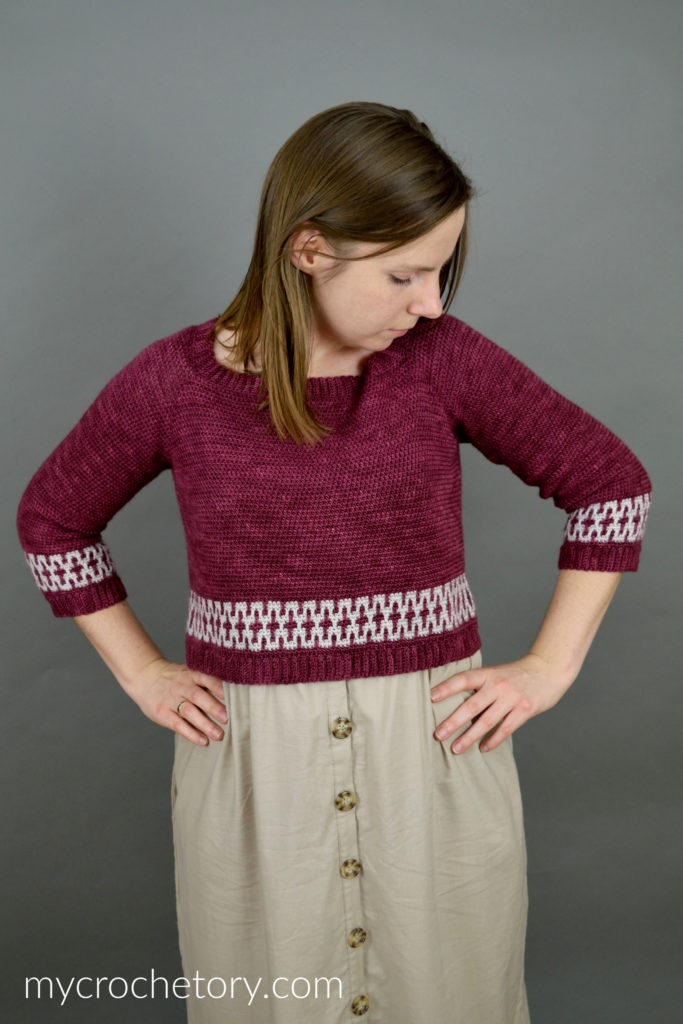


- Mosaic Cropped Sweater, a top-down raglan pullover with short-row back shaping and mosaic colorwork, in 8 sizes.
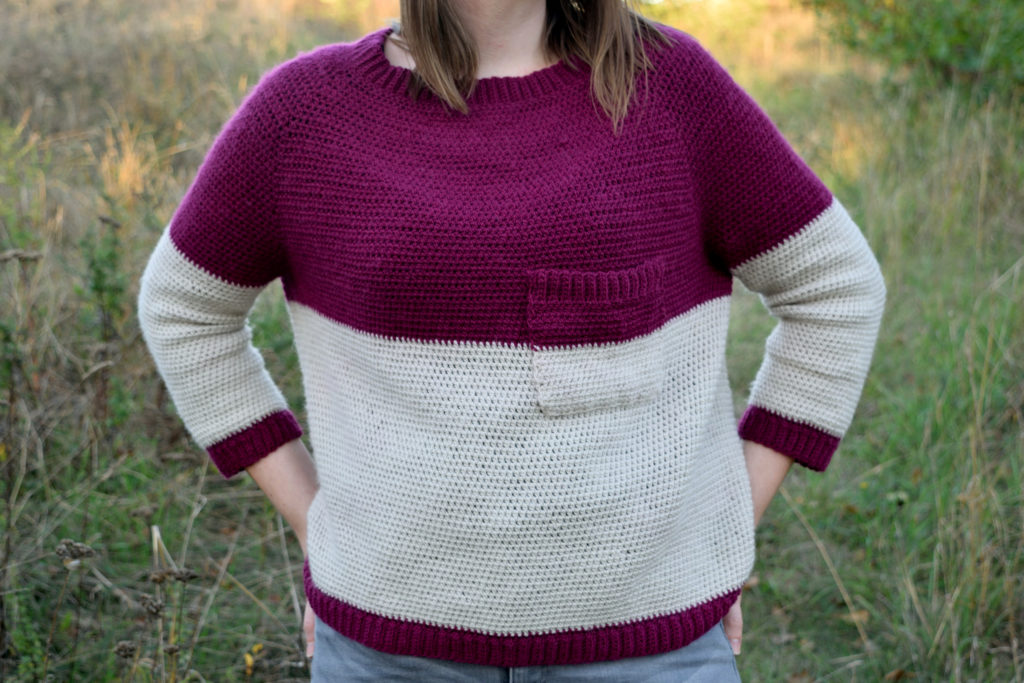
- Pocket Raglan Sweater, a two-color top-down raglan with short rows and a pocket you add at the end, in 8 sizes.
- Rhea V-Neck Cardigan, a seamless top-down cropped cardigan with a V-neck, in 9 sizes.
- Mosaic Cocoon Cardigan, two rectangles with mosaic panels, seamed into a cocoon shape, in 6 sizes.
More Lightweight Crochet Layers
For warm days you can also throw a lace shrug over a plain tee. And if you want even more tops, my roundup of 40+ crochet women’s tops patterns collects free tops from lots of designers.
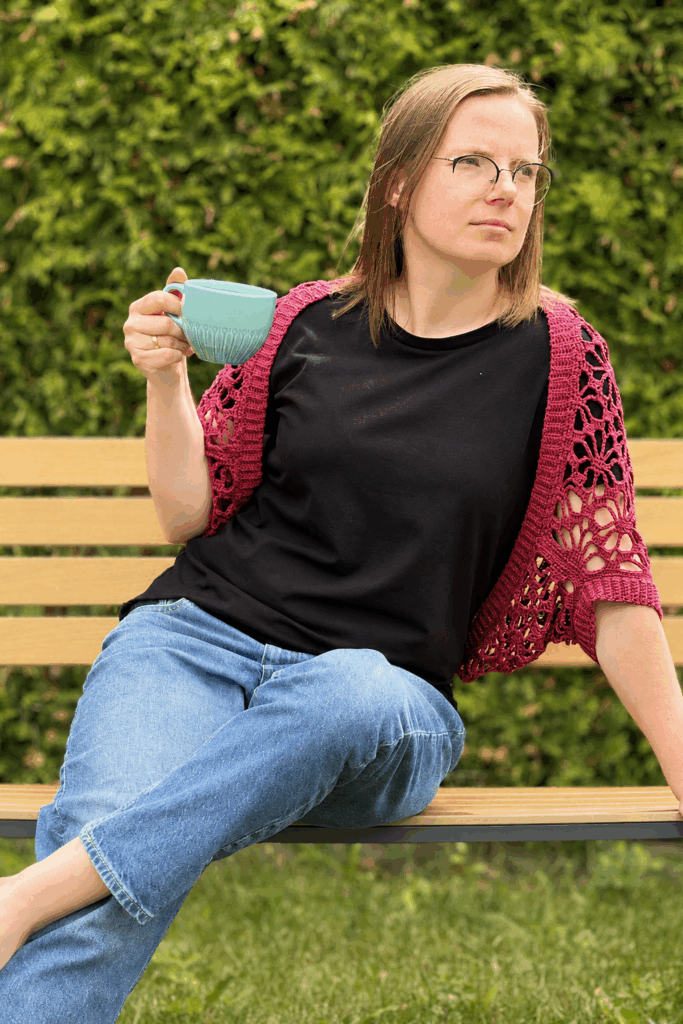
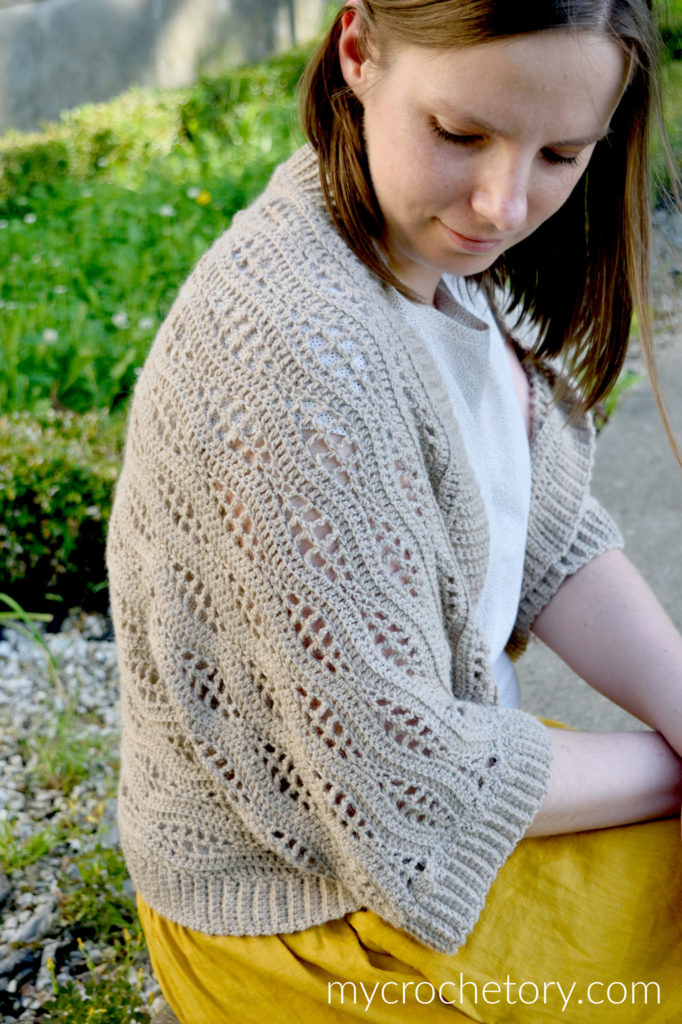
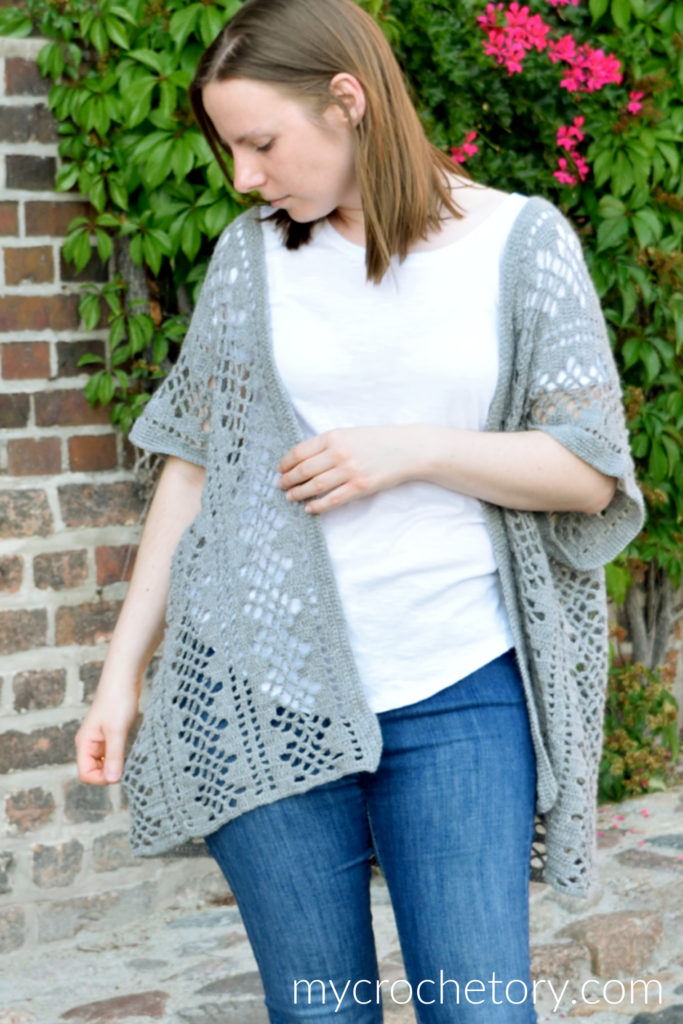

- Meadow Lace Shrug, one lace rectangle folded and seamed, with ribbed cuffs and collar, no shaping at all.
- Nalu Shrug, another one-rectangle shrug with a lace body and ribbed cuffs.
- Nusa Cardigan, an open lace cardigan in one size that fits S to L.
- Willow Shawl, a moss stitch triangle shawl in the same Woolly Whirl yarn as this tee.
Crochet Tee Pattern FAQ
Can I use a different yarn for this crochet tee pattern?
Yes, any fingering weight yarn that gives you 27 stitches and 19 rows in 4 inches after blocking will work. A cotton or cotton blend keeps the tee light for summer.
How do I make the Willow Tee longer or cropped?
Keep repeating Rounds 4 to 9 of the lower body until the tee is 1.2 inches shorter than you want, then add the hem. A longer body needs more yarn than the pattern lists.
Why does my beginning of round marker drift to one side?
Unturned rounds slowly lean, so the marker moves a bit with every round. That’s normal, and the pattern tells you to move it to the natural center back before you separate the body and sleeves.
What does ease mean in a crochet tee pattern?
Ease is the difference between the finished tee and your body. Positive ease means the tee is bigger than your bust, negative ease means it’s smaller and stretches to fit.

Pin it for later and come back when you’re ready to start.
Very pretty! Thanks so much for sharing with us!