Updated: 24 October 2026 by Sylwia (MyCrochetory)
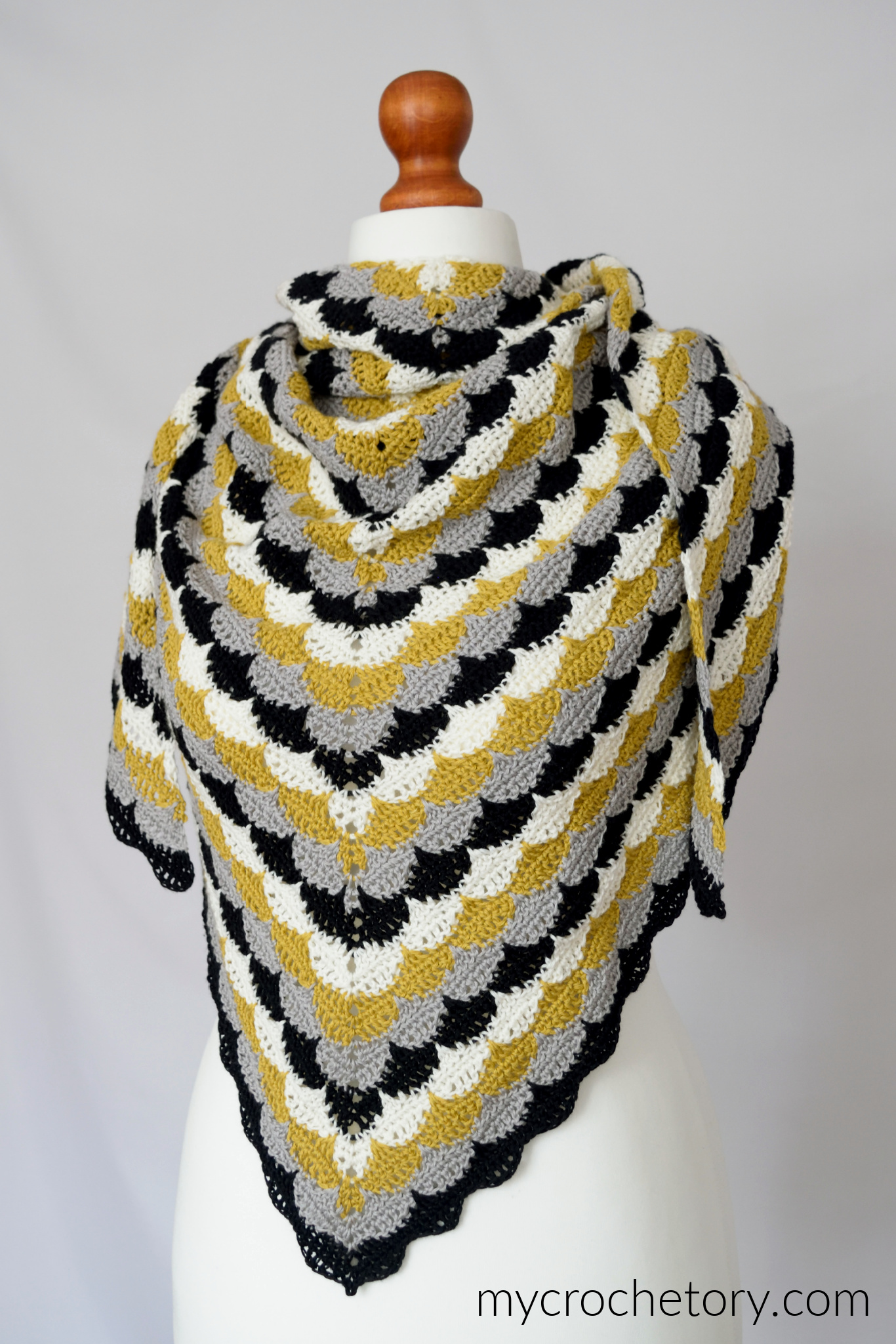
This clamshell crochet shawl began with a knitting pattern. Yes, a knitted one. It had rows of tiny scallops, and I wanted that look in crochet.
So I played with several stitch patterns. The clamshell stitch won. It gave me real scallops, a playful look and a fabric full of texture.
I liked it so much that I photographed every step while I made this shawl. Those photos became my clamshell stitch tutorial.
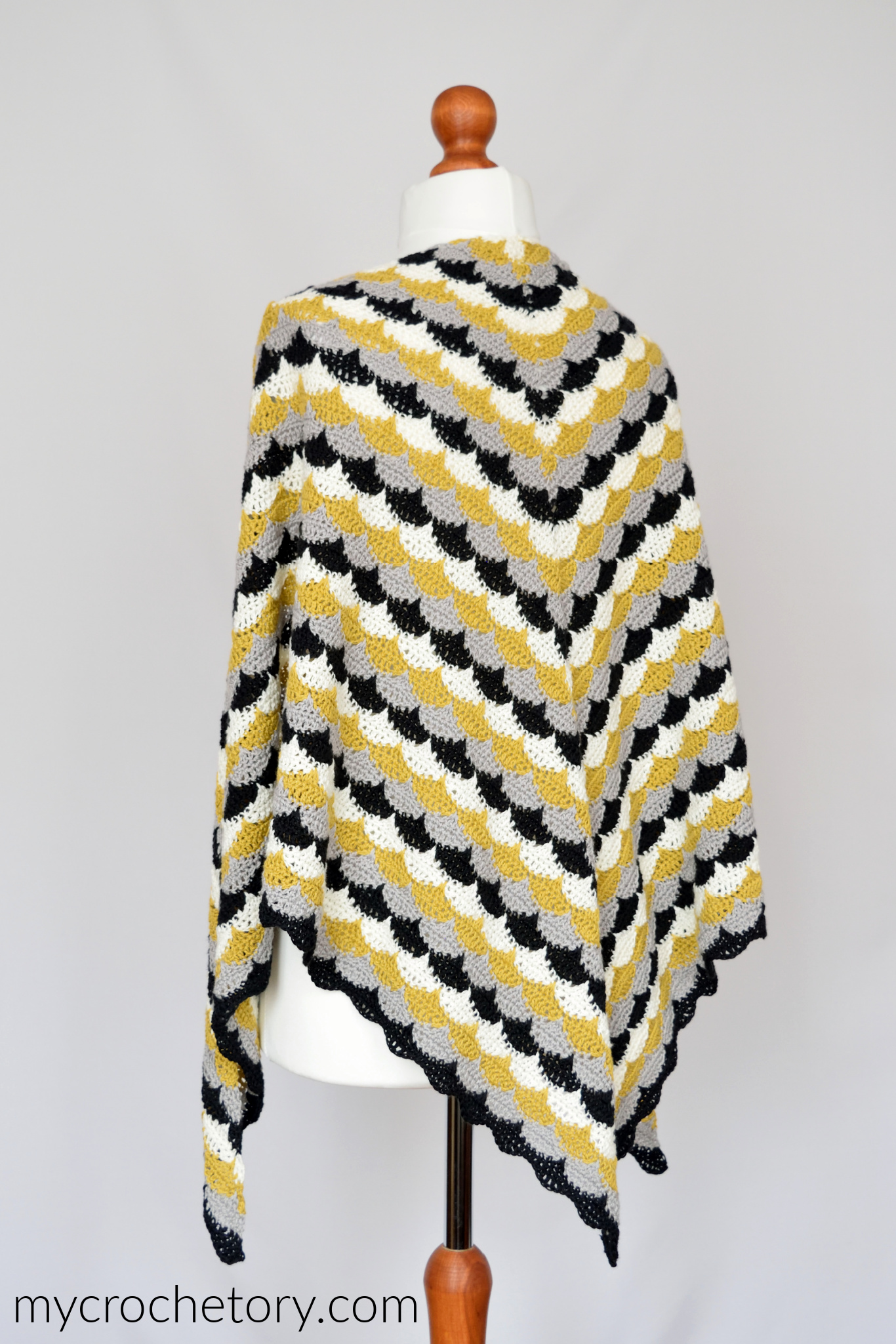
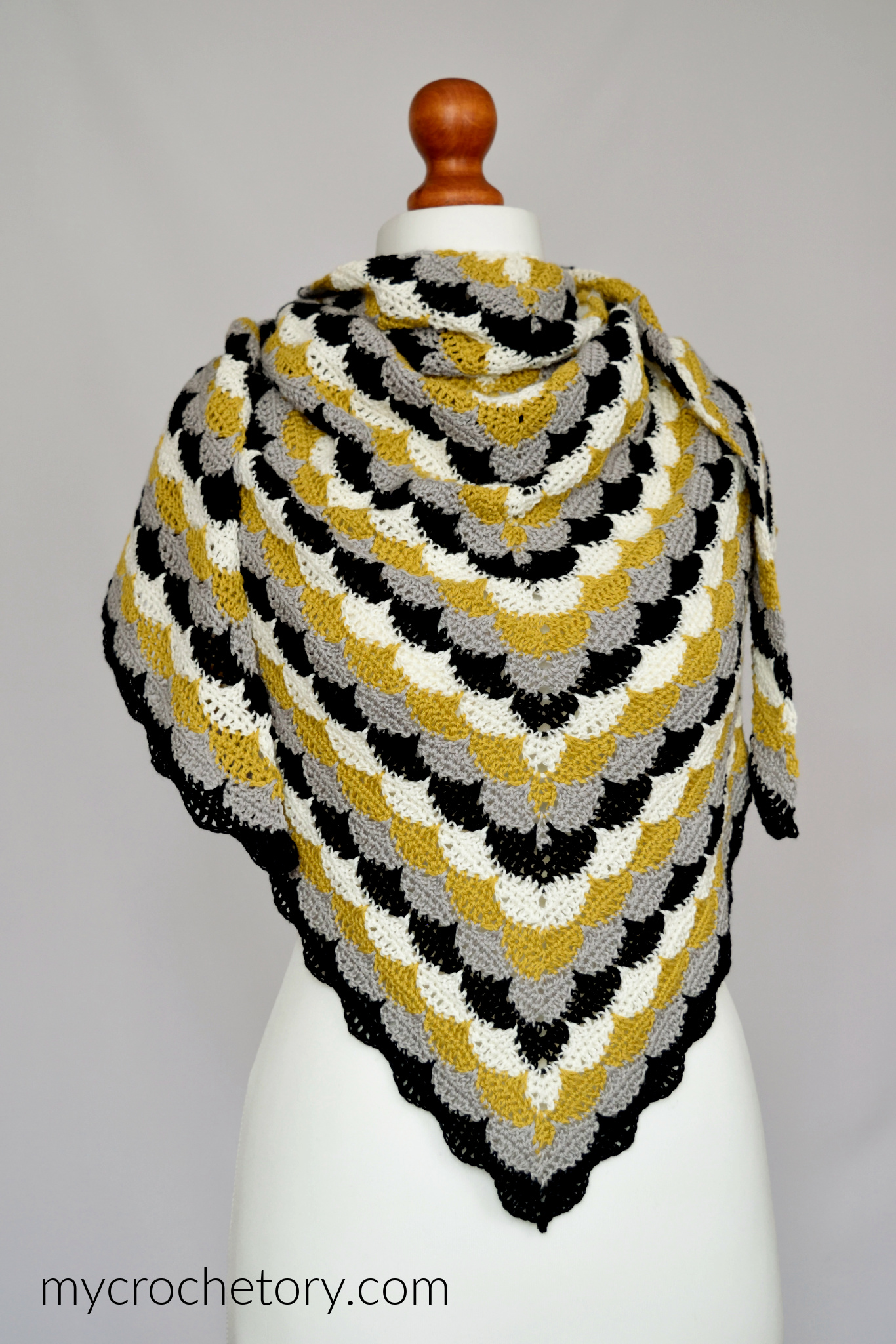
Then I picked the colors. Mustard, black and white has been my favorite combo for years. I added light gray, so four colors take turns every three rows.
The result is a light, top-down triangle. It’s easy to wrap, and it goes with almost anything you wear.
Below you’ll see how the shells work, how the shawl grows and which yarn I used. Want to start right away? Jump to the free Clamshell Shawl pattern.
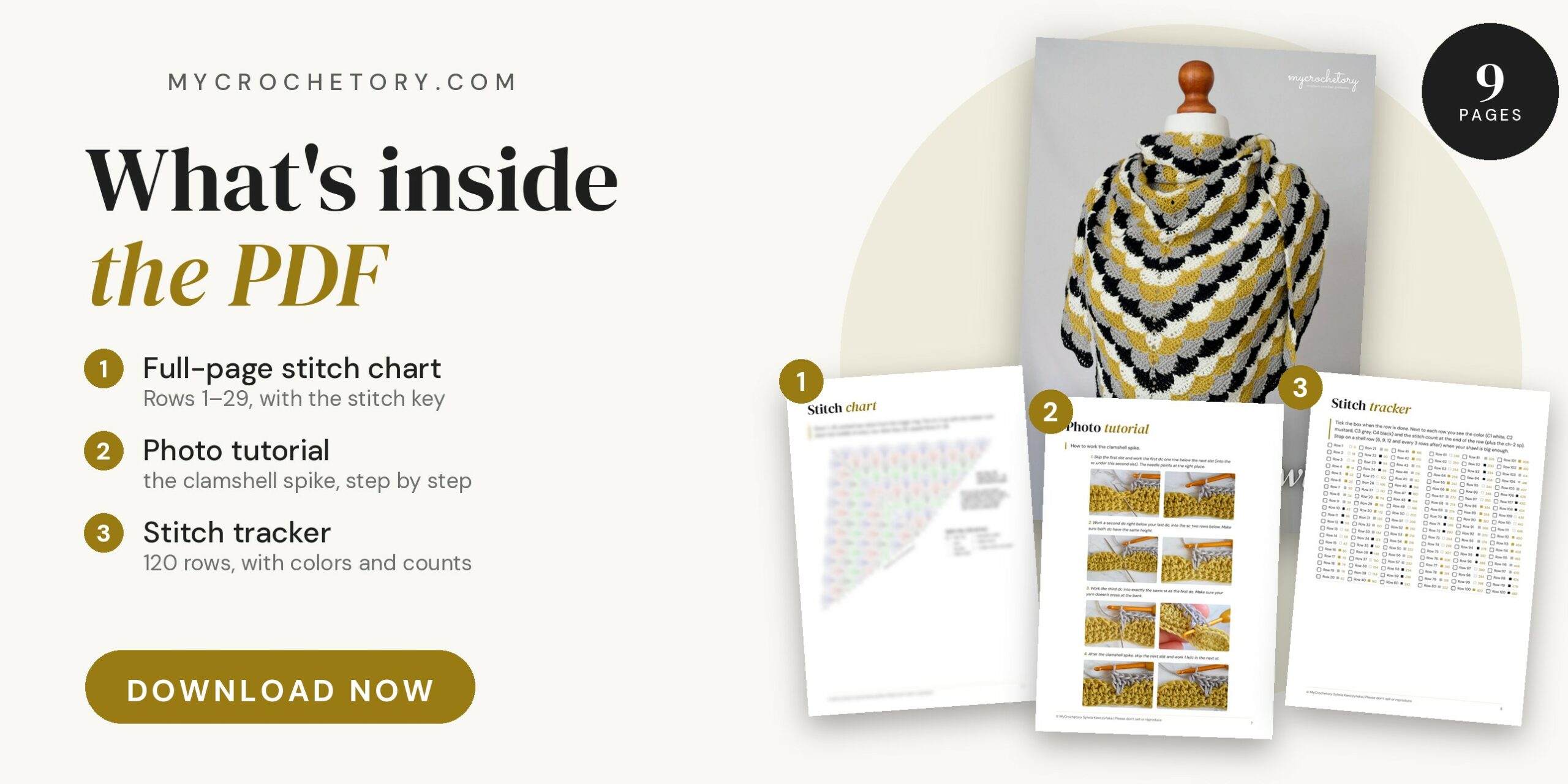
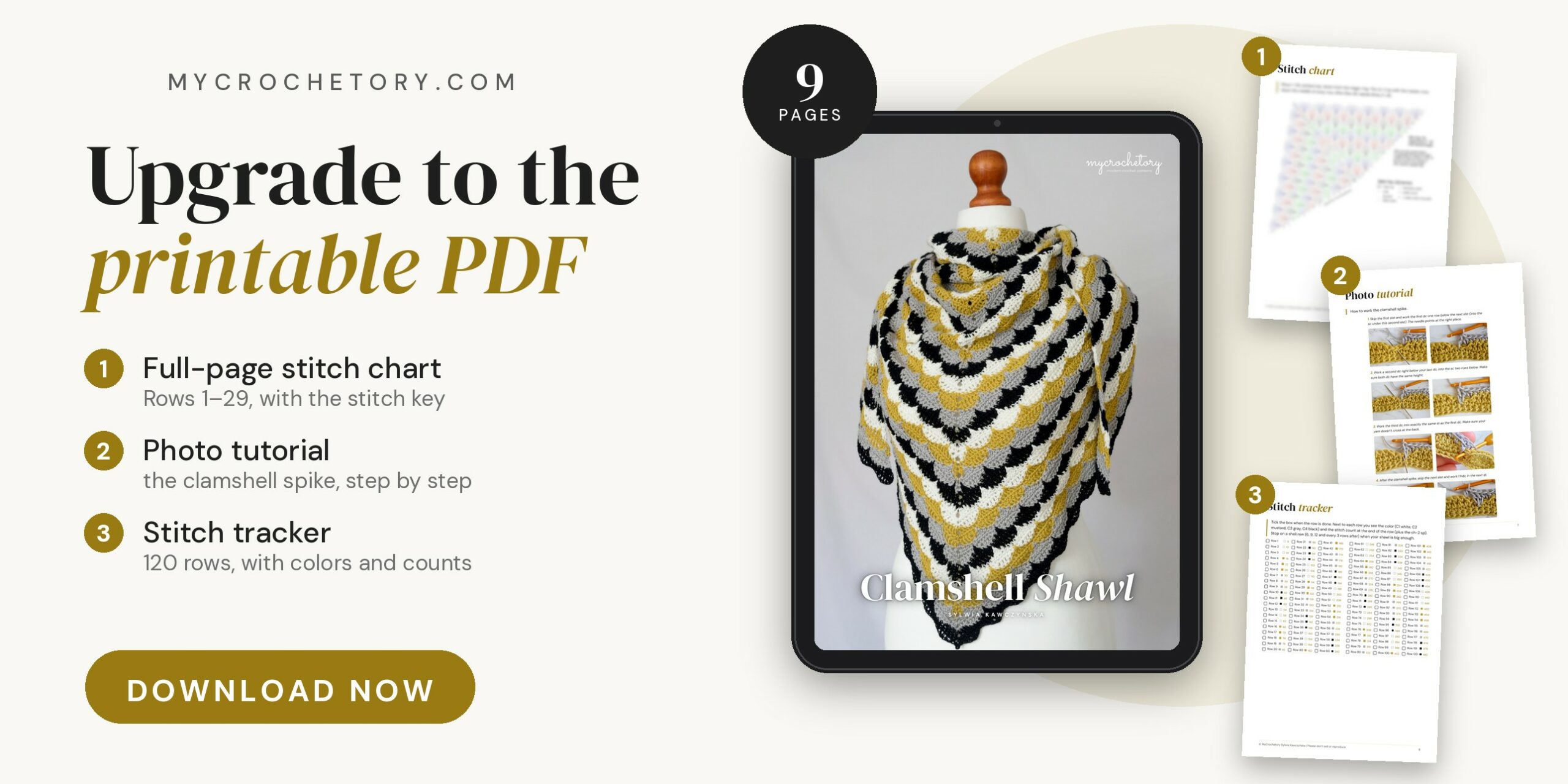
The ad-free, printable PDF of the Clamshell Shawl, with a stitch chart, is on Etsy and Ravelry.
Join my Facebook Group and Ravelry Group to ask questions and share your finished projects. You can also follow me on Instagram, Facebook and Pinterest.
How the clamshell stitch makes the shells
This stitch cheats a little. It reaches back into rows you already made.
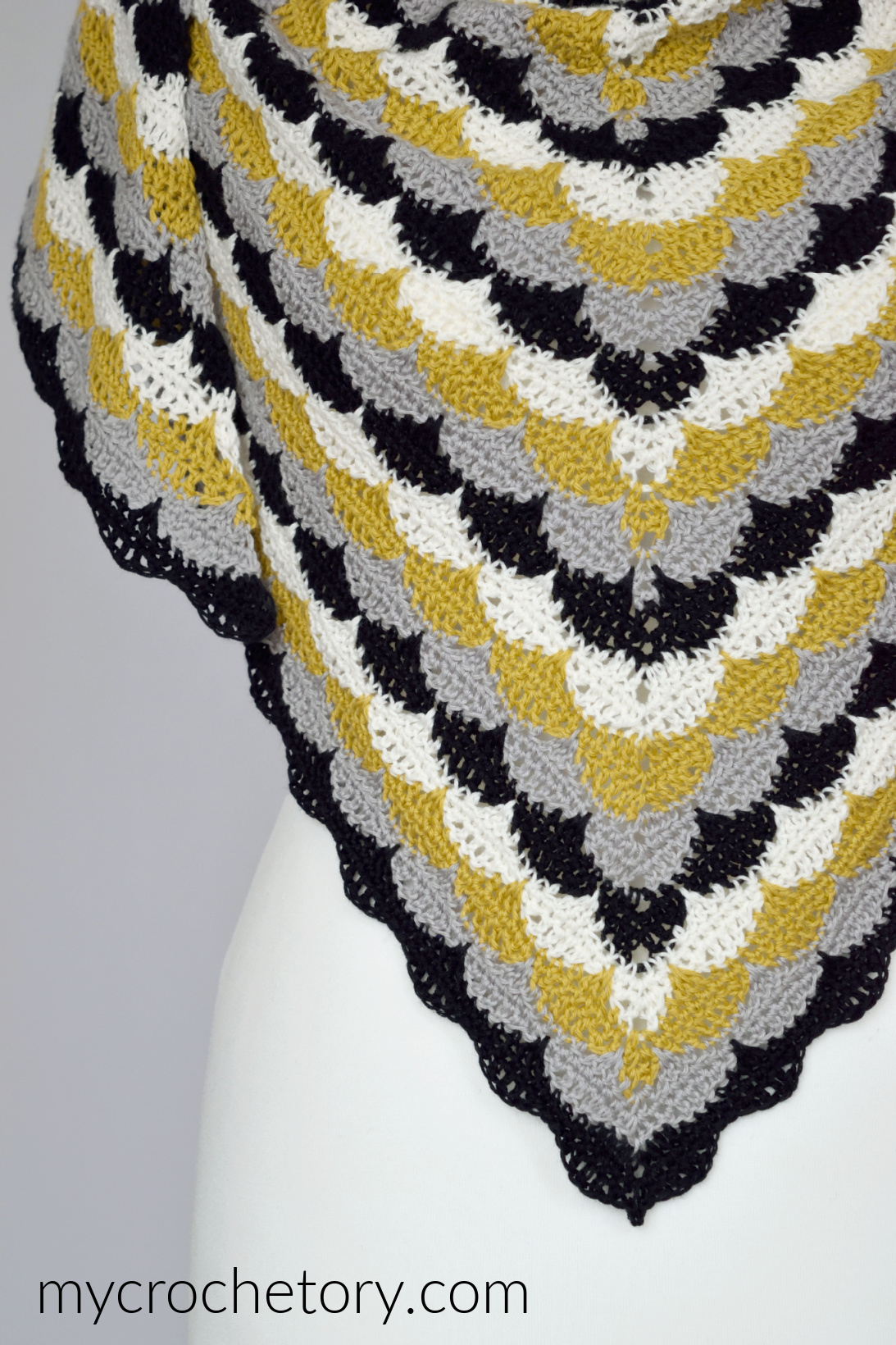
Every shell takes three rows, and every three rows get a new color. First comes the spike row. Three double crochets dip into the rows below and fan out.
That fan is the clamshell spike. Next is a plain row of single crochet. Then slip stitches, half double and double crochet build the round top of each shell.
You only work with one color at a time. So it’s simpler than it looks. Never tried it? My clamshell stitch tutorial shows every step in photos.
Picking colors for your clamshell crochet shawl
One color would hide every single shell. The scallops only show up when the color changes.
That’s why this shawl needs at least two colors. You change color in the last stitch of each shell row. With four colors, the order repeats every 12 rows.
Picking your own? Choose shades that stand out against each other. Light next to dark gives each shell a clear outline.
A top-down shawl that grows from one ring
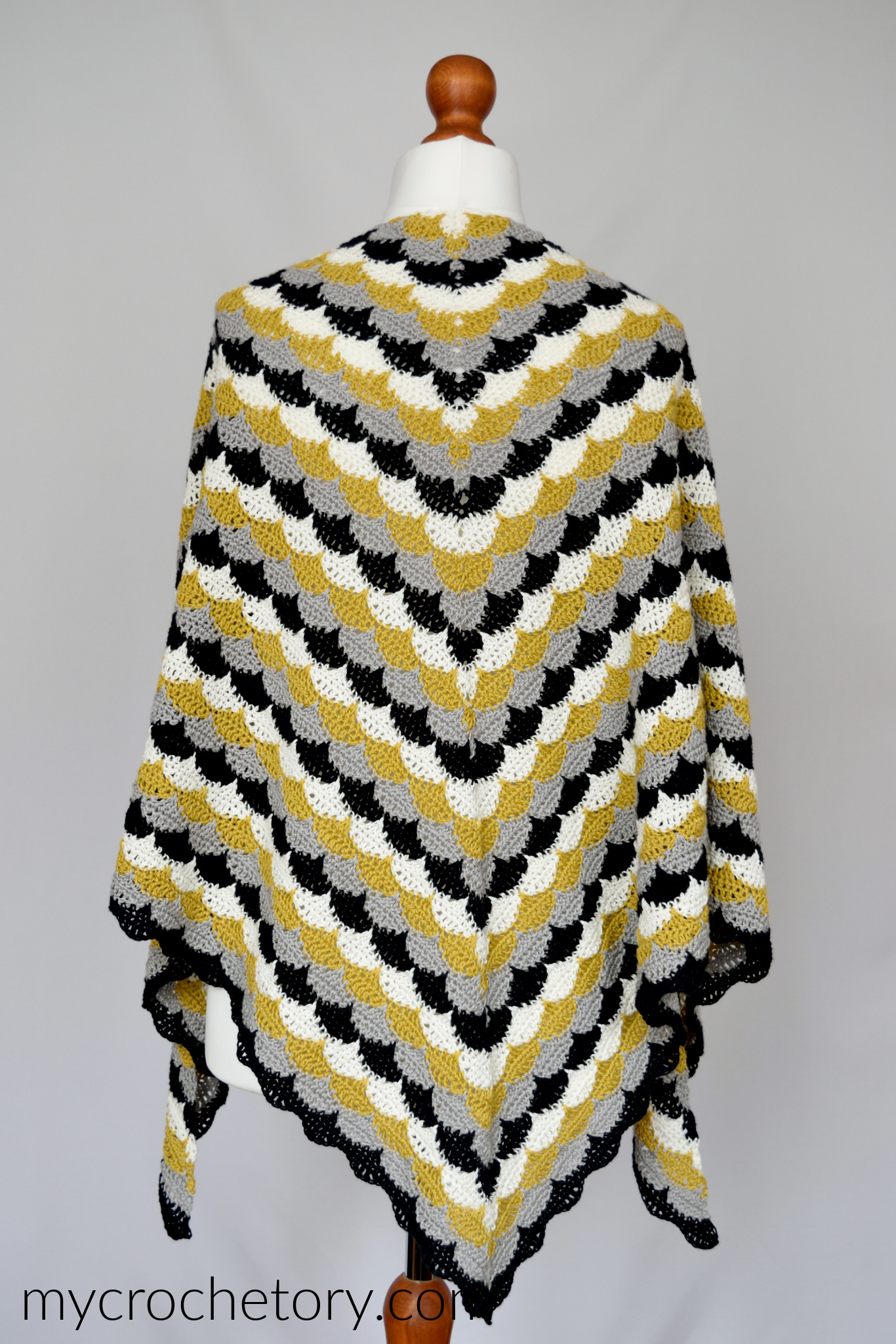
Triangle shawls are one of my favorite things to design. This one starts with a tiny magic ring.
The ring sits at the center of the top edge. A ch-2 space with a marker runs down the middle of every row. Each row adds 4 stitches.
After Row 28, you repeat Rows 5 – 28 until the shawl is big enough. Mine is about 70 inches wide and 30 inches deep.
Stop on a shell row, like Row 6, 9 or 12. Then the bottom edge ends in scallops. The finished shawl drapes nicely over your shoulders.
Yarn and blocking for a clamshell crochet shawl
Thin yarn, big shawl, almost no weight. I made mine in Scheepjes Whirlette, a fingering weight cotton and acrylic yarn.
One 100 g ball has about 498 yd. The whole shawl needs about 1,290 yd, and each color takes less than one ball.
So the shawl stays very light. It’s a nice layer for spring days.
Blocking is quick too. Whirlette is cotton and acrylic, so I pin the shawl to a mat and steam it. The hot iron stays about 0.4 inches above the yarn and never touches it.
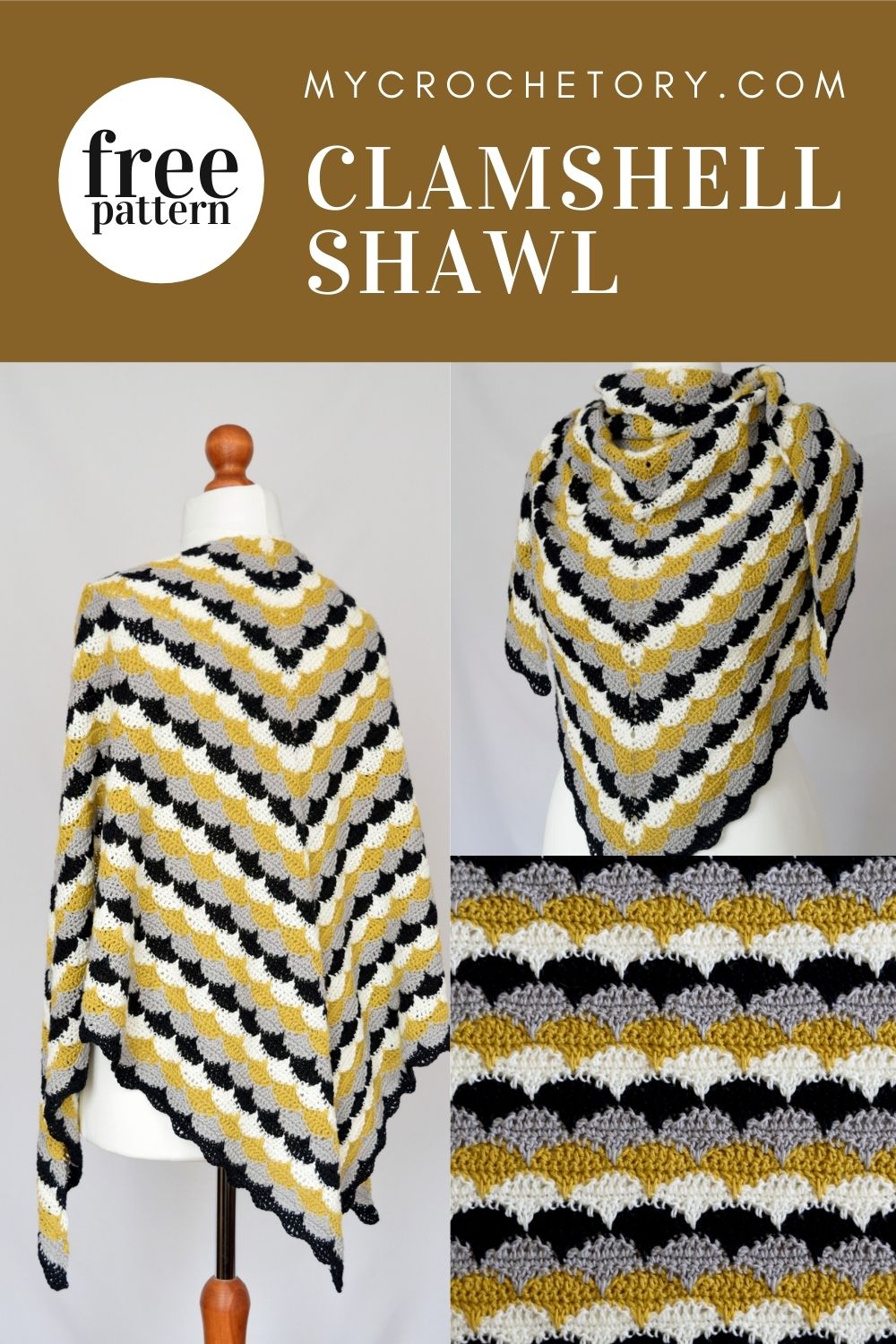
Not ready to start yet? Save the clamshell crochet shawl to your Pinterest board so it’s easy to find later.
Free clamshell crochet shawl pattern
- Get the ad-free, printable PDF with a stitch chart here on Etsy or here on Ravelry.
- Add this pattern to your Ravelry queue.
- Grab the MyCrochetory Shawl Pattern Bundle with 14 patterns for one low price.
- Pin it for later.
Copyright 2021 – 2026 MyCrochetory. All rights reserved. This pattern is the property of Sylwia Kawczyńska @MyCrochetory. Please DO NOT sell the pattern or claim it as your own. The pattern is for personal use only and may not be translated or reproduced in another language. Please respect my rights and DO NOT share or publish this pattern anywhere without my permission.
The clamshell shawl you make following this pattern is yours, and you are free to sell it, as long as you credit MyCrochetory as the original designer. For more information, please read the Terms Page.
Materials & Tools
- Yarn: Fingering weight yarn in 4 colors. These are approximations: C1 (white) – 56 g (278 yd/255 m), C2 (mustard) – 62 g (309 yd/283 m), C3 (gray) – 68 g (339 yd/310 m), C4 (black) – 73 g (364 yd/333 m).
- Suggested yarn: Scheepjes Whirlette (60% cotton, 40% acrylic, 100 g/455 m/498 yd). I used Ice (860) for C1, Mango (853) for C2, Frosted (852) for C3 and Liquorice (851) for C4.
- Hook: 3.5 mm (US E/4). Adjust the hook size if needed to get the correct gauge.
- Tapestry needle (to weave in the yarn ends).
- Scissors.
- Stitch marker.
Level
Intermediate.
Size after blocking
Wingspan: approx. 178 cm / 70″. Center depth: approx. 76 cm / 30″.
Gauge after blocking
After Row 15, the triangle is approx. 10 cm / 4″ high.
Gauge is not important for this project. However, changes might result in different yardage and a different finished size.
Notes
- The pattern uses US crochet terms.
- The shawl is worked top-down in rows, back and forth, in one piece.
- You can also use yarn in a different weight, but the size will change with your gauge.
- You can make this shawl as big as you like by adding or subtracting pattern repeats.
- The numbers in parentheses (…) are the stitch counts for each row.
- If the previous row starts with a turning chain that counts as a st, work the last stitches of the next row in the top of that turning chain, unless otherwise stated.
- Instructions in square brackets […] are worked as many times as indicated.
- The stitch chart is included in the ad-free, printable PDF here on Etsy or here on Ravelry.
Stitches & Abbreviations (US terms)
st(s) – stitch(es)
yo – yarn over
PM – place marker
M – marker
RPM – reposition marker
sp – space
sk – skip
clamshell spike – skip the first slip stitch and work the first double crochet one row below the next slip stitch (into the single crochet one row below this second slip stitch). Work a second double crochet right below your last double crochet, into the single crochet two rows below. Work the third double crochet into exactly the same stitch as the first double crochet, then skip the third slip stitch. See the photo steps below the pattern and my clamshell stitch tutorial.
Pattern
Read all Notes before you start.
Using C1, start with a magic ring or with ch5 and slst in the first ch to close the round.
Row 1: ch1 (doesn’t count as a st), 3sc in the ring, ch2, PM, 3sc in the ring. Turn. (6sts, 1ch-2sp)
Row 2: ch1 (doesn’t count as a st), 2sc in first st, sc in each st until ch-2sp, (sc, ch2, RPM, sc) in ch-2sp, sc in each st until 1 st remains, 2sc in last st. Turn. (10sts, 1ch-2sp)
Row 3: ch3 (counts as a st), hdc in first st, slst in next 3sts, hdc in next st, (dc, ch2, RPM, dc) in ch-2sp, hdc in next st, slst in next 3sts, (hdc, dc) in last st. Change to C2 in final st. Turn. (14sts, 1ch-2sp)
Row 4: ch1 (doesn’t count as a st), 2sc in first st, hdc in next st, clamshell spike, hdc in next st, sc in next st, (sc, ch2, RPM, sc) in ch-2sp, sc in next st, hdc in next st, clamshell spike, hdc in next st, 2sc in last st. Turn. (18sts, 1ch-2sp)
Row 5: Rep Row 2. (22sts, 1ch-2sp)
Row 6: ch2 (doesn’t count as a st), (hdc, slst) in first st, slst in next 2sts, [hdc in next st, dc in next 3sts, hdc in next st, slst in next 3sts] rep across until ch-2sp, (hdc, ch2, RPM, hdc) in ch-2sp, slst in next 2sts, [slst in next st, hdc in next st, dc in next 3sts, hdc in next st, slst in next 2sts] rep across until 1 st remains, (slst, hdc) in last st. Change to C3 in final st. Turn. (26sts, 1ch-2sp)
Row 7: ch1 (doesn’t count as a st), (sc, hdc) in first st, clamshell spike, hdc in next st, [sc in next 3sts, hdc in next st, clamshell spike, hdc in next st] rep across until ch-2sp, (sc, ch2, RPM, sc) in ch-2sp, hdc in next st, clamshell spike, [hdc in next st, sc in next 3sts, hdc in next st, clamshell spike] rep across until 1 st remains, (hdc, sc) in last st. Turn. (30sts, 1ch-2sp)
Row 8: Rep Row 2. (34sts, 1ch-2sp)
Row 9: 2slst in first st, [slst in next st, hdc in next st, dc in next 3sts, hdc in next st, slst in next 2sts] rep across until ch-2sp, (slst, ch2, RPM, slst) in ch-2sp, [slst in next 2sts, hdc in next st, dc in next 3sts, hdc in next st, slst in next st] rep across until 1 st remains, 2slst in last st. Change to C4 in final st. Turn. (38sts, 1ch-2sp)
Row 10: ch2 (counts as a st), dc in first st, dc in next 2sts, hdc in next st, sc in next 3sts, hdc in next st, [clamshell spike, hdc in next st, sc in next 3sts, hdc in next st] rep across until 3 slsts remain before ch-2sp, dc in next 3sts, (hdc, ch2, RPM, hdc) in ch-2sp, dc in next 3sts, hdc in next st, sc in next 3sts, hdc in next st, [clamshell spike, hdc in next st, sc in next 3sts, hdc in next st] rep across until 3 slsts remain, dc in next 2sts, (dc, hdc) in last st. Turn. (42sts, 1ch-2sp)
Row 11: Rep Row 2. (46sts, 1ch-2sp)
Row 12: 2slst in first st, hdc in next st, dc in next 3sts, hdc in next st, slst in next st, [slst in next 2sts, hdc in next st, dc in next 3sts, hdc in next st, slst in next st] rep across until ch-2sp, (slst, ch2, RPM, slst) in ch-2sp, slst in next st, hdc in next st, dc in next 3sts, hdc in next st, [slst in next 3sts, hdc in next st, dc in next 3sts, hdc in next st] rep across until 1 st remains, 2slst in last st. Change to C1 in final st. Turn. (50sts, 1ch-2sp)
Row 13: ch3 (counts as a st), dc in first st, dc in next st, hdc in next st, sc in next 3sts, hdc in next st, [clamshell spike, hdc in next st, sc in next 3sts, hdc in next st] rep across until 2 slsts remain before ch-2sp, dc in next 2sts, (dc, ch2, RPM, dc) in ch-2sp, dc in next 2sts, hdc in next st, sc in next 3sts, hdc in next st, [clamshell spike, hdc in next st, sc in next 3sts, hdc in next st] rep across until 2 slsts remain, dc in next st, 2dc in last st. Turn. (54sts, 1ch-2sp)
Row 14: Rep Row 2. (58sts, 1ch-2sp)
Row 15: (slst, hdc) in first st, dc in next 3sts, hdc in next st, [slst in next 3sts, hdc in next st, dc in next 3sts, hdc in next st] rep across until ch-2sp, (slst, ch2, RPM, slst) in ch-2sp, hdc in next st, dc in next 3sts, [hdc in next st, slst in next 3sts, hdc in next st, dc in next 3sts] rep across until 1 st remains, (hdc, slst) in last st. Change to C2 in final st. Turn. (62sts, 1ch-2sp)
Row 16: ch3 (counts as a st), dc in first st, hdc in next st, sc in next 3sts, hdc in next st, [clamshell spike, hdc in next st, sc in next 3sts, hdc in next st] rep across until 1 slst remains before ch-2sp, dc in next st, (dc, ch2, RPM, dc) in ch-2sp, dc in next st, hdc in next st, sc in next 3sts, hdc in next st, [clamshell spike, hdc in next st, sc in next 3sts, hdc in next st] rep across until 1 st remains, 2dc in last st. Turn. (66sts, 1ch-2sp)
Row 17: Rep Row 2. (70sts, 1ch-2sp)
Row 18: ch2 (counts as a st), dc in first st, dc in next 2sts, [hdc in next st, slst in next 3sts, hdc in next st, dc in next 3sts] rep across until ch-2sp, (hdc, ch2, RPM, hdc) in ch-2sp, dc in next 2sts, [dc in next st, hdc in next st, slst in next 3sts, hdc in next st, dc in next 2sts] rep across until 1 st remains, (dc, hdc) in last st. Change to C3 in final st. Turn. (74sts, 1ch-2sp)
Row 19: ch3 (counts as a st), hdc in first st, sc in next 3sts, hdc in next st, [clamshell spike, hdc in next st, sc in next 3sts, hdc in next st] rep across until ch-2sp, (dc, ch2, RPM, dc) in ch-2sp, hdc in next st, sc in next 3sts, [hdc in next st, clamshell spike, hdc in next st, sc in next 3sts] rep across until 1 st remains, (hdc, dc) in last st. Turn. (78sts, 1ch-2sp)
Row 20: Rep Row 2. (82sts, 1ch-2sp)
Row 21: ch3 (counts as a st), dc in first st, [dc in next st, hdc in next st, slst in next 3sts, hdc in next st, dc in next 2sts] rep across until ch-2sp, (dc, ch2, RPM, dc) in ch-2sp, [dc in next 2sts, hdc in next st, slst in next 3sts, hdc in next st, dc in next st] rep across until 1 st remains, 2dc in last st. Change to C4 in final st. Turn. (86sts, 1ch-2sp)
Row 22: ch2 (counts as a st), sc in first st, sc in next 2sts, [hdc in next st, clamshell spike, hdc in next st, dc in next 3sts] rep across until ch-2sp, (hdc, ch2, RPM, hdc) in ch-2sp, sc in next 2sts, [sc in next st, hdc in next st, clamshell spike, hdc in next st, sc in next 2sts] rep across until 1 st remains, (sc, hdc) in last st. Turn. (90sts, 1ch-2sp)
Row 23: Rep Row 2. (94sts, 1ch-2sp)
Row 24: ch3 (counts as a st), dc in first st, hdc in next st, slst in next 3sts, hdc in next st, dc in next st, [dc in next 2sts, hdc in next st, slst in next 3sts, hdc in next st, dc in next st] rep across until ch-2sp, (dc, ch2, RPM, dc) in ch-2sp, dc in next st, hdc in next st, slst in next 3sts, hdc in next st, [dc in next 3sts, hdc in next st, slst in next 3sts, hdc in next st] rep across until 1 st remains, 2dc in last st. Change to C1 in final st. Turn. (98sts, 1ch-2sp)
Row 25: ch1 (doesn’t count as a st), 2sc in first st, [sc in next st, hdc in next st, clamshell spike, hdc in next st, sc in next 2sts] rep across until ch-2sp, (sc, ch2, RPM, sc) in ch-2sp, [sc in next 2sts, hdc in next st, clamshell spike, hdc in next st, sc in next st] rep across until 1 st remains, 2sc in last st. Turn. (102sts, 1ch-2sp)
Row 26: Rep Row 2. (106sts, 1ch-2sp)
Row 27: ch3 (counts as a st), hdc in first st, slst in next 3sts, hdc in next st, [dc in next 3sts, hdc in next st, slst in next 3sts, hdc in next st] rep across until ch-2sp, (dc, ch2, RPM, dc) in ch-2sp, hdc in next st, slst in next 3sts, [hdc in next st, dc in next 3sts, hdc in next st, slst in next 3sts] rep across until 1 st remains, (hdc, dc) in last st. Change to C2 in final st. Turn. (110sts, 1ch-2sp)
Row 28: ch1 (doesn’t count as a st), 2sc in first st, hdc in next st, clamshell spike, hdc in next st, sc in next st, [sc in next 2sts, hdc in next st, clamshell spike, hdc in next st, sc in next st] rep across until ch-2sp, (sc, ch2, RPM, sc) in ch-2sp, sc in next st, hdc in next st, clamshell spike, hdc in next st, [sc in next 3sts, hdc in next st, clamshell spike, hdc in next st] rep across until 1 st remains, 2sc in last st. Turn. (114sts, 1ch-2sp)
Then, repeat Rows 5 – 28 until the desired length.
When you reach the desired length, end on a repeat of Row 6, 9, 12, 15, 18, 21, 24 or 27, so you finish with a scalloped edge.
Fasten off, weave in all ends and block your shawl.
How to work the clamshell spike
Skip the first slip stitch and work the first double crochet one row below the next slip stitch (into the single crochet of Row 2 under this second slip stitch). The needle points at the right place.


Then work a second double crochet right below your last double crochet, into the single crochet two rows below. The needle points at the right place. Make sure both your double crochets have the same height.


Work the third double crochet into exactly the same stitch as the first double crochet. The needle points at the right place. Make sure your yarn doesn’t cross at the back.


After the clamshell spike, skip the next slip stitch and work 1 hdc in the next stitch.

Finished your Clamshell Shawl? Share it on Instagram with #mycrochetory and tag @mycrochetory so I can see your colors.
Stuck on a row or found a mistake? Ask in my Facebook Group or Ravelry Group, or email me at mycrochetory@gmail.com.
More clamshell and top-down shawl patterns
Liked the shells? Here’s the same stitch in a blanket, plus three more shawls that start at the top.
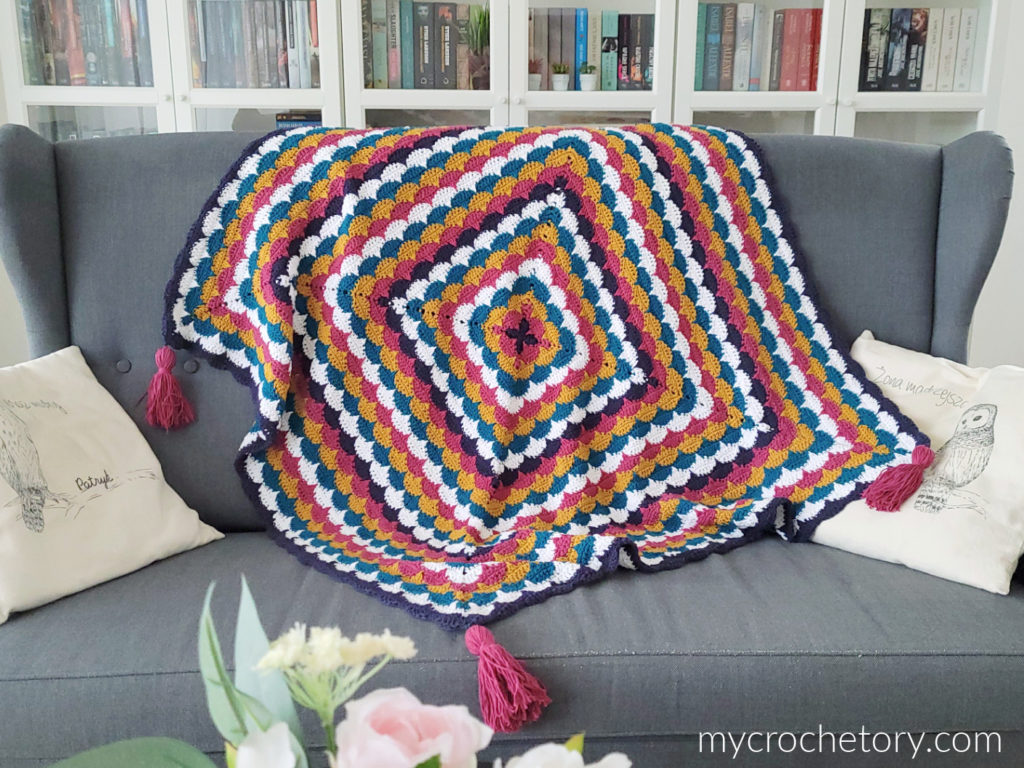


- Clamshell Crochet Baby Blanket, the same clamshell stitch worked in rounds from the center, in five colors.
- Forsythia Shawl, a top-down triangle with lace clusters and a picot edge.
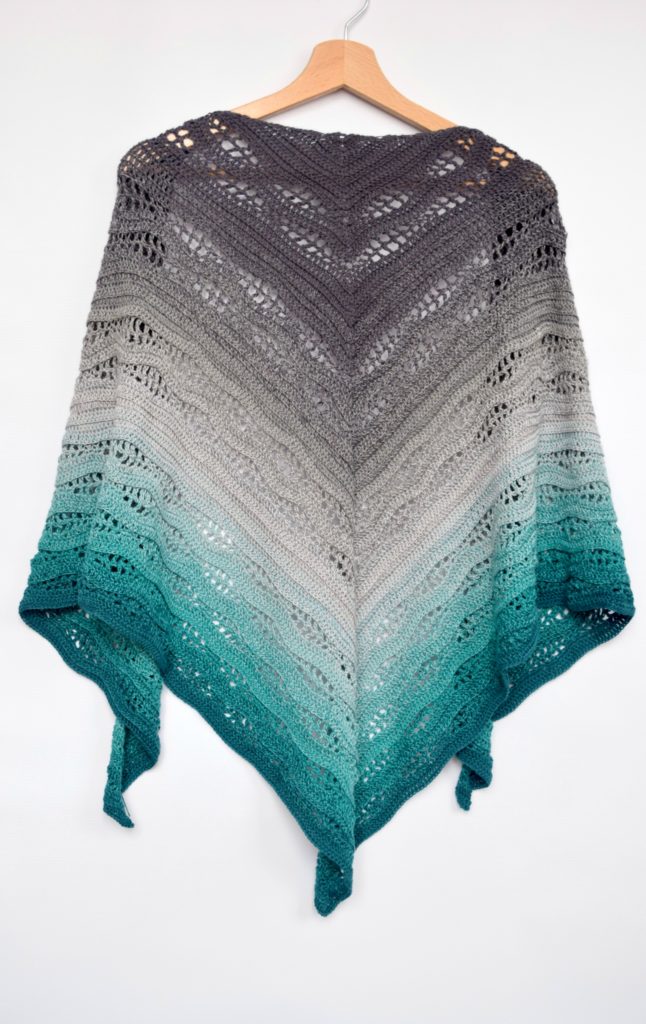
- Kalinda Shawl, a top-down triangle in the wave stitch, made from one gradient yarn cake.
- Field of Flowers Shawl, a top-down triangle full of lace flowers.
New to shawl shapes? My guide to how to crochet a shawl explains the main constructions, including top-down triangles.
Clamshell crochet shawl FAQ
Can I make the clamshell crochet shawl bigger or smaller?
Yes. Repeat Rows 5 – 28 more or fewer times, and end on a shell row for a scalloped edge. A bigger shawl needs more yarn.
Can I use a different yarn weight?
Yes. Use a hook that suits your yarn, and expect a different size and yardage.
How many colors do I need for a clamshell crochet shawl?
The pattern uses four. Two or more colors work, as long as they contrast, because the shells only show when the color changes.
This is a beauty! I can imagine shawls is so many different color schemes. Thank you for putting this pattern together. Fantastic job.