Updated: 28 September 2026 by Sylwia (MyCrochetory)
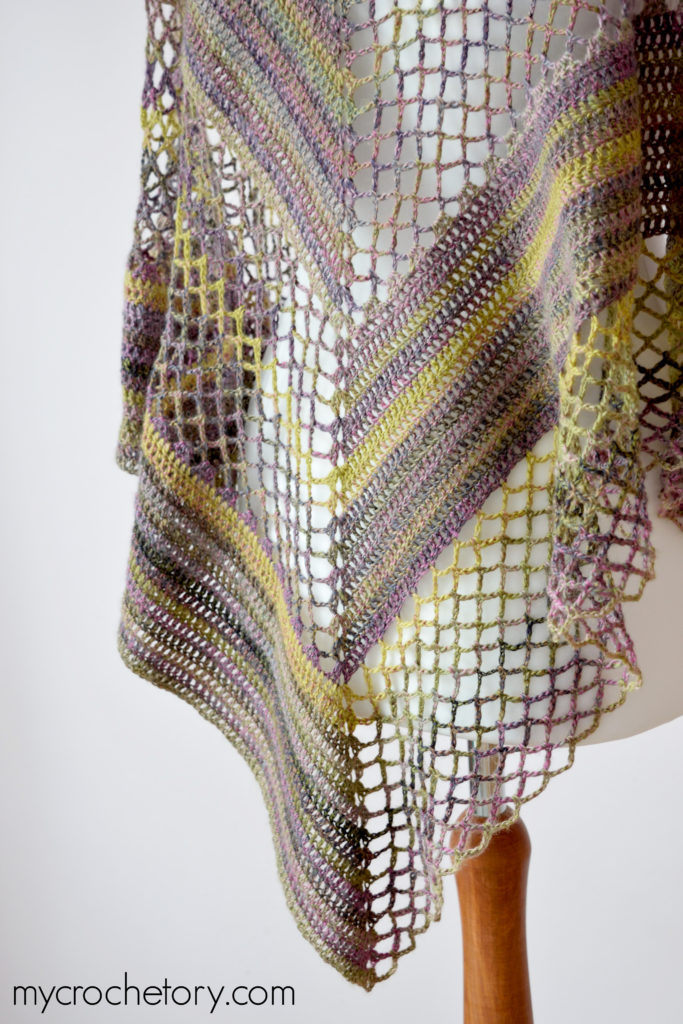
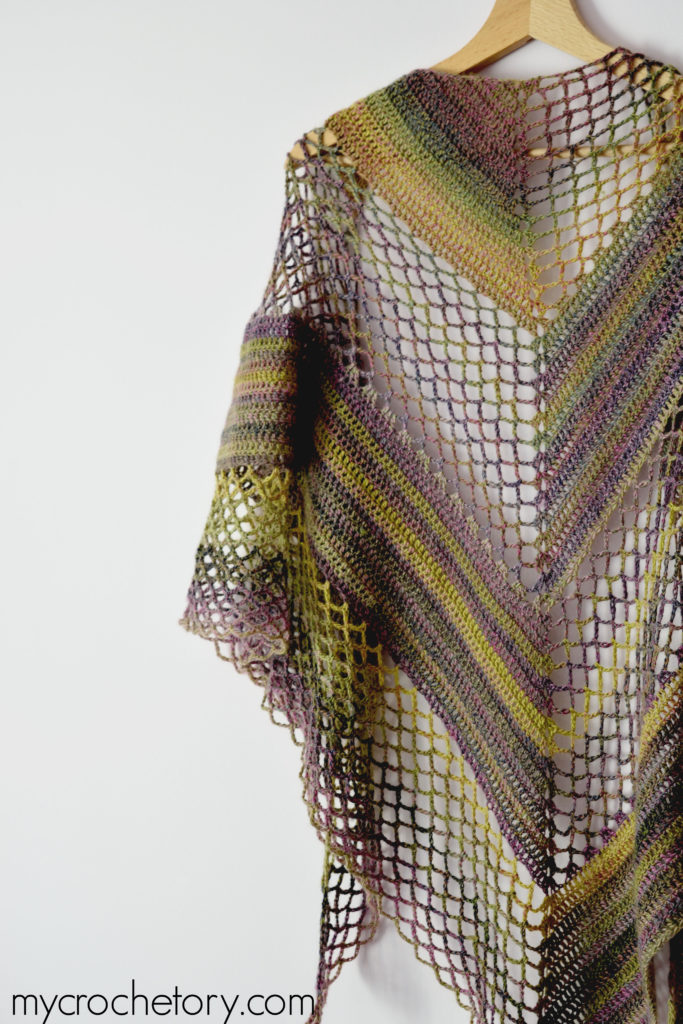
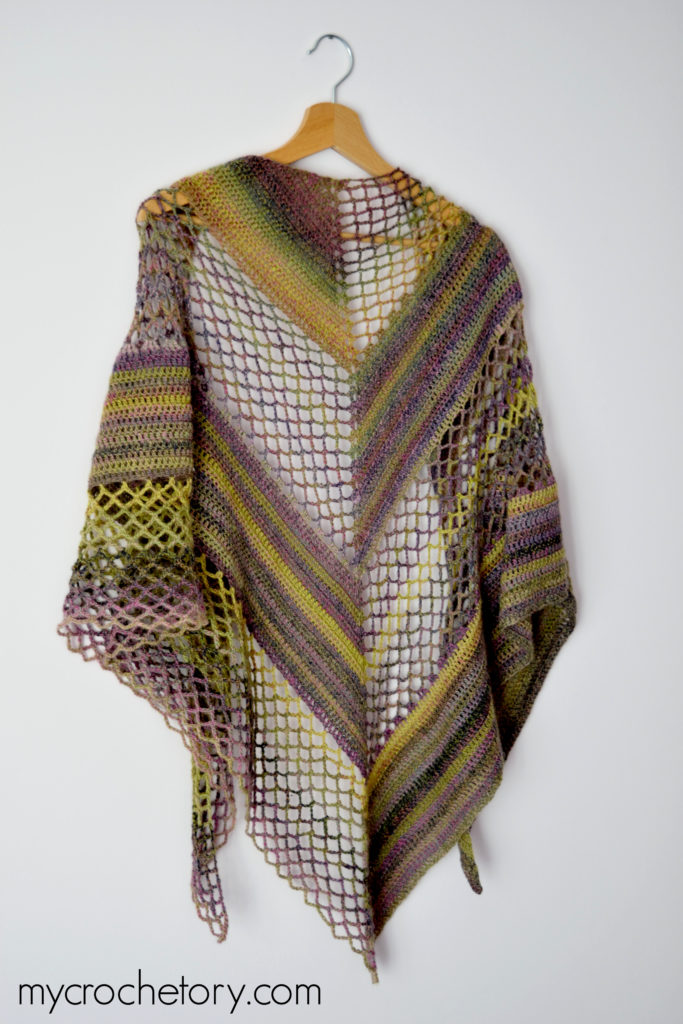
This crochet mesh shawl pattern began with a little “what if” in my head. What if the other side of the row didn’t have the same pattern? I just had to try it. So I crocheted one half of the row in solid double crochet and the other half in open mesh.
Then I got curious again and swapped the two halves. That’s how the shawl got its blocks of solid rows and mesh. You make it as a top-down triangle with two skeins of thin yarn, and it’s a fun project for adventurous beginners.
In this post, I show you how the blocks work, which yarn to pick and how to change the size.
The free pattern comes after that, so just scroll down. Want an ad-free printable PDF with the stitch chart? You can get it on Etsy or Ravelry.
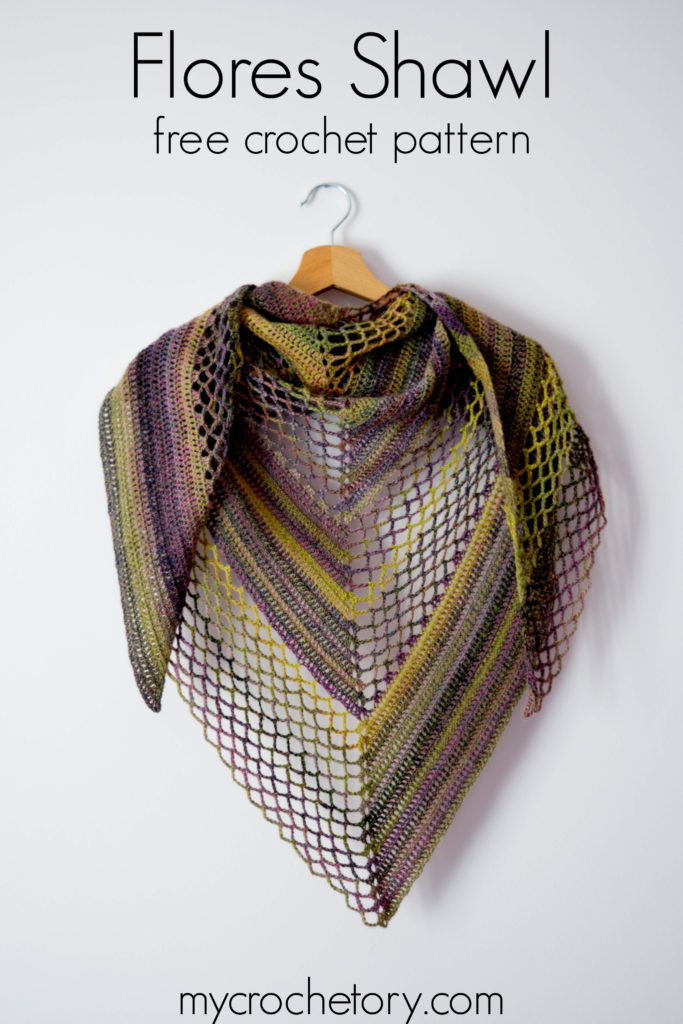
Love the blocks but no time to start today? Save this pin to your Pinterest board, so you can find your Flores fast when you’re ready.
How the solid and mesh blocks work
So where do the blocks come from? From a swap! In this crochet mesh shawl, you switch the two halves of the row three times, and every switch starts a new block. When I was designing Flores, this was the part I played with the most, because it’s where my “what if” idea turns into something you can see.
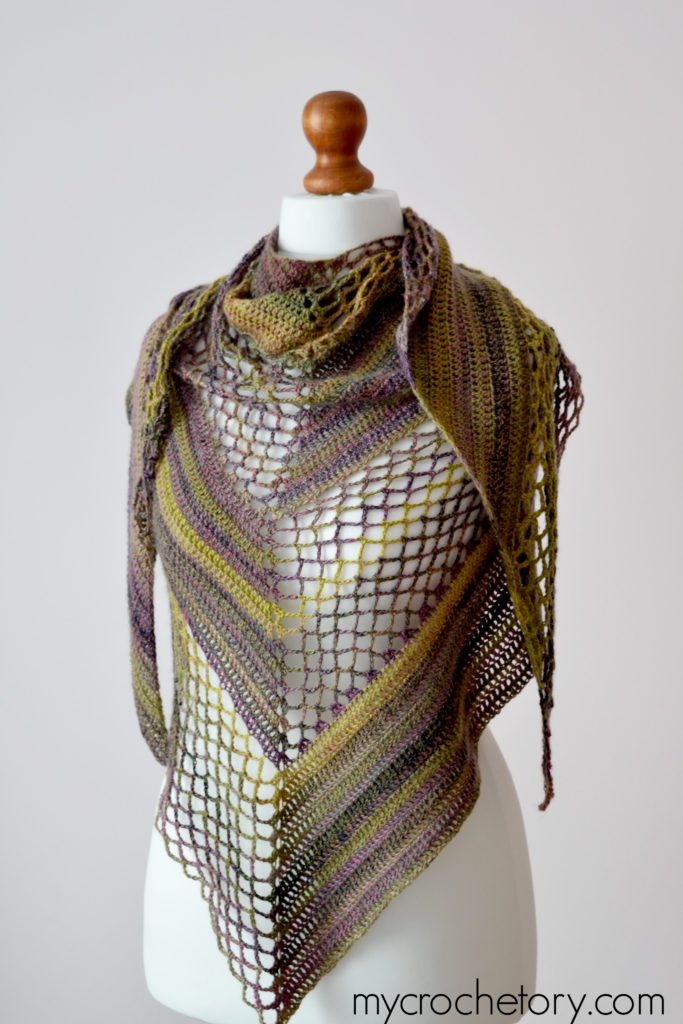
Your first swap comes at Rows 15 and 16. I know it sounds tricky, but it’s really just two rows. In Row 15, you fill the mesh with groups of 3 double crochet. Then in Row 16, you turn the solid side into mesh. Now the mesh sits on the other side of your shawl, and you’ve done your first swap!
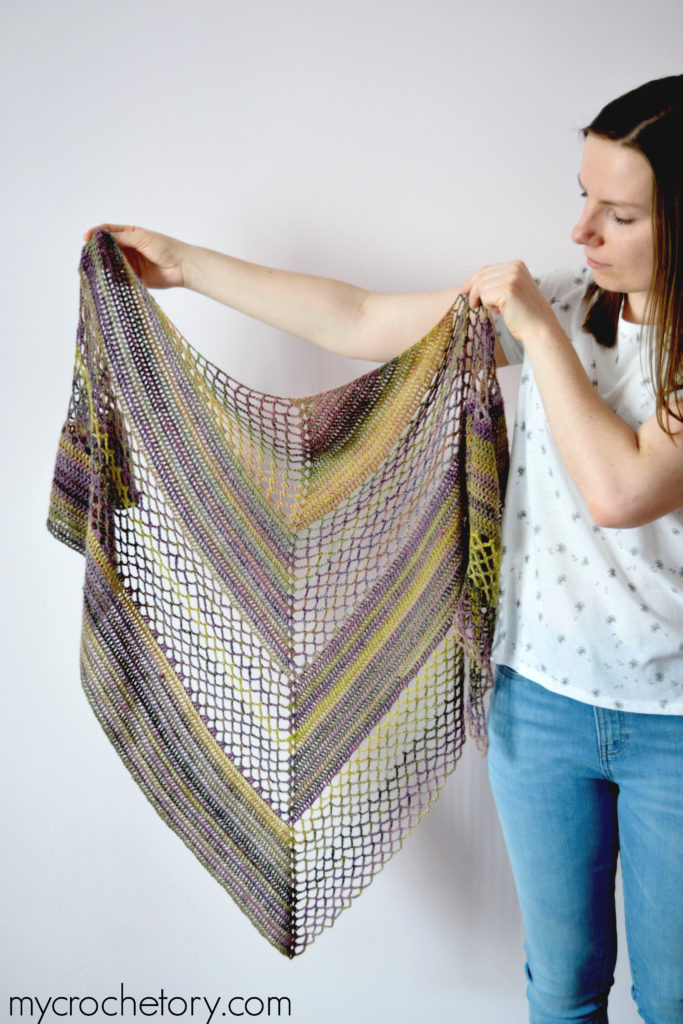
After that, you get 12 to 14 rows where nothing changes, until the next swap at Rows 29 and 30, and the last one at Rows 43 and 44. And since every row is a bit longer than the one before, each new block turns out bigger than the one above it.
Is this crochet mesh shawl good for beginners?
Yes, you can make this crochet mesh shawl as a beginner, as long as you don’t mind a little challenge. The stitches won’t scare you. You only need chains, single crochet, double crochet and slip stitches, and you probably know most of them already. If not, my guide to beginning crochet stitches shows you each one step by step. What takes a bit more attention is how they fit together, so before you start, check if you’re OK with these three things.
First, can you read a crochet pattern? I write repeats in square brackets, and for the first rows, I give you stitch counts in parentheses. That way you can count your stitches and know you’re on the right track.
Second, are you happy working in rows? You’ll turn your work at the end of every row, so this should feel normal to you. And third, do you know how to make increases? In every row, you add a few stitches at both edges and in the center. That’s how your tiny start grows into a big triangle.
If you said “no” to one of these, that’s totally fine. My guide on how to crochet a shawl shows you three easy ways to make a triangle shawl, so start there and get comfy with the basics. Then come back to Flores, and I’ll be happy to see you here again.
Which yarn to use for this crochet mesh shawl
For this crochet mesh shawl, pick a thin yarn: I recommend fingering or sport weight. You’ll need about 840 m, and I made my Flores with 2 skeins of Scheepjes Our Tribe. It’s 70% merino and 30% polyamide, so it’s nice and soft around your neck.
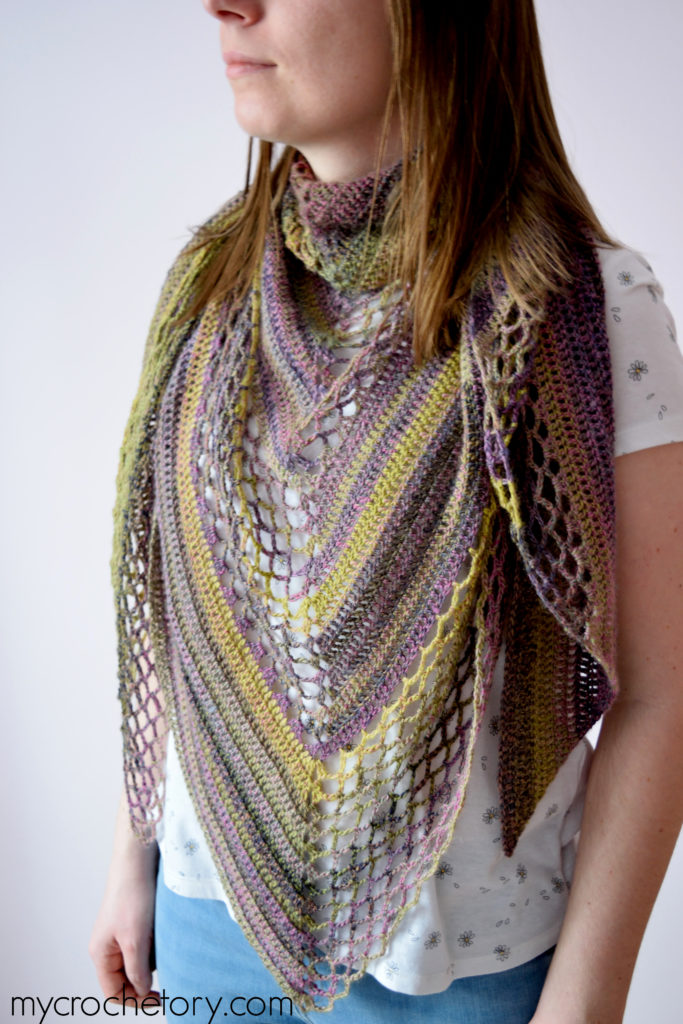
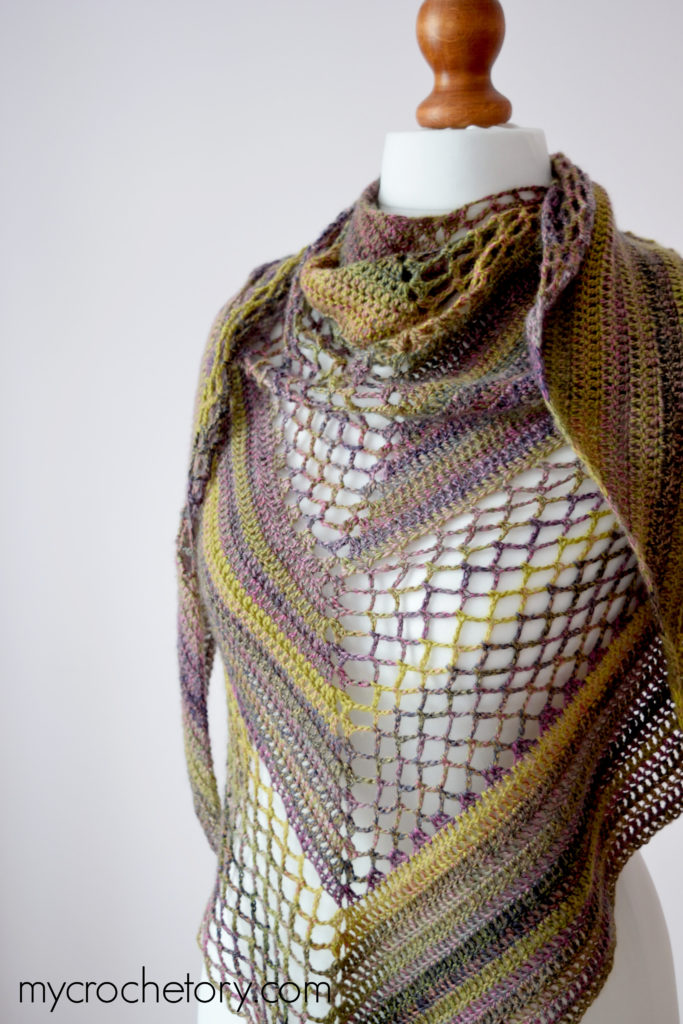
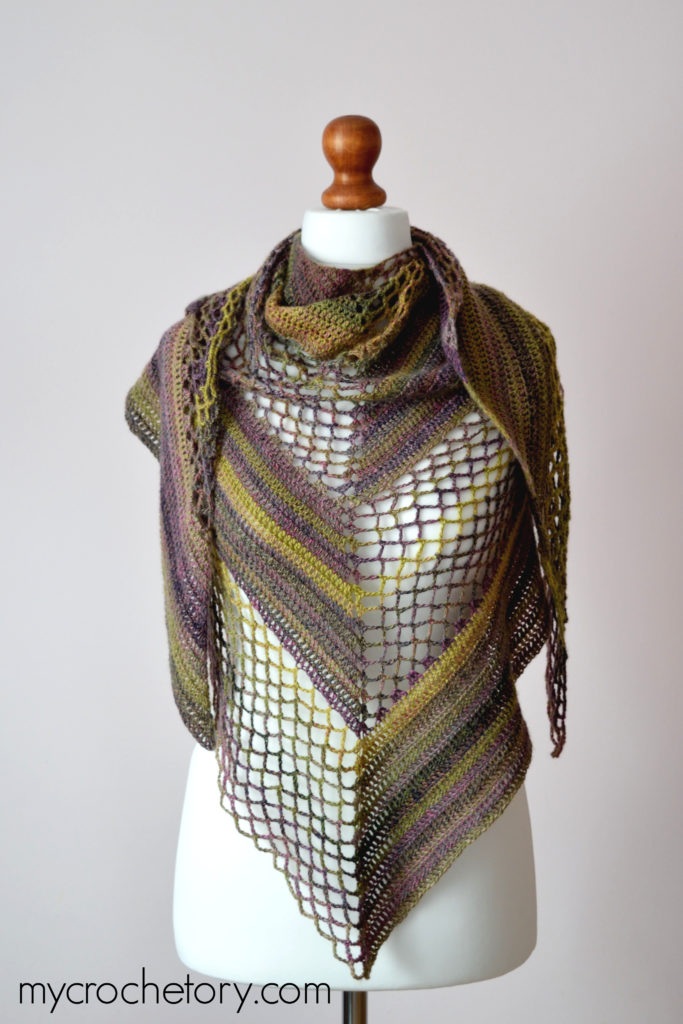
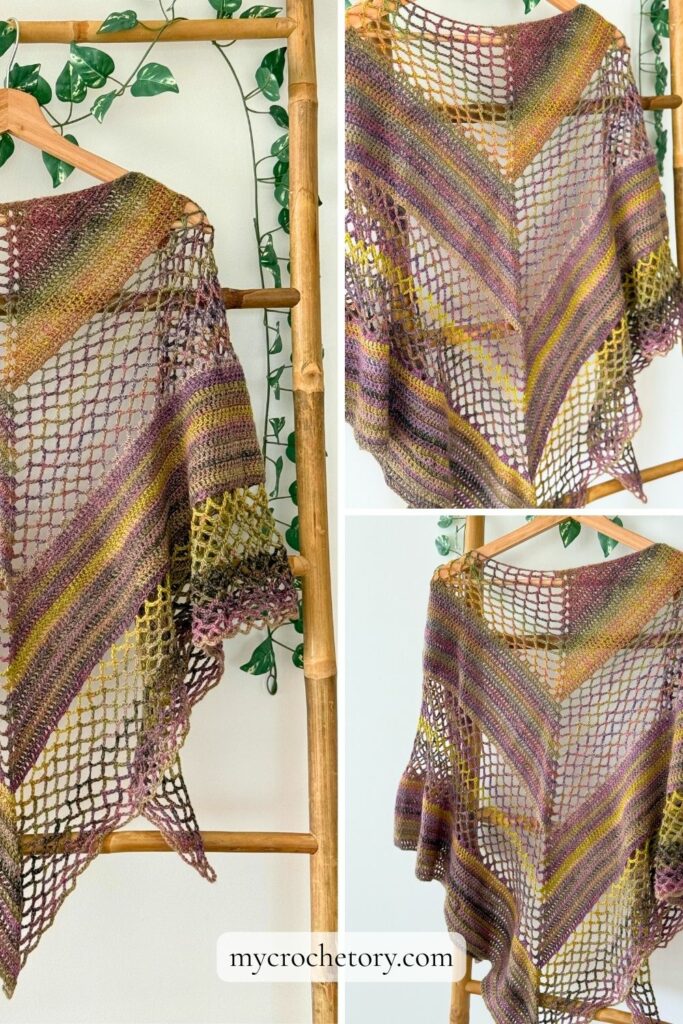
My colorway is called It’s all in a Nutshell (973), and it changes color on its own as you crochet. That’s where the purple, olive green, mustard, gray and cream in my photos come from. In the solid blocks, the colors show up as clear stripes, and in the mesh, they look lighter because of all the little holes.
With two skeins, you’ll need to join new yarn once. My guide on how to join yarn ends shows you 4 easy ways, so just pick the one you like best.
How to make your Flores Shawl smaller or bigger
You can stop your Flores Shawl at any row you like, so making it smaller or bigger is easy. My shawl has 56 rows, and after blocking it’s about 182 cm wide and 83 cm deep at the center. Want a smaller shawl? Just stop earlier. Want a bigger one? Keep adding rows at the end, and get some extra yarn.
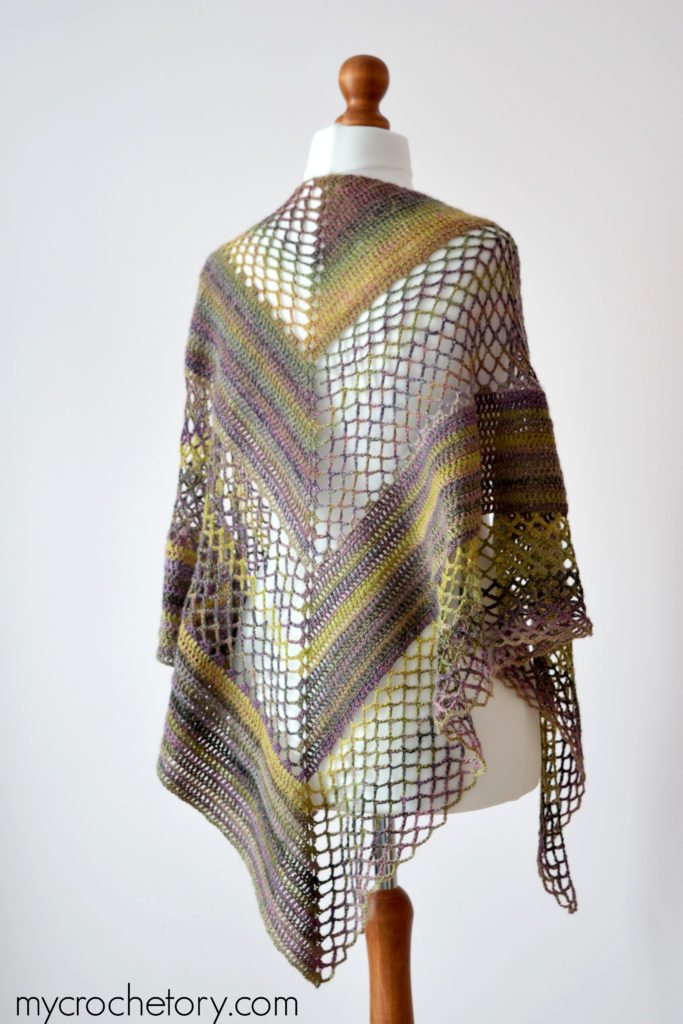
You can also change the size of the blocks themselves. The swap rows don’t have to stay where I put them. Work more rows before a swap, and that block gets bigger. Work fewer rows, and it gets smaller. So your shawl can have big and small blocks, mixed any way you like.
Just add or take away rows in pairs, two rows at a time. That way, the row before each swap is still the right one, and the swap rows work the way they should.
How to block your crochet shawl
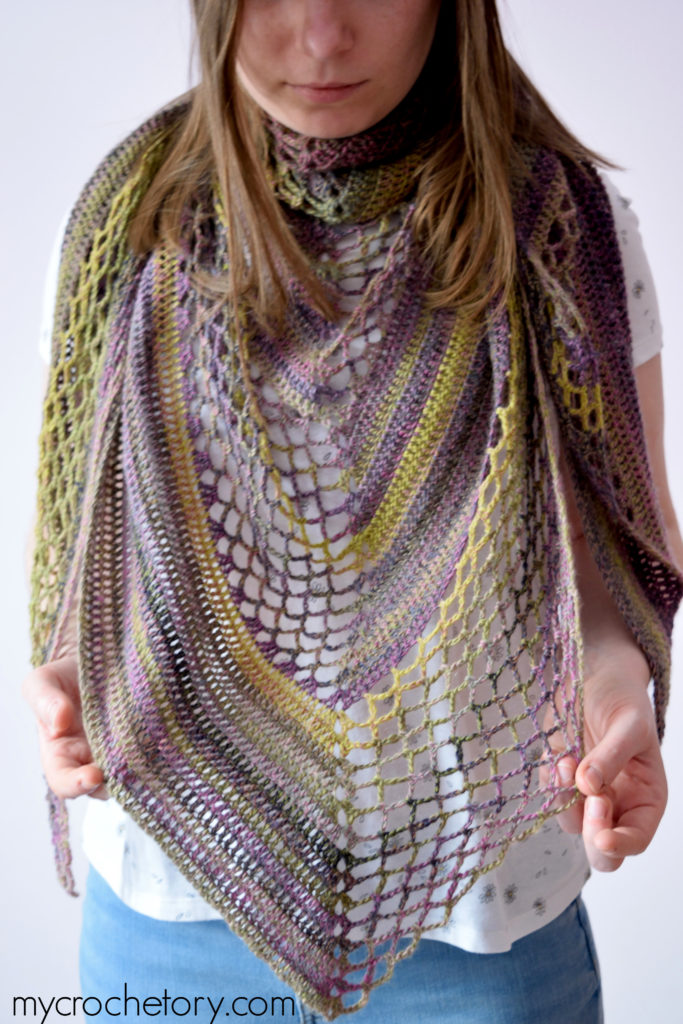
To block your crochet shawl, soak it in water, gently stretch it into a triangle and pin it to a blocking mat until it’s completely dry. That’s how I block my Flores, because Our Tribe is a merino yarn. And please don’t skip it: all the sizes in my pattern are measured after blocking, so an unblocked shawl may come out smaller than mine.
Is your yarn cotton or acrylic? You can block it with water too, but I prefer steam for these fibers, because it’s faster and safe for them. I pin the dry shawl to the mat and move my iron about 1 cm above it, with lots of hot steam. The iron never touches the yarn, only the steam does.
Flores shawl FAQ
Do I have to add the picot edging? No, the edging is optional. The pattern is complete after Row 56. The picot row was designed by Roberta, one of my testers, and you can add it if you want a lacy finish.
Is there a video tutorial for this shawl? No, the pattern is written only.
Can I make it in a solid color? Yes, it works in a solid color too. Then you’ll see the blocks through the texture alone: solid double crochet next to open mesh.
Is there a stitch chart? Yes, the stitch chart is in the ad-free printable PDF on Etsy and Ravelry. Here on the blog, you’ll find the written pattern.
Can I sell the shawls I make from this pattern? Yes, the shawl you make is yours to sell. Please credit MyCrochetory as the designer. You just can’t sell or share the pattern itself.
I’d love to see your blocks, so please share your Flores on social media with the hashtag #mycrochetory. Stuck on a row? Ask me in my Facebook Group or my Ravelry Group. You can also find me on Instagram, Facebook and Pinterest.
Flores crochet mesh shawl free pattern
- Purchase the ad-free, printable PDF with stitch charts here on ETSY or here on Ravelry.
- Add this pattern to your Ravelry Queue HERE.
- Grab the MyCrochetory Shawl Pattern BUNDLE that includes 14 patterns for one low price HERE.
- Pin it for later.
Copyright 2018 – 2026 MyCrochetory. All right reserved. This pattern is property of Sylwia Kawczyńska @MyCrochetory. Please DO NOT sell the pattern and claim this pattern as your own. The pattern is for personal use only and may not be translated or reproduced in another language. Please respect my rights, DO NOT share or publish this pattern anywhere without my persmission.
The crochet mesh shawl you make following this pattern is yours you are free to sell it, as long as you credit MyCrochetory as original designer. For more information, please, read Terms Page.
As a bonus in the ad-free, printable PDF, I’ve included a stitch chart. If you’re a visual learner or if you just want to support my work you can purchase this crochet pattern HERE on ETSY or HERE on Ravelry. Thank you and I hope you find it useful!
Materials & Tools:
- Yarn SCHEEPJES Our Tribe 100g = 420m, 70% Merino Superwash and 30% Polyamide, 2 skeins. For the shawl sample I used It’s all in a Nutshell (973) colorway.
- Hook size 3.5mm. Adjust hook size if necessary to obtain correct gauge.
- Tapestry needle (to weave and hide yarn ends).
- Scissors.
Level:
Beginner +
Size after blocking:
Wingspan – 182cm, Center depth – 83cm
Gauge after blocking:
After Row 7, the triangle is approx. 10cm/4in high.
Gauge isn’t very important for this project, but a different gauge will change the amount of yarn you need and the finished size.
Notes:
- This pattern uses US crochet terminology.
- The shawl is worked top-down in one piece.
- Stitch counts for the first rows are given in parentheses (…).
- Instructions in square brackets […] are worked as many times as indicated.
- The stitch chart is included in the ad-free printable PDF on here on ETSY or here on Ravelry.
Stitches & Abbreviations (US terms):
st(s) – stitch(es)
yo – yarn over
sp – space
beg – beginning
prev – previous
sk – skip
pm – place marker
m – marker
rm – reposition marker
PATTERN
Start with a magic ring or with 5ch and sl st in the first st to close the round.
Row 1: ch3 (counts as a dc here and throughout), 4dc in the ring, ch3, 5dc in the ring. Turn. (10dc, 1 ch-3 space)
Row 2: ch8 (counts as a dc and ch5 here and throughout), sk next dc, sc in next dc, ch5, sk next 2dc, (2dc, ch3, 2dc) in ch-3 sp, dc in every st until last st, 3dc in last dc. Turn. (12dc, 1sc, 1 ch-3 sp, 2 ch-5 sp)
Row 3: ch3, 2dc in first st, dc in every st until ch-3 sp, (2dc, ch3, 2dc) in ch-3 sp, ch5, sk next 2 dc, [sc in next ch-5 sp, ch5, sk next sc] rep until ch8 remain, sc in ch-8 sp, ch5, dc in 3rd chain of 8th at beg of prev row. Turn. (16dc, 2sc, 1 ch-3 sp, 3 ch-5 sp)
Row 4: ch8, sc in first ch-5 sp, [ch5, sk next sc, sc in next ch-5 sp] rep until the last ch-5 sp, ch5, sk next 2dc, (2dc, ch3, 2dc) in ch-3 sp, dc in every st until last st, 3dc in last dc. Turn. (20dc, 3sc, 1 ch-3 sp, 4 ch-5 sp)
Row 5 – Row 14 – Repeat Rows 3-4
Row 15: ch3, 2dc in first dc, dc in every st until ch-3 sp, (2dc, ch3, 2dc) in ch-3 sp, ch1, sk 2dc, [3dc in next ch-5 sp, ch1, sk next sc] rep until ch-8 sp remain, 3dc in ch-8 sp, ch1, 2dc in 3rd chain of 8th at beg of prev row. Turn.
Row 16: ch3, 2dc in first dc, dc in every dc and ch-1 sp until ch-3 sp, (2dc, ch3, 2dc) in ch-3 sp, ch5, sk next 2 dc, sc in next st, [ch5, sk next 3sts, sc in next st] rep until 2sts remain, ch5, sk 1dc, dc in last st. Turn.
Rows 17–28: Work Row 4, then Row 3. Repeat these two rows 6 times in total (12 rows).
Row 29: ch3, dc in first st, ch1, 3dc in next ch-5 sp, [ch1, sk next sc, 3dc in next ch-5 sp] rep until 2dcs remain before ch3-sp, ch1, sk next 2dc, (2dc, ch3, 2dc) in ch-3 sp, dc in every st until last st, 3dc in last dc. Turn.
Row 30: ch8, sk next st, sc in next st, [ch5, sk next 3sts, sc in next st] rep until 2dcs remain before ch-3 sp, ch5, sk next 2dc, (2dc, ch3, 2dc) in ch-3 sp, dc in every dc and ch-1 sp until last st, 3dc in last st. Turn.
Rows 31 – 42: Rep Rows 3 – 4
Rows 43 – 44: Rep Rows 15 – 16
Rows 45–56: Work Row 4, then Row 3. Repeat these two rows 6 times in total (12 rows).
Fasten off yarn, weave in all ends and block your shawl.
If you have any suggestions or have detected any mistakes, please feel free to email me at mycrochetory@gmail.com
OPTIONAL EDGING designed by my dear tester Roberta:
PICOT ROW: ch6, sl st into 4th chain, ch3, (sc in next ch-5 sp, ch5, sl st into 3rd ch, ch3) rep until ch-3 sp, (2dc, ch5, sl st into 3rd ch, ch3, 2dc) in ch-3 sp, ch5, sl st into 3rd ch, ch3, sk 2dc, sc into next dc, (ch5, sl st into 3rd ch, ch3, sk 3 dc, sc in next st) rep until last 2sts remain, ch5, sl st into 3rd ch, ch3, sk 1 dc, dc in last st.
Fasten off.
More free crochet shawl patterns
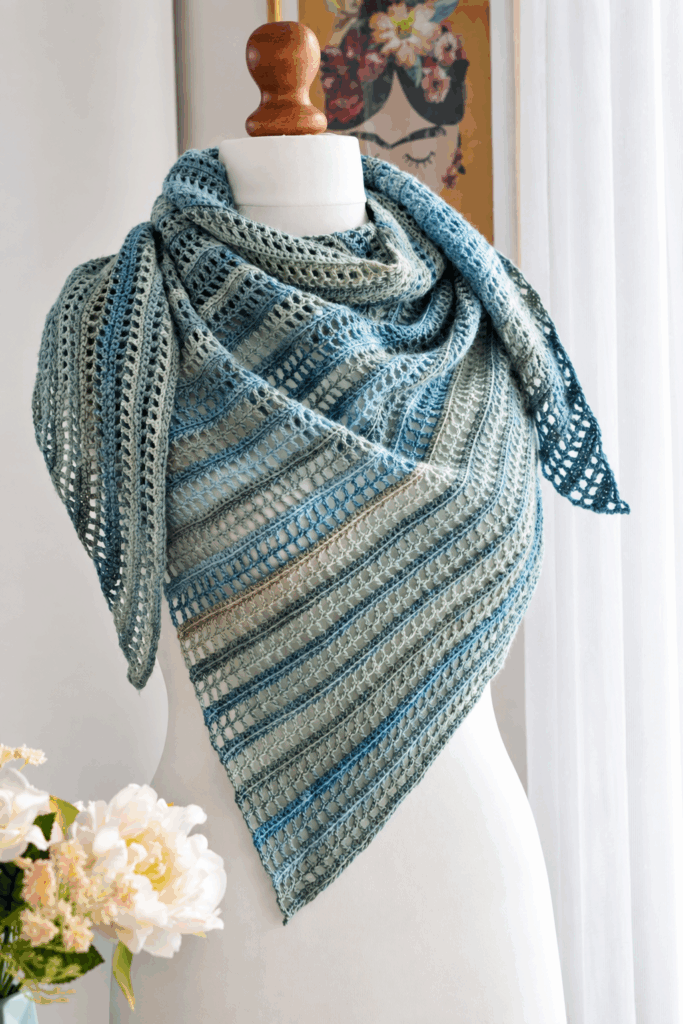
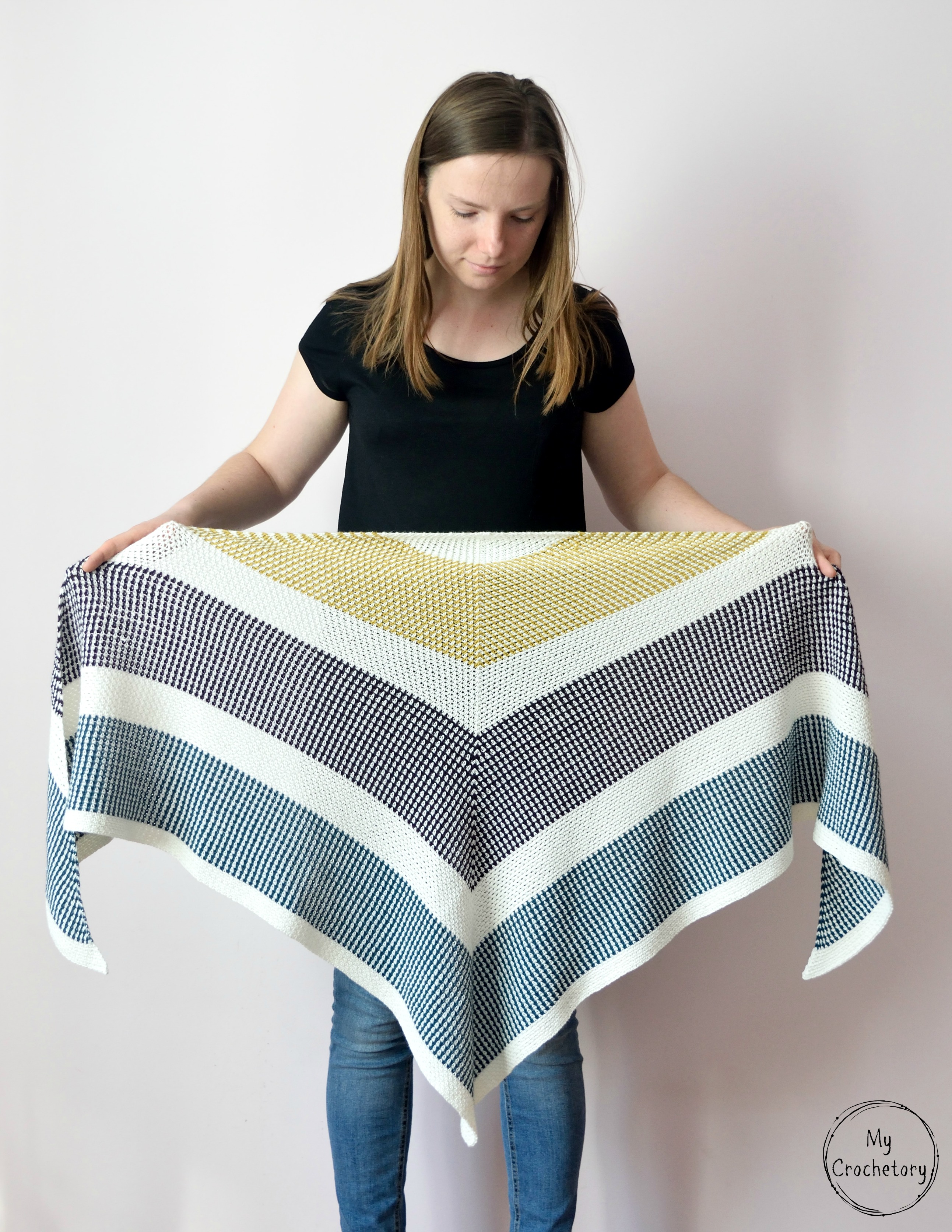
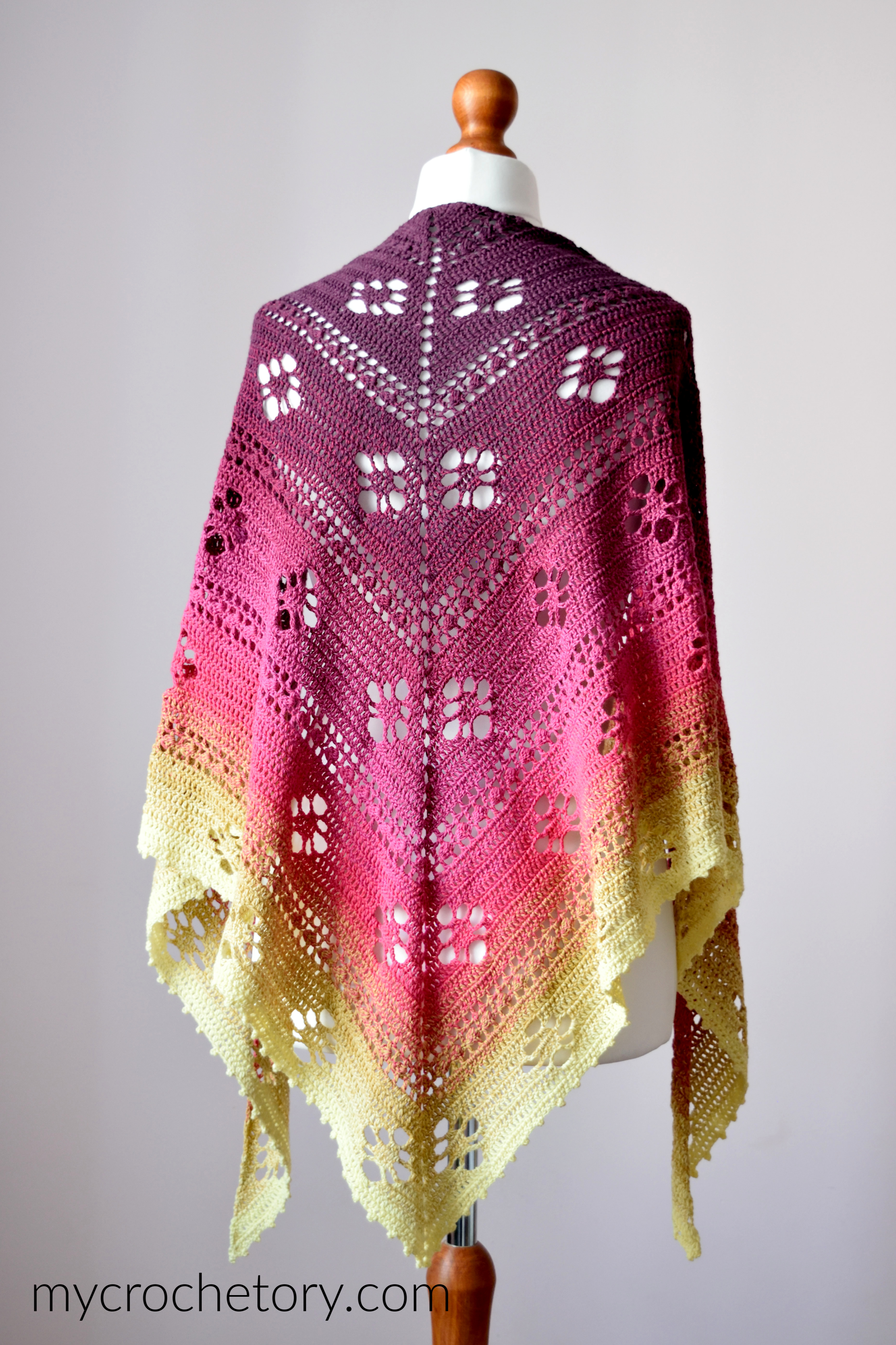
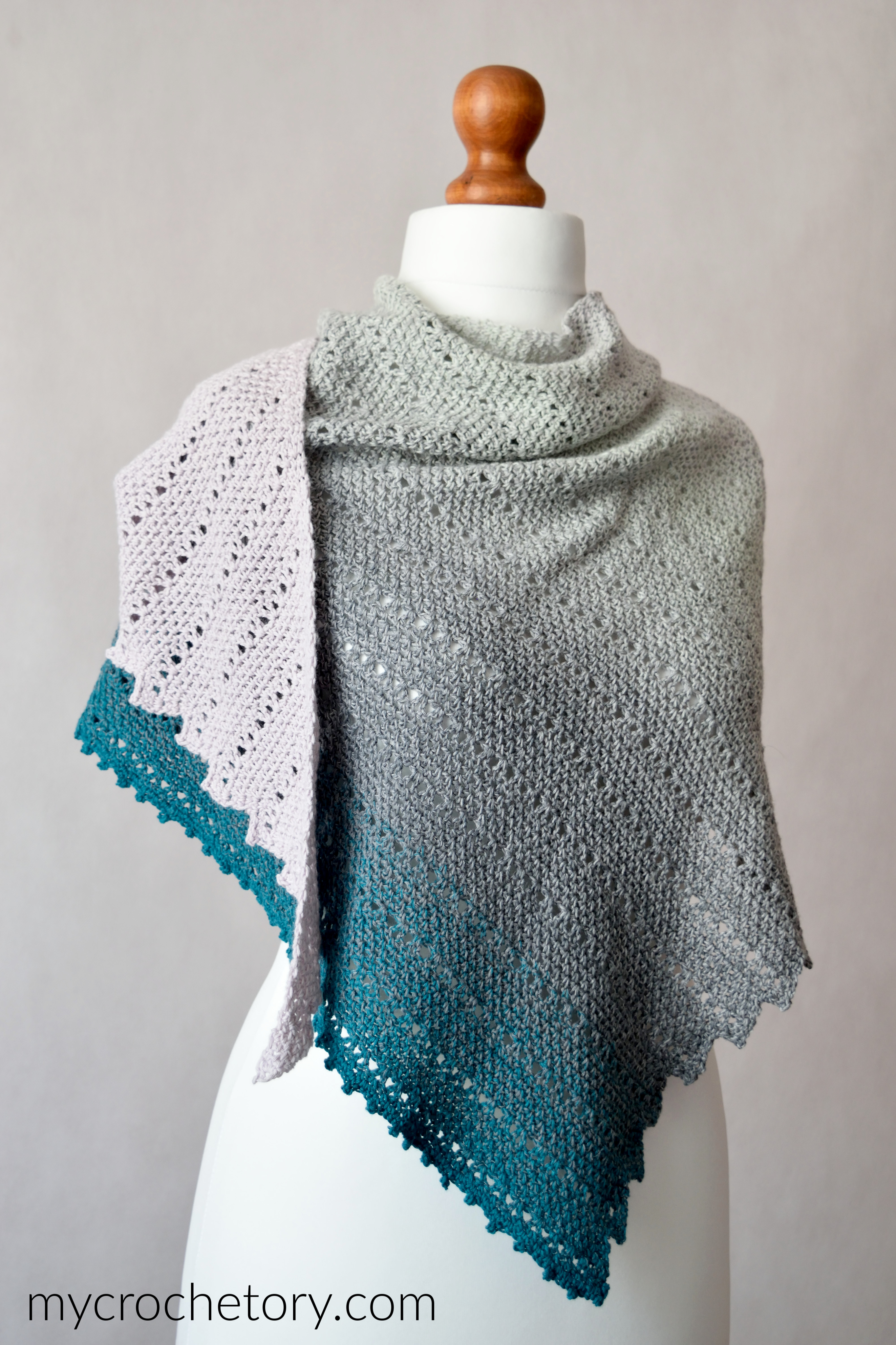
- Aprilis Shawl. This one grows from one tip instead of from the top, so its stripes run on the diagonal. It uses just three basic stitches and a 4-row repeat, and it’s made with Our Tribe too.
- Triangle Moss Stitch Shawl. Want something simpler? This shawl has a one-row repeat of moss stitch, so you only need chains and single crochet. It’s worked from the center top down in fingering weight yarn.
- Forsythia Shawl. Here’s another top-down shawl, with a delicate lace motif that looks a bit like flowers and a picot edging. It takes one cake of Scheepjes Woolly Whirl, and the pattern has written instructions and a chart.
- Willow Shawl. Willow starts with a few stitches at one tip and grows to one side. It’s worked in moss stitch with V-stitch rows and a pointed edge, using one cake of Scheepjes Woolly Whirl.
Want more? Browse all my free crochet shawl patterns.
Want to hear about my new shawl patterns first? Join my newsletter, and I’ll send them straight to your inbox.
Did you keep my blocks, or did you make yours bigger or smaller? Tell me in the comments, I’m curious how your Flores turned out. And if a row doesn’t make sense, ask me there too, so the next person with the same question finds the answer.
Wow just beautiful . Can’t wait to start this Shawl.
Thank you for sharing.
A
Hi there! What a beautiful piece. A question: for both Row 17 – Row 28 and Row 45 – 56, you say Rep Rows 4-3. Do you mean to first do row 4, then row 3, or is that a typo, asnd should be 3 then 4? I thought I’d better ask before starting!
Thanks,
Lisa G.
Yakima, WA, USA
First row 4 then row 3.
Love it! It came out beautiful! Thank you!