Updated: 6 November 2026 by Sylwia (MyCrochetory)
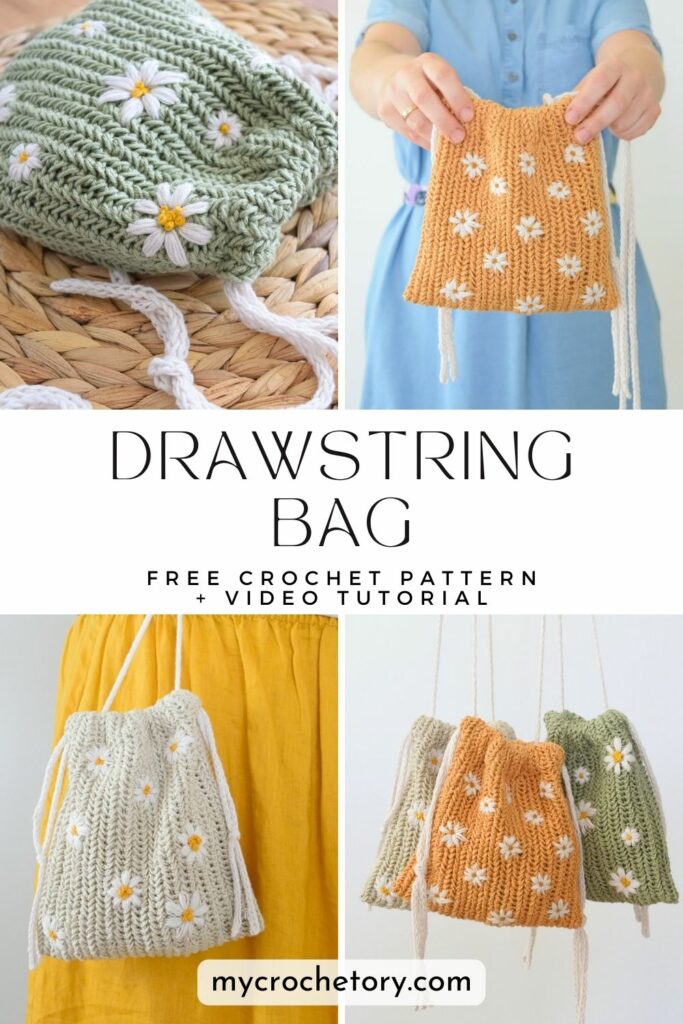
This crochet drawstring bag pattern started with a Pinterest scroll. I kept seeing small bags covered in embroidered daisies, and the crocheter in me decided to make her own.
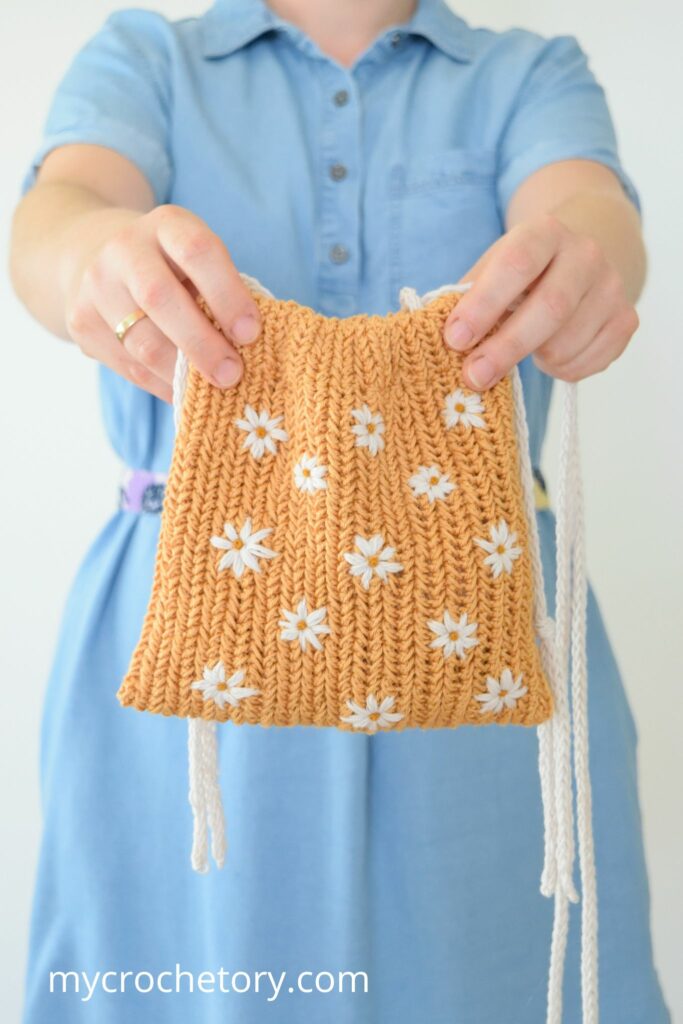
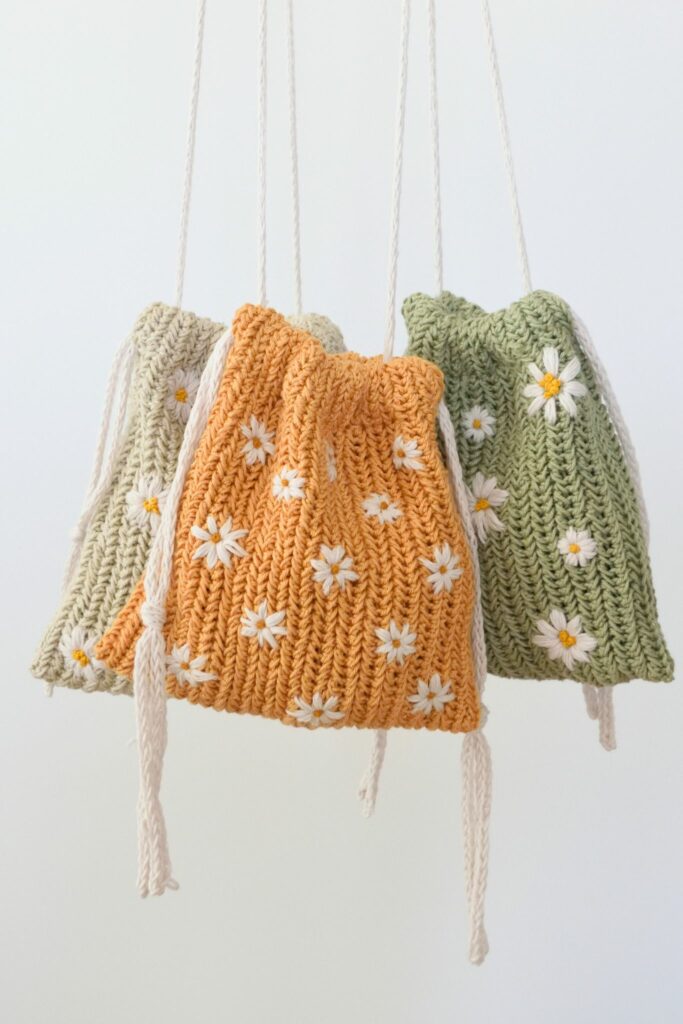
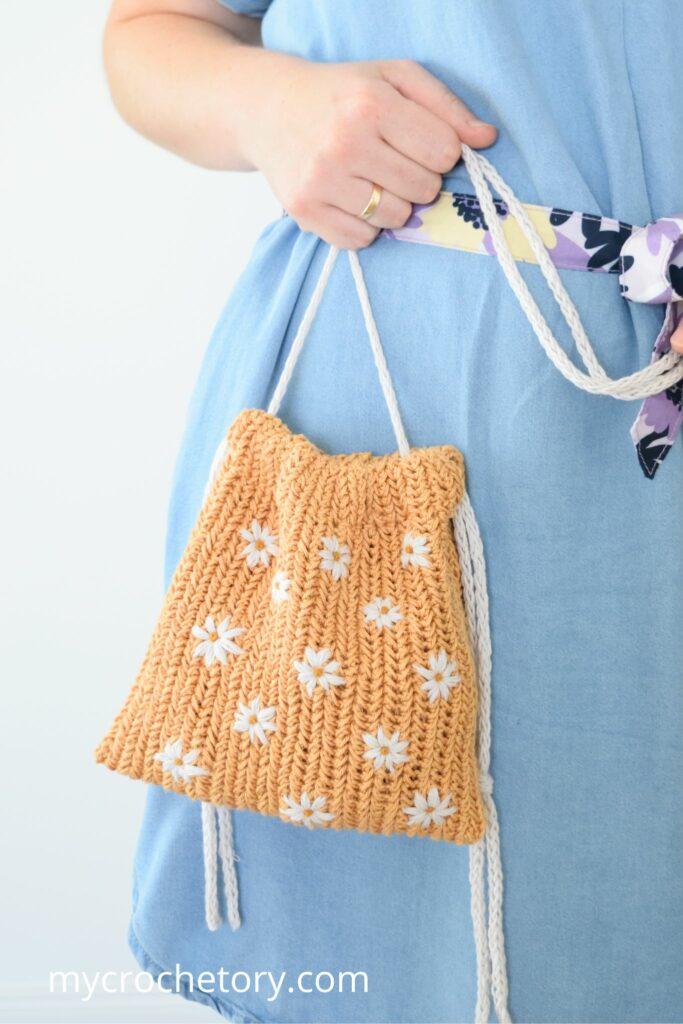
So I took my favorite stitch, herringbone, and turned it into a little bag with two I-cord drawstrings and a long strap. The zigzag texture looks almost woven, and the embroidered daisies sit right on top of it.
It makes a cute purse, a project bag for a small WIP or a gift bag you can fill with something sweet. Below you’ll find the free pattern with step-by-step photos and a video, plus everything I figured out while making it.
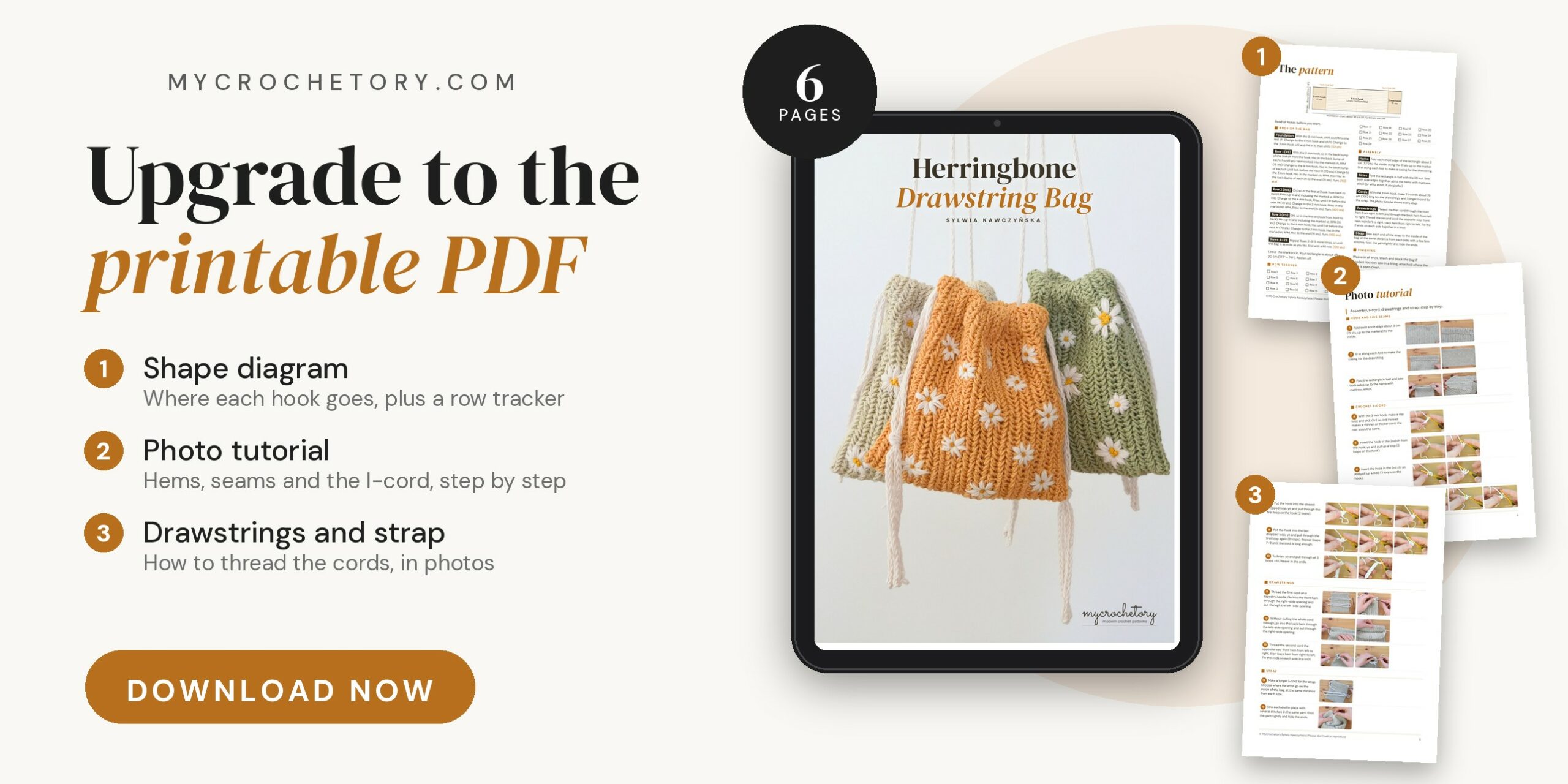
Jump to the free pattern, or get the ad-free, printable PDF on Etsy or Ravelry. The PDF has the shape diagram, a row tracker and the whole photo tutorial in one place.
This post contains affiliate links. If you buy through them, I may earn a small commission at no extra cost to you. Read my affiliate disclosure.
Why I designed a herringbone crochet drawstring bag
Herringbone is my favorite crochet stitch, and this crochet drawstring bag is my favorite way to show it off. Each stitch leans on the one before it, so the rows stack up into tiny zigzags that look like a woven fabric.
The idea came straight from those daisy bags on Pinterest. I wanted the same sweet look, but with a texture that does half the work before a single flower goes on.
Those daisies turned into the extra challenge of this project. Crochet and embroidery are two very different crafts, and a needle full of yarn behaves nothing like a hook.
How this crochet drawstring bag pattern is built
The whole crochet drawstring bag pattern is one rectangle worked lengthways in rows. The foundation chain runs around the bag, and every row you add makes it wider.
Every row uses two hooks. The 3 mm hook works the 15 stitches at each end, which later become the hems, and the 4 mm hook works the 70 stitches in between, so the opening stays neat and firm.
Once the rectangle is done, you fold each short edge about 1.2 inches to the inside and slip stitch it down to make a casing. Then you fold the whole piece in half and close the sides with the mattress stitch, and that’s your bag.
Why the drawstrings are crochet I-cords
I actually learned the crochet I-cord for this bag. A plain chain looked way too flimsy as a drawstring next to the thick herringbone fabric, so I went looking for something sturdier.
An I-cord is a small round tube made with just a hook and three loops. It’s thick, it holds its shape and it slides through the casing easily.
You’ll make three of them, two drawstrings about 30 inches long and one strap as long as you like. My crochet I-cord tutorial shows every step with photos and a video.
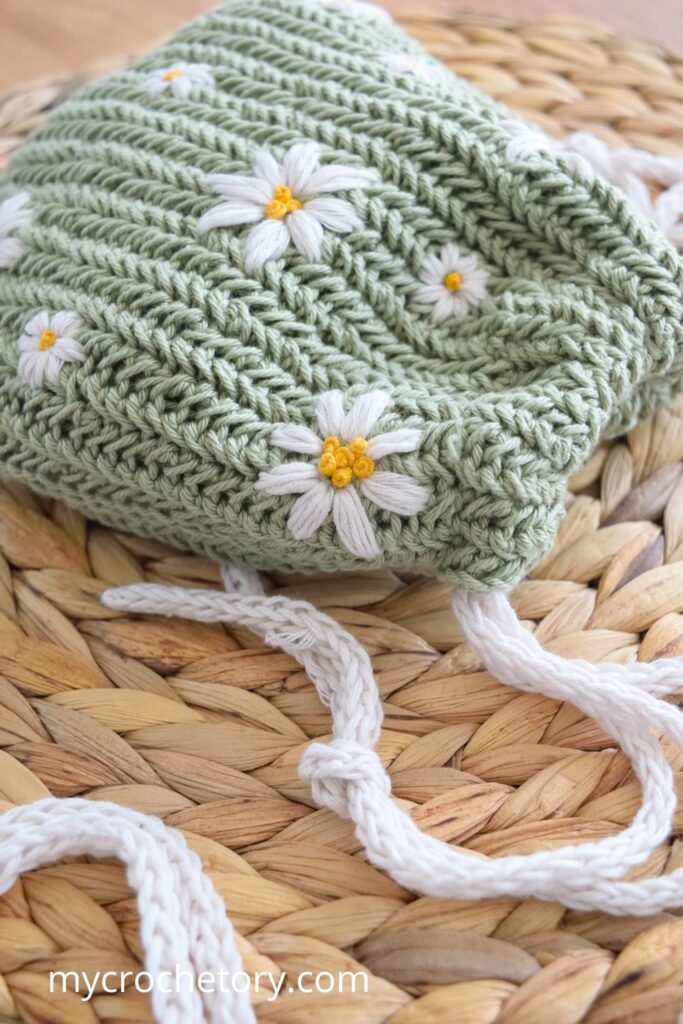
Daisies and other ways to decorate your bag
I embroidered little daisies on my bags with the help of free tutorials online. I’m far from an embroidery expert, so if I managed, you can too.
Not into embroidery? One big crochet flower, beads, buttons, patches, tassels or fringe all look great on this bag.
You can also leave it plain. The herringbone texture is pretty enough to carry the bag on its own.
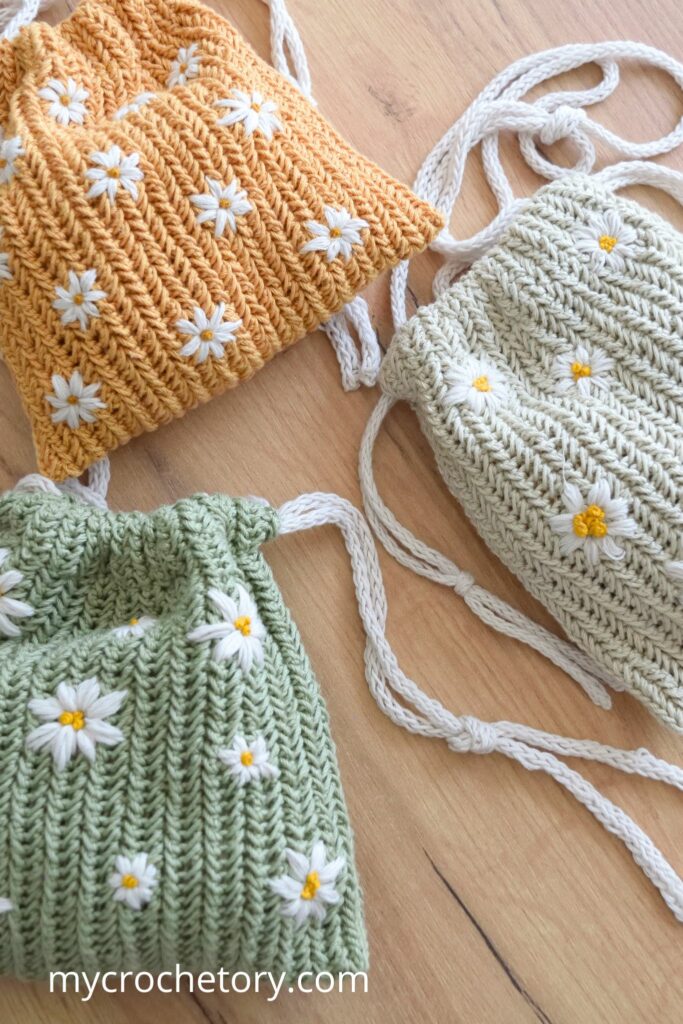
What to carry in a crochet drawstring bag
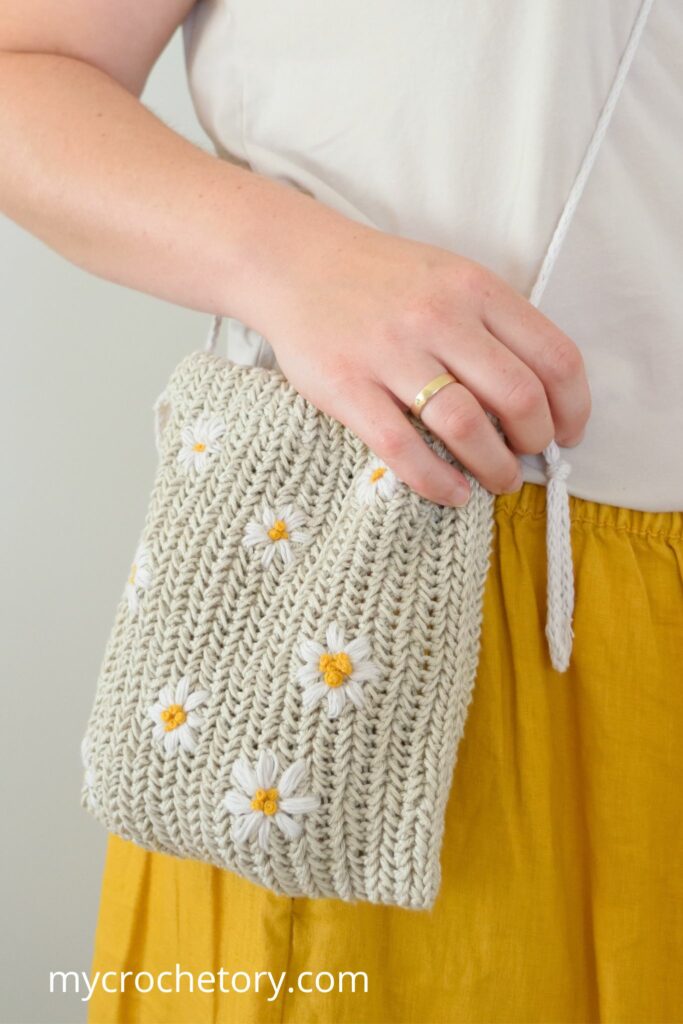
With the long strap, this crochet drawstring bag is a cute little purse for your phone, keys and lip balm. It measures about 7.9 by 7.5 inches, and the drawstrings pull it shut tight.
It also works as a project bag for a small WIP, like a pair of socks or a hat. Leave the strap off and you have a gift bag, a dice bag or a pouch for your stitch markers.
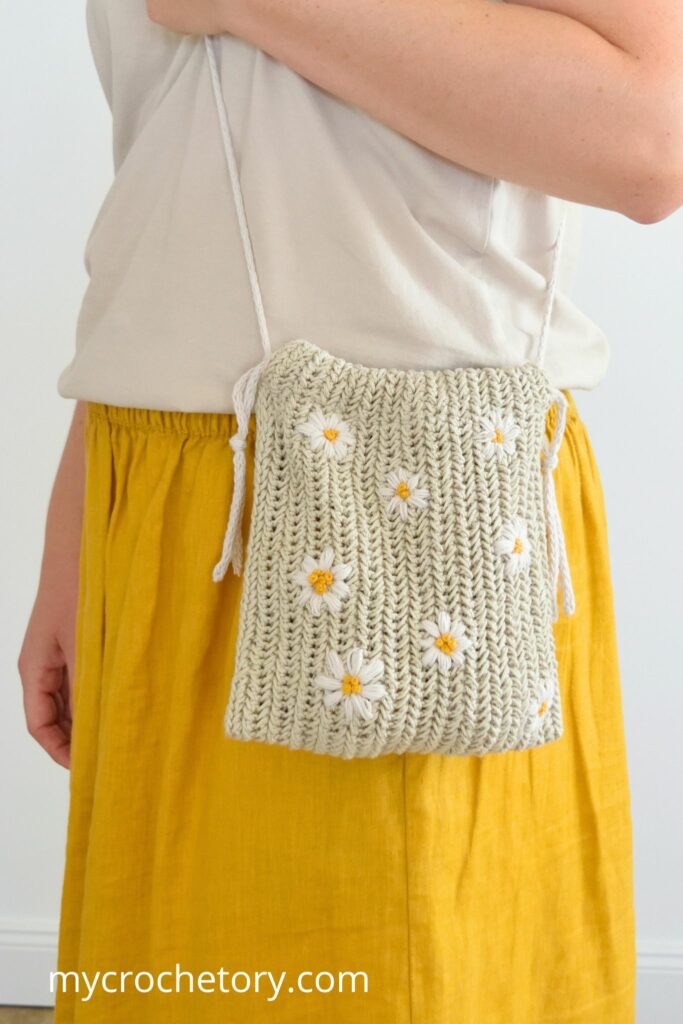
The best yarn for a crochet drawstring bag
Mercerized cotton is my top pick for a crochet drawstring bag. It’s strong, it has a soft sheen and it shows off every zigzag of the herringbone stitch.
I used Scheepjes Catona, a fingering weight 100% mercerized cotton, and I still recommend it. It comes in a huge range of colors, so making a few bags in different shades gets very tempting.
Since Catona is cotton, I block it with steam. I pin the piece, hold the iron about ½ inch above it and leave it pinned for at least 20 minutes.
How hard is this crochet drawstring bag pattern?
This crochet drawstring bag pattern is intermediate, mostly because you switch hooks twice in every row. If you know single crochet and can work with stitch markers, the rest falls into place fast.
Along the way you’ll practice the herringbone stitch, slip stitches for the hems, the mattress stitch for the side seams and the crochet I-cord.
Stuck on a step? The video below the notes walks you through the whole bag, from the first chain to the strap.
Want to make this bag later? Save it to your Pinterest board so the pattern is one tap away.
Free herringbone crochet drawstring bag pattern
- Get the ad-free, printable PDF on Etsy or Ravelry.
- Add this pattern to your Ravelry queue here.
- Pin it for later.
Copyright 2024–2026 MyCrochetory. All rights reserved. This pattern is the property of Sylwia Kawczyńska @MyCrochetory. Please do not sell, share or claim this pattern as your own. It is for personal use only and may not be translated or reproduced in any language without my permission.
The herringbone crochet drawstring bag you make following this pattern is yours, and you are free to sell it, as long as you credit MyCrochetory as the original designer. For more information, please read the Terms Page.
Materials & tools
- Yarn: fingering weight, about 188 m (206 yd) for the body, plus a little more for 3 I-cords and the embroidered flowers. I used Scheepjes Catona (100% mercerized cotton).
- Hooks: 3 mm and 4 mm, or the sizes you need to get gauge.
- Notions: 2 stitch markers, tapestry needle, scissors.
Level
Intermediate: herringbone stitch, seaming, crochet I-cord.
Size after blocking
One size, adjustable: about 20 cm (7.9″) wide and 19 cm (7.5″) high.
Gauge after blocking
22 sts and 16 rows of herringbone stitch with the 4 mm hook = 10 × 10 cm (4″ × 4″).
Notes
- US terms. The bag is one rectangle, worked lengthways in rows. The foundation chain runs around the bag, and the rows make its width.
- For a taller or shorter bag, chain more or fewer sts in the 4 mm section. For a wider or narrower bag, work more or fewer rows.
- Every row uses both hooks: the 3 mm hook for the 15 sts at each end (these become the hems) and the 4 mm hook for the 70 sts in between. This keeps the bag opening neat.
- When you place or move a marker, put it in the last st you worked. It sits in a st, not between sts.
- Ch1 at the start of a row doesn’t count as a st.
- You need 3 I-cords: 2 drawstrings about 76 cm (30″) long and 1 strap, as long as you like. You can use any cord or ribbon that fits through the hem instead.
- Other yarn weights work too, but your bag will be a different size.
Stitches & abbreviations (US terms)
- ch chain
- st(s) stitch(es)
- sc single crochet
- sl st slip stitch
- yo yarn over
- prev previous
- rep repeat
- M marker
- PM place marker
- RPM reposition marker
- RS right side
- WS wrong side
- Hsc (herringbone sc, worked on the RS) insert the hook in the left leg of the prev st, then in the next st from front to back, pull up a loop, yo and pull through all 3 loops.
- RHsc (herringbone sc, worked on the WS) with the RS facing you, insert the hook in the left leg of the prev st, then in the next st from back to front, pull up a loop, yo and pull through all 3 loops.
Video tutorial
Prefer to watch? This video shows the whole bag, from the foundation chain to the strap.
Tip: To view this video tutorial properly, please disable any ad blocker you have running.
Body of the bag
Read all Notes before you start.
Foundation: With the 3 mm hook, ch15 and PM in the last ch. Change to the 4 mm hook and ch70. Change to the 3 mm hook, ch1 and PM in it, then ch15. (101 ch)
Row 1 (RS): With the 3 mm hook, sc in the back bump of the 2nd ch from the hook. Hsc in the back bump of each ch until you have worked into the marked ch, RPM (15 sts). Change to the 4 mm hook, Hsc in the back bump of each ch until 1 ch before the next M (70 sts). Change to the 3 mm hook, Hsc in the marked ch, RPM, then Hsc in the back bump of each ch to the end (15 sts). Turn. (100 sts)
Row 2 (WS): Ch1, sc in the first st (hook from back to front), RHsc up to and including the marked st, RPM (15 sts). Change to the 4 mm hook, RHsc until 1 st before the next M (70 sts). Change to the 3 mm hook, RHsc in the marked st, RPM, RHsc to the end (15 sts). Turn. (100 sts)
Row 3 (RS): Ch1, sc in the first st (hook from front to back), Hsc up to and including the marked st, RPM (15 sts). Change to the 4 mm hook, Hsc until 1 st before the next M (70 sts). Change to the 3 mm hook, Hsc in the marked st, RPM, Hsc to the end (15 sts). Turn. (100 sts)
Rows 4–29: Repeat Rows 2–3 13 more times, or until the bag is as wide as you like. End with a RS row. (100 sts)
Tip: Leave the markers in. Your rectangle is about 45 × 20 cm (17.7″ × 7.9″). Fasten off and weave in all ends.
Hems and side seams
Hems: Fold each short edge of the rectangle about 3 cm (1.2″) to the inside, along the 15 sts up to the marker.
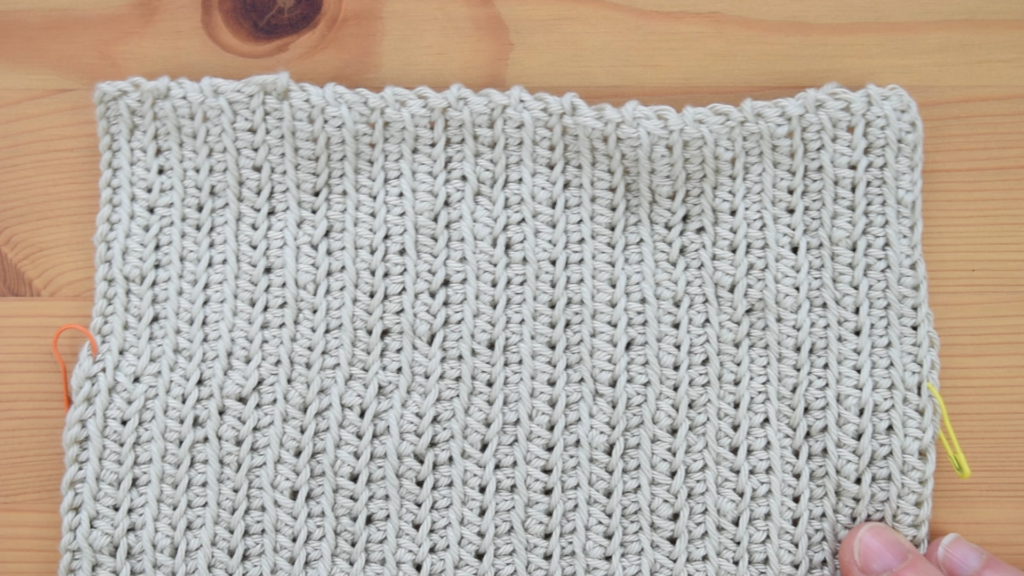
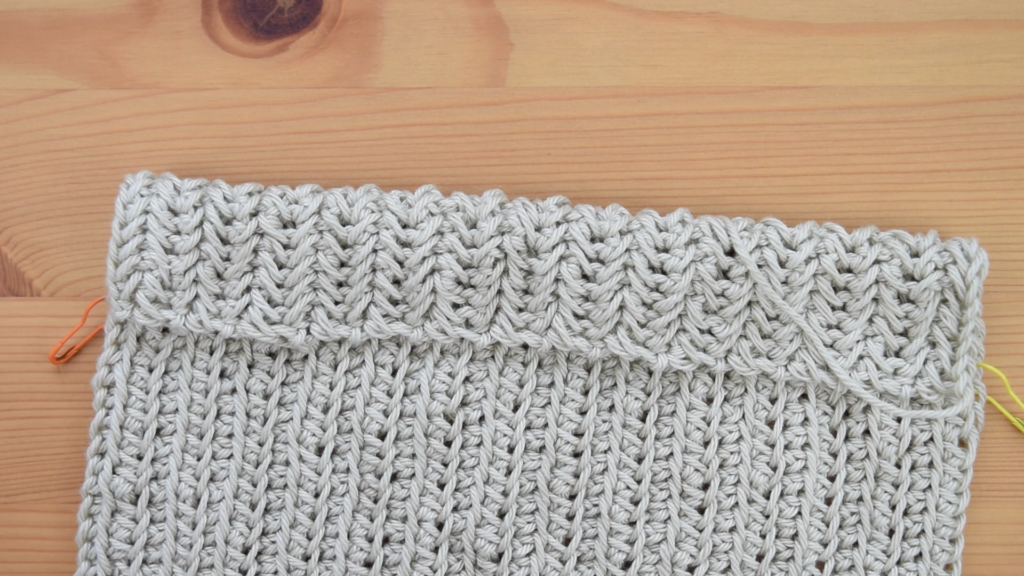
Sl st along each fold to make a casing for the drawstring.
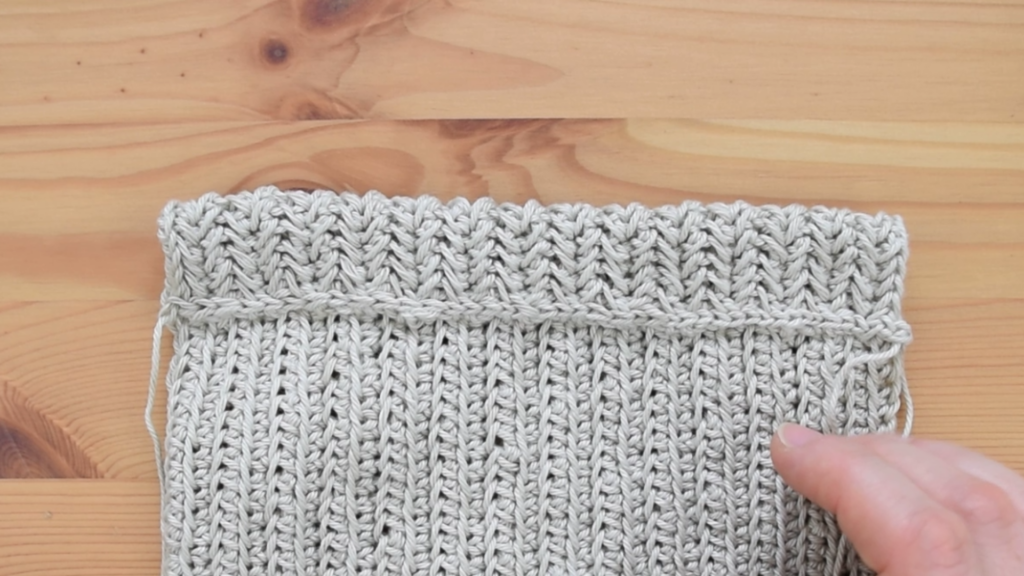
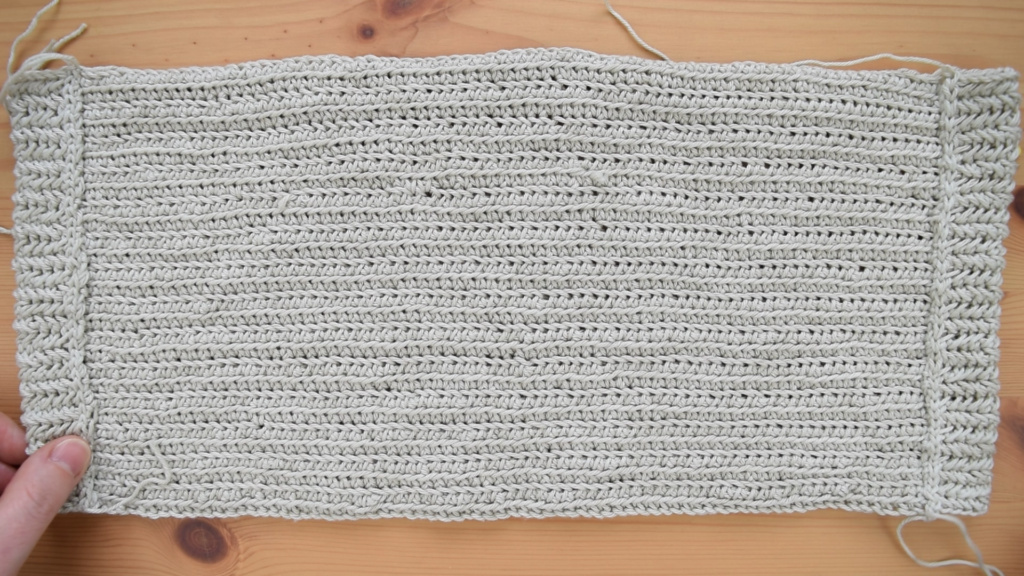
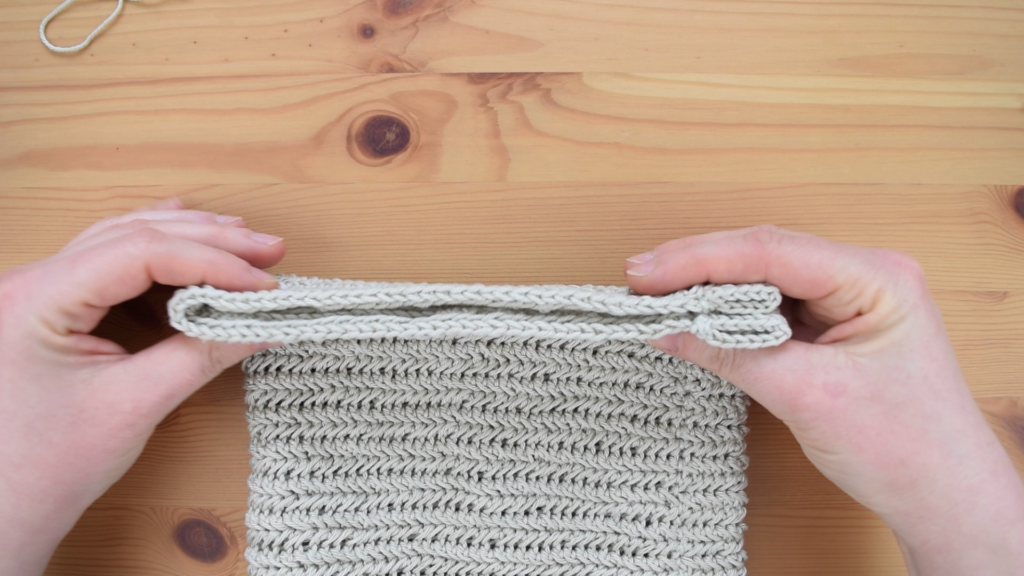
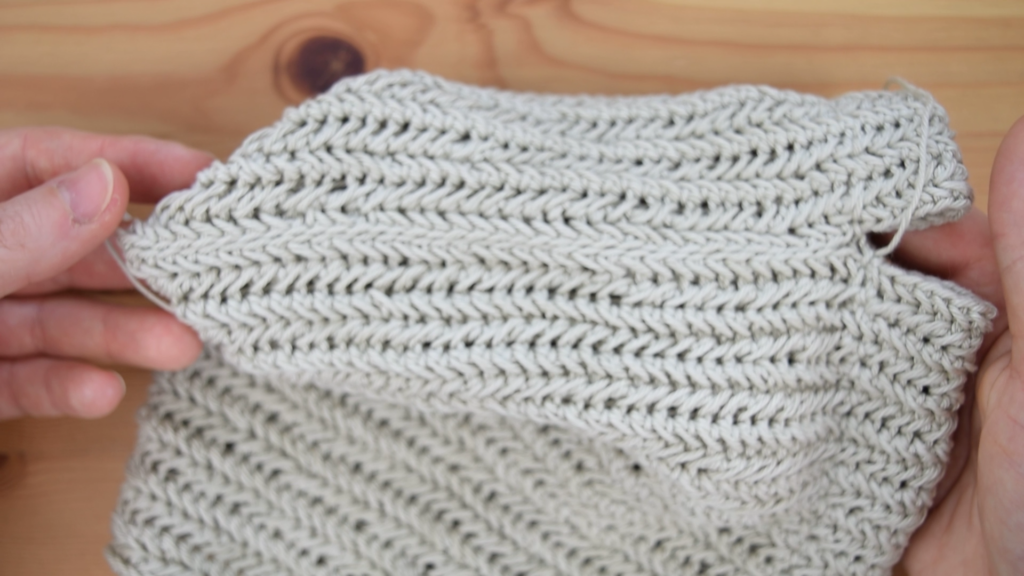
Sides: Fold the rectangle in half with the RS out. Sew both side edges together up to the hems with mattress stitch (or whip stitch, if you prefer).
I-cords
With the 3 mm hook, make 2 I-cords about 76 cm (30″) long for the drawstrings and 1 I-cord for the strap, as long as you like. My crochet I-cord tutorial shows each step with photos and a video.
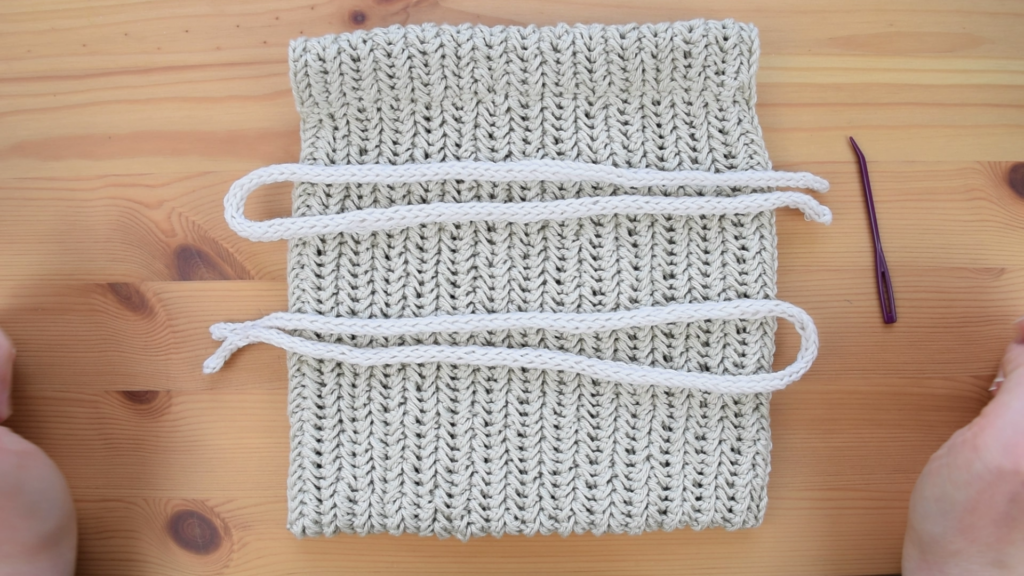
Drawstrings
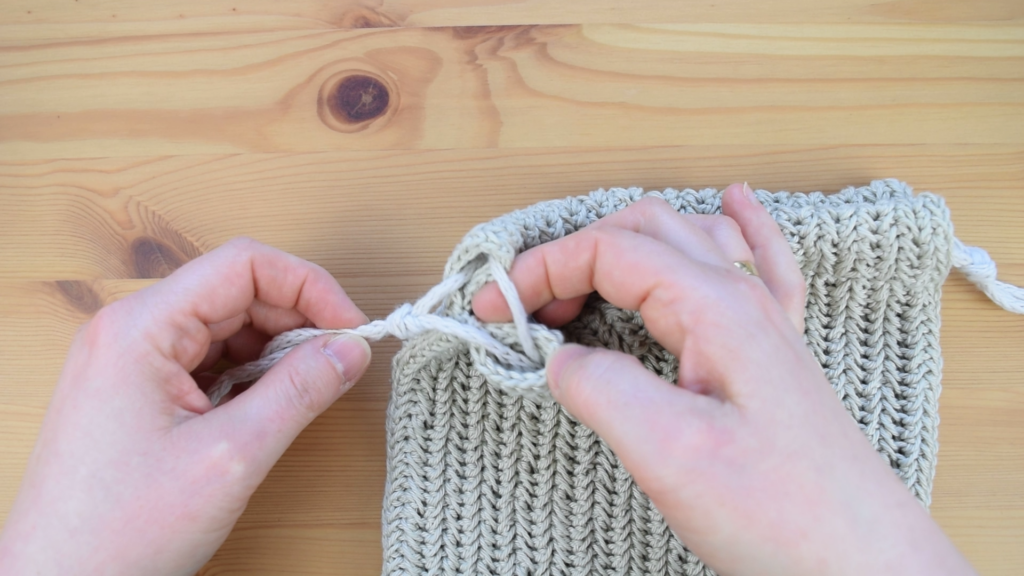
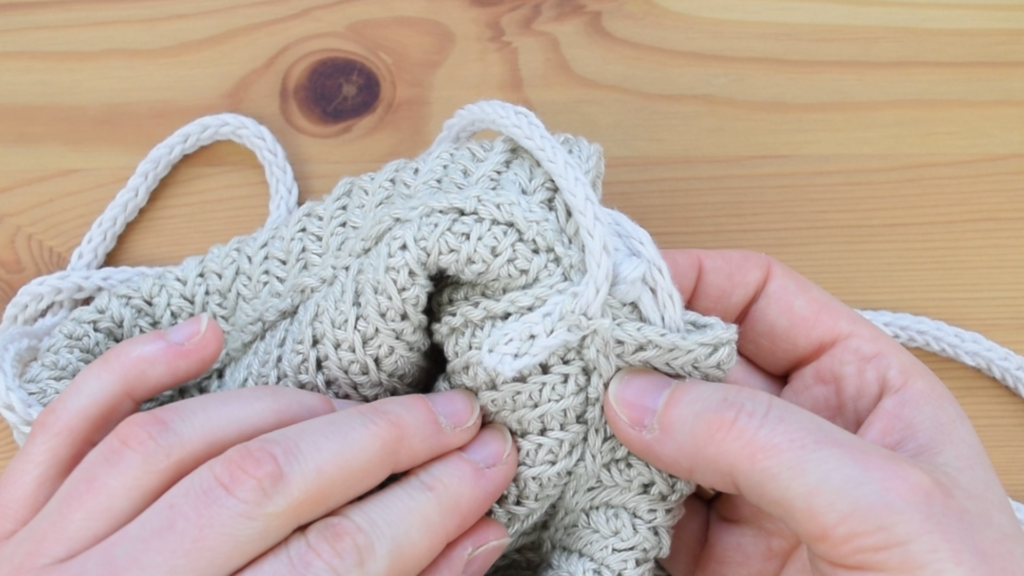
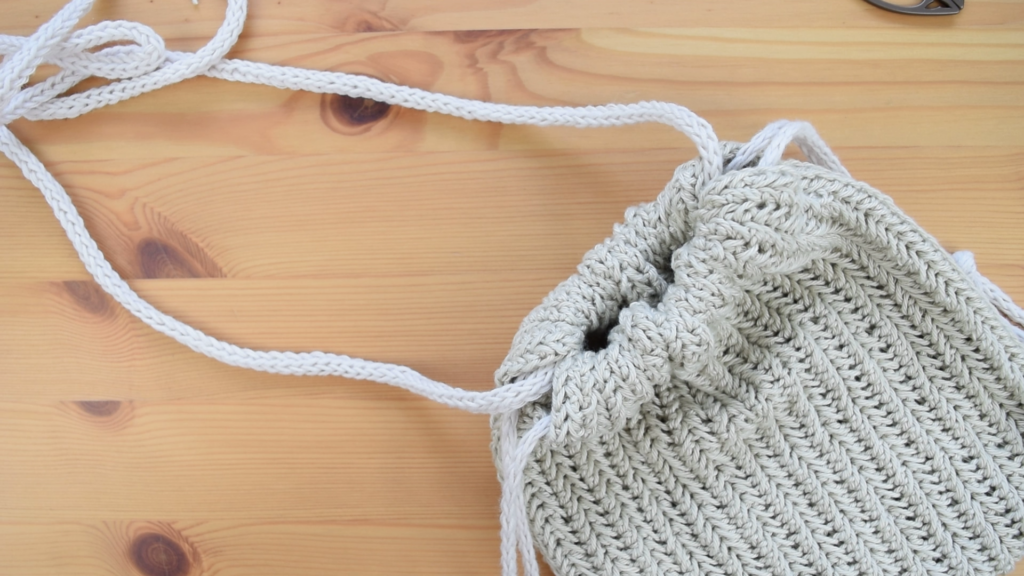
First drawstring: Thread the first cord on a tapestry needle. Go into the front hem (the one closest to you) through the right-side opening and out through the left-side opening. Without pulling the whole cord through, go into the back hem through the left-side opening and out through the right-side opening.
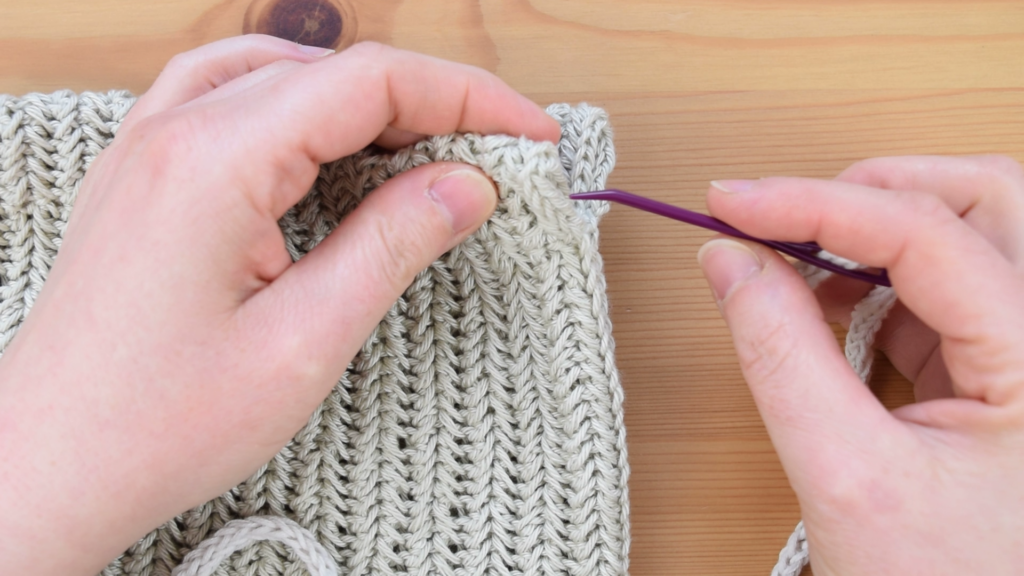
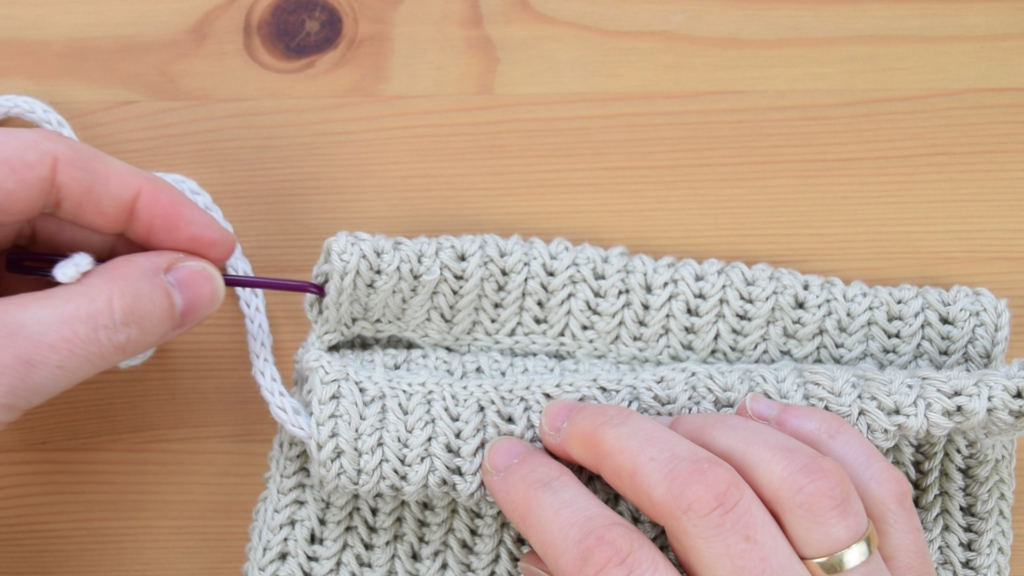
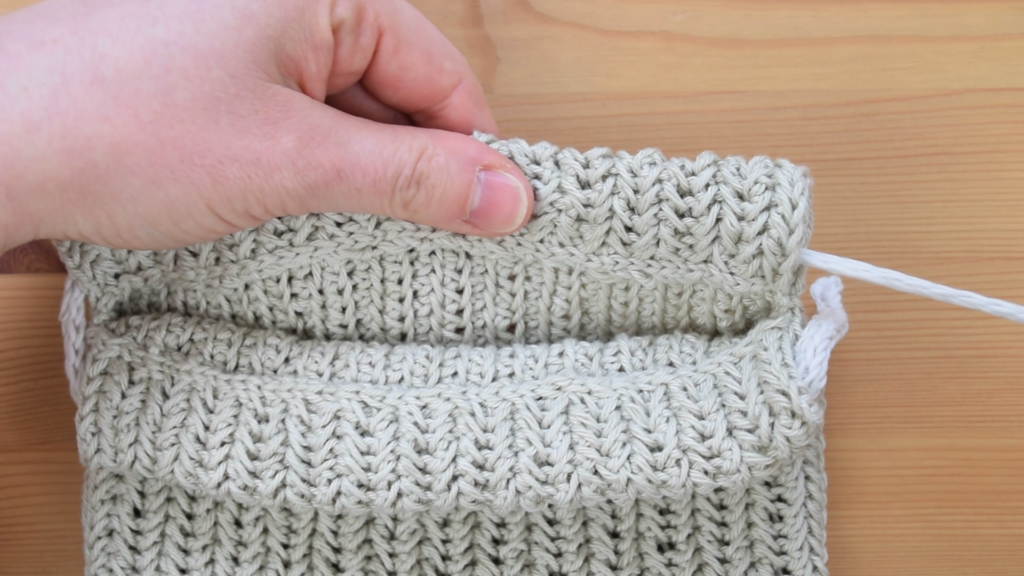
Second drawstring: Thread the second cord the opposite way. Go into the front hem through the left-side opening and out through the right, then into the back hem through the right-side opening and out through the left.
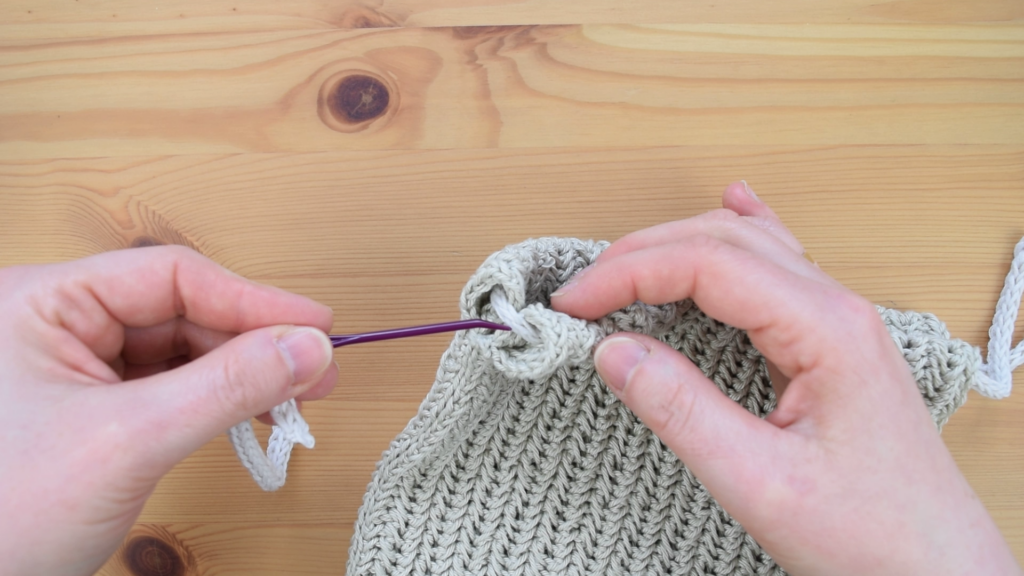
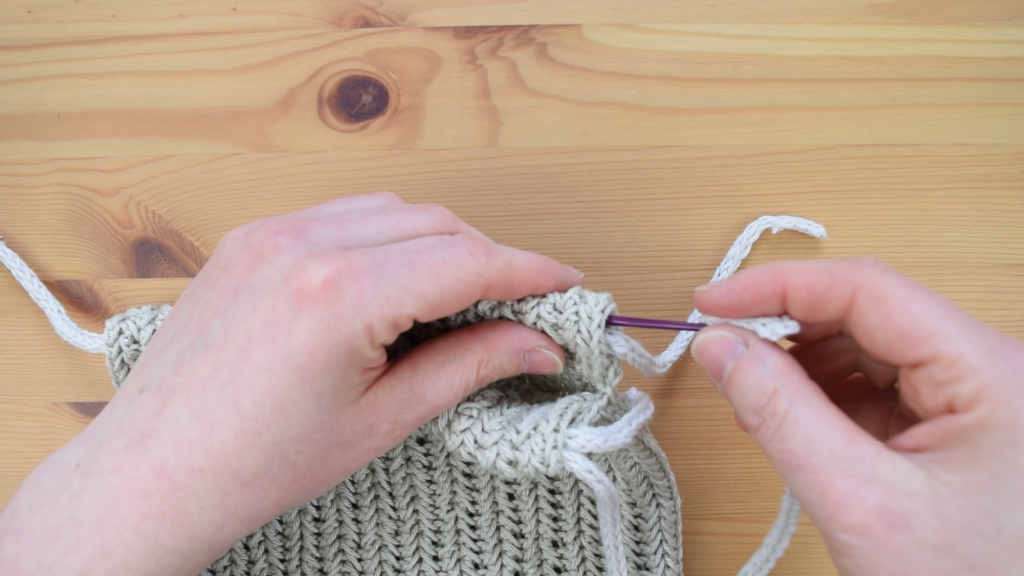
Tie the 2 ends on each side together in a knot.
Strap
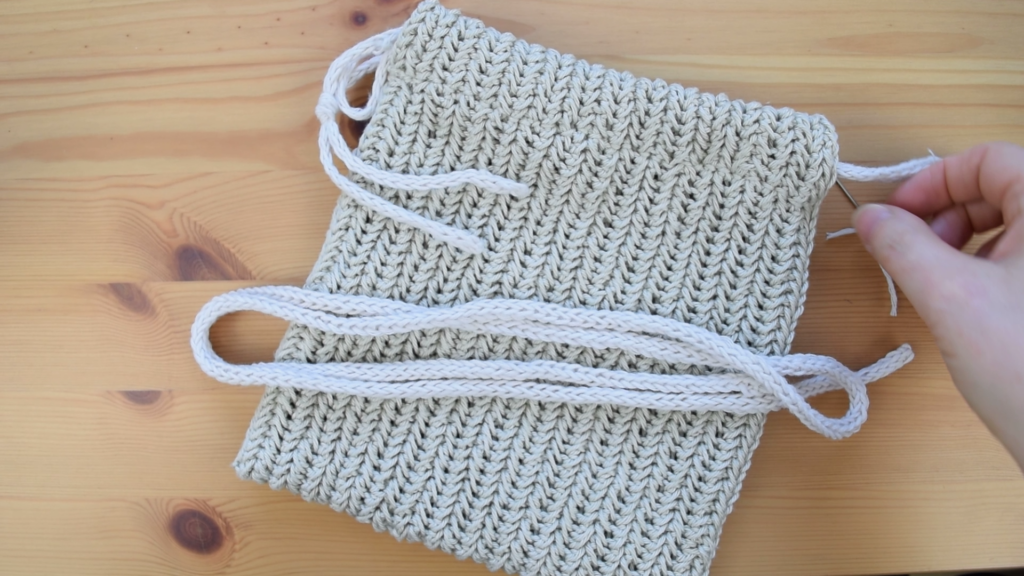
Sew each end of the strap to the inside of the bag, at the same distance from each side, with a few firm stitches in the same yarn. Knot the yarn tightly and hide the ends.
Finishing
Weave in all ends. Wash and block the bag if needed. You can sew in a lining, attached where the hem is sewn down.
Found a mistake? Email me at mycrochetory@gmail.com.
Finished your bag? Share it on Instagram with #mycrochetory and tag @mycrochetory, I love seeing which flowers you pick.
Stuck on a row or the drawstrings? Ask in my Facebook Group or my Ravelry Group, and we’ll sort it out together.
More herringbone crochet patterns
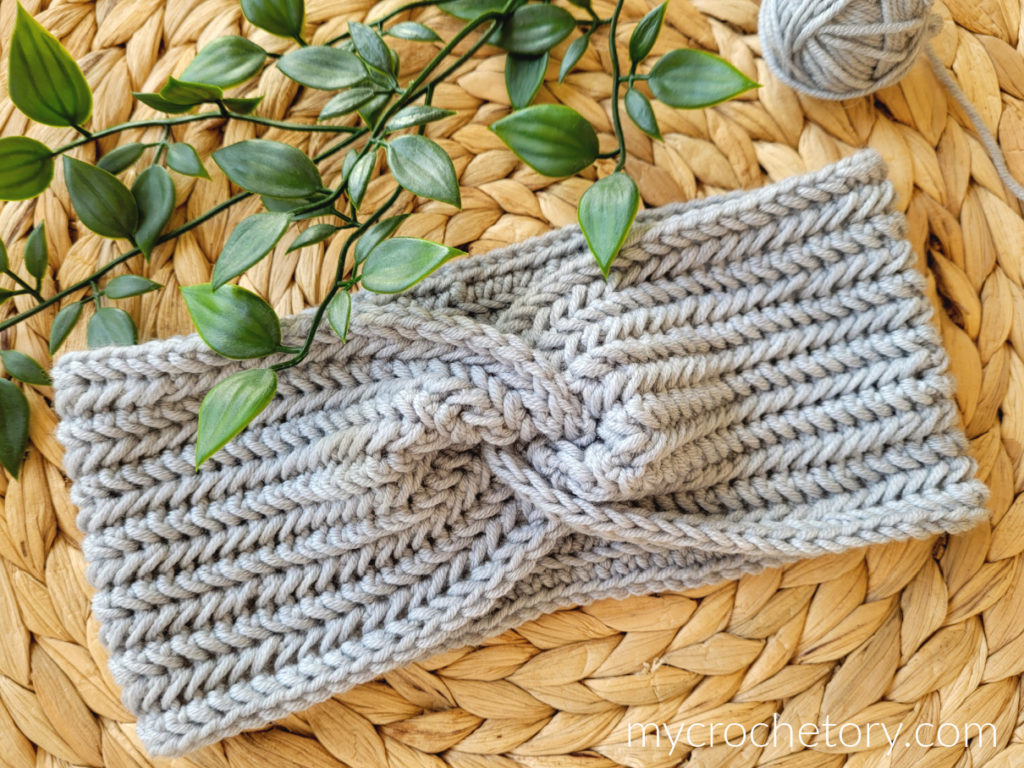
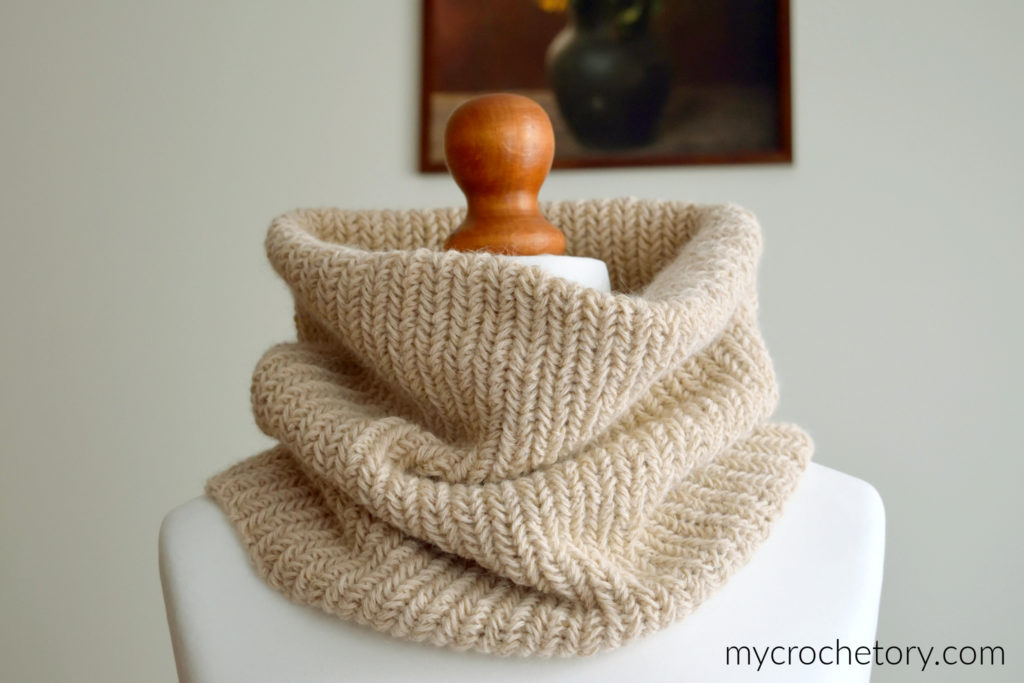
Hooked on the herringbone stitch now? These free patterns of mine use the same zigzag texture in a hat, a headband, a shawl, a cowl and a coaster.
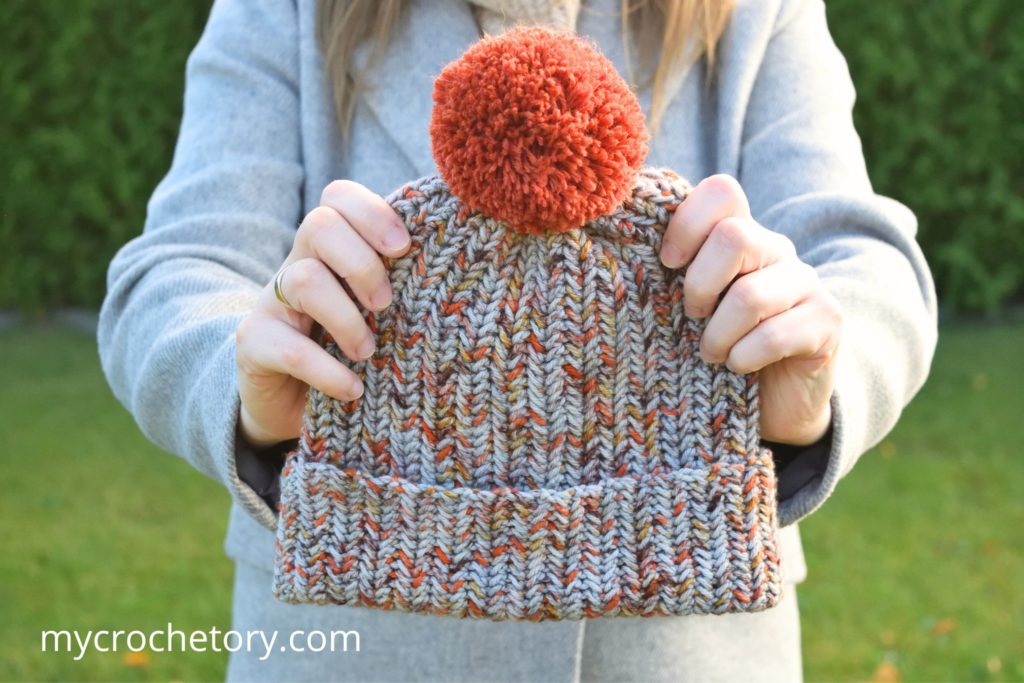

- Siri Herringbone Hat, a beanie worked flat as a rectangle with three hook sizes, then seamed and topped with a pom pom.
- Twisted Herringbone Headband, worked flat and seamed with a twist, in three sizes.
- Diana Herringbone Shawl, a tip-to-tip triangle shawl in worsted weight yarn.
- Herringbone Crochet Cowl, a unisex neck warmer in alpaca yarn that makes an easy gift.
- Herringbone Round Coaster, a quick coaster with a crab stitch border.
- How to Crochet the Herringbone Stitch, my photo and video tutorial for the stitch itself.
More crochet bag patterns
Want a bigger bag next? My roundup of 80+ free crochet bag patterns has totes, market bags, granny square bags and crossbody bags from other designers.
Crochet drawstring bag pattern FAQ
How much yarn do I need for a crochet drawstring bag?
About 206 yards (188 m) of fingering weight yarn for the body. Add a little more for the three I-cords and any embroidered flowers.
Can I make the bag bigger or smaller?
Yes. Chain more or fewer stitches in the 4 mm section to change the height, and work more or fewer rows to change the width.
Do I have to use an I-cord for the drawstring?
No, any cord or ribbon that fits through the hem works. Just make both drawstrings the same length so the bag closes evenly.
Does a crochet drawstring bag need a lining?
It’s optional. A fabric lining keeps tiny things like earrings or coins from slipping between the stitches, and you sew it in where the hem is sewn down.
Very nice design. I haven’t heard from you in a while and hope you are good. The world is crazy now. My name is Sylvia, so much like yours. I am old enough to be your mother. If you need anything please email. ellieloulou11@icloud.com.
Very proud of you to make your business work.
Very nice bag. Can’t see a link to the video though.