Updated: 24 October 2026 by Sylwia (MyCrochetory)
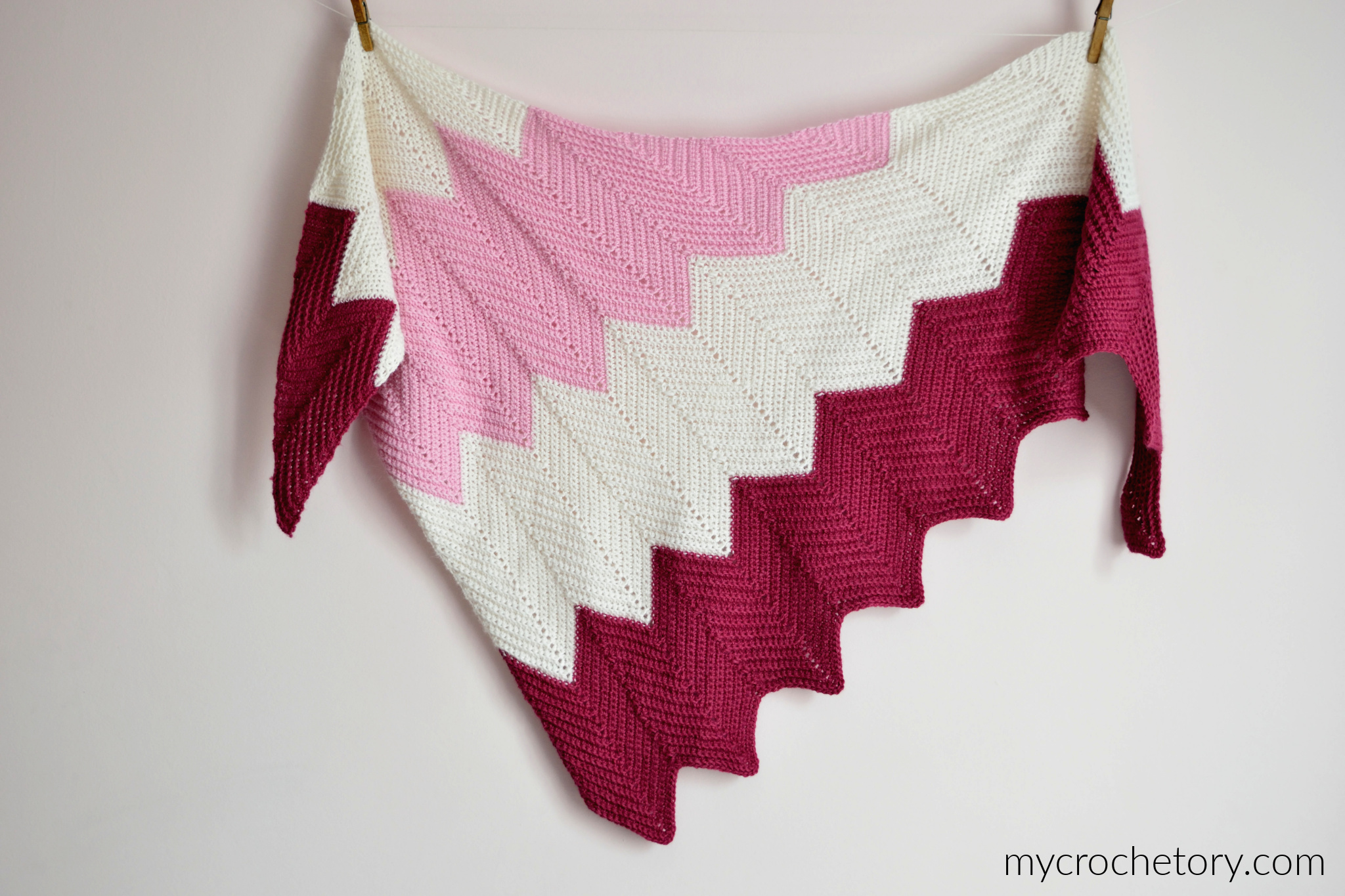
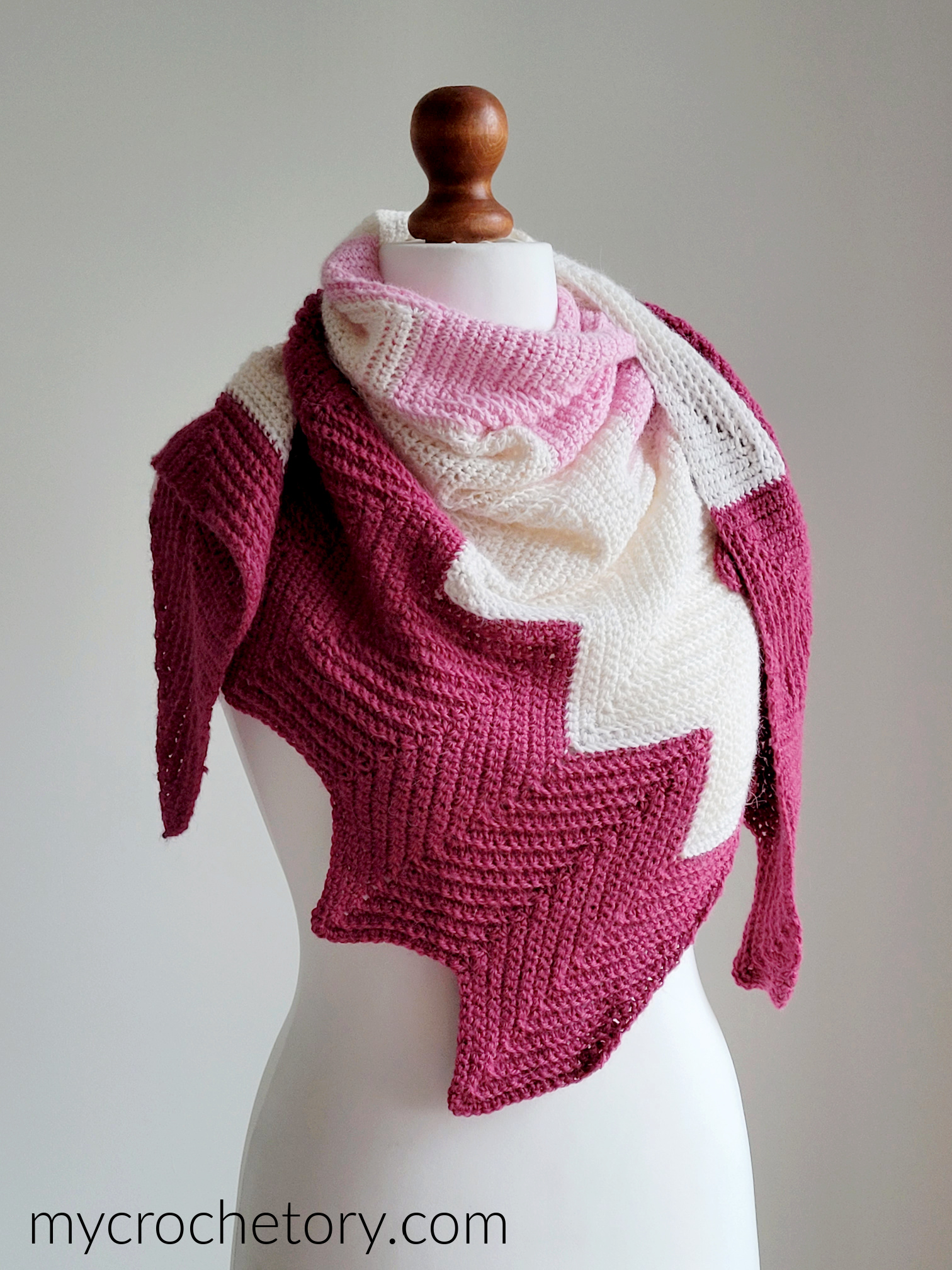
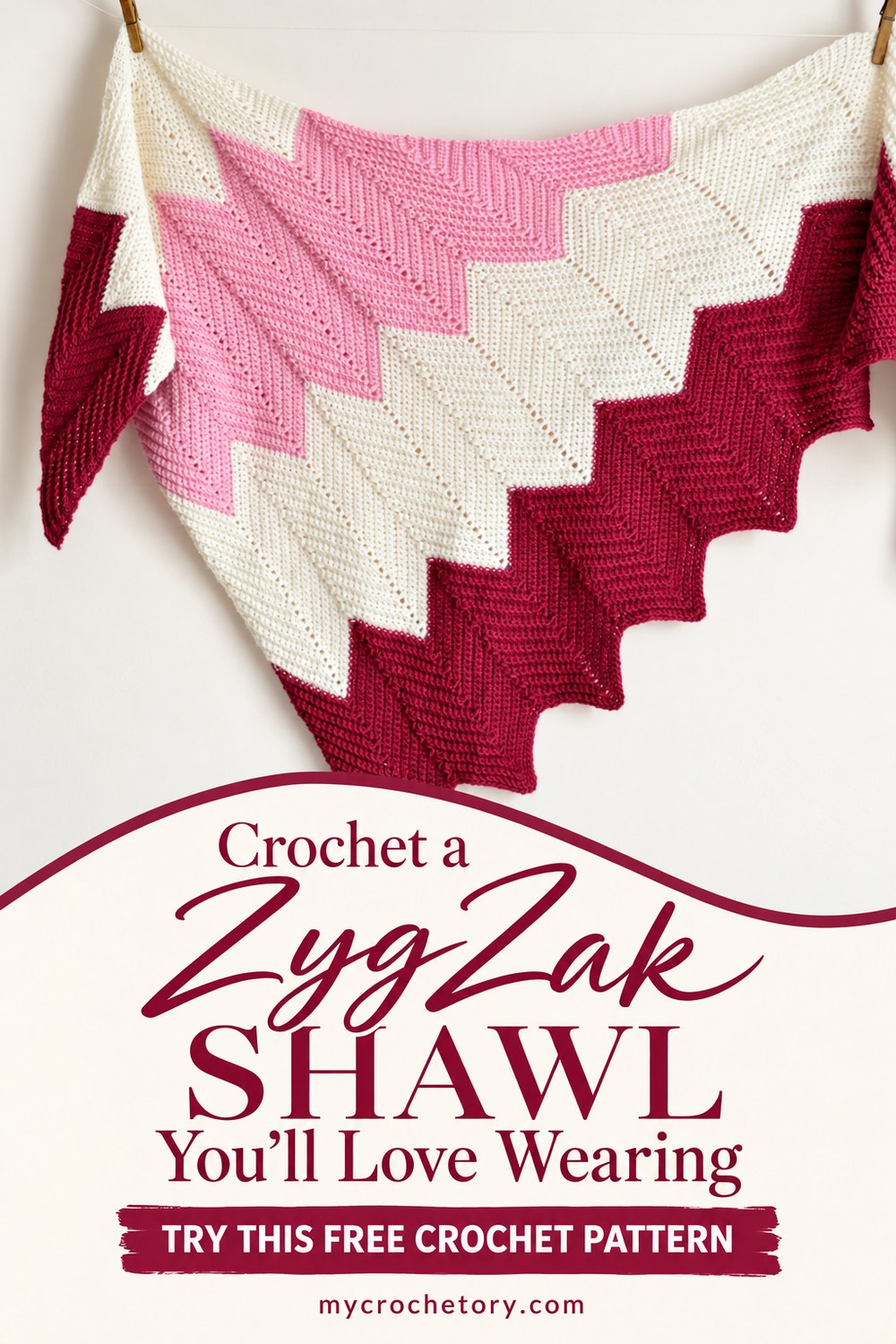
This chevron shawl wears its name on its sleeve. Zygzak is simply the Polish word for zigzag. And zigzags are all this shawl does.
I’ve always been drawn to geometric shapes, and this one is full of them. It starts at one sharp tip and grows sideways, one zigzag at a time. Three colors of DROPS Alpaca turn those zigzags into five bold stripes.
Look closer and there’s more. Some columns are plain single crochet, others are back loop single crochet with tiny ridges. So every zigzag gets fine stripes of its own.
Below I’ll show you how the shawl grows, how to pick your colors and how hard it really is. Want to start right away? Jump to the free ZygZak Shawl pattern.
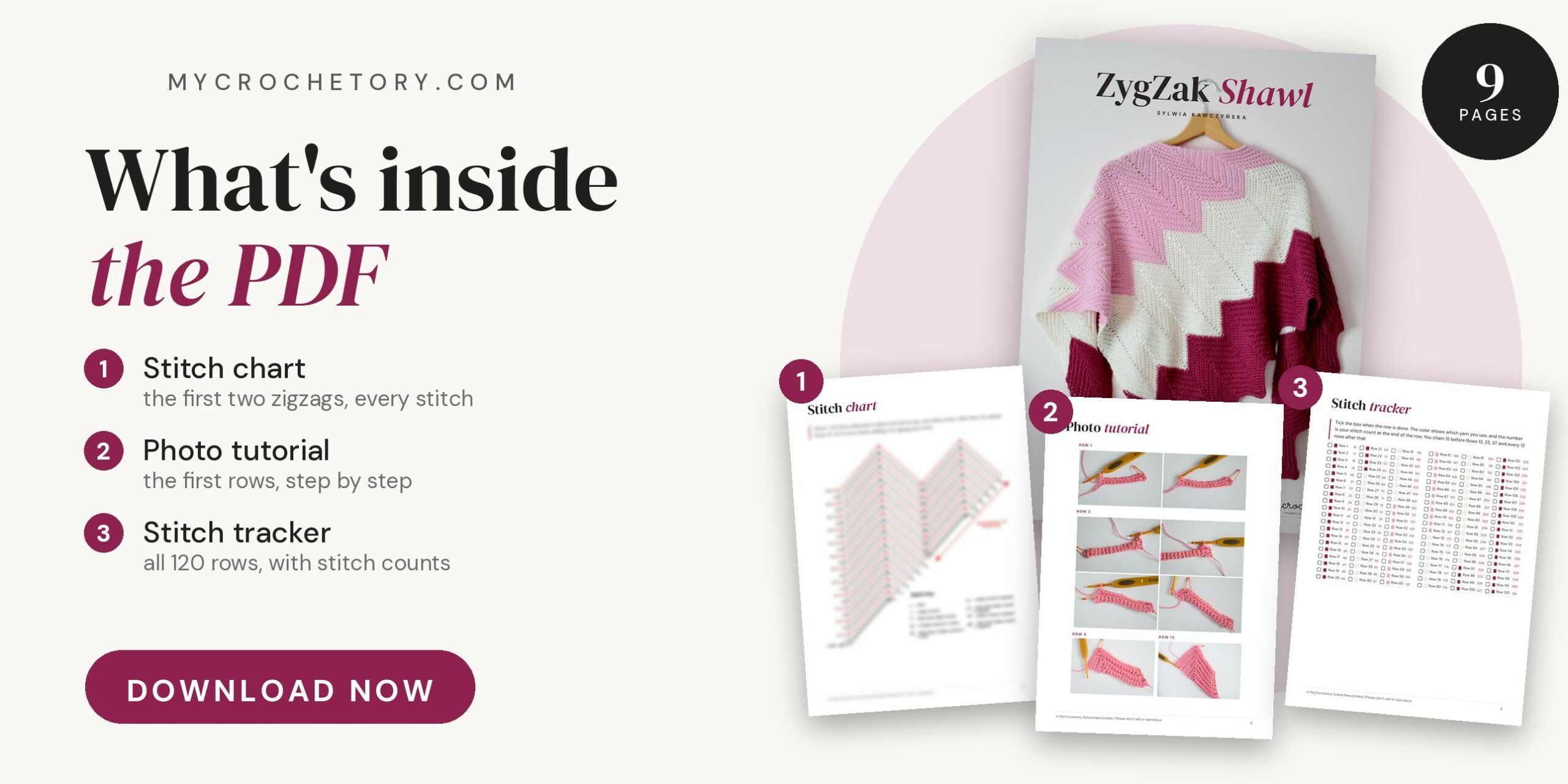
The ad-free, printable PDF of the ZygZak Shawl, with a stitch chart, is on Etsy and Ravelry.

Join my Facebook Group and Ravelry Group to ask questions and share your finished projects. You can also follow me on Instagram, Facebook and Pinterest.
How the chevron shawl grows from tip to edge
Forget counting increases on both sides. This chevron shawl starts with just 16 chains at one tip. From there, it grows sideways.
Every 12 rows, you chain 15 more stitches at the start of a row. That new piece becomes the next zigzag. Ten of these blocks make the whole shawl.
Stitch markers do the bookkeeping. One sits in the middle of every increase and one in every decrease. You move them up as you go, so you always know where the next point or dip is.
Choosing colors for your chevron shawl
Three colors, five stripes. I used dark pink, white and light pink of DROPS Alpaca, in five sections from the tip to the long edge.
The sections grow with the shawl, so the last one eats the most yarn. Yarn A, at the tip and along the long edge, needs about 90 g. The light pink middle needs only 45 g.
The dark pink is the same shade as the stripes of my Spring Solstice Wrap. Picking your own colors? Keep them in the same yarn weight, and save your favorite for the last section, since that’s the one everyone sees.

Is this chevron shawl hard to crochet?
The stitches won’t scare you, but the counting might. Every stitch in this chevron shawl is a kind of single crochet.
What makes it intermediate to advanced is everything around the stitches. Each row has increases and decreases. You switch between plain and back loop stitches and move a lot of markers.
The good part comes after Row 24. From then on, it’s the same 12-row block again and again, and you mostly follow your markers.

Yarn and blocking for your chevron shawl
This chevron shawl sits right around your neck. That’s why I always pick soft, non-itchy yarn for pieces like this.
I still recommend DROPS Alpaca. It’s a fingering weight yarn with about 183 yd per 50 g, and you need about 804 yd in total.
Alpaca is an animal fiber, so I wet block the shawl. I soak it and pin it out on blocking mats, with a pin in every zigzag point. After blocking, mine is about 66 inches wide and 27 inches long at the center.
Not ready to start yet? Save the chevron shawl to your Pinterest board so it’s easy to find later.

Free chevron shawl crochet pattern
- Get the ad-free, printable PDF with a stitch chart here on Etsy or here on Ravelry.
- Add this pattern to your Ravelry queue.
- Pin it for later.

Copyright 2019 – 2026 MyCrochetory. All rights reserved. This pattern is the property of Sylwia Kawczyńska @MyCrochetory. Please DO NOT sell the pattern or claim it as your own. The pattern is for personal use only and may not be translated or reproduced in another language. Please respect my rights and DO NOT share or publish this pattern anywhere without my permission.
The chevron shawl you make following this pattern is yours, and you are free to sell it, as long as you credit MyCrochetory as the original designer. For more information, please read the Terms Page.
Materials & Tools
- Yarn: DROPS Alpaca (100% alpaca, 50 g/167 m/183 yd) in 3 colors: approx. 90 g (329 yd) of Yarn A dark pink (3770), approx. 85 g (310 yd) of Yarn B white (101), approx. 45 g (164 yd) of Yarn C light pink (3140).
- Hook: 3.5 mm (US E/4). Adjust the hook size if needed to get the correct gauge.
- Tapestry needle (to weave in the yarn ends).
- Scissors.
- 19 stitch markers.
Level
Intermediate/Advanced.
Size after blocking
One size: approx. 168 cm / 66.1″ wide and 68 cm / 26.8″ long at the center.
Gauge after blocking
After Row 12: 16.8 cm / 6.6″ wide and 6.8 cm / 2.7″ long at the center.
Gauge is not important for this project. However, changes might result in different yardage and a different finished size.
Notes
- The pattern uses US crochet terms.
- The shawl is worked sideways in single crochet and back loop single crochet, from the tip to the edge.
- Place a stitch marker in each decrease and in the middle of every increase.
- Instructions in square brackets […] are worked as many times as indicated.
- Change color after Row 24, Row 48, Row 72 and Row 96.
- The shawl is divided into 5 sections in three colors: Section 1 (Rows 1–24), approx. 10 g of Yarn A; Section 2 (Rows 25–48), approx. 28 g of Yarn B; Section 3 (Rows 49–72), approx. 45 g of Yarn C; Section 4 (Rows 73–96), approx. 57 g of Yarn B; Section 5 (Rows 97–120), approx. 80 g of Yarn A.
Stitches & Abbreviations (US terms)
st(s) – stitch(es)
BLsc – back loop only single crochet
yo – yarn over
sc2tog (single crochet 2 together) – [insert hook in indicated st, yo and pull up a loop] twice, yo and pull through all 3 loops on hook.
BLsc2tog – back loop only single crochet 2 together
sc3tog (single crochet 3 together) – [insert hook in indicated st, yo and pull up a loop] three times, yo and pull through all 4 loops on hook.
BLsc3tog – back loop only single crochet 3 together
M – marker
PM – place marker
RM – reposition marker
Pattern
Ch16
Row 1: 2scs in 2nd ch from hook, PM, sc in the same st*, sc in next 11sts, sc2tog in next 2sts, sc in last st. Turn.
*this is 3scs in one st with the stitch marker placed in the middle stitch.
Row 2: ch1 (doesn’t count as a sc here and throughout), sc in first st, BLsc2tog in next 2sts, BLsc until M, 2BLscs in next st, RM, BLsc in the same st*, sc in every st to the end. Turn.
*this is 3BLscs in one st with the stitch marker placed in the middle stitch.
Row 3: ch1 (doesn’t count as a sc here and throughout), sc until M, 2BLscs in next st, RM, BLsc in the same st, BLsc until 3sts remain, BLsc2tog in next 2sts, sc in last st. Turn.
Rows 4 – 11: Repeat Rows 2-3
Row 12: Repeat Row 2
After row 12, don’t break the yarn (unless you change the color) and make ch15.
Row 13: 2scs in 2nd ch from hook, PM, sc in the same st, sc in next 11sts, sc3tog in next 3sts, PM, sc until M, 2BLscs in next st, RM, BLsc in the same st, BLscs until 3sts remain, BLsc2tog in next 2sts, sc in last st. Turn.
Row 14: ch1, sc in first st, BLsc2tog in next 2sts, BLscs until M, 2BLscs in next st, RM, BLsc in the same st, sc until 1 st remains before next M, BLsc3tog in next 3sts, RM, BLscs until next M, 2BLscs in next st, RM, BLsc in the same st, sc in every st to the end. Turn.
Row 15: ch1, sc until M, 2BLscs in next st, RM, BLsc in the same st, BLscs until 1 st remains before next M, BLsc3tog in next 3sts, RM, sc until next M, 2BLscs in next st, RM, BLsc in the same st, BLscs until 3sts remain, BLsc2tog in next 2sts, sc in last st. Turn.
Rows 16 – 23: Repeat Rows 14-15
Row 24: Repeat Row 14
After row 24 change color (or continue with the same yarn) and make ch15.
Row 25: 2scs in 2nd ch from hook, PM, sc in the same st, sc in next 11sts, sc3tog in next 3sts, PM, sc until M, [2BLscs in next st, RM, BLsc in the same st, BLsc until 1 st remains before next M, BLsc3tog in next 3 sts, RM, sc until next M] rep until last M, 2BLscs in next st, RM, BLsc in the same st, BLsc until 3sts remain, BLsc2tog in next 2 sts, sc in last st. Turn.
Row 26: ch1, sc in first st, BLsc2tog in next 2sts, BLsc until M, [2BLscs in next st, RM, BLsc in the same st, sc until 1 st remains before next M, BLsc3tog in next 3sts, RM, BLsc until next M] rep until last M, 2BLscs in next st, RM, BLsc in the same st, sc in every st to the end. Turn.
Row 27: ch1 (doesn’t count as a sc here and throughout), sc until M, [2BLscs in next st, RM, BLsc in the same st, BLsc until 1 st remains before next M, BLsc3tog in next 3sts, RM, sc until M] rep until last M, 2BLscs in next st, RM, BLsc in the same st, BLsc until 3sts remain, BLsc2tog in next 2 sts, sc in last st. Turn.
Rows 28 – 35: Repeat Rows 26-27
Row 36: Repeat Row 26
Repeat Rows 25 – 36 7 more times. Make ch15 before each new Row 25, and change colors after Row 48, Row 72 and Row 96 as listed in the Notes.
Fasten off, weave in all ends and block your shawl.
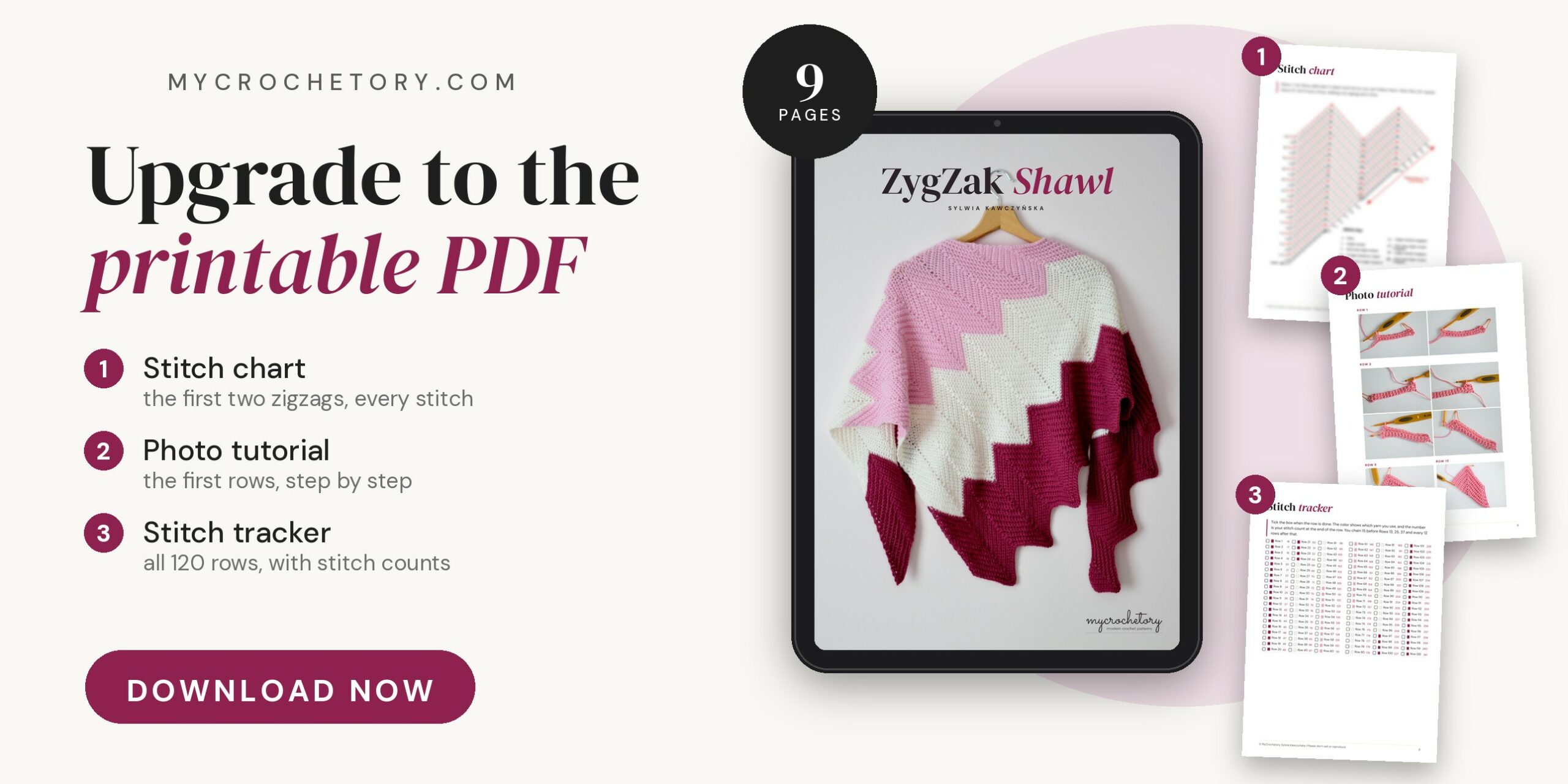
Finished your ZygZak Shawl? Share it on Instagram with #mycrochetory and tag @mycrochetory so I can see your colors.
Stuck on a row or found a mistake? Ask in my Facebook Group or Ravelry Group, or email me at mycrochetory@gmail.com.
More asymmetrical crochet shawl patterns
Liked the sideways shape? These shawls are asymmetrical too, each built in its own way.
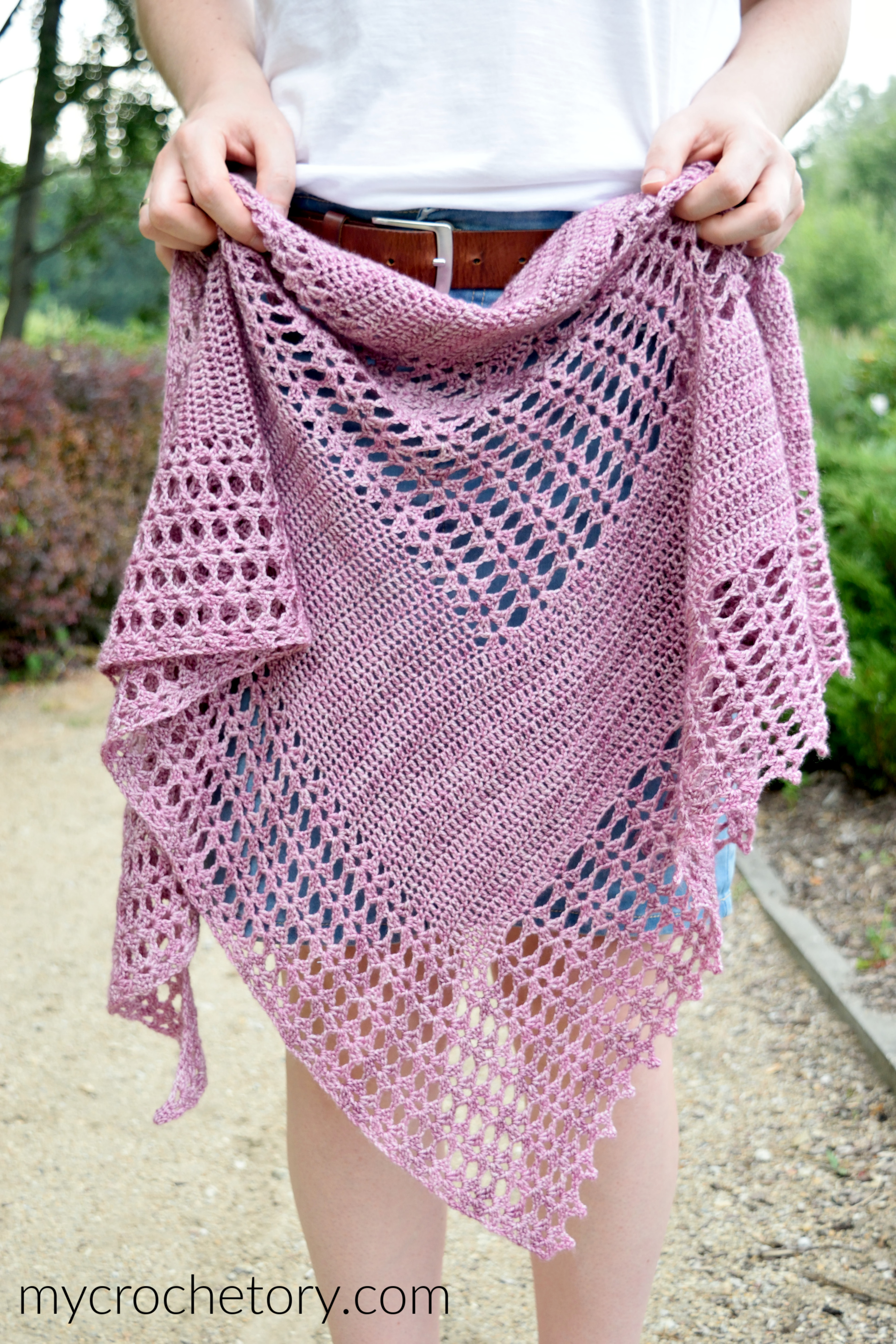

- Despina Shawl, worked sideways with V-shell lace.
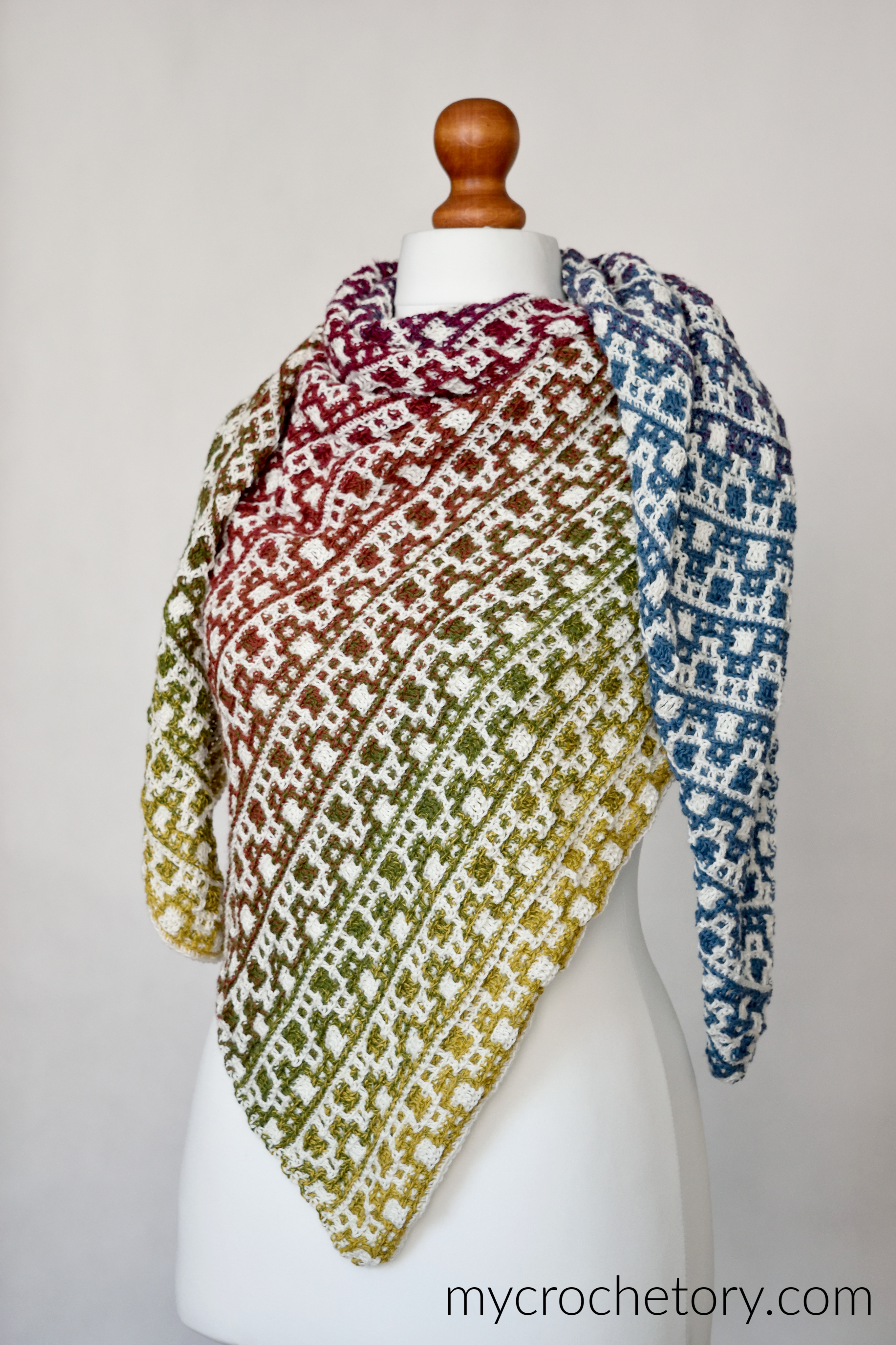
- Crax Gradient Shawl, two-color mosaic crochet in gradient yarn.
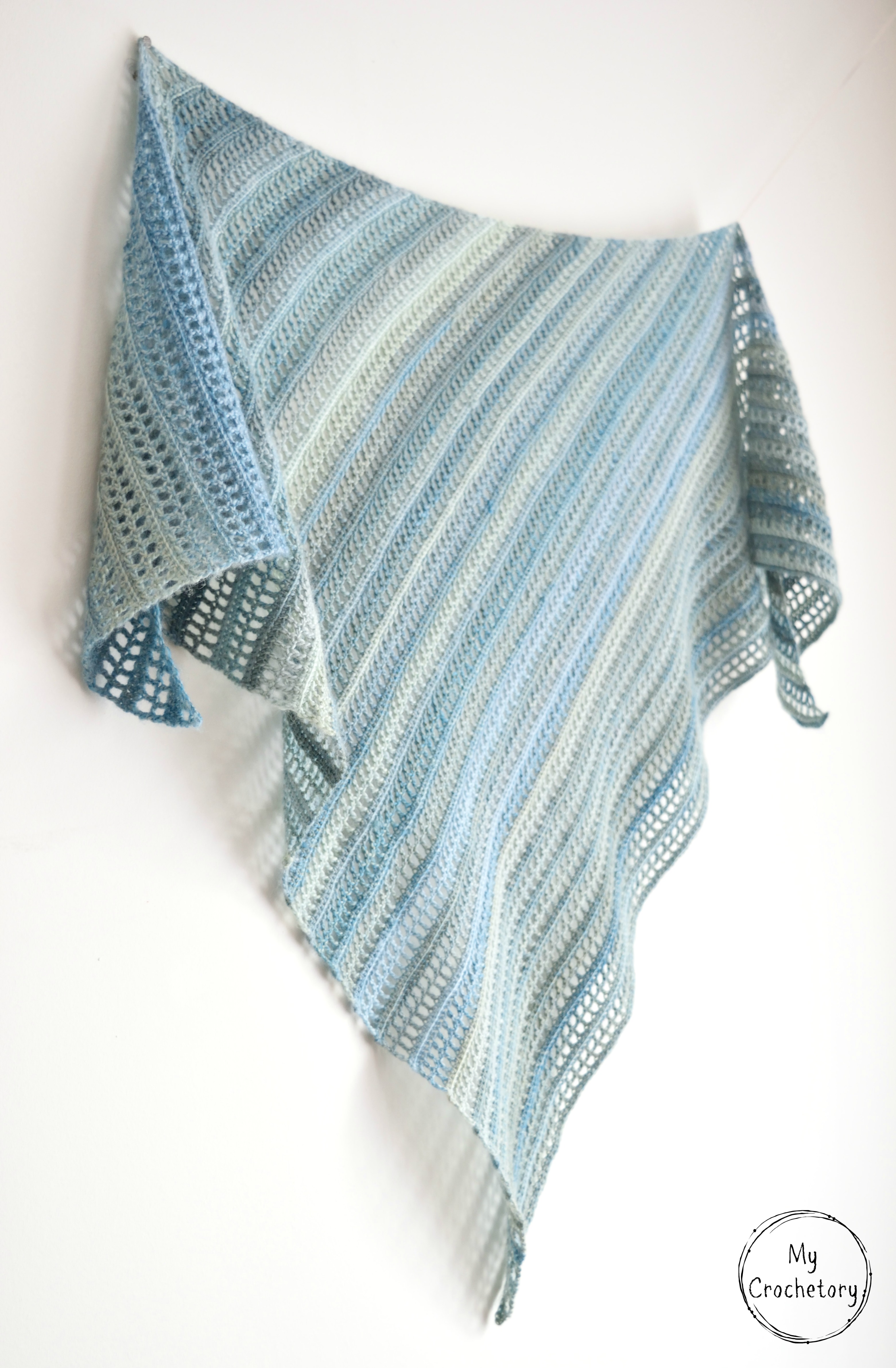
- Aprilis Shawl, a simple corner to corner triangle in an easy mesh.
- Flores Shawl, a solid part and a mesh part in one asymmetrical triangle.
More chevron and wave crochet patterns
Still in a zigzag mood? These patterns play with chevrons and waves in other shapes.
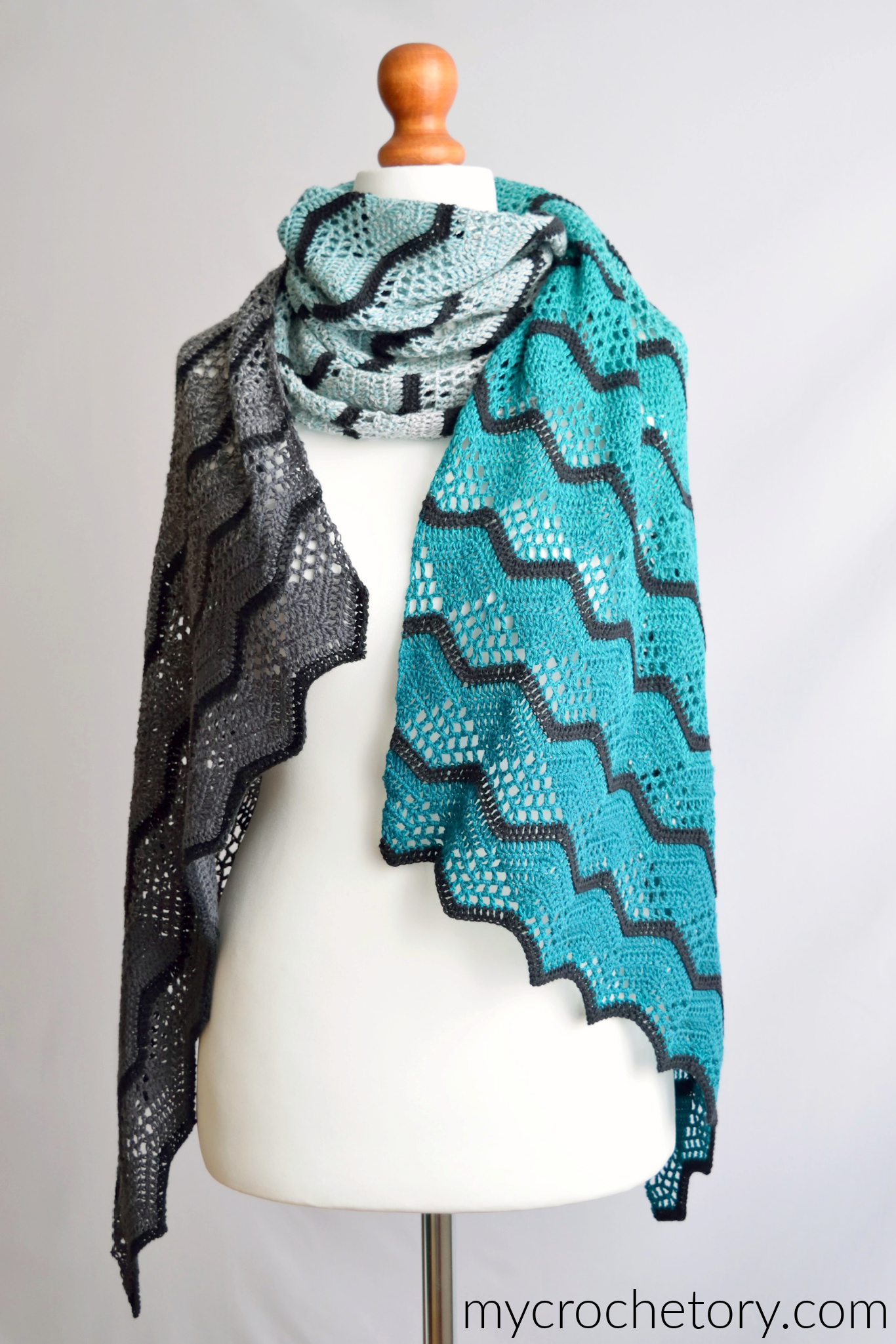


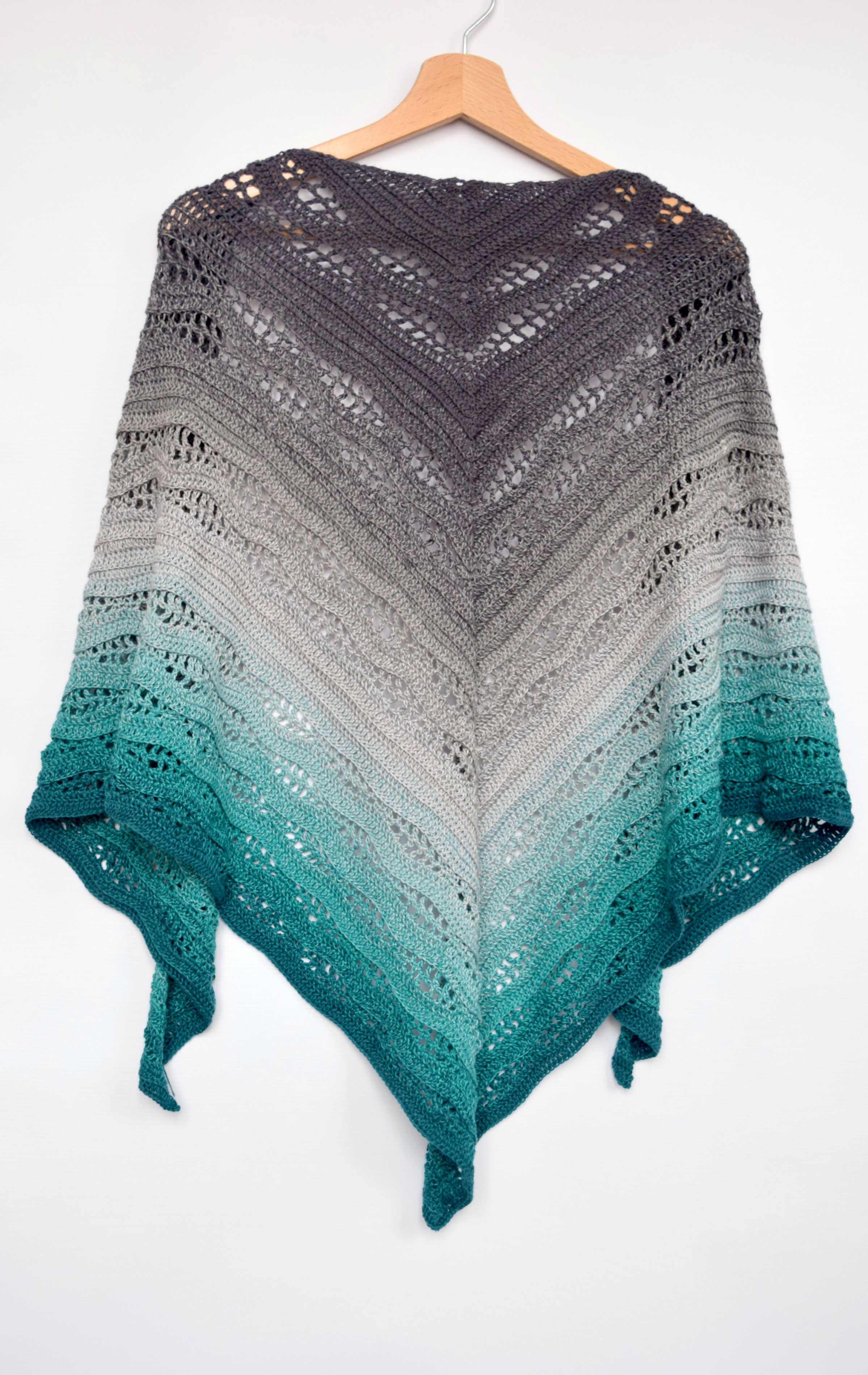
- Havra Wrap, a chevron lace wrap worked on the bias in two colors.
- Tonnta Lightweight Scarf, a wavy lace scarf in lace weight yarn.
- Flourish Linen Wrap, a linen stitch chevron with only 4 yarn ends to weave in.
- Kalinda Shawl, a top-down triangle in the wave stitch, made from one gradient yarn cake.
New to shawl shapes? My guide to how to crochet a shawl explains the main constructions, including shawls worked from one tip.
Chevron shawl FAQ
Can I make the chevron shawl bigger or smaller?
Yes. Every 12-row block adds one zigzag, so add or skip blocks to change the size, and plan your yarn amounts for the bigger or smaller sections.
Can I use a heavier yarn for this chevron shawl?
Yes, the pattern adapts to a heavier yarn. Use a hook that suits it, and expect a bigger shawl that needs more yardage.
How many stitch markers do I need?
You need 19 stitch markers by the end, because every zigzag needs one marker in its increase and one in its decrease.
Leave a Reply